
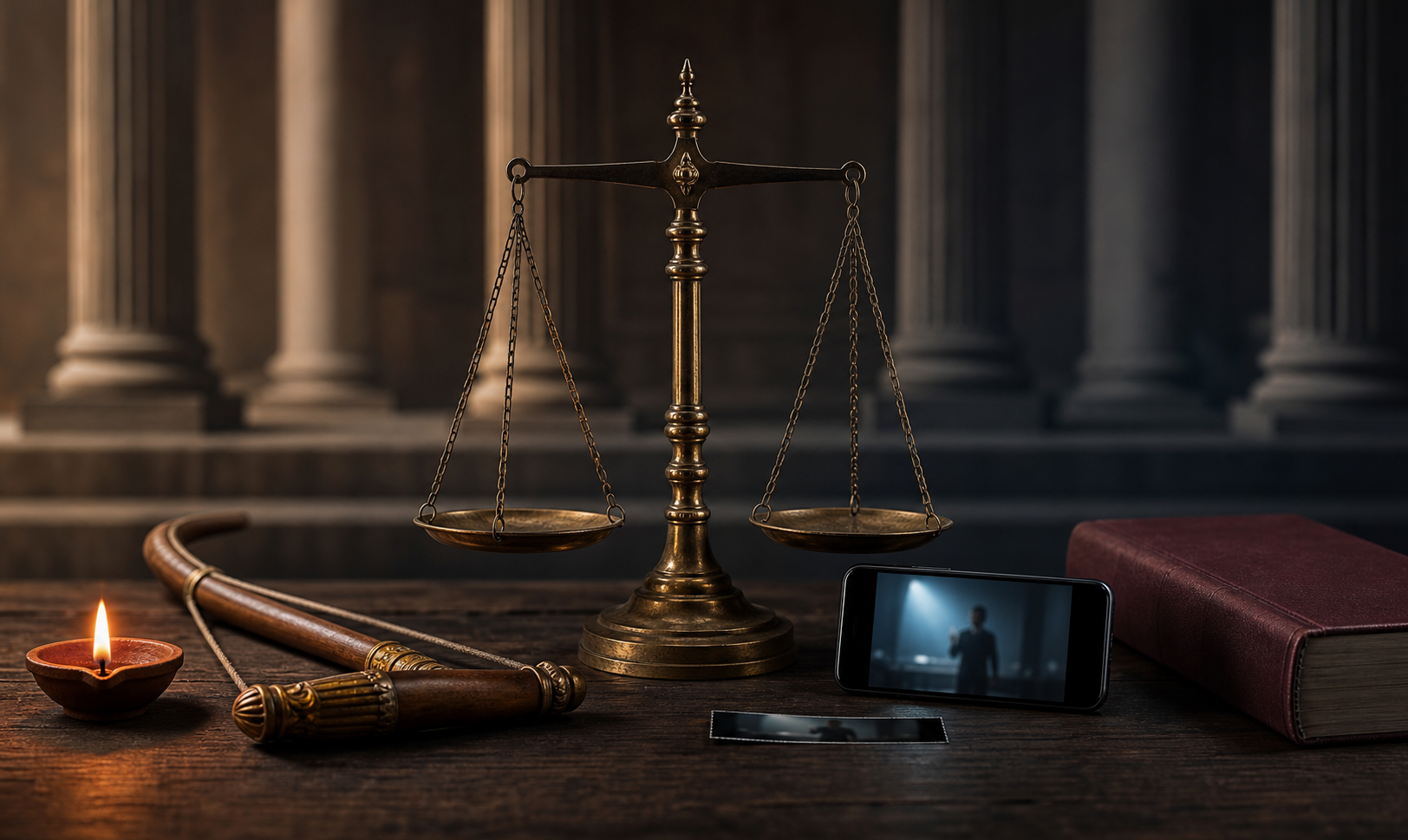
If the Prakash Raj Ramayana clip has reached your feed, do not let its caption decide the case for you. The immediate question is not simply whether the material offends you. It is what was actually said, in what context, and whether the reported conduct meets the demanding threshold for criminal liability.
You do not have to choose between reverence for Prabhu Shri Ram and respect for due process. Taking both seriously is the stronger Hindu position: acknowledge the injury, insist on the complete evidence, and refuse to turn an allegation into a verdict.
What the complaint establishes — and what it does not
A criminal complaint has reportedly been filed against actor Prakash Raj after a video containing a fictional narration related to the Ramayana circulated on social media. Some viewers perceived the narration as mocking Prabhu Shri Ram and hurting Hindu religious sentiments.
That establishes the existence of a reported allegation. It does not, by itself, establish that an FIR has been registered, that a particular criminal provision has been invoked, that the circulated clip is complete, or that a court has found the allegation proved. A complaint asks the legal system to examine conduct; it is not the legal system’s final answer.
This distinction should control the language you use. Unless you have the relevant official document, say that a complaint has reportedly been filed. Do not upgrade that statement to “booked,” “charged,” “arrested,” or “convicted.” Those words describe different procedural events, and careless substitutions spread misinformation even when the underlying grievance is sincere.
The meaningful developments to watch are documentary: an FIR number, a police notice, a filing before a Magistrate, an application for anticipatory bail, a petition seeking quashing, a forensic finding, or a judicial order. Any one of these may move the matter forward, but none should be treated as proof of guilt unless a competent court reaches that conclusion after examining the evidence.
If you are personally involved, named in a complaint, or considering initiating legal proceedings, obtain advice from a lawyer who can inspect the actual filing and the complete recording. A viral caption cannot tell you which law applies to your facts or what procedural step is safe.
The legal test is stricter than “people were offended”

Section 295A of the Indian Penal Code is the familiar reference point in allegations involving deliberate and malicious insult to religion. Sections 153A and 505(2) have also historically appeared in cases involving alleged group enmity or public mischief. The exact provision in this controversy must come from an authentic complaint, FIR, or court record; seeing a section number in a social-media post does not confirm that it was invoked.
The central Section 295A distinction is between material that causes offense and an aggravated insult made with deliberate and malicious intent. Ramji Lal Modi v. State of U.P. (1957) upheld the provision on that narrower understanding. The law does not make every irreverent, tasteless, erroneous, or provocative expression a religious offense.
Amish Devgan v. Union of India (2020) placed weight on context, target, and intent. Applied to a video, those factors require more than counting angry reactions. A decision-maker must consider the precise words, the setting in which they were spoken, the nature of the fictional narration, the intended target, the surrounding material, and whether an edited excerpt changes the apparent meaning.
An outraged audience cannot supply malicious intent that the evidence fails to show. The opposite is also true: calling something satire or fiction does not automatically immunize deliberate religious vilification. The label attached by the speaker, the complainant, or the uploader is not decisive. The content and context are.
The constitutional side of the question matters as well. Shreya Singhal v. Union of India (2015) invalidated Section 66A of the Information Technology Act and reinforced the principle that restrictions on speech must fit within the grounds permitted by Article 19(2). S. Rangarajan v. P. Jagjivan Ram (1989) warned against allowing hostile reactions to become a veto over expression, while S. Khushboo v. Kanniammal (2010) recognized that unpopular and provocative ideas can remain constitutionally protected.
For you as a reader, the practical rule is straightforward: religious hurt is relevant, but hurt alone does not answer the criminal-law question. Ask what proves intent, what establishes the full context, and what connects the expression to the specific legal threshold being alleged.
The full video is evidence; the viral clip may not be

A short social-media clip is a lead, not necessarily the complete evidentiary record. A few missing seconds can remove a fictional setup, change who appears to be speaking, conceal a response, or turn criticism of an idea into what looks like an attack on believers. The possibility of editing does not prove that a clip is misleading, but it does make certainty premature.
Electronic evidence therefore demands basic discipline. Investigators and courts may need the original file, the complete recording, metadata, information about the account that first uploaded it, and a traceable chain showing how the file was obtained and preserved. Section 65B of the Indian Evidence Act has historically governed certification of electronic records in proceedings framed under that evidentiary regime.
If you encounter the video and want to document it responsibly, preserve the original URL, the visible account name, the upload details shown on the platform, and the surrounding caption. Keep the file in the form in which you obtained it. Do not crop it, add subtitles, replace the audio, or repeatedly re-encode it and then present the altered copy as the original. Record what you did to preserve it rather than relying on memory later.
Look for the longest available version and identify where it originated. Compare its audio and frames with shorter copies. If the words are disputed, a transcript should include enough preceding and following material to show who is speaking and why. A transcript prepared from an edited clip cannot repair the missing context.
This caution has become more important as synthetic audio, manipulated video, false subtitles, and recycled footage become easier to circulate. Forensic examination, provenance, metadata, and an unbroken chain of custody can become decisive when authenticity is challenged. The absence of an original file does not prove fabrication, but it should reduce your confidence in categorical claims about wording or intention.
Platform action is a separate question from criminal guilt. A service may restrict or remove material under its rules or in response to a lawful request, but moderation does not amount to a judicial finding. Likewise, continued availability does not certify that the material is lawful, authentic, or respectful.
A dharmic response can be firm without becoming reckless
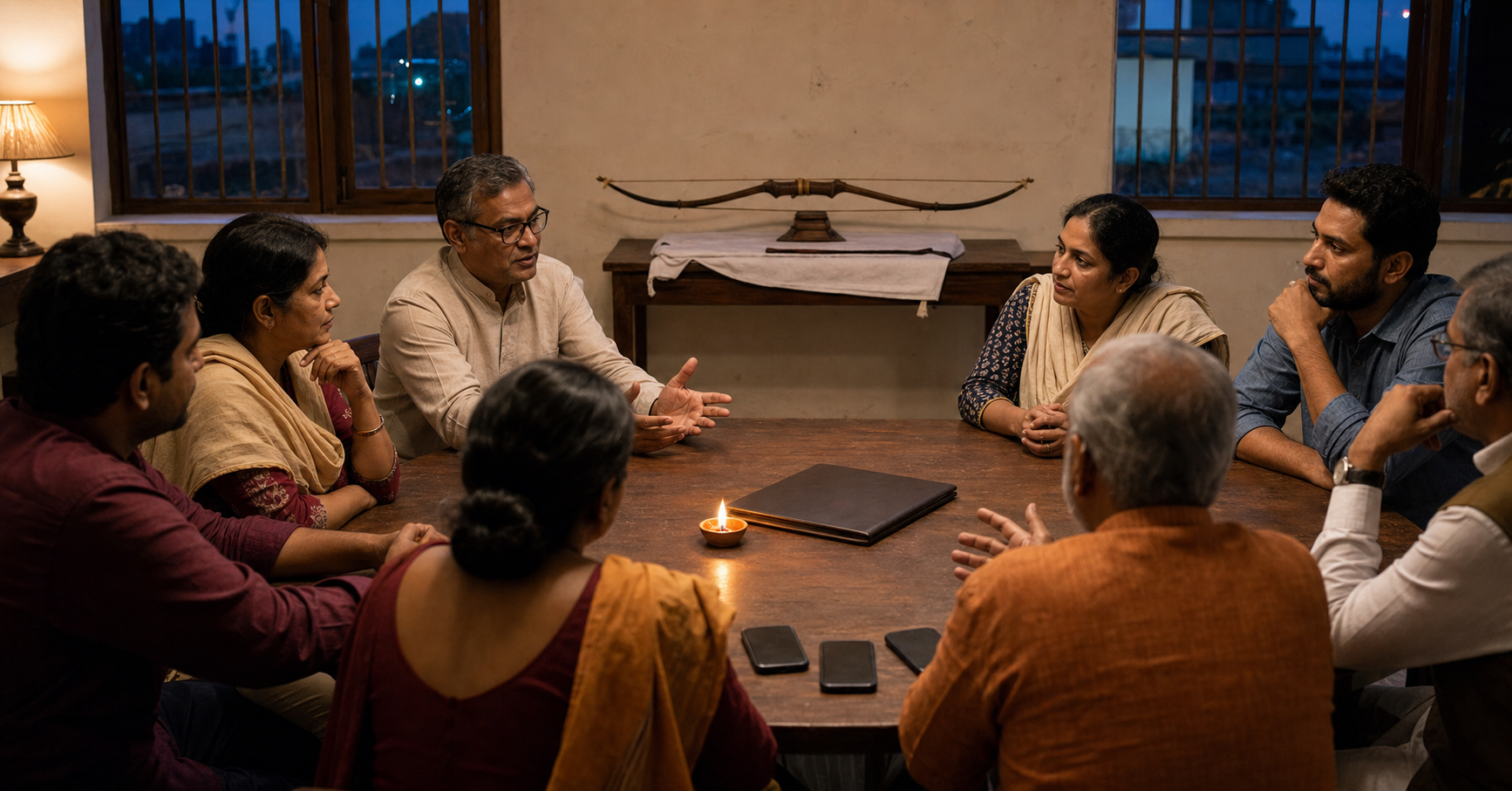
For many Hindu families, Shri Ram is not merely a character available for detached cultural commentary. Rama Katha lives through worship, festivals, bhajans, temple traditions, family storytelling, and moral reflection. An expression perceived as derisive can therefore wound a community at a level that outsiders may underestimate. Freedom of expression does not require you to pretend that this injury is trivial.
But dharma governs the response as well as the grievance. Ahimsa rules out threats and intimidation. Satya rules out altered clips, invented quotations, and false claims about arrests or court decisions. Daya and karuna require you to criticize conduct without treating another human being as beyond dignity. These are not signs of passivity. They are constraints that keep a just cause from being damaged by adharma committed in its name.
Effective counterspeech should identify the exact expression being challenged, provide the full available context, explain why the portrayal is objectionable, and state what remedy is sought. That remedy might be clarification, withdrawal, an apology, platform review, or lawful investigation. Precision makes the objection harder to dismiss and gives neutral readers something they can evaluate.
Do not enlarge the harm merely to display your outrage. Reposting an inflammatory excerpt can give it a much wider audience, strip it of context again, and complicate later questions about provenance. Where documentation is necessary, preserve it privately and share it with the relevant platform, investigator, or legal adviser. Where public rebuttal is useful, quote no more than is necessary to identify the objection and link to complete context when authentic context is available.
Keep the criticism focused. You can condemn alleged mockery of Shri Ram without issuing communal generalizations, encouraging harassment, publishing private information, or threatening the speaker. Those actions do not protect Hindu dignity. They shift attention from the original conduct to the misconduct of the response and may expose participants to consequences of their own.
A pro-Hindu response should be especially careful with truth because credibility compounds. When Hindu organizations and citizens distinguish verified facts from allegations, defend sacred traditions in clear language, and accept the discipline of lawful process, future claims of genuine religious hostility become harder to wave away as partisan outrage.
Key takeaways
- What has been reported is a criminal complaint, not a conviction. Verify the FIR, filing, or judicial order before using stronger procedural language.
- Religious hurt can be sincere and serious, but criminal liability requires the elements of the applicable offense; under the Section 295A framework, deliberate and malicious intent is central.
- The complete, authenticated recording matters more than a captioned excerpt. Preserve provenance and context before drawing conclusions about the speaker’s words or purpose.
- Satire and fiction are not automatic defenses, just as offense and public anger are not automatic proof of a crime.
- Respond through accurate counterspeech, responsible platform reporting, evidence preservation, and due process. Reject threats, harassment, and unsupported claims.
Your next move should depend on what you can verify. If all you have is a viral excerpt, seek the complete recording. If you have an authentic legal document, describe only what it establishes. If you choose to object publicly, make the objection exact, truthful, and proportionate. That is how reverence for Shri Ram becomes disciplined cultural strength rather than another cycle of online fury.