
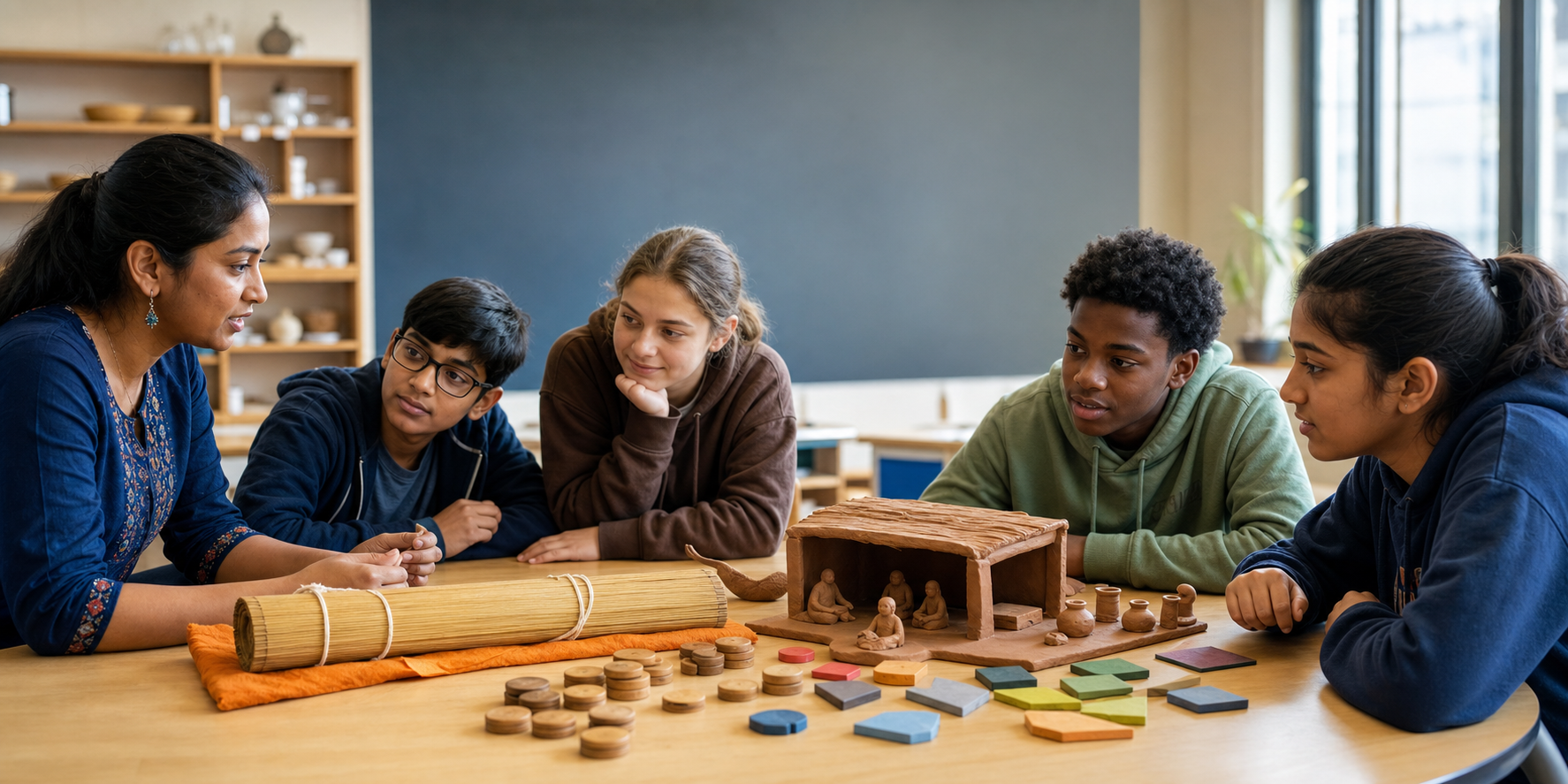
If your child’s school reduces Bharat to a festival day, a paragraph about ancient India, or a passing reference to yoga, asking for more can feel awkward. You may want cultural confidence without turning the classroom into a contest of civilizational slogans.
The practical answer is to ask for depth, not decoration. A serious Dharmic heritage curriculum gives students an intellectual object to examine, a method for examining it, and a piece of work through which they demonstrate what they learned. Sanskrit and the Indian development of zero offer two strong starting points because they unite cultural context with skills a modern school already knows how to teach.
Begin with an educational outcome, not an identity slogan
Heritage belongs in education when it helps a student do something more demanding than repeat a flattering fact. The student might learn to parse a Sanskrit sentence, distinguish a placeholder from zero as a number, compare two interpretations of shunya, or explain why a historical attribution needs more precision than a textbook caption can provide.
This distinction protects the curriculum from two common failures. The first is tokenism: food, clothing, festivals, and famous names appear, but no sustained body of knowledge does. The second is reaction: a dismissive account is answered with an equally sweeping claim of civilizational supremacy. Neither approach teaches a young person how knowledge is established.
A better unit should answer four questions. What exactly will the student examine? Which skill will the student practise? Which claims are established facts, and which are interpretations? What will the student produce to demonstrate understanding? If a proposed activity cannot answer those questions, it may be cultural celebration, but it is not yet a curriculum.
Key takeaways
- Start with a teachable object: a passage, grammatical form, numeral, calculation, manuscript image, or historical claim.
- Separate technical facts from historical attribution and cultural interpretation.
- Present Hindu, Buddhist, Jain, and Sikh traditions as related participants in Bharatiya civilization without making their doctrines interchangeable.
- Require visible student work: parsing, translation, calculation, comparison, commentary, or a corrected textbook explanation.
- Use heritage pride as a reason to investigate more carefully, not as permission to lower the standard of proof.
Use Sanskrit to build a cumulative course, not a ceremonial lesson
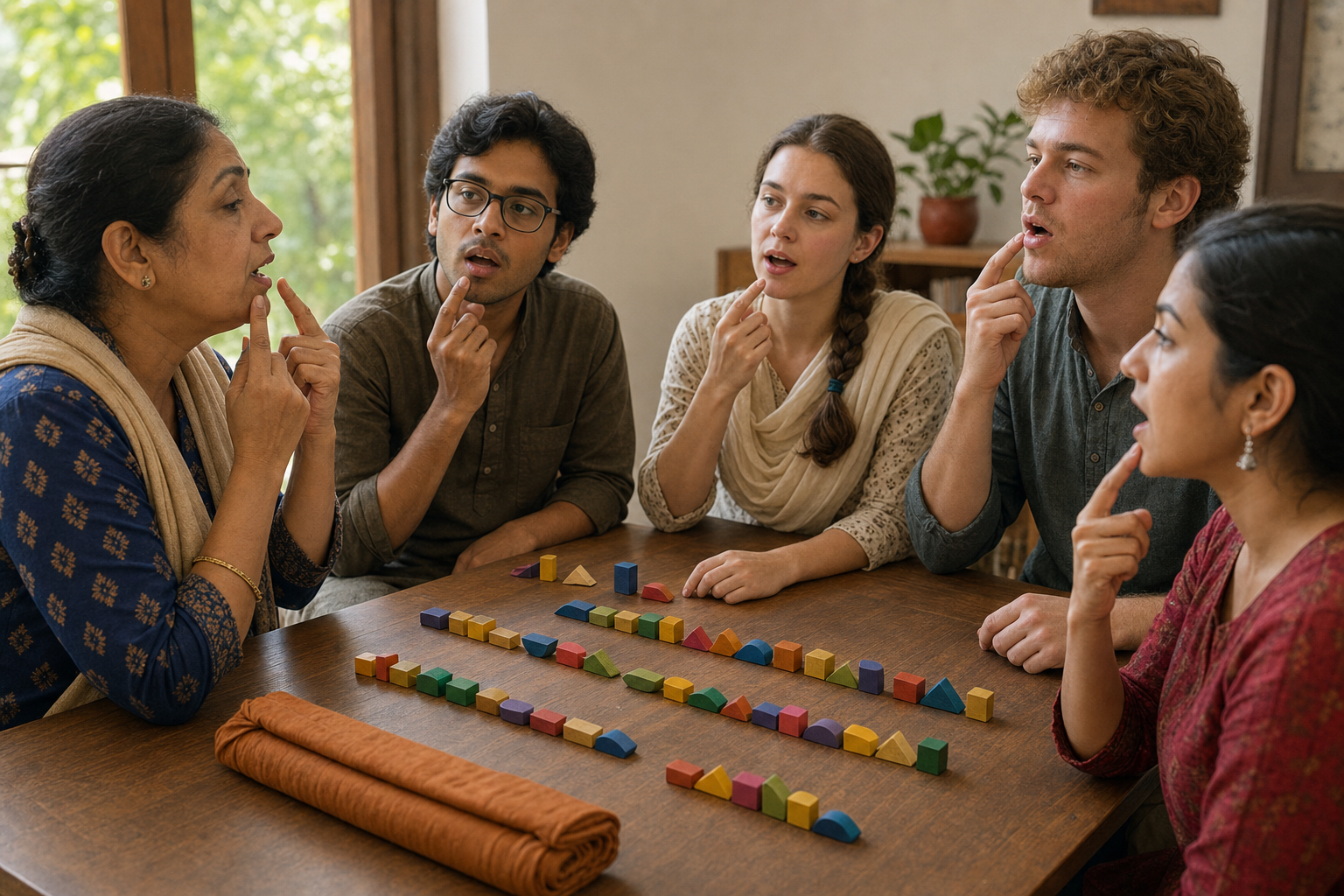
Sanskrit works especially well in modern education because it can be taught as a language with clear progression. St James schools in London have maintained a Sanskrit program established in 1975. All Prep School pupils study it, while many Senior School students continue toward IGCSE or O Level study; some later pursue Sanskrit or related fields at university. That longevity matters because it shows that Sanskrit need not survive at school only as an occasional chant or heritage-club activity.
The transferable lesson is not that every school must copy one institutional model. It is that language learning needs an ordered sequence. Students cannot meaningfully discuss the subtleties of classical literature if they have never learned how its sentences are constructed.
- Begin with Devanagari, precise sound production, and foundational vocabulary. Script and phonetics give students access to the language itself rather than permanent dependence on English spellings.
- Introduce the grammatical framework cumulatively: vibhakti case endings, lakara-s for verbal tense and mood, sandhi or sound combination, and basic samasa or compounding.
- Use recitation to reinforce pronunciation, metre, attention, and memory. Recitation should accompany comprehension rather than substitute for it.
- Move from controlled sentences to graded passages. Ask students to identify forms, explain syntax, translate, and justify consequential choices.
- At an advanced stage, combine prepared texts with unseen passages. Students should demonstrate linguistic accuracy, contextual comprehension, and interpretation of literary, historical, and ethical features.
This progression also gives parents and school leaders a way to evaluate a proposed Sanskrit course. Ask whether the scheme of work shows how each grammatical topic prepares students for the next one. Ask whether pronunciation, listening, reading, and translation reinforce one another. Ask what support exists for students who need additional practice and what extension work challenges those moving faster.
A strong course can combine traditional grammar and translation with spoken and aural work. The first supplies analytical precision; the second prevents the language from becoming a silent code on a worksheet. Neither method has to exclude the other.
Digital tools can help, but their role must be explicit. Dictionaries such as Monier-Williams and Apte, searchable text collections, and reputable morphology tools can accelerate checking and exploration. They should not conceal whether a student understands a form. If software proposes an analysis, require the student to identify the ending, state the grammatical function, and explain why that analysis fits the sentence. The tool then becomes an aid to reasoning rather than an answer dispenser.
If a full language course is not possible, choose a bounded outcome for a smaller module. Students might learn the script well enough to read a short passage aloud, recognise selected case endings, or compare a transliteration with Devanagari. A narrow competence honestly achieved is more educationally valuable than a broad tour of quotations the class cannot read.
Teach zero as a problem in mathematics, history, and interpretation
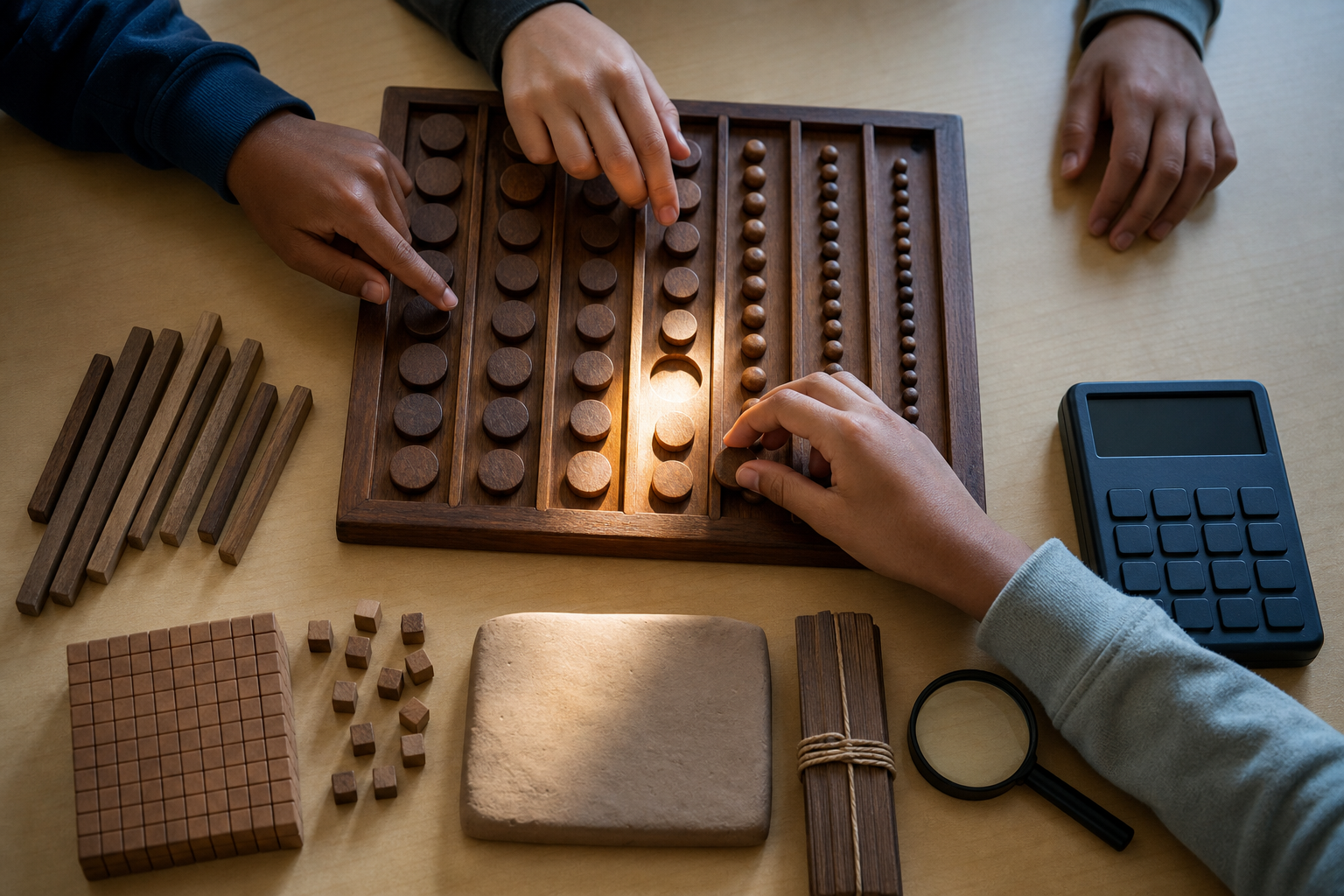
The history of Indian mathematics gives you another route into Dharmic heritage, but it needs one crucial distinction. A zero symbol, an empty position in a numeral, and zero treated as a number are related achievements, not three names for exactly the same thing.
Start with the mathematical operation. In a place-value numeral such as 204, the zero preserves the empty tens position; removing it produces 24, a different number. Then ask what additional intellectual work is required before zero can participate in arithmetic according to stated rules. Students can now see why the history involves notation, positional value, and mathematical operations rather than a vague claim that someone invented nothing.
Indian scholars played a central role in this development. The seventh-century mathematician Brahmagupta formulated rules for working with zero, while the development of decimal place-value reasoning is associated with Indian thinkers including Aryabhata. These contributions supported more systematic written calculation and further work in areas such as algebra and trigonometry.
Shunya adds a valuable cultural question. Hindu, Buddhist, and Jain traditions could treat emptiness as a serious subject of reflection rather than dismissing it as mere nonexistence. That intellectual environment makes comparison between philosophical and mathematical uses of absence worth exploring. It does not prove that a philosophical doctrine directly caused a mathematical invention. Cultural setting, conceptual resemblance, and historical causation are different claims, and students should learn to label them correctly.
| Kind of claim | Classroom example | What the student should do |
|---|---|---|
| Mathematical | Zero can hold an empty position in a place-value numeral. | Demonstrate the effect by reading, rewriting, and calculating with numerals. |
| Historical | Brahmagupta formulated rules for operations involving zero. | Identify the person, period, precise contribution, and difference between notation and arithmetic rules. |
| Interpretive | Reflection on shunya may illuminate the cultural setting of mathematical inquiry. | Explain why the connection is plausible while stating that conceptual affinity alone does not establish causation. |
This three-part method is useful whenever a heritage claim becomes contentious. First establish what the idea does. Then establish who contributed what and when. Only then discuss what the development may reveal about a civilization’s intellectual habits. Pride becomes more durable when students understand the reasoning beneath the attribution.
If a textbook characterises the development of zero as accidental, do not merely replace that sentence with a triumphant one. Ask what the word accidental implies. Does it erase the sustained work needed to formalise notation and rules? Which stages has the sentence compressed? What evidence would distinguish an isolated discovery from a developed mathematical practice? A reductive sentence can become a lesson in how historical framing works.
Teach Dharmic connection without erasing Dharmic difference
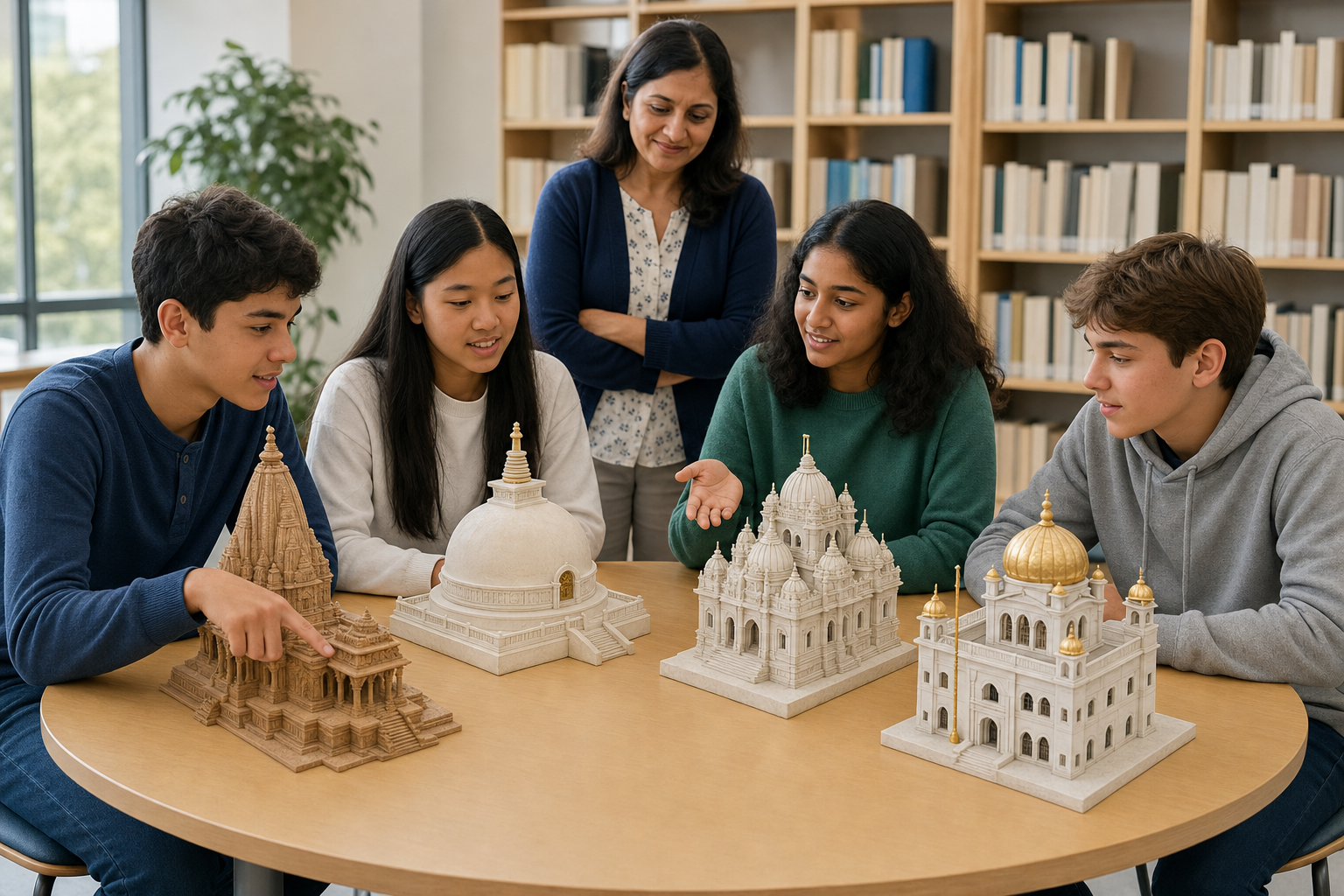
A modern heritage curriculum should make civilizational relationships visible, but shared inheritance does not mean identical theology. Hindu, Buddhist, Jain, and Sikh traditions developed within the wider world of Bharat through interaction, disagreement, adaptation, and distinct lines of authority. Students deserve both the connection and the distinction.
Sanskrit is a particularly important bridge across Hindu, Buddhist, and Jain intellectual histories and has influenced wider South Asian literary cultures. That does not make every community’s relationship to Sanskrit the same. Sikh heritage also belongs within the wider Bharatiya story, but it should be taught through its own texts, vocabulary, historical formation, and principles rather than being forced into a Sanskrit-centred genealogy.
Use a disciplined order whenever traditions are compared:
- Describe each tradition on its own terms before looking for common ground.
- Name the relevant concept, language, text, practice, or intellectual problem rather than treating Dharma as a single undifferentiated doctrine.
- Identify an actual connection, such as a shared arena of debate, a language of transmission, a region, or a recurring ethical question.
- State the limit of the comparison. Similar vocabulary may carry different meanings, and similar practices may rest on different explanations.
- Let students express the relationship in a complete sentence that includes both connection and difference.
For example, a class examining shunya should not conclude that several traditions held one doctrine of emptiness. It should ask what the term or related idea means in the particular context being examined, how mathematical usage differs from philosophical usage, and why later readers might still place them in conversation.
This approach strengthens rather than weakens Dharmic solidarity. Unity that depends on suppressing internal difference will collapse under basic questioning. Unity grounded in a shared civilizational space, sustained intellectual exchange, and respect for distinct sampradayas can withstand it.
Turn advocacy into a lesson a school can actually adopt

Parents and community organisations often approach schools with a large request: represent Dharmic civilization properly. The concern may be justified, but the request is hard for a department to translate into teaching. Give the school a small, academically formed proposal instead.
If you are a parent
Choose the subject in which the addition naturally belongs. A lesson distinguishing zero’s mathematical functions fits mathematics or history of mathematics. A short unit on Devanagari, phonetics, and grammatical structure fits languages or classics. A comparison of philosophical and mathematical uses of shunya may fit religious studies or philosophy.
Your request should name the learning outcome, the material students will inspect, and the work they will complete. A concise proposal could ask the department to add a lesson in which students distinguish zero as a symbol, positional marker, and number; identify the roles associated with Aryabhata and Brahmagupta; and separate historical evidence from a cultural interpretation involving shunya. That is easier to assess and approve than a request to teach more Indian achievements.
Ask to see the exact textbook wording if your concern began with a questionable sentence. Quote it accurately. Identify whether the problem is factual error, omitted context, ambiguous language, or dismissive framing. These are different problems and require different corrections.
If you are a teacher or school leader
Build the unit around one intellectual movement from problem to method to meaning. Students first encounter a problem: how can an empty position be represented, or how can an inflected sentence be read accurately? They then learn the technical tool. Historical context follows once they understand why the tool matters. Interpretation comes last, when they have enough knowledge to evaluate it.
Assessment should match that structure. A Sanskrit program can test linguistic competence, textual understanding, and interpretive skill. A mathematics-history unit can assess whether students distinguish the functions of zero, attribute specific contributions carefully, and explain why shunya is a cultural interpretation rather than a complete causal history.
Do not award full credit for reverence, hostility, or confident assertion. Reward accurate vocabulary, demonstrated method, appropriate evidence, and clearly marked uncertainty. Students should be able to admire an inheritance while still asking hard questions about chronology, transmission, and interpretation.
If you support education through a temple or community group
Prepare materials a teacher can use without already being a specialist. For each lesson, provide a short glossary, the original material where available, transliteration or notation as needed, a careful translation or explanation, contextual notes, discussion questions, and an answer key. Mark devotional interpretation, historical claim, and technical explanation separately.
Enrichment can extend beyond worksheets. Recitation circles and reading clubs give language practice a social setting. Museums and libraries with South Asian manuscripts and artefacts can connect classroom study to the material history of texts. The educational purpose must remain visible: students should arrive with a question and leave with an observation, transcription, comparison, or commentary of their own.
Start this term with one object, not an entire civilization. Choose a Sanskrit passage or the zero-place-value problem. Define one skill the learner must demonstrate, supply enough context to make the object intelligible, and require a finished piece of work. Once that lesson succeeds, you have something more valuable than a heritage display: you have the beginning of a curriculum.
References
- DharmaRenaissance Blog – St James London Seeks Sanskrit Teacher: Empower Young Minds, Preserve Dharmic Heritage
- DharmaRenaissance Blog – Zero and Shunya: The Dharmic Legacy of Indian Mathematics