

You are sitting in a seminar when Hindu traditions are described almost entirely through caste, hierarchy, nationalism, or control. If you object, you may be treated as defensive or political. If you stay silent, a disputed interpretation can pass as settled knowledge.
You do not have to choose between anger and acquiescence. A stronger response identifies the exact claim, tests whether the method is fair, offers a better account of Hindu diversity and continuity, and protects everyone’s right to speak. That approach works in classrooms, conferences, student unions, and contentious campus events.
First identify what kind of conflict you are facing

Not every uncomfortable argument is anti-Hindu, and not every objection to it is censorship. Before responding, separate intellectual disagreement from unequal treatment and physical disruption. Each requires a different remedy.
- A descriptive dispute: You disagree about what Hindus believe or do. Answer it with texts, practices, historical evidence, and practitioner testimony.
- A methodological dispute: You accept the facts but challenge the framework used to interpret them. Ask what the framework reveals, what it obscures, and what evidence could disprove its conclusion.
- An identity dispute: Hindu self-understanding is admitted only when it confirms the analyst’s theory, while contrary practitioner accounts are dismissed as apologetics or politics. Ask for a consistent rule governing whose testimony counts.
- A conduct dispute: People are being prevented from speaking, entering, listening, or asking questions. Stop debating theology and move to event rules, safety, access control, and documented institutional procedure.
This classification prevents two common mistakes. The first is calling every hostile interpretation hatred, which makes legitimate grievances easier to dismiss. The second is treating obstruction as merely another opinion, even after someone takes a microphone, enters a dais, or prevents a scheduled speaker from continuing.
Key takeaways
- Challenge the exact proposition, not the presumed motives of everyone in the room.
- Ask scholars to define contested labels and identify what evidence could change their conclusions.
- Defend Hindu unity without pretending that every sampradaya, language, or regional practice is identical.
- Distinguish peaceful protest from conduct that prevents other people from speaking or listening.
- Create a factual written record before demanding disciplinary, political, or legal action.
Challenge loaded academic frames with precise questions

The dispute surrounding Yale’s conference on “Rethinking Vernacular Hinduisms of South Asia and Beyond” illustrates why terminology matters. Critics see the plural “Hinduisms” as fragmenting a connected civilization and “vernacular” as carrying colonial associations. Defenders of such terminology may regard it as a way to recognize regional agency and resist imposing a single official form on varied traditions.
Do not try to settle that disagreement by declaring the words forbidden. Make the analyst explain what the words do. A term becomes academically suspect when it quietly assumes the conclusion that the argument is supposed to establish.
Use a five-question audit whenever a syllabus, lecture, panel, or paper introduces a disputed category:
- What is the operational definition? Does “Hinduisms” simply acknowledge internal diversity, or does it assert that no meaningful Hindu unity exists?
- What evidence would count against the category? If every similarity is called domination and every difference is called fragmentation, the framework cannot be tested.
- Is the method applied symmetrically? Ask how the same standard handles denominations, regional traditions, reform movements, and internal disagreements in other religions.
- Where does practitioner testimony enter? Lived experience does not overrule evidence, but neither should it be discarded merely because it complicates a theory.
- Does the conclusion distinguish plurality from disunity? Many forms can belong to a connected tradition without requiring a central church, one compulsory creed, or uniform ritual practice.
The same discipline should govern objections to “vernacular.” The term has a colonial administrative history in South Asia and can imply a hierarchy between elite and local languages. That history deserves examination, but etymology alone does not prove a present scholar’s intention. The decisive questions are how the term is defined, which traditions it groups together, and whether it casts Sanskritic and regional expressions as natural adversaries before the evidence has been considered.
Power analysis also has a legitimate place. Religious institutions, like other human institutions, can contain struggles over authority, status, gender, and resources. The problem begins when those categories become the only permitted explanation. Devotion, metaphysics, sadhana, sacred memory, aesthetic experience, and a practitioner’s own reasons then disappear from view.
A useful classroom intervention is short enough to be answered: “You have shown how this practice relates to authority. What evidence would distinguish a practice created to reproduce authority from one that also carries theological, devotional, or spiritual meaning for its participants?” That question does not demand immunity from criticism. It demands an explanation adequate to the human beings being studied.
Follow up in writing if the response is evasive. Quote the exact definition or slide, explain the hidden assumption in one sentence, and ask for the missing evidence. A narrow written question is harder to recast as generalized outrage.
Defend Hindu unity without flattening Hindu diversity
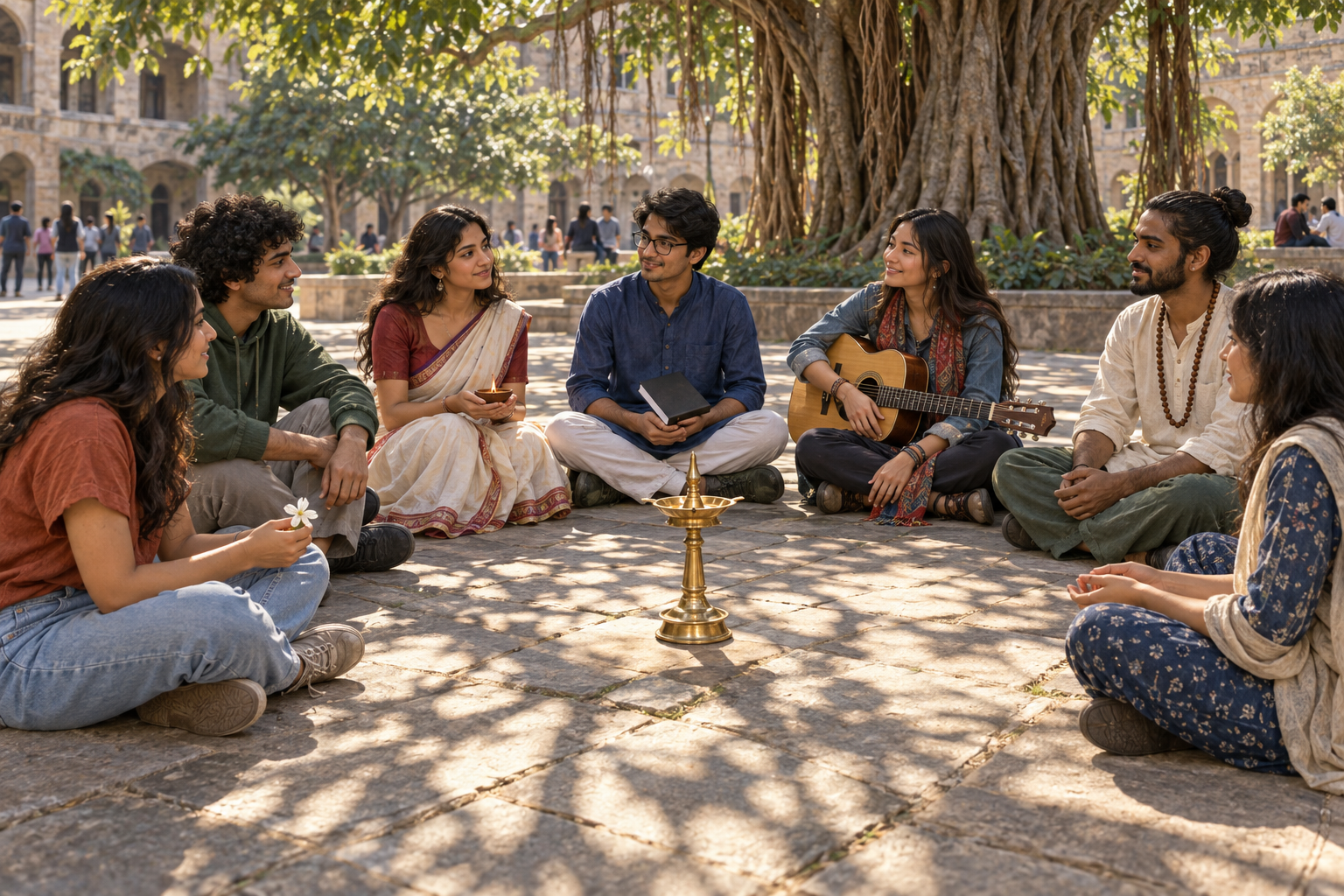
A weak defence says all Hindus believe the same things. That is plainly untenable and gives critics an easy target. A better defence says diversity does not logically disprove relationship, continuity, or civilizational self-recognition.
Keep three levels separate when you make that case:
- Observed diversity: Sampradayas, philosophical schools, deities, languages, rituals, and regional customs differ. Do not minimize those differences.
- Patterns of relationship: Traditions can borrow, debate, reinterpret, and recognize one another while remaining distinct. Interaction is neither perfect sameness nor total independence.
- Civilizational self-understanding: Hindus may understand these paths as participating in a broader dharmic world. That self-understanding is evidence to be examined, not a claim that an outside analyst may automatically erase.
The crucial error is jumping directly from the first level to a conclusion about the third: regional variation exists, therefore Hindu unity must be artificial. The reverse jump is equally careless: a broad unity exists, therefore local differences do not matter. Make whoever advances either argument show the intermediate reasoning.
You can state the balanced position in one sentence: Hindu Dharma contains substantial internal plurality alongside shared concepts, memories, practices, debates, and forms of belonging; the scope and meaning of those connections must be investigated rather than assumed away.
This formulation protects both the integrity of Hindu identity and the freedom of individual traditions. It does not require every Hindu to accept one theology. It also refuses the notion that only centralized religions may possess a meaningful civilizational coherence.
When preparing for a seminar, build an evidence file around the actual claim under discussion. Include the assigned definition, the relevant passage or lecture slide, examples that fit it, and counterexamples that do not. Add practitioner perspectives from the tradition being described. Do not rely on a general assertion that an interpretation feels insulting. Academic claims are best challenged by showing exactly where their categories fail.
When debate becomes disruption, change your response
Campus politics often collapses criticism, protest, and obstruction into one emotionally charged event. You need a conduct-based distinction that remains valid regardless of who is speaking.
| Conduct | What it means | Proportionate response |
|---|---|---|
| Critical questions, leaflets, placards, or a peaceful walkout | Dissent within ordinary campus expression | Answer the claim, enforce neutral time and place rules, and protect the protester’s speech |
| Sustained shouting that prevents the event from continuing | Disruption rather than participation | Give a clear warning, apply the published event rule, and restore the scheduled program |
| Taking control of a microphone, occupying the dais, blocking entry, or physically preventing speech | Interference with other people’s access and expression | Use trained university staff or security; participants should not attempt a physical removal |
| Threats, assault, or an immediate safety risk | A safety matter, not a debate tactic | Move to safety and contact the responsible campus or emergency authority |
A useful test is viewpoint reversal. If you would call the conduct unacceptable when directed against a speaker you support, it remains unacceptable when directed against a speaker you oppose. The same rule should protect a Hindu event, a Marxist meeting, a Muslim association, and a critic of each.
The reported disruption of a Vande Mataram seminar at Kerala Central University shows why the boundary matters. During the event on October 6 and 7, 2026, demonstrators were alleged to have entered the auditorium, shouted through proceedings, climbed onto the dais, displayed footwear, and switched off a microphone before police intervened. Some participants were also reported not to be students of the university. Those details, if established, concern access and obstruction, not merely opposition to a keynote speaker.
Police reportedly registered an FIR against 25 identified people on October 8. An FIR records allegations and begins a criminal process; it is not a finding that the allegations have been proved. Demanding guilt or a particular punishment before evidence is tested weakens the principled case for campus order.
If an event is likely to attract protest, ask the organizers in advance for written answers to practical questions: Who may enter? Is identification required? Where may protest occur? Who gives a warning if proceedings are obstructed? Who decides when university security intervenes? Will a moderated question period be protected? Clear rules lower the risk that enforcement will appear improvised or partisan.
During a disruption, do not surround protesters, seize their phones, trade communal slogans, or attempt to identify their religion from clothing. Do not publish names or personal details merely because they appeared in a crowd. Ask the moderator to state the rule, preserve a lawful record where institutional policy permits, and let trained personnel handle access or removal.
Put a defensible campus response on the record

The strongest complaint is not the angriest one. It is the one a neutral reader can verify. Whether you are a student, faculty member, organizer, or parent, build the record in this order:
- Preserve contemporaneous facts. Record the event title, location, scheduled speakers, published rules, sequence of incidents, and the words or actions you directly observed. Keep original emails, notices, and permitted recordings.
- Separate observation from report. Write “I saw the microphone switched off” only if you saw it. Otherwise write “the organizer reported that the microphone was switched off.” Do not convert inference into eyewitness testimony.
- Name the violated standard. Cite the syllabus rule, event policy, student code, room-access condition, anti-discrimination provision, or academic procedure that applies. Avoid vague appeals to fairness when a written rule is available.
- Request a proportionate remedy. Depending on the facts, that might be a correction, an opportunity to respond, an additional scholarly perspective, restoration of a cancelled event, consistent access controls, or an impartial conduct review.
- Ask for a written decision. Request the office responsible for the matter, the process it will follow, and the date by which it expects to respond. Preserve the reply.
Keep academic and conduct complaints separate. A poor interpretation should usually be met with evidence, criticism, and better scholarship. A speaker’s political association may justify hard questions, but it does not by itself justify preventing the person from speaking. Physical obstruction should be handled under neutral conduct and safety rules rather than turned into a theological argument.
Do not describe an entire religious, ethnic, or political population through the alleged actions of particular protesters. Identify organizations or affiliations only when they are verified and relevant to responsibility for the event. Collective labels may energize allies online, but they make an institutional complaint less precise and can unfairly implicate people who were not involved.
Escalate carefully. Start with the instructor, moderator, department, event office, or student-affairs process that actually controls the issue. Move higher when that channel fails, has a conflict of interest, or cannot address a safety concern. If police action, disciplinary jeopardy, threats, or possible civil liability are involved, obtain advice from a qualified lawyer familiar with the relevant jurisdiction rather than relying on social-media guidance.
Your immediate next move can be modest: choose the single sentence, category, or action you believe was unfair; write down the evidence; and ask for one specific remedy. Hindu students and scholars will protect their place in academic life most effectively when they combine intellectual confidence with standards they are willing to apply to everyone.
References
- Hindu Post – Dissecting Yale’s Conference on ‘Vernacular Hinduisms’: American Academia’s War on Hindu Dharma
- Hindu Post – Keralam: FIR registered against 25 left-wing jihadi students over disruption of Vande Mataram seminar at Central University

Leave a Reply
You must be logged in to post a comment.