
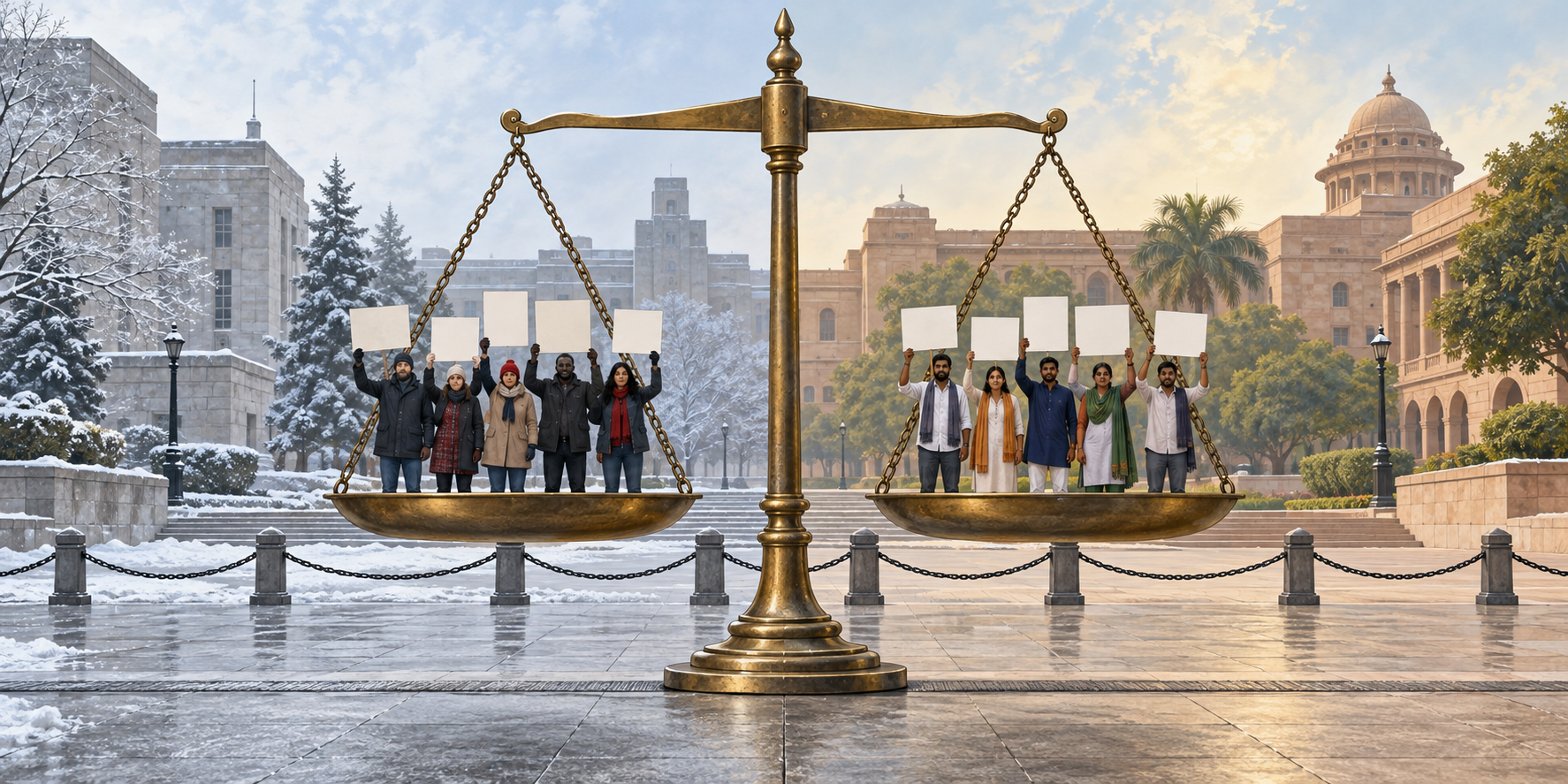
If you are asking why Canada’s free-speech position on Khalistan feels hollow to many Indians, use a simple test: replace India with Canada while leaving the conduct unchanged. Would Canadian officials describe it in the same language and accept the same official response?
This test does not require you to oppose peaceful separatist advocacy or support indiscriminate censorship. It asks for something more defensible: one threshold for political speech, one threshold for intimidation and one threshold for violence, regardless of whose country a movement seeks to divide.
The issue is equal thresholds, not equal sympathy
The contradiction became unusually clear in New Delhi. About 150 Alberta and Quebec separatist protesters reportedly gathered outside an event attended by Canada’s High Commissioner. A smaller group allegedly approached him aggressively, one participant wielded a sword, and the diplomat later said they had come close to physically harming members of his party. A parade also displayed a tableau depicting the imagined assassination of former Canadian prime minister Pierre Trudeau. Ottawa protested that the incidents attacked Canadian democracy and sovereignty, while Delhi declined to intervene and invoked the protesters’ democratic rights.
The right question is not whether Canada was entitled to object. A government should object when its diplomat appears to be endangered. It can also condemn imagery celebrating the killing of a former leader without automatically demanding that every offensive display be prohibited.
The harder question is whether Ottawa would draw those same distinctions when the target is India. Peaceful advocacy for an independent Alberta, Quebec or Khalistan belongs in the same analytical category. An alleged attempt to reach and harm a diplomat belongs in a different one. Changing the label on the separatist cause must not move the boundary between expression and coercion.
This is where the familiar appeal to free speech becomes inadequate. Free speech answers whether an idea may be expressed. It does not answer whether a diplomat must tolerate physical intimidation, whether officials may condemn the glorification of political murder, or whether police should investigate conduct that crosses an applicable legal threshold. When those questions are collapsed into one slogan, governments can call an incident expression when restraint is convenient and an attack on sovereignty when their own country is offended.
Compare conduct with conduct, not cause with cause
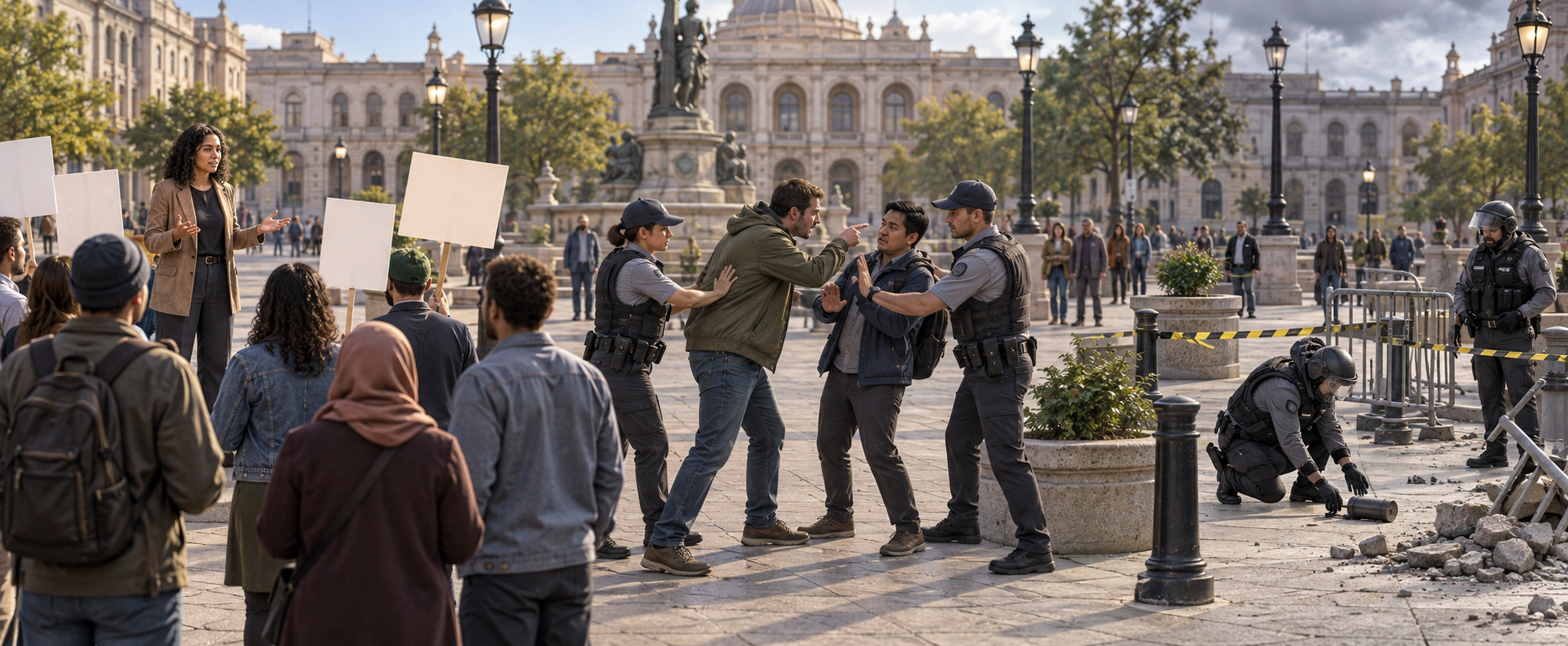
You cannot test consistency by placing every separatist activity in one basket. A rally, a provocative tableau, a targeted threat and an assault are not interchangeable. Begin with the conduct rather than the flag under which it occurred.
| Conduct | Consistent democratic response |
|---|---|
| Peaceful advocacy for independence | Protect the right to argue the case without implying government endorsement. |
| Imagery praising or reenacting political murder | Condemn it consistently and assess its context. Do not automatically equate offensiveness with a prosecutable threat. |
| Targeted pursuit or intimidation of a diplomat | Secure the person and event, document what occurred and investigate under the same safety standard in every case. |
| Weapon use, a direct threat or attempted physical harm | Treat it as a public-safety matter rather than allowing a political cause to provide cover. |
The October Crisis explains why the New Delhi imagery would strike a Canadian nerve. In 1970, the militant Front de liberation du Quebec kidnapped British diplomat James Cross and Quebec cabinet minister Pierre Laporte. Laporte was murdered. Prime Minister Pierre Trudeau then invoked the War Measures Act, leading to sweeping arrests and the detention of hundreds of people in Quebec. The parade deliberately invoked that history.
That history deserves care, but it cannot become a Canadian exemption from a universal rule. Present-day peaceful Quebec advocates must not be treated as members of the FLQ merely because both favour separation. The same principle applies to Sikh identity: neither Sikhs as a community nor every person expressing support for Khalistan should be treated as violent. Collective suspicion is unjust and analytically lazy.
At the same time, refusing collective blame does not require a government to ignore individual acts of intimidation. The correct comparison is peaceful speech with peaceful speech, assassination imagery with assassination imagery, and violence with violence. If Ottawa compares a peaceful Canadian rally with an aggressive Khalistan-related incident, or India compares a peaceful Khalistan rally with an attack on a diplomat, both comparisons fail.
A Dharmic approach is useful here because it binds rights to responsibility. The demanding rule is not the one applied to an opponent. It is the one you remain willing to bear when your own nation, history and public figures become the targets.
A practical test for the next separatism controversy

When the next dispute appears, do not begin with words such as extremist, activist, traitor or dissident. Those labels often smuggle the desired conclusion into the description. Work through the following checks instead.
- Describe the conduct with verbs. Did the person advocate, march, display, follow, surround, threaten, strike or attempt to injure? A precise verb reveals whether the dispute concerns an idea or an act.
- Choose a materially similar comparator. Compare an Alberta independence speech with a Khalistan speech. Compare a murder tableau with another murder tableau. Compare the alleged threatening of one diplomat with the alleged threatening of another. A shared separatist objective is not enough if the conduct differs.
- Separate legal permission from official approval. A state may permit offensive expression while its ministers condemn it. Conversely, a ministerial statement of disapproval does not prove that censorship or prosecution is justified. Ask separately what was legal, what officials said and what protective action authorities took.
- Identify the jurisdiction and the demand. Canada does not control policing in Delhi, and India does not control policing in Canada. Each can nevertheless request protection, lodge a diplomatic protest and explain the principle it expects the other state to enforce. Then ask whether it honours that principle inside its own jurisdiction.
- Run the name-swap test. Replace Khalistan with Quebec or Alberta, India with Canada, and an Indian diplomat with a Canadian one. If the official vocabulary changes from free expression to an assault on sovereignty while the conduct stays the same, officials owe the public a factual explanation.
- Check the evidence behind the reaction. Look for the official protest, police account, available recording, description of the alleged weapon or threat, and any later investigative outcome. A forceful headline is not a substitute for establishing what occurred.
This method also keeps criticism credible. It prevents a serious allegation of violence from being diluted by exaggerated claims about every objectionable slogan. It also prevents a government from placing threatening conduct under the protective umbrella of an otherwise lawful political movement.
What a credible Canadian policy would look like

Canada does not need to ban separatist politics to correct the inconsistency. In fact, a broad ban would weaken the argument for equal treatment because it would punish ideas instead of identifying harmful conduct. A credible policy would protect peaceful advocacy while making the boundary around intimidation visible and predictable.
- State the boundary in conduct-neutral terms. Ministers and police should distinguish advocacy, offensive symbolism, targeted harassment, threats and physical violence without changing definitions according to the movement involved.
- Explain comparable decisions in comparable language. If assassination imagery is condemned as dangerous when it targets a Canadian figure, equivalent imagery aimed at an Indian figure should not be dismissed merely as diaspora expression. If neither display crosses a legal threshold, officials can say so while condemning both.
- Protect diplomatic personnel without political screening. Security should turn on the behaviour and threat indicators surrounding an event, not on whether authorities sympathise with the demonstrators’ grievance.
- Publish the reason for enforcement or non-enforcement. A short factual explanation should identify the conduct, the applicable threshold and the action taken. That record makes later comparisons possible and reduces selective political storytelling.
- Reject collective blame. Canadian Sikhs, Indian Hindus, Quebecers and Albertans should not be treated as extensions of a separatist organisation or a foreign government. Accountability belongs to people and organisations responsible for specific acts.
- Apply reciprocity before making diplomatic demands. Before Ottawa asks another country to suppress, investigate or condemn an incident, it should ask how it handled materially similar conduct directed at India on Canadian soil. Delhi should accept the same discipline.
This approach would also improve Canada’s relationship with India. India would still encounter speech it considers hostile, because democratic consistency does not guarantee diplomatic comfort. Canada, however, could show that its protection of peaceful advocacy is principled rather than selective, and that neither Khalistan nor any other cause receives immunity for coercive conduct.
For Indians, the corresponding discipline is important. Defending Bharat’s sovereignty does not require describing every separatist opinion as terrorism. That overreach makes it easier for foreign governments to avoid the real issue. The stronger case identifies a direct threat, security failure or glorification of violence precisely, then asks why the Canadian response differs from the response it expects when Canada is the target.
Key takeaways
- Peaceful separatist advocacy should face the same civil-liberties standard whether it concerns Khalistan, Quebec or Alberta.
- Assassination imagery may be condemnable without automatically being illegal; a threat, attempted assault or weapon used to intimidate requires a separate safety analysis.
- Canada’s position becomes inconsistent when materially similar conduct is called free expression abroad but an attack on democracy and sovereignty when directed at Canada.
- The most persuasive Indian response is a conduct-by-conduct comparison, not a demand to silence an entire community or political identity.
When the next case arises, write the conduct in two columns and remove the national and communal labels. If the official responses still differ, ask which factual distinction justifies the difference. If none can be stated, you have exposed the double standard without sacrificing either free expression or public safety.
References

Leave a Reply
You must be logged in to post a comment.