

You may be teaching students who can reproduce the right answer and still struggle to judge when it applies, hear a serious objection, or use what they know responsibly. That gap is not a failure of intelligence. It is what happens when education stops at information.
Hindu, Buddhist, Jain and Sikh traditions offer practical ways to close that gap. Their doctrines are not interchangeable, but their educational disciplines can help you connect intellectual mastery with reflection, ethical conduct, community and service. The result is not a religious coating on an ordinary lesson. It is a different account of what successful learning should produce.
Set a transformation you can actually observe

Begin planning with the person you want the learner to become in relation to the subject. A useful outcome has four parts: what the learner should understand, what the learner should notice, what the learner should practise, and whom the learning should benefit.
Complete this sentence before choosing readings or activities: By the end of this lesson, the learner should be able to explain ___, examine ___ from more than one standpoint, practise ___ when difficulty arises, and use the learning to serve ___.
This is the practical force of the distinction between aparā and parā vidyā in the Muṇḍaka Upaniṣad. Aparā vidyā includes the disciplines, arts and techniques that make competent action possible. Parā vidyā directs the learner toward knowledge of what is enduring and liberating. The distinction does not ask you to choose wisdom instead of technical competence. It asks what will govern that competence once the learner possesses it.
Keep the outcomes separate enough to assess honestly. A student may solve a problem accurately but overlook its consequences. Another may express admirable intentions without understanding the subject. Neither performance is complete, and one should not be used to conceal the absence of the other.
- Name the concept or skill precisely. Avoid outcomes such as understand dharma or appreciate compassion, which cannot tell you what the learner can do.
- Name the confusion, habit or narrow standpoint the lesson should loosen. Do not define transformation as agreement with the teacher.
- Choose visible evidence: an explanation, a counterexample, a revised judgment, a disciplined practice or a useful application.
- Decide where the learning should travel next. If it never leaves the examination paper, its transformative claim remains untested.
The Bhagavad Gītā 4.34 places praṇipāta, paripraśna and sevā together: a humble approach, searching inquiry and service. This combination prevents two common errors. Humility without inquiry becomes compliance; inquiry without humility becomes performance. A serious classroom needs the learner’s willingness to be corrected and the teacher’s willingness to receive a real question.
Keep the traditions distinct while learning from each one
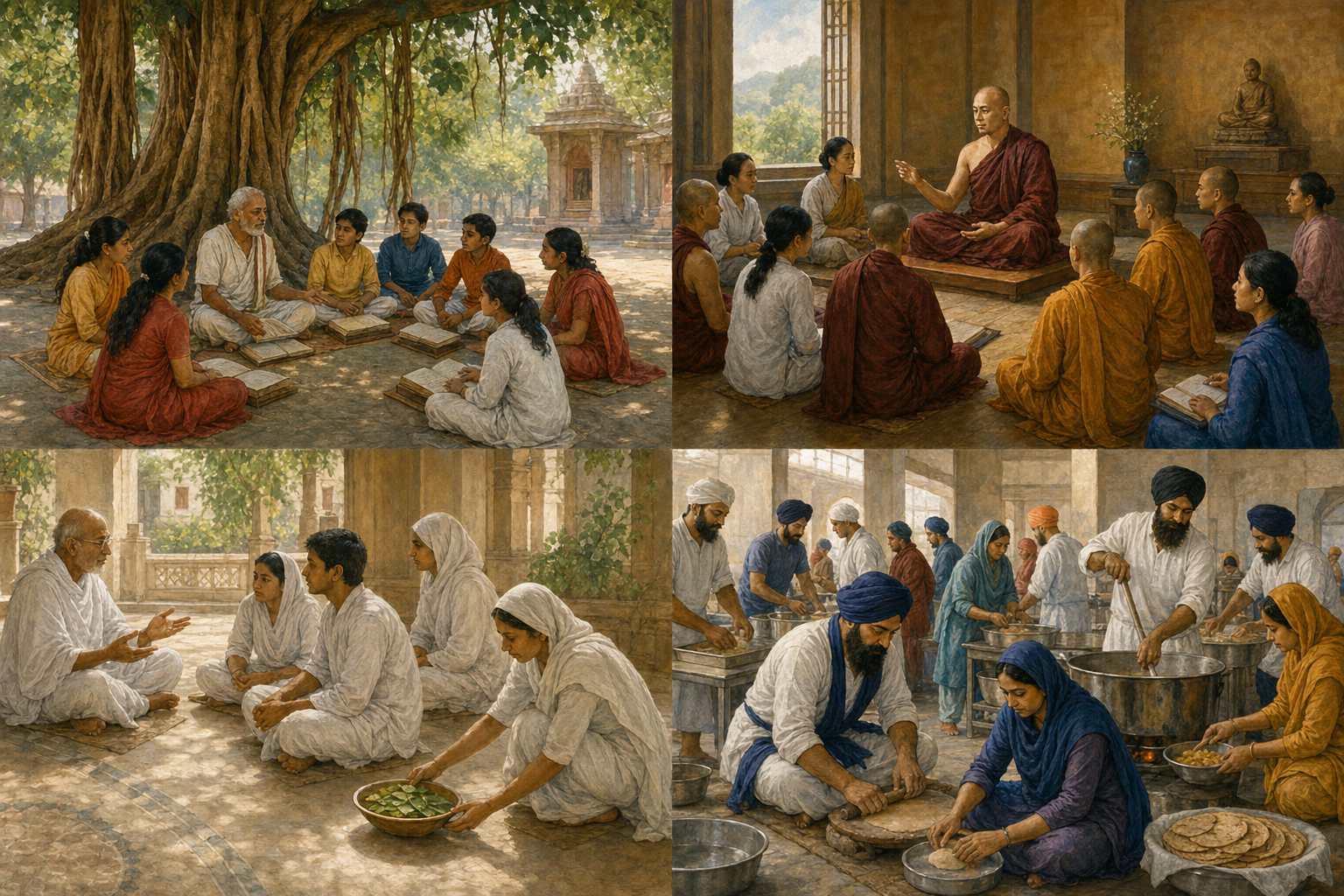
Shared dharmic concerns do not erase differences of theology, metaphysics or practice. You can place the pedagogical strengths of these traditions in conversation without pretending that they teach the same doctrine. That distinction matters in a plural classroom: unity becomes credible when it does not demand uniformity.
Hindu traditions: receive, examine and assimilate
The sequence śravaṇa–manana–nididhyāsana gives you a reliable structure for deep learning. Śravaṇa is attentive reception of a coherent teaching. Manana is the work of questioning, comparing, reasoning and resolving doubt. Nididhyāsana is sustained assimilation until the insight becomes available in perception and action, not merely in recitation.
Do not compress this sequence into lecture, quick discussion and test. After exposition, ask learners to reconstruct the reasoning without looking at their notes. Give them a case that appears to contradict the principle. Let them revise their first explanation. Then provide a quiet interval in which they write what changed in their understanding and what still remains unresolved. Active learning, retrieval, reflection and consolidation belong to one process here, not to separate educational fashions.
The pramāṇas sharpen the same lesson. Ask what was directly observed through pratyakṣa, what was inferred through anumāna, and what rests on trustworthy testimony through śabda. A student who labels these routes can detect when an inference is being presented as an observation or an unsupported assertion is borrowing the status of testimony.
Ethical preparation also affects the quality of inquiry. Yama and niyama place non-harming, truthfulness, moderation, contentment and self-study near the foundation rather than at the end. In classroom terms, establish truthful citation, non-harming criticism, restraint from interruption and willingness to examine one’s own motives before asking students to conduct a difficult dialogue.
Jain traditions: qualify a claim before defending it
Anekāntavāda trains the mind to resist the assumption that one standpoint exhausts a complex reality. Syādvāda gives this discipline linguistic form by qualifying a statement according to the standpoint and conditions under which it holds. This is not an instruction to declare every opinion equally valid. It is a demand for greater precision.
Use an anekāntic dialogue protocol when students confront a disputed question:
- State the claim without caricaturing the opposing position.
- Name the standpoint, conditions and assumptions from which the claim appears valid.
- Present the observation, inference or testimony supporting it.
- Identify another standpoint that reveals something the claim leaves out.
- Revise the claim so that it becomes more exact without becoming empty.
You will know the exercise is working when students stop treating qualification as weakness. A carefully bounded claim is usually more defensible than a sweeping one. In history, policy and interfaith dialogue, this practice also makes it harder to win an argument by erasing the people most affected by it.
Buddhist traditions: test the teaching and adapt the path
The ehipassiko invitation, commonly rendered as come and see, places examination inside the learning process. The Kālama Sutta similarly directs attention toward testing a teaching through experience, reason and the wholesome or unwholesome qualities it cultivates. A learner should not be asked to confuse repetition with verification.
Give students a proposition and ask three kinds of questions. What can they observe? Does their reasoning follow? What qualities of mind and conduct are strengthened when the proposition is applied? The last question is important. An argument can be clever while cultivating cruelty, vanity or heedlessness.
Upāya-kauśalya, or skillful means, adds adaptation to this testing. Adaptation does not require you to lower the intellectual goal. Change the route according to readiness. A novice may need a concrete example and guided questions; a more prepared learner may need to construct a counterexample, defend a qualification or teach the idea to a peer. If every learner receives the same intervention regardless of readiness, equal treatment may produce unequal access to understanding.
Sikh traditions: join word, community and service
The Sikh educational pattern of śabad, sangat and sevā prevents learning from becoming a private possession. Śabad gives the community a word worthy of sustained attention. Sangat creates a shared discipline in which learners remember, question and correct one another. Sevā tests whether understanding can take the form of responsible action.
Recitation and kīrtan also remind you that memory is not restricted to silent reading. Rhythm, voice and repetition can carry meaning into durable communal memory. Where the setting does not permit devotional practice, preserve the educational principle through accurate oral reading, collective recitation, attentive listening and a shared application. Do not detach the service activity from the learning objective. Unrelated volunteering may be worthwhile, but it does not demonstrate that the subject itself has matured into responsibility.
Build one complete lesson from purpose to sevā

You do not need to redesign an institution before using this model. Build one lesson in which each stage prepares the next. The following sequence turns the dharmic architecture into a planning checklist.
- Set the ethical ground. Name the conduct the inquiry requires, such as truthful representation, non-harming disagreement or responsible use of evidence.
- State the dharmic purpose. Explain why the knowledge matters beyond the test and what kind of freedom from confusion, carelessness or narrowness it can support.
- Provide structured exposition through śravaṇa. Curate a manageable body of material and distinguish established knowledge, inference and open questions.
- Create direct encounter and inquiry. Give learners something to observe, analyse, derive, compare or make. Ask them to identify pratyakṣa, anumāna and śabda within their reasoning.
- Use manana to expose doubt. Require a question, counterexample, teach-back or dialogue in which the learner must defend and, when necessary, revise the first account.
- Allow nididhyāsana to consolidate the insight. Use silence, a reflective entry or repeated focused practice. Ask what the learner now sees differently, not merely how the activity felt.
- Bring the learning into sangat or saṅgha. Let peers test explanations, give specific feedback and share responsibility for the quality of the discussion or project.
- Complete the movement through sevā. Choose an application that meets a real need and requires the subject knowledge. Assess both the technical work and the judgment used in applying it.
Consider a lesson on conservation of energy. Begin with a demonstration and data that students can observe. Move to guided derivation and the analysis of apparent counterexamples. Add trustworthy readings and ask students to distinguish what they observed from what they inferred or received through testimony. Have each learner teach the principle to a peer, answer an objection, and record how the explanation changed.
The sevā component can be an energy-use audit of a community space followed by practical recommendations. This is not an ornamental moral ending. The project forces students to decide what to measure, apply the technical principle outside the textbook, consider the needs of people who use the space, and communicate a feasible improvement. Problem sets and a lab report still matter; they are joined by evidence of transfer and responsibility.
The same structure works in other fields. In literature, śravaṇa becomes close reading, manana becomes comparative interpretation, and nididhyāsana becomes reflective writing that connects form, meaning and self-understanding. In law or public policy, anekāntavāda can require learners to represent each stakeholder’s standpoint fairly before proposing a resolution. The subject changes; the movement from reception through inquiry to responsible application remains.
Use digital and AI tools where they genuinely support access, visualization or practice. They can accelerate śravaṇa, but they cannot perform a learner’s manana or nididhyāsana. If a tool produces the explanation, objection and reflection, the student has bypassed the very work meant to transform understanding. Require an unaided teach-back, a visible chain of reasoning, a response to peer criticism, or a revision tied to direct observation.
Assess maturation without grading belief

A transformative classroom still needs rigorous assessment. The difference lies in what counts as evidence. Recall tells you whether information is available. It does not by itself reveal clarity of judgment, steadiness of conduct, compassion or the ability to apply a principle in a new situation.
| Dimension | Evidence to collect | Question for the teacher |
|---|---|---|
| Clarity of judgment, or prajñā | Accurate explanation, distinction between observation and inference, response to a counterexample | Can the learner explain why the conclusion holds and where its limits begin? |
| Steadiness of conduct, or śīla | Truthful use of evidence, reliable participation, fair representation of another view | Does conduct remain disciplined when disagreement or difficulty appears? |
| Compassion, or karuṇā and dayā | Stakeholder analysis, constructive peer response, attention to the people affected by an application | Can the learner recognise consequences beyond personal success? |
| Transfer | Novel problem, teach-back, community application, revision after feedback | Can the learner use the principle when the familiar wording and cues are removed? |
Collect more than one kind of evidence. Pair conceptual work such as problems, derivations or textual analysis with dialogue, a reflective entry and an applied project. A journal should be assessed for specificity, intellectual honesty and revision of thought, not for private disclosure. A sevā project should be assessed for the knowledge applied, the need addressed, responsiveness to feedback and the quality of reflection, not for sentimental language.
Do not grade devotion, religious identity, silence or conformity to a teacher’s view. Inner transformation cannot be turned into institutional surveillance without distorting it. Assess observable reasoning and conduct within the learning setting. If you do not have evidence about a learner’s life outside that setting, do not claim to measure it.
The teacher must submit to a parallel standard. Subject mastery is necessary, but so are the ability to facilitate doubt, model ethical consistency and adapt instruction to adhikāra, the learner’s readiness. Before using a transformative rubric, ask whether students can question you safely, whether you distinguish uncertainty from ignorance, and whether your adaptations preserve rigor. The guru–śiṣya ideal becomes credible through the quality of the relationship, not through the teacher’s title.
Key takeaways for your next lesson
- Define success as understanding, judgment, disciplined practice and useful application; do not let one substitute for the others.
- Use śravaṇa, manana and nididhyāsana as a sequence: receive the teaching, test it through inquiry, and consolidate it through reflection and repeated practice.
- Triangulate claims through direct experience, inference and trustworthy testimony.
- Use anekāntavāda to make claims more precise, ehipassiko to keep them open to examination, upāya to adapt the path, and sangat with sevā to carry learning into community responsibility.
- Assess observable maturation without grading belief, identity or coerced personal disclosure.
For your next lesson, write the four-part outcome before preparing the lecture. Choose one direct encounter, one serious doubt, one quiet act of assimilation and one application that benefits someone beyond the learner. Afterward, look for the point where the sequence broke. If students received the material but could not question it, strengthen manana. If they could discuss it but could not apply it, strengthen consolidation and sevā.
The decisive test is not whether students sound like their teacher. It is whether they can see more clearly, reason more honestly, remain steadier under difficulty and act with greater responsibility. Build for that change one complete lesson at a time.
References
