

You are planning a vrata, temple programme, or family New Year observance in March 2026, but the calendars in front of you appear to disagree. One calls 10 March Chaitra, another calls it Phalguna, and the Indian National Calendar begins Chaitra on 22 March. Those labels cannot be used interchangeably, but they do not necessarily describe different skies.
The way through the confusion is to identify the calendar system before copying a date. You also need the location, time zone, paksha, tithi, and any special festival rule. Once those details are attached, March 2026 becomes coherent rather than contradictory.
March 2026 contains three different uses of Chaitra

Chaitra is not a fixed Gregorian interval. The name belongs to more than one Indian calendrical framework, and each framework places its boundary differently.
| Calendar framework | How the boundary works | What Chaitra means in 2026 | Where it matters |
|---|---|---|---|
| Purnimanta lunar calendar | The month starts after a full moon and ends at the next full moon. | 4 March through 2 April 2026 in IST. | Religious reckoning across much of northern India, including Uttar Pradesh, Madhya Pradesh, Bihar, Jharkhand, Himachal Pradesh, Uttarakhand, and Chhattisgarh. |
| Amanta lunar calendar | The month starts after a new moon and ends at the next new moon. | Chaitra begins only after the March 2026 new moon and continues until the next new moon in April. The exact local civil dates require a location-aware Panchang. | Common in Maharashtra, Goa, Andhra Pradesh, Telangana, Karnataka, and neighbouring traditions. |
| Indian National Calendar | This is the reformed solar Saka calendar, not the lunisolar month used to assign most religious observances. | Saka year 1948 begins with Chaitra on 22 March 2026, as 2026 is not a leap year. | Civil and national-calendar use rather than direct determination of lunar festival tithis. |
The practical difference between Purnimanta and Amanta is easiest to see around the waning fortnight. Purnimanta assigns the Krishna Paksha following the full moon to the newly named month. Amanta keeps that same Krishna Paksha in the preceding month until the new moon has passed. The lunar phase can therefore agree while the month name differs.
There is a second distinction worth recording. Chaitra Shukla Pratipada is a traditional lunisolar New Year for several communities and inaugurates Shaka Samvat 1948; many regional almanacs name the samvatsara Parabhava. The Indian National Calendar also calls its year Saka 1948, but begins it on 22 March. A shared year number does not make the two Chaitra starting dates interchangeable.
March 10 exposes the month-name trap

Tuesday, 10 March 2026 provides a useful test case. In the IST-based calculation, it is Krishna Paksha Saptami through the civil day, ending at 12:11 AM on 11 March, when Ashtami begins. That tells you the paksha and tithi. It does not, by itself, settle the regional month name.
- In the North Indian Purnimanta system: Chaitra began on 4 March, immediately after Phalguna Purnima. Therefore 10 March is Chaitra Krishna Saptami.
- In the Amanta system: the March new moon has not yet closed Phalguna. Therefore the same 10 March tithi is Phalguna Krishna Saptami.
If a calendar calls 10 March “Phalguna Krishna” in a North Indian Purnimanta column, treat that month label with caution. It does not fit a Purnimanta Chaitra span beginning on 4 March. A correct tithi can sit beside an incorrectly mapped month name when information from two regional systems has been combined.
The underlying mechanism is astronomical. A tithi represents a 12-degree change in the angular relationship between the Sun and Moon. It is not a 24-hour weekday and usually does not begin at midnight. The clock can say Tuesday while Saptami is ending shortly after the next midnight; the Panchang can also give two month names for that Saptami because the systems place the monthly boundary on different lunar events.
Do not carry the 12:11 AM IST endpoint unchanged into Toronto, London, Singapore, or another location. Local observance is determined from the tithi interval at that location and the criterion prescribed for the event, not by treating an Indian civil date as universal. A simple time-zone conversion may help you understand an IST table, but a location-aware Panchang is the proper tool for fixing your local religious date.
Map Chaitra observances by tithi before adding dates
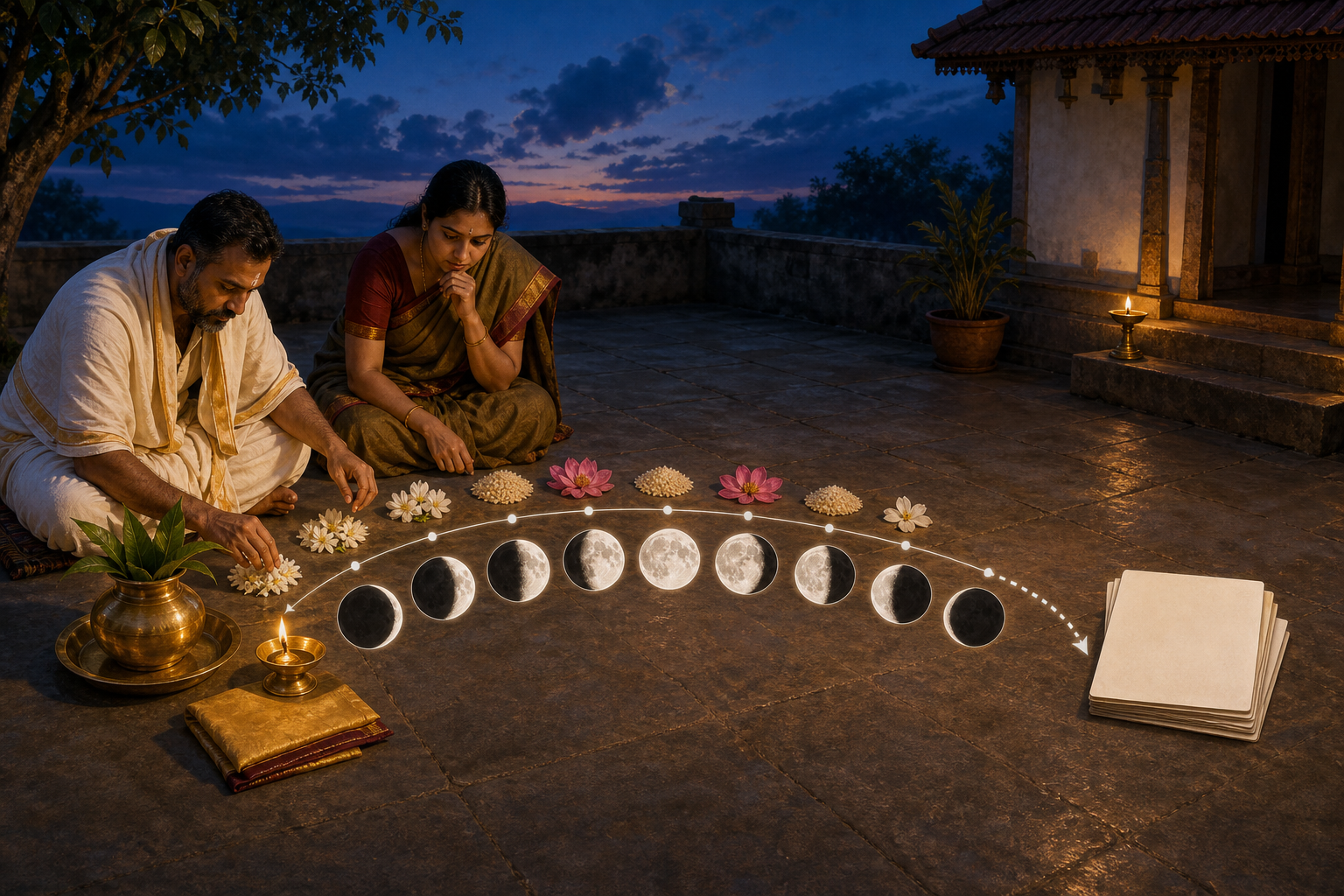
A Gregorian planner should be the last layer of your festival calendar, not the first. Begin with the observance and its lunar anchor. Then determine when that tithi satisfies the applicable sunrise, midday, or other ritual rule where you live.
| Observance | Calendrical anchor | What you should verify |
|---|---|---|
| Papamochani Ekadashi | Krishna Paksha Ekadashi near the beginning of Purnimanta Chaitra | Check the local fasting day and parana guidance rather than inferring the date from the North Indian monthly range alone. |
| Ugadi, Gudi Padwa, and Navreh | Chaitra Shukla Pratipada | Use the first bright-fortnight tithi after the March new moon under the relevant regional tradition. This is also the opening of Chaitra Navratri. |
| Cheti Chand | Usually on or near Chaitra Shukla Dwitiya | Follow the Sindhi community calendar because the customary placement is not expressed as an inflexible Gregorian date. |
| Kamada Ekadashi | Chaitra Shukla Ekadashi | Confirm both the local vrata date and the prescribed breaking-of-fast interval. |
| Rama Navami | Chaitra Shukla Navami | For Smarta and Vaishnava observance, pay particular attention to Navami during madhyahna, the local midday period. Sunrise alone is not the whole rule. |
| Mahavir Janma Kalyanak | Generally Chaitra Shukla Trayodashi | Use the local Jain calendar for the procession, pravachan, and temple programme date. |
| Hanuman Jayanti in much of North India | Chaitra Purnima | Confirm the Purnima assignment locally, especially if you are coordinating a temple event outside India. |
Chaitra Navratri runs from Shukla Pratipada through Navami, so a family undertaking the full observance should record the local Pratipada start, each daily tithi, and the Navami madhyahna criterion before arranging the concluding Rama Navami puja. Gangaur and Gauri Puja unfold through the early Chaitra fortnight with strong regional variation; for those observances, the local community schedule carries more practical weight than a generic all-India date list.
Do not force the mid-April solar New Years into this lunar sequence. Tamil Puthandu, Malayalam Vishu, Bengali Pohela Boishakh, and Sikh Vaisakhi belong to a related springtime arc but are tied to solar transitions. In 2026 they fall after the 2 April close of North Indian Purnimanta Chaitra. Shared seasonal meaning does not erase calendrical difference.
A reliable six-step check for any March Panchang entry

- Set the place first. Record the city and time zone for the person or temple observing the event. “India time” is not sufficient for a diaspora calendar, and a calendar generated for Delhi should not silently govern Toronto.
- Name the calendar system. Write Purnimanta, Amanta, or Indian National Calendar beside the month. If you do not know the household convention, follow the family’s established regional Panchang or the temple conducting the rite.
- Record paksha and tithi separately from the month. An entry such as “Chaitra Krishna Saptami” contains three distinct claims. Check each one. On 10 March 2026, Saptami may be sound even when a copied month label is not.
- Identify the ritual criterion. Most daily assignments begin with the tithi at local sunrise, but a festival can require another part of the day. Rama Navami, for example, depends especially on Navami during madhyahna. Do not replace a specific festival rule with a generic sunrise rule.
- Calculate muhurta from the actual local day. Abhijit Muhurta is centred near local solar noon. Rahu Kaal is derived from weekday segments between local sunrise and sunset. For a theoretical 12-hour Tuesday, Rahu Kaal is often approximated near 3:00–4:30 PM, but that is not a fixed clock window and should not be copied when day length or latitude differs.
- Keep the calculation convention consistent. Drik and traditional Surya Siddhanta methods, different ayanamsha values, and local horizon effects can shift a tithi, nakshatra, yoga, or karana boundary. Use one trusted regional or temple Panchang through the entire decision instead of assembling individual fields from unrelated calculators.
A difference of several minutes between two otherwise consistent Panchangs can arise from their astronomical settings. A contradiction between a stated month boundary and a later month label is a different kind of problem: it is a mapping inconsistency. Check the system before assuming that every disagreement is merely a small ephemeris variation.
For a shared calendar, add a short note under every important entry: “Location: [city]; system: [Purnimanta or Amanta]; times: local.” Add the governing tithi criterion when it is not sunrise. That one line lets relatives, priests, and community organisers see whether an apparent date conflict is real or only regional.
Key takeaways
- North Indian Purnimanta Chaitra runs from 4 March through 2 April 2026 in IST.
- Amanta Chaitra begins only after the March new moon, so its civil span starts roughly half a lunar cycle later.
- On 10 March, Purnimanta reckoning gives Chaitra Krishna Saptami, while Amanta reckoning gives Phalguna Krishna Saptami.
- The Indian National Calendar starts solar Chaitra and Saka year 1948 on 22 March 2026; this does not determine the lunisolar festival sequence.
- Tithi, local location, and the festival’s sunrise, midday, or other criterion determine the observance date. An IST date by itself does not.
- When two calendars differ, compare their system, location, and calculation convention before deciding that one is wrong.
Before you publish invitations or book a community programme, ask your temple or family priest for the locally applicable Panchang entry and preserve its system alongside the date. You will have a calendar others can verify, and you will avoid turning Bharat’s legitimate regional diversity into an unnecessary dispute.
References
- DharmaRenaissance Blog – Chaitra Month 2026 Dates Explained: Sacred Beginnings, Festivals, and Regional Calendars
- DharmaRenaissance Blog – March 10, 2026 Panchang: Krishna Paksha Saptami, Auspicious Muhurtas, Nakshatra & Rashi
