
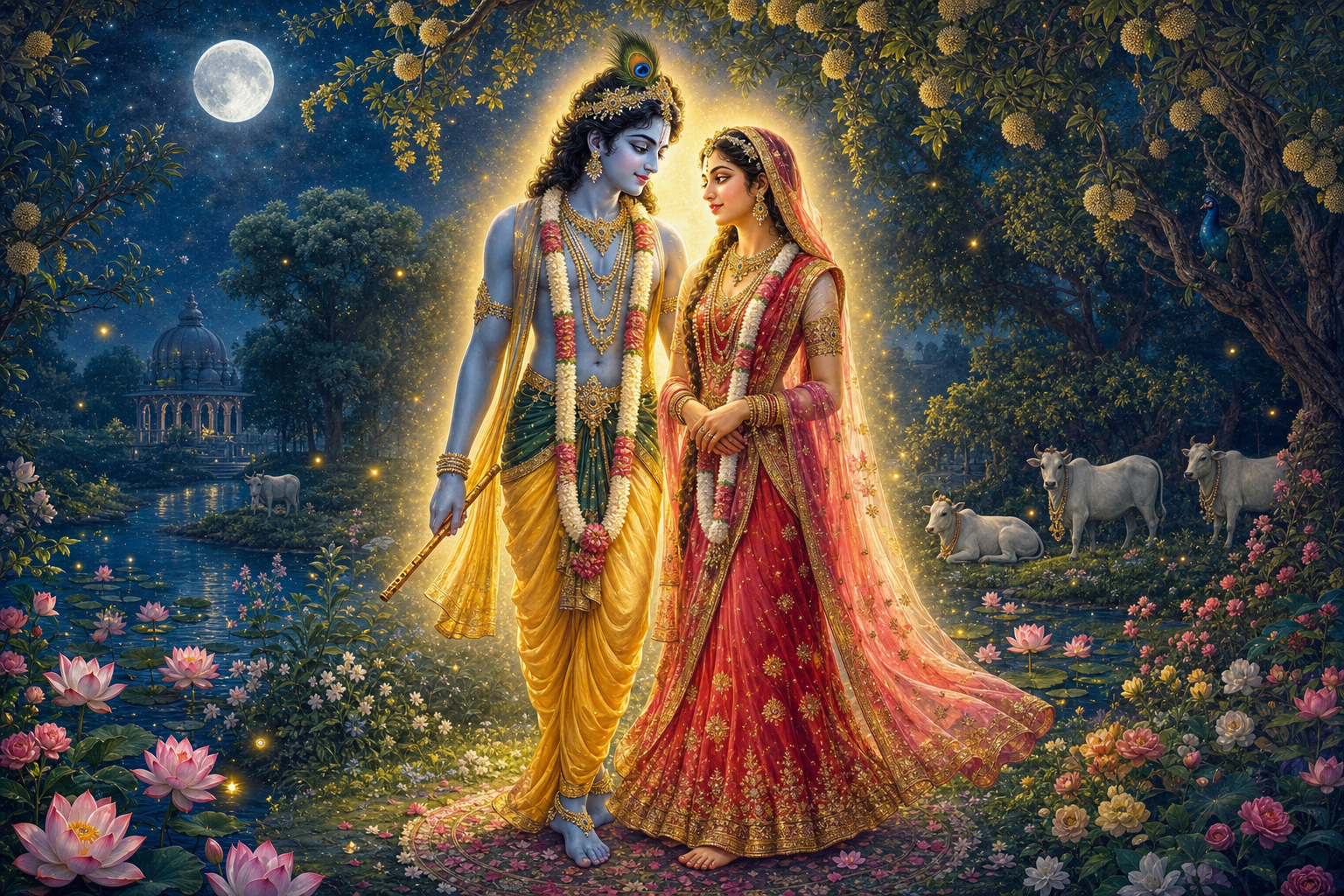
You may have heard Krishna called Purna Purusha, the Complete Being, and then wondered why Radha seems indispensable to every intimate vision of him. If Krishna is already complete, what does Radha add?
The question rests on a misleading picture of completeness. Krishna is not one incomplete half waiting for Radha to supply the other. Nor is Radha a beautiful accessory to an otherwise self-sufficient male deity. Their relationship reveals a fullness that contains both the source of divine power and its capacity to become love, bliss, tenderness, reciprocity, and relationship. Understanding that distinction changes how you read the theology, approach the rasa-lila, and stand before a Radha-Krishna murti.
Divine completeness does not mean divine solitude

In ordinary speech, a complete person is someone who does not need anything from another person. If that definition is carried unchanged into theology, relationship starts to look like deficiency: a perfect God should remain untouched, solitary, and independent.
Krishna’s completeness means something larger. Bhagavad Gita 9.17 identifies him not only as the father of the world but also as its mother, sustainer, and grandsire. These descriptions are not competing biological identities. They disclose a divine reality capable of every originating, nurturing, supporting, and relational function without being confined to one of them.
This is also why Purusha must be read carefully. In these theological contexts, it means the cosmic person or ground of consciousness; it does not simply mean a male human being enlarged to cosmic proportions. Bhagavad Gita 15.16-18 presents Krishna as Purushottama, the Supreme Person beyond the ordinary categories used to classify embodied existence. The teaching does not make masculine imagery worthless, but it prevents that imagery from becoming a boundary around the Divine.
The same discipline applies to Prakriti and Shakti. Prakriti names the dynamic matrix of manifestation, while Shakti names divine power or potency. Neither is dead material placed beside a conscious male controller. Bhagavad Gita 13.20-23 places Purusha and Prakriti together within its account of experience, and 14.20 directs the seeker beyond the gunas that condition manifested nature. The categories help you understand divine action, but realization cannot be imprisoned inside the categories.
When you hear Krishna called Purna Purusha, therefore, do not translate it mentally as “the perfect man.” Read it as a claim about divine completeness: nothing that belongs to the fullness of consciousness, power, love, or bliss lies outside him.
Radha is Krishna’s bliss potency, not his missing half
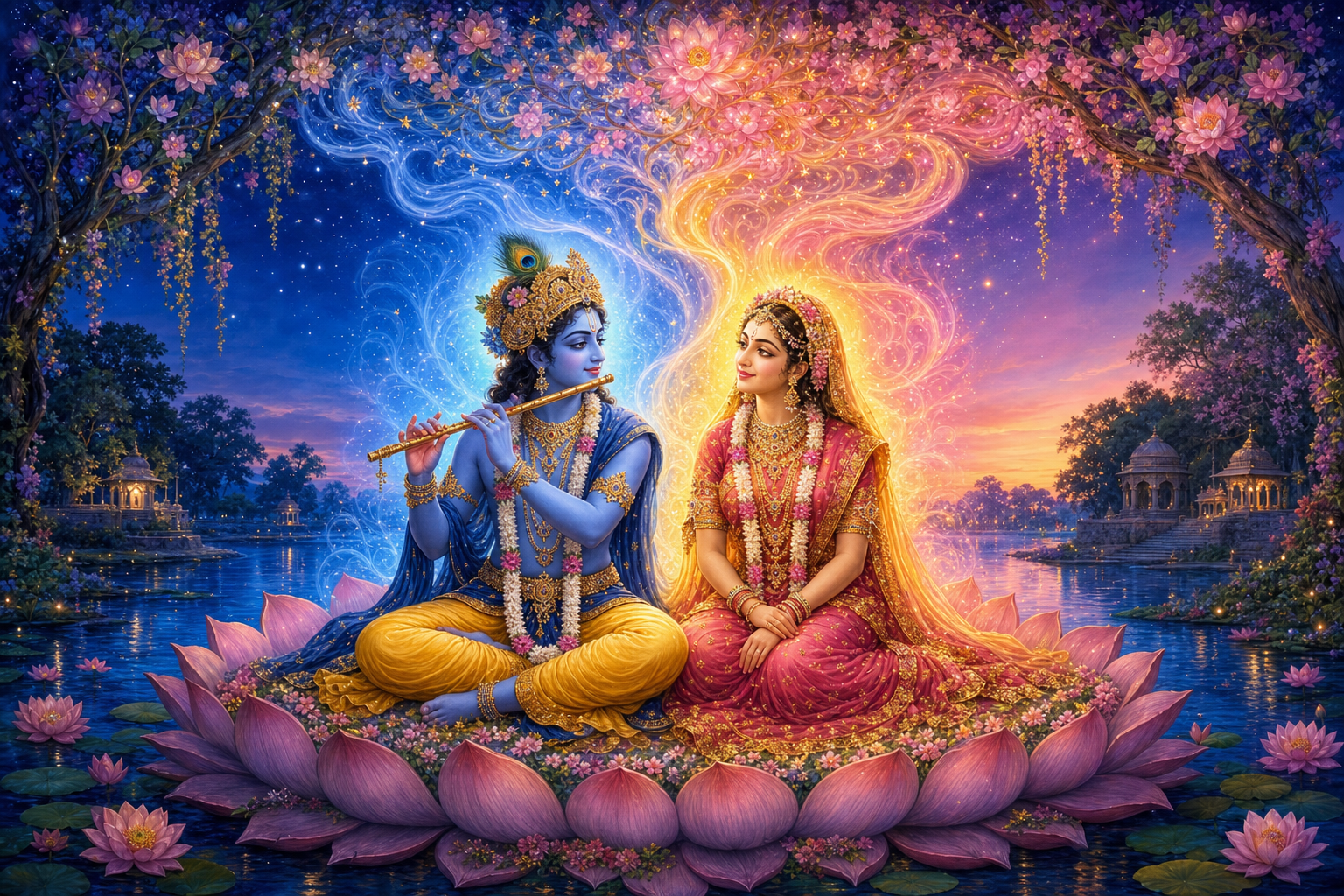
Gaudiya Vaishnava theology gives the apparent paradox a precise form. Radha is Krishna’s Hladini Shakti, the potency of divine bliss through which love is experienced, exchanged, and shared. Krishna is the possessor and source of Shakti; Radha is that Shakti in its most intimate personal revelation.
The relationship is expressed through shakti-shaktiman abheda, the non-separation of divine energy and the one whose energy it is. Radha and Krishna can appear as two because love requires relation: one loves, another receives and returns that love, and each discovers new sweetness through the exchange. Yet the two are not independent ultimate realities accidentally joined together. They are one divine reality disclosed relationally.
This gives you a reliable test for interpreting Radha-Krishna. If an explanation makes Krishna an incomplete male who acquires feminine qualities from outside himself, it has divided what the theology holds together. If it reduces Radha to a subordinate companion who contributes nothing essential to divine self-revelation, it has made Shakti secondary to the Divine whose very fullness is known through Shakti.
Gaudiya Vaishnavism describes this relation through achintya-bheda-abheda: inconceivable oneness and difference. Difference is real enough for love, longing, meeting, service, and delight. Oneness is real enough that neither Radha nor Krishna can finally be understood in isolation. The word achintya matters because the doctrine is not asking you to solve the pair as a logical puzzle. It is warning you that ordinary either-or categories cannot contain divine relationship.
This is a specifically Gaudiya Vaishnava formulation, even though the broader inseparability of deity and divine power appears across Dharmic traditions. You do not need to present one sampradaya’s vocabulary as the only Hindu vocabulary in order to take it seriously. Name the theological setting, and then let its distinctions do their work.
The Bhagavata Purana supplies the devotional setting. It affirms Krishna as Bhagavan himself and presents the rasa-lila in chapters 10.29-33. Krishna stands beside each gopi by multiplying his presence, reciprocating a multitude of devotional longings without ceasing to be one. At the theological level, this is what completeness looks like in relationship: the limitless Divine becomes personally available without being divided or depleted.
A merely worldly reading of the rasa-lila misses that scale. The gopis are not competing for the attention of a scarce, socially powerful man. Krishna is not one finite lover distributing limited affection. The lila dramatizes divine reciprocity: every surrendered heart can encounter the whole Divine, not a fraction left over after others have been loved.
In Gaudiya practice, madhurya-rasa uses the language and affect of intimate love to cultivate total devotion. Calling it the highest rasa within that tradition does not turn ordinary romance into an unrestricted spiritual model. Rasa is disciplined devotional perception. Its human imagery points beyond itself, and treating it as permission for mundane indulgence reverses its purpose.
Gendered forms reveal the Divine without limiting it
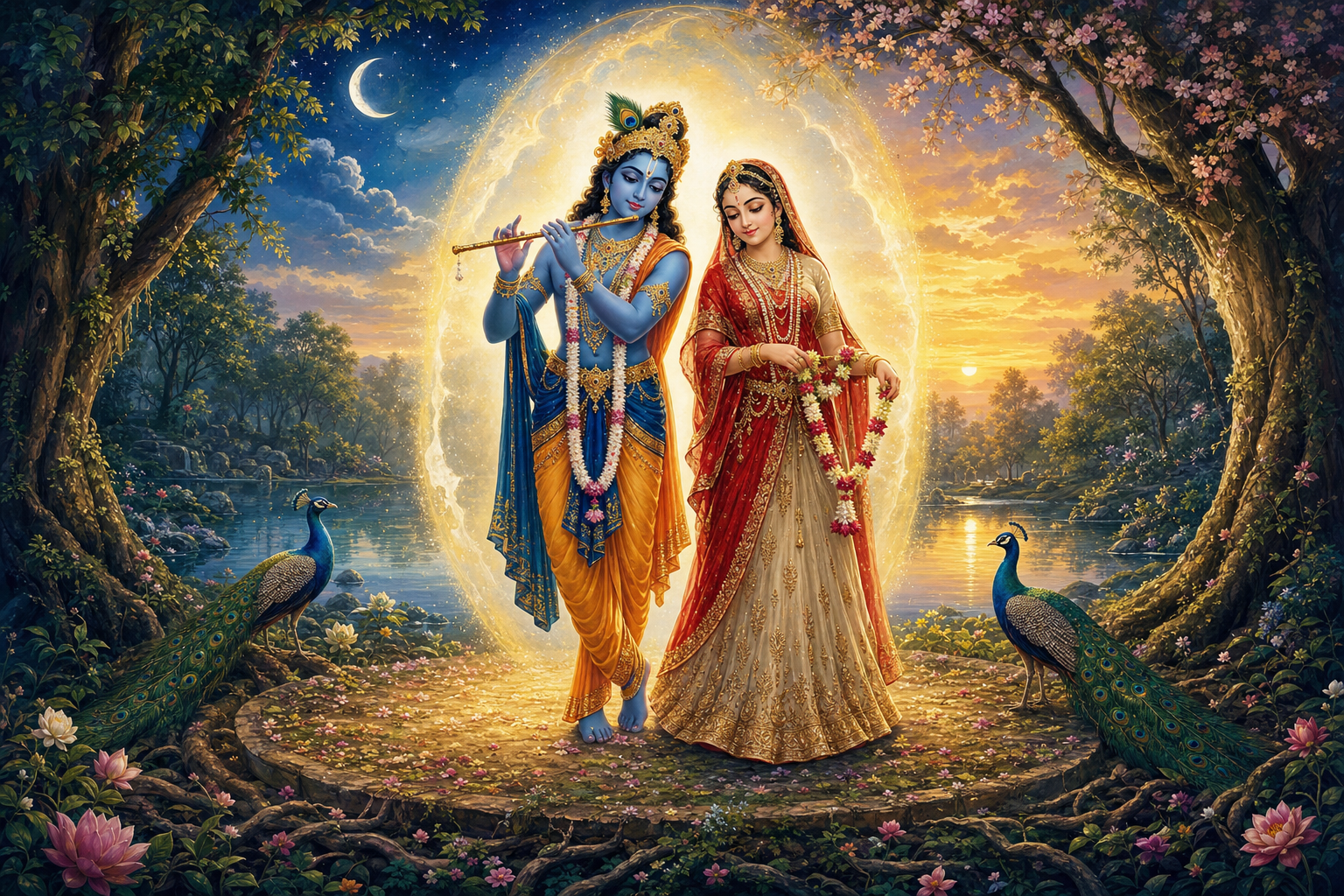
It is tempting to resolve the question by saying that God is beyond gender and stopping there. That answer is only half complete. The Divine is not limited to male or female embodiment, but Dharmic traditions still use gendered forms because those forms disclose real modes of relationship. Father, mother, beloved, bride, protector, and nurturer are not disposable decorations. Each trains the heart to recognize something it might otherwise overlook.
Radha’s femininity therefore matters, but it must not be reduced to a social stereotype. Receptivity, tenderness, empathy, nurture, and surrender may be culturally coded as feminine, yet bhakti treats them as capacities every seeker needs. A man does not become less fully himself by learning receptive devotion. A woman is not confined to receptivity or denied strength and agency. The symbol opens spiritual capacity; it does not assign a narrow social script.
The Vaishnava-Puranic figure of Mohini makes the same point through a different form. In Bhagavata Purana 8.9-8.12, Vishnu assumes an enchanting feminine embodiment in the course of restoring cosmic order. Traditions that understand Krishna as the source of the avatars can receive Mohini without treating feminine form as foreign to supreme divinity. Divine form answers the need of lila and dharma; it is not constrained by human anxiety about fixed presentation.
Vrindavan’s Gopeshvara Mahadeva tradition adds an important Vaishnava-Shaiva resonance. Shiva is remembered as assuming a gopi form in order to enter the rasa-lila. The motif does not demean Shiva or make femininity a disguise of lesser status. It places receptive devotion at the threshold of the highest lila and allows two great Dharmic lineages to illuminate one another.
Some bhakti practitioners similarly cultivate sakhi-bhava, approaching devotion inwardly as a companion or handmaid of Radha. This is a contemplative orientation, not a claim that the practitioner’s social gender has changed, and not a costume to be borrowed for effect. Its purpose is to refine service, empathy, attentiveness, and surrender. If you are drawn to it, learn how your own lineage disciplines that mood rather than imitating its external language without its devotional framework.
These traditions also help explain why Dharmic sacred space can carry meaning for people whose experience of gender does not fit a simple binary. At Tamil Nadu’s Koovagam festival, aravani communities participate in rituals associated with Mohini’s marriage to Aravan. The observance has its own regional history and should not be flattened into a slogan, but it demonstrates a durable principle: sacred belonging is not exhausted by ordinary social labels.
There are three common mistakes to avoid when applying this theology. The first is literalism: imagining a biologically male supreme being with feminine power attached from outside. The second is erasure: declaring gender meaningless and thereby discarding Radha’s distinctive revelation. The third is social overreach: converting a spiritual symbol into a rule that every man or woman must behave according to a fixed list of traits. Divine transcendence, meaningful form, and human dignity must be held together.
Ardhanarishvara can serve as a comparison, but not as an interchangeable name or image. The half-Shiva, half-Shakti form belongs to Shaiva iconography, while Radha-Krishna emerges from a Vaishnava theology of loving relation. Both can teach that masculine and feminine principles belong within divine fullness, but they express that insight through different visual and doctrinal grammars. Comparison should clarify the difference, not erase it.
A practical way to contemplate Radha-Krishna
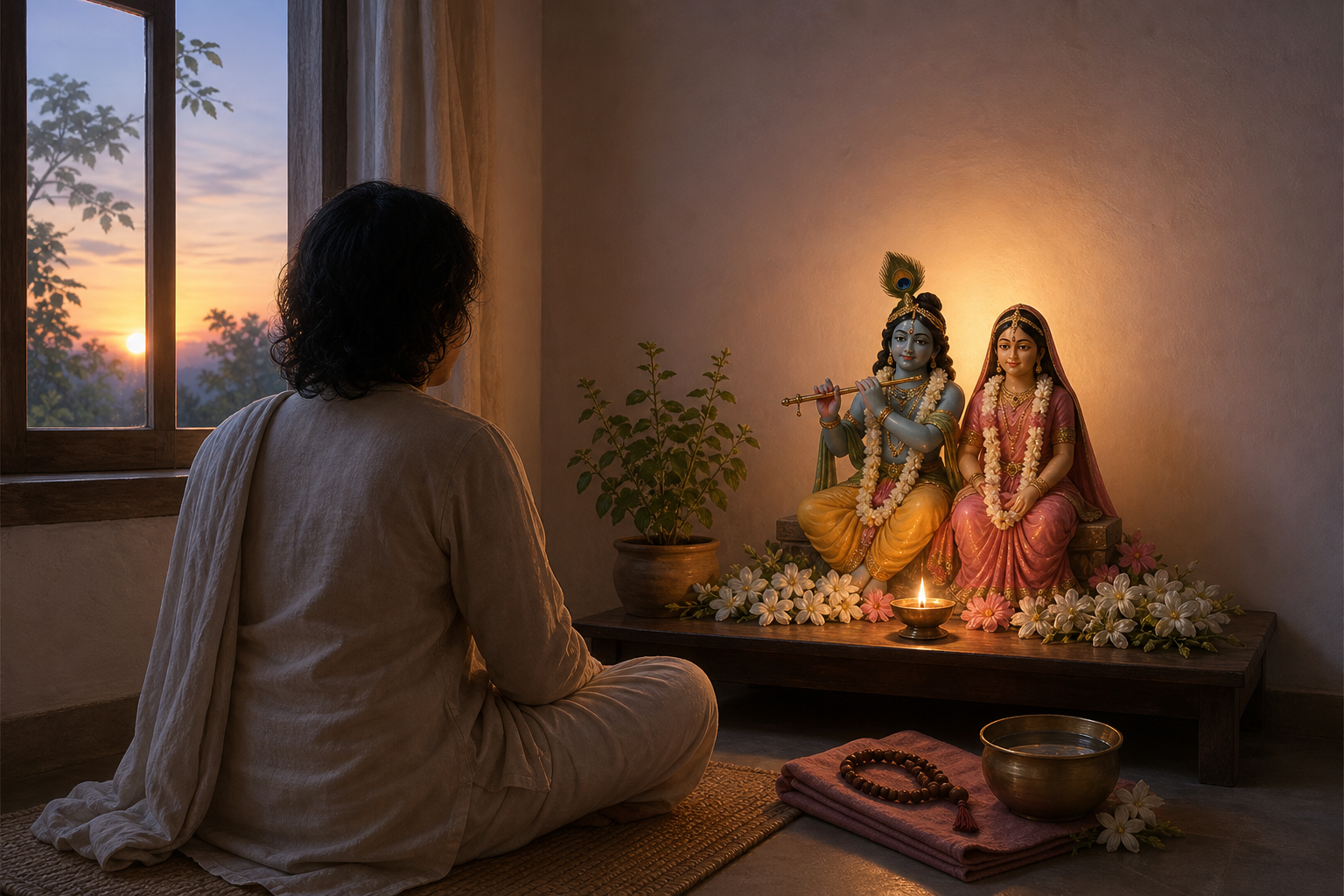
You do not need to master every technical term before this teaching can shape your sadhana. You do need to keep its levels distinct. The following sequence works as a reading practice, a preparation for darshan, or a way to examine an interpretation you have encountered.
- Begin with the textual anchor. Read Bhagavad Gita 9.17, followed by 15.16-18. Notice that Krishna includes maternal as well as paternal relation and then exceeds the categories applied to conditioned beings. Ask which assumptions you have been placing inside the word Purusha.
- State both sides of the theology. Use one complete sentence: “Radha and Krishna are distinct for the exchange of love and non-different in divine reality.” If an interpretation preserves only distinction or only unity, it has lost the central balance.
- Read the rasa-lila at the scale the narrative requires. In Bhagavata Purana 10.29-33, attend to Krishna’s capacity to be wholly present to each gopi. Do not import the scarcity, rivalry, possession, or bodily limitation of an ordinary romantic triangle into an account built around unlimited divine reciprocity.
- Look at the murti relationally. Do not ask which figure is the main deity and which is the addition. Notice what becomes visible only through the pair: invitation and response, delight and the power to taste delight, lover and beloved, unity that does not consume difference.
- Translate symbolism into one act of sadhana. If your devotion is mostly speaking, spend part of it listening. If it is mostly asking, offer service without demanding recognition. If strength is easy for you but tenderness feels threatening, bring tenderness deliberately into your conduct. If receptivity has become passivity, remember that Radha is divine potency, not helplessness.
- Respect the sampradaya. Madhurya-rasa and sakhi-bhava belong to developed devotional disciplines. Learn their purpose and boundaries from the tradition that practices them. You can cultivate humility, attentive service, and loving receptivity without prematurely claiming a specialized inner identity.
- Test the interpretation by its fruit. A sound understanding should deepen reverence for Radha, clarify Krishna’s completeness, and make you more capable of reciprocal love. If it produces contempt for women, embarrassment about tenderness, license for indulgence, or rivalry between Vaishnava and Shaiva traditions, something has gone wrong in the application.
Key takeaways
- Purna Purusha means complete divine personhood, not perfected biological maleness.
- Radha does not repair a deficiency in Krishna; she is his Hladini Shakti, the personal revelation of divine bliss and love.
- Radha and Krishna are distinct enough for genuine relationship and non-different enough to remain one divine reality.
- The rasa-lila concerns unlimited divine reciprocity, not an ordinary romance governed by scarcity and possession.
- Being beyond gender does not make gendered sacred forms meaningless; it means no single form can confine the Divine.
- Your practical test is simple: the theology should produce deeper service, receptivity, tenderness, dignity, and reverence rather than stereotype or indulgence.
The next time you stand before Radha and Krishna, resist the urge to solve them into one figure or separate them into two competing ones. Hold difference and unity together long enough for the image to question you: can you become strong without hardening, receptive without becoming passive, and loving without trying to possess? Begin there. Divine completeness is not merely something to define; it is a way of learning how wholeness can make room for relationship.
References
