

If you are a Hindu student, parent, teacher, or community organiser watching a Valentine’s Day dispute, you may feel pushed toward a false choice: either accept every campus celebration as beyond criticism or applaud whoever can force it to stop. Neither position protects Dharma, students, or the authority of an educational institution.
The better position begins with jurisdiction. Students may organise activities within campus rules. Administrators must decide whether those activities comply with the rules. Cultural organisations may criticise, petition, and protest peacefully. Police manage immediate danger. When these roles are confused, a disagreement about culture becomes a contest over who can create the most pressure.
Key takeaways
- Campus autonomy means rule-bound self-government, not freedom from cultural criticism.
- Approval gives an event permission to proceed under institutional rules; it does not make the event morally unquestionable.
- Community groups may object, seek dialogue, and organise peaceful counter-expression, but an objection does not by itself confer authority to enter a controlled campus or cancel an approved event.
- A police decision to pause an event during a confrontation is a safety response, not a final judgment on the event or the protest.
- A credible Hindu objection identifies the exact concern—such as commercialisation, institutional endorsement, or a rule violation—and proposes a proportionate remedy.
- Ahimsa, karuna, maitri, and seva require both organisers and objectors to pursue their aims without intimidation or contempt.
A police pause is an emergency action, not a cultural verdict
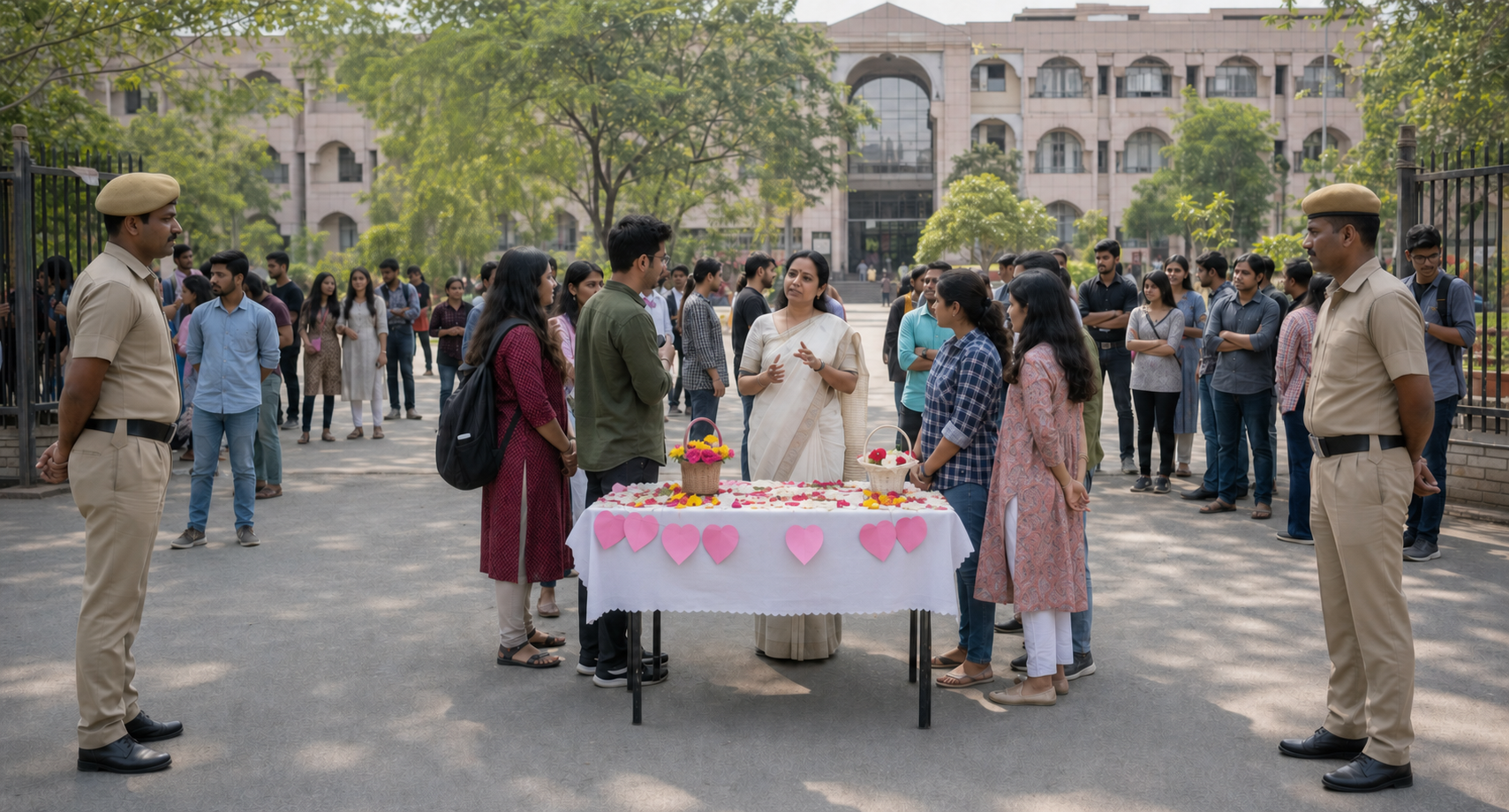
On February 13, 2026, a Valentine’s Week Bake & Sell activity at NMIMS Indore was paused after protestors identifying with Hindutva activism entered the campus. Police intervened to prevent escalation, and local accounts reported no major injuries at the time.
That sequence contains three different decisions, and you should resist collapsing them into one.
The first is an immediate safety decision: is there a credible risk of confrontation, crowding, intimidation, or injury? Police and campus officials may need to separate groups, restrict access, or pause an activity while they regain control. That decision concerns the conditions at that moment. It does not establish that the programme violated campus policy, nor does it establish that every method used to oppose it was justified.
The second is an institutional decision: was the activity properly approved, and did it remain within the conditions of approval? That judgment belongs to the university’s authorised decision-makers. They should examine the permission, the code of conduct, access restrictions, the nature of the sale, and what actually occurred. A written decision should identify the rule applied rather than hiding behind vague phrases such as cultural sensitivity or student freedom.
The third is a cultural judgment: should a university community welcome, criticise, reinterpret, or decline Valentine’s Day observances? Some students see such activities as expressions of friendship and companionship. Some Hindus see Valentine’s Day as a commercial import that displaces local understandings of relationships and responsibility. These positions can be debated without assigning either side control over the other by force.
This separation matters because an emergency measure can create a bad precedent when it is mistaken for a verdict. If creating a disturbance reliably produces cancellation, every faction learns that disruption is the quickest route to institutional power. If prior approval is treated as immunity from all criticism, students learn that procedure excuses cultural indifference. The university must restore safety first and then make its own reasoned decision.
Campus autonomy needs rules that everyone can inspect

Campus autonomy is neither sovereignty nor a cultural blank cheque. It is the practical capacity of an educational institution to make and enforce decisions through known procedures. It protects student initiative, but it also makes administrators answerable for what they approve and how they respond to objections.
When you are trying to judge a disputed event, ask for the institutional record before choosing a side. Was permission granted by the appropriate office? Was participation voluntary? Were the purpose, location, timing, access conditions, and financial arrangements of the sale disclosed? Did the same safety and conduct rules apply that would govern another student activity? Was there a usable grievance channel before the confrontation?
Those questions reveal more than slogans do. An approved student activity can still be poorly conceived or culturally shallow. A sincere cultural objection can still use an improper method. The moral quality of an event and the legitimacy of the means used against it must be judged separately.
| Participant | Legitimate role | Boundary to preserve |
|---|---|---|
| Student organisers | Propose and conduct voluntary activities under campus rules | Follow the approved purpose, access conditions, and code of conduct |
| Administrators | Approve, modify, or reject activities through published procedures | Do not surrender the decision to whichever side generates the greatest pressure |
| Cultural organisations | Criticise, petition, request dialogue, and organise peaceful counter-expression | Do not treat disagreement as permission for unauthorised entry, harassment, or forced cancellation |
| Police | Protect people and restore public order when a confrontation develops | Do not let a temporary safety intervention become a substitute for the institution’s final policy decision |
Consistent procedure also protects Hindu life on campus. If an outside group can establish a veto merely by arriving in sufficient numbers, the same tactic can later be directed against a Diwali programme, a Gita discussion, a Jain observance, a Sikh seva activity, or a Buddhist meditation gathering. You cannot defend a method for one cultural dispute and assume it will never be used against you.
Administrators therefore need event-neutral standards. The same rules for permission, voluntary participation, sales, publicity, outside access, respectful conduct, and emergency response should apply regardless of whether an activity is labelled traditional, modern, religious, secular, Indian, or Western. Equal procedure does not erase cultural differences; it keeps those differences from being settled through intimidation.
Hindu cultural advocacy is strongest when it names the harm
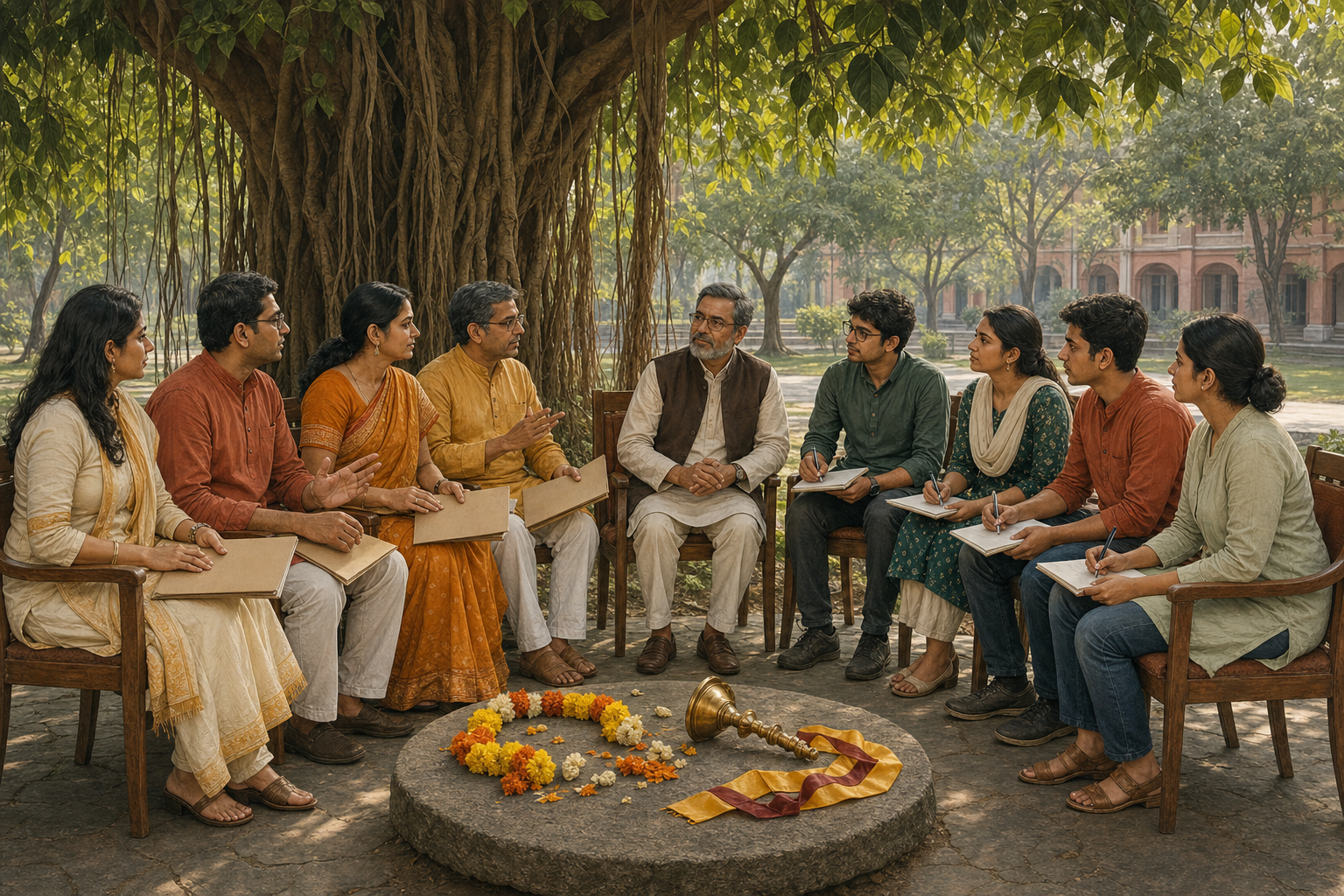
Valentine’s Day is a reasonable subject for cultural criticism. Its commercial packaging can reduce affection to purchasing, public display, and social pressure. A Hindu response can offer a deeper account of love: one connected to fidelity, restraint, friendship, family, duty, compassion, and service. But that argument becomes weaker when every activity associated with the day is treated as though it carries the full weight of a civilisational threat.
A student bake sale is not automatically equivalent to endorsing every commercial or social message attached to Valentine’s Day. If you object to such an event, state the precise problem. Is the concern that the institution appears to endorse the observance? Is participation effectively compulsory? Does the publicity violate a stated code? Is a commercial activity being conducted without the required permission? Is the objection to the event’s conduct, or to the mere fact that other adults have chosen to participate?
Each concern points toward a different remedy. An undisclosed sale may require financial clarification. Misleading institutional branding may require a correction. Coercive participation may require an explicit opt-out. A policy breach may justify modification or cancellation under the same rule applied to everyone. Moral disagreement alone calls for argument, dialogue, or counter-programming—not the seizure of administrative authority.
If the aim is cultural renewal, give students something better to consider. A campus group can hold a discussion on Dharmic understandings of love and responsibility, organise a seva activity, examine consumerism, or create an observance centred on maitri rather than romantic display. Such alternatives allow students to encounter a living Dharmic vocabulary instead of hearing only that someone else’s activity must disappear.
This is not a demand for cultural passivity. Administrators should not dismiss Hindu concerns as backward simply because students have received formal permission. They should hear the objection, identify the applicable rule, explain their decision, and make reasonable adjustments when a genuine policy or safety problem exists. Respect must operate in both directions.
A confident Hindu public culture should be able to criticise imported commercial habits without acting as though Dharma depends on physically stopping a modest campus activity. Persuasion invites people to examine their choices. Coercion often leaves them defending the event simply because they resent the method used against it.
A campus protocol that keeps disagreement within bounds

The best time to prevent a Valentine’s Day confrontation is before a poster circulates without context and each side fills the gaps with its worst assumptions. Universities can use the following protocol for any event likely to attract cultural or religious objections.
- Require a short event brief. It should identify the activity’s purpose, location, timing, responsible student and faculty contacts, participation rules, access arrangements, publicity language, conduct expectations, and the handling of money when sales are involved.
- Issue a written decision. Approval, modification, or rejection should refer to an existing institutional rule. Conditions must be clear enough for organisers to follow and for objectors to inspect. A verbal assurance passed through several people is an invitation to later dispute.
- Provide a defined grievance route. An objection should identify the specific feature at issue, the policy allegedly breached, and the remedy requested. This forces everyone to move from broad accusations to a question the institution can actually decide.
- Offer dialogue and lawful counter-expression. When the event complies with policy but remains controversial, administrators can arrange a meeting and identify how a peaceful counter-programme or protest may occur without obstructing the approved activity.
- Name event-day liaisons. Organisers, administrators, security personnel, and any recognised group of objectors should know who is authorised to communicate. Participants should receive instructions from those people rather than arguing with a gathering at an entrance.
- Record emergency decisions. If an activity is paused, the institution should state whether the action was precautionary, identify the immediate risk, preserve the relevant permission and incident records, and announce how the final decision will be reviewed.
If you are present when the confrontation begins
If you are an organiser, do not debate a crowd at the gate. Follow the authorised safety instruction, move participants away from the point of confrontation, preserve the written approval and relevant messages, and let the designated liaison speak for the event. A temporary pause is preferable to exposing students to a physical clash.
If you are an objector, do not enter controlled premises without permission, surround students, block exits, or attempt to enforce your own cancellation. Choose a spokesperson, give the precise objection to the responsible administrator, keep supporters within lawful boundaries, and request a recorded response. These steps protect both your message and the people present.
If you are an administrator, communicate through one accountable voice. Confirm whether the activity was approved, separate the groups, state whether any pause is a safety precaution, and explain when the institutional review will occur. Calling police may be necessary when safety is at risk, but police presence should not relieve the university of its duty to make and explain the final decision.
If you are a parent, observer, or social-media user, do not convert a short clip into a verdict about every student, Hindu organisation, or university official involved. Ask what happened before the recording began, whether entry was authorised, what the event permission allowed, and what reason was given for the police action. Circulating unverified accusations can intensify the very confrontation people claim to oppose.
Use the Dharmic test before defending a tactic
Ahimsa asks whether your method exposes another person to violence, intimidation, or avoidable danger. It does not require silence, but it rules out treating fear as a persuasive instrument.
Karuna asks whether you still see the human being behind the disputed symbol. A student selling food is not the whole machinery of commercial culture. A Hindu objector is not reducible to a caricature of intolerance. Compassion requires proportion.
Maitri asks whether disagreement leaves room for continued civic relationship. You may oppose the observance and still speak to its organisers as fellow members of the community. Friendship is most meaningful when it survives a dispute.
Seva asks whom the action serves. Does it help students think more carefully about love, culture, and responsibility? Does it protect the community? Or does it mainly display the power of one faction over another?
The same test applies to every side. Organisers fail it when they mock sincere cultural concerns. Administrators fail it when they hide behind procedure or yield to intimidation. Objectors fail it when they replace persuasion with physical pressure. Dharmic ends do not make adharmic means harmless.
When the next campus controversy appears, do not begin by deciding whether Valentine’s Day is good or bad in the abstract. Ask who authorised the event, which rule governs it, what exact harm is alleged, and whether the proposed response preserves safety and voluntary choice. Put those answers in writing before a crowd gathers. A confident Dharmic culture can criticise without coercion, and a confident campus can listen without surrendering its duty to decide.
References
