
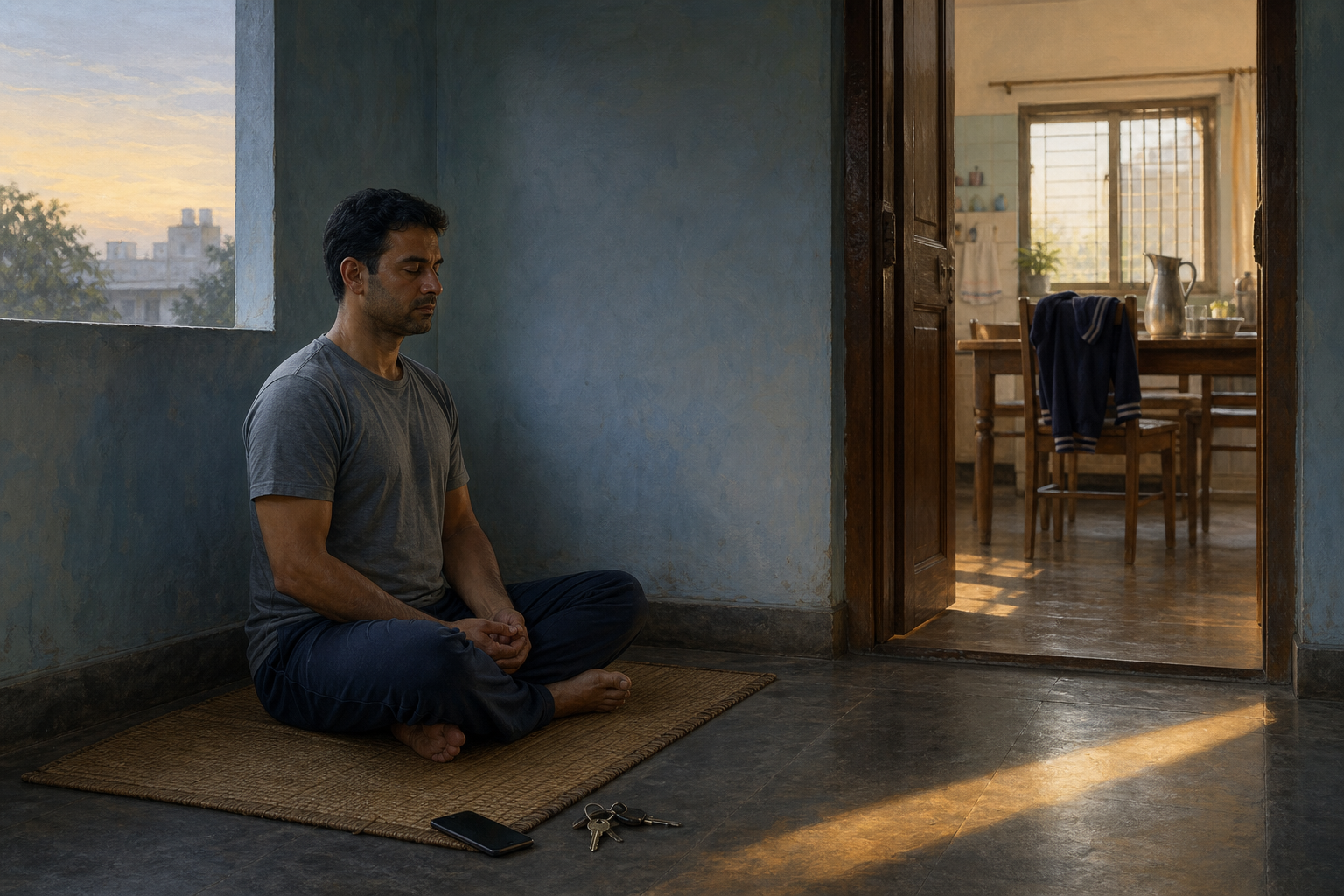
You may be wondering whether your desire to be alone is a spiritual call or simply exhaustion. You do not want to abandon your family, work, or seva. You want enough quiet to see what is driving your restlessness before you make a decision from it.
You do not need to disappear in order to begin renouncing. Sacred solitude gives you a protected space in which to observe attachment; inner renunciation asks you to stop obeying it. The test comes afterward: you should return to your responsibilities with less grasping, clearer speech, and greater willingness to serve.
What inner renunciation actually asks you to give up

Formal sannyasa is a serious vocation with its own disciplines. Inner sannyasa is not an imitation of that vocation, and it does not turn household life into a lesser path. It begins wherever you are able to notice the impulse to possess, control, impress, or secure yourself through changing things.
The Katha Rudra Upanishad places direct knowledge above the outward emblems of renunciation. A staff, water vessel, ochre cloth, or secluded dwelling has meaning when it supports freedom from clinging. None of them can accomplish the inward relinquishment on your behalf.
For a householder, the first distinction is between responsibility and appropriation. Responsibility says, This duty is mine to perform carefully. Appropriation says, The result must confirm my worth, obey my plan, or remain under my control. Renunciation releases the second demand without weakening the first. You can prepare a meal, earn a living, care for a parent, raise a child, or defend a principle without making the outcome the foundation of your identity.
This is why vairagya is not indifference. Indifference refuses to care. Vairagya cares without trying to possess the person, praise, role, or result involved. It allows you to act fully while admitting that circumstances, opinions, relationships, and bodily conditions change.
Ethical restraint keeps this inward work honest. Ahimsa asks whether your detachment is becoming cruelty. Truthfulness exposes spiritual posturing. Aparigraha reveals the fear beneath accumulation. Restraint of the senses shows whether you are choosing your actions or merely following stimulation. Without these foundations, solitude can strengthen ahankara: you become attached to being the quiet, pure, or unusually discerning person.
Use interruption as a diagnostic. If someone needs you during a period of quiet, notice the first movement of the mind. Irritation does not make the practice a failure, but it shows that peace was still dependent on having conditions arranged in your favour. Fulfil the legitimate duty, then return to practice when you can. Renunciation includes relinquishing ownership of the schedule.
Give solitude a boundary, a purpose, and a return
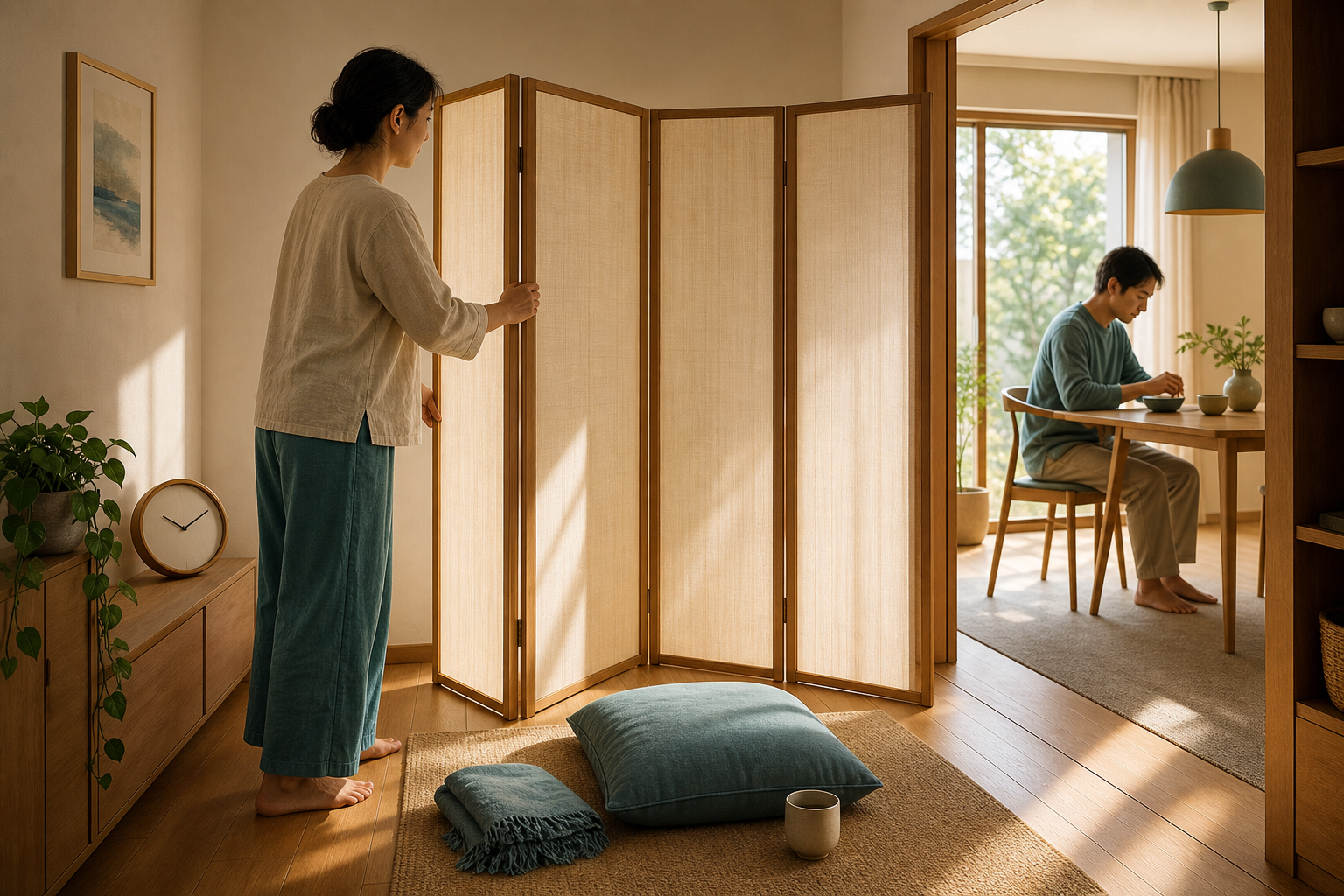
Loneliness and sacred solitude can look similar from outside because both may involve being physically alone. Their inner structures are different. Loneliness is experienced as unwanted disconnection. Sacred solitude is deliberately entered, directed toward a discipline, and followed by conscious re-entry into relationship and duty.
The Bhagavad Gita gives seclusion a legitimate place in yogic life. Gita 6.10 directs the yogin toward meditation in a secluded setting, while Gita 13.10 values vivikta-desa-sevitvam, an inclination toward solitude, alongside disinclination toward crowds. These instructions establish a protected ecology for attention rather than a rejection of society.
Before withdrawing, establish four boundaries:
- Name the purpose. Enter quiet for japa, dhyana, svadhyaya, self-inquiry, or ethical reflection. Do not enter merely to rehearse grievances without interruption.
- Define the practical limit. Choose a period that fits your real obligations. Tell anyone affected when you will be available again.
- Protect the space from consumption. Keep social media, news, shopping, entertainment, and non-essential messages outside it. Consuming silently is not the same as being in silence.
- Choose the act of return. Decide beforehand which duty or act of seva will follow. Re-entry prevents quiet from becoming a private refuge that competes with dharma.
This structure matters especially when you feel disappointed with people. Hurt can put on the language of vairagya and announce that no one is worth engaging. Test that claim carefully. If withdrawal increases contempt, feeds fantasies of superiority, or becomes a way to punish others with your absence, it is not yet sacred solitude. Shorten the retreat, restore necessary communication, and bring the resentment itself into observation.
There is also a health boundary. If being alone reliably intensifies despair, panic, disorientation, or thoughts of self-harm, do not interpret deeper isolation as tapas. End the session, contact someone trustworthy, and seek qualified mental-health or emergency help appropriate to your location. Contemplative practice should not be used as a substitute for needed care.
A repeatable solitude practice for household life
Consistency matters more than creating an impressive retreat. Select a time you can protect without neglecting an essential duty. Use the same clean, uncluttered place when possible. A dedicated room is unnecessary; a stable seat and a small area kept free of ordinary clutter can mark the transition from consumption to attention.
- Cross the threshold deliberately. Silence notifications and place the device beyond easy reach. Acknowledge the duties awaiting you, and give yourself permission not to solve them during this period.
- Remember the ethical ground. Recall ahimsa, truthfulness, and non-grasping. This keeps meditation connected to conduct rather than treating calm as an achievement separate from life.
- Settle the body and breath. Sit in a stable, sustainable posture. Allow breathing to become even. If gentle pranayama is already part of your practice, use it without strain; this is preparation for attention, not a contest in breath control.
- Gather the mind through remembrance. Use japa of Om, a mantra given within your lineage, or Naam in Sikh practice. Return to the sound whenever thought begins constructing arguments, plans, or imagined conversations.
- Let mauna become inward. After verbal repetition subsides, watch the urge to explain, defend, and perform. Outer silence is only the doorway. The subtler practice is declining to continue every mental conversation that asks for your participation.
- Inquire without forcing an answer. Notice the identity being defended: the competent professional, neglected relative, admired devotee, injured friend, or person who must remain in control. Ask whether that role is the whole of you or an appearance known within awareness.
- Record the attachment, not a spiritual score. Write a brief note naming what repeatedly captured attention and how it shaped conduct. End by choosing a concrete correction in speech, consumption, or duty.
- Return through seva. Complete the promised responsibility, offer practical help, or give undistracted attention to someone in your care. Let the first fruit of solitude belong to more than yourself.
Practise within your own Dharmic path
Dharmic traditions share disciplines of restraint, attention, simplicity, and compassion, but they do not become metaphysically identical. You do not need to blur their teachings in order to recognise their kinship.
Within Advaita Vedanta, contemplation may move from name and form toward the non-dual identity of atman and Brahman. Om, neti, neti, atma-vichara, and mahavakyas such as tat tvam asi or aham brahmasmi can support that movement. These are not motivational affirmations. They require ethical preparation, discernment, and nididhyasana so that knowledge affects the way you cling and act.
A Buddhist may use noble silence, samatha, and vipassana to observe agitation and impermanence. A Jain may combine aparigraha with kayotsarga, loosening identification with possessions and bodily demands. A Sikh may centre solitude on simran and remembrance of Naam, then carry remembrance directly into seva. The shared practical question is not whether the vocabulary matches. It is whether quiet reduces compulsive grasping and enlarges truthful, compassionate conduct.
Choose a coherent practice rather than collecting techniques whenever discomfort appears. Abhyasa develops steadiness through repetition; vairagya prevents you from turning a pleasant state into another possession. If you have a guru, acharya, or established discipline, let that relationship guide the finer points rather than assembling an improvised path from attractive fragments.
Judge solitude by the life you lead afterward

A peaceful sitting can be genuine and still remain incomplete. The stronger evidence appears when a familiar trigger returns. Watch what happens when someone criticises you, a plan changes, recognition goes elsewhere, or an inconvenience blocks what you wanted. Those moments reveal whether silence has loosened appropriation or merely paused it.
Carry inner renunciation into the ordinary places where attachment hides:
- Consumption: Before an optional purchase, identify the promise attached to it. Are you meeting a real need, or asking an object to provide identity, status, relief, or control? Renunciation may mean declining the purchase, but its deeper work is seeing the promise clearly.
- Speech: Before replying to provocation, notice whether the response will serve truth or merely recover wounded importance. Silence is useful when it prevents harm; it becomes avoidance when necessary truth is withheld from fear.
- Attention: Treat repeated checking of news, messages, and social feeds as a form of grasping when it is driven by the need to know, react, or be seen immediately. Establish periods in which attention is unavailable to those demands.
- Relationships: Do not rename emotional neglect as detachment. Inner renunciation gives up the demand to own another person; it does not remove the duty to listen, communicate, apologise, protect appropriate boundaries, or offer care.
- Work and service: Perform the task fully, then release the wish to control every judgement of it. Accepting that results are not entirely yours does not excuse careless effort.
At the end of a normal day, ask where you tried to secure the self through possession, praise, certainty, or victory. Then ask what duty remains after that demand is removed. The answer is often plain: make the call, finish the work, apologise without self-defence, stop the unnecessary purchase, or serve without announcing it.
Three distortions deserve particular attention. If solitude makes you brittle, you may be attached to ideal conditions. If it makes you superior, you may be attached to a spiritual identity. If it makes you passive, you may be confusing freedom from results with freedom from effort. In each case, the remedy is not more self-condemnation. Return to ethics, simplify the practice, and test it through a neglected duty.
The desired movement is from reactivity to discernment, not from relationship to numbness. Sacred solitude should make compassionate presence more possible. Inner sannyasa should leave your hands available for work because they are less occupied with grasping.
Key takeaways
- Sacred solitude is chosen, purposeful, bounded, and followed by a conscious return to relationship and duty.
- Inner renunciation relinquishes clinging to possessions, roles, praise, control, and outcomes; it does not relinquish dharma.
- Ahimsa, truthfulness, aparigraha, and sense restraint keep detachment from becoming cruelty, avoidance, or spiritual pride.
- A stable practice can move through preparation, breath, japa or remembrance, inward silence, self-inquiry, reflection, and seva.
- Follow the contemplative language of your own tradition without erasing real differences among Hindu, Buddhist, Jain, and Sikh teachings.
- Evaluate solitude by its effects after re-entry: clearer speech, simpler consumption, steadier attention, responsible action, and more compassionate presence.
- When isolation worsens serious psychological distress, seek human and professional support rather than treating further withdrawal as spiritual discipline.
At your next available quiet period, leave the stream of consumption outside, sit with one form of remembrance, and notice the identity that most urgently asks to be defended. Then return and complete one duty without demanding recognition. That small passage from silence to service is where inner renunciation becomes lived dharma.
References
- DharmaRenaissance Blog – Katha Rudra Upanishad: A Timeless, Transformative Guide to Sannyasa and Brahma-Jnana
- DharmaRenaissance Blog – Sacred Solitude in Kali Yuga: Hindu Wisdom to Turn Loneliness into Inner Strength
