
Artificial intelligence can retrieve facts and produce polished answers with remarkable speed. Education still has a larger responsibility: forming people who can question those answers, judge their consequences, and act with character.
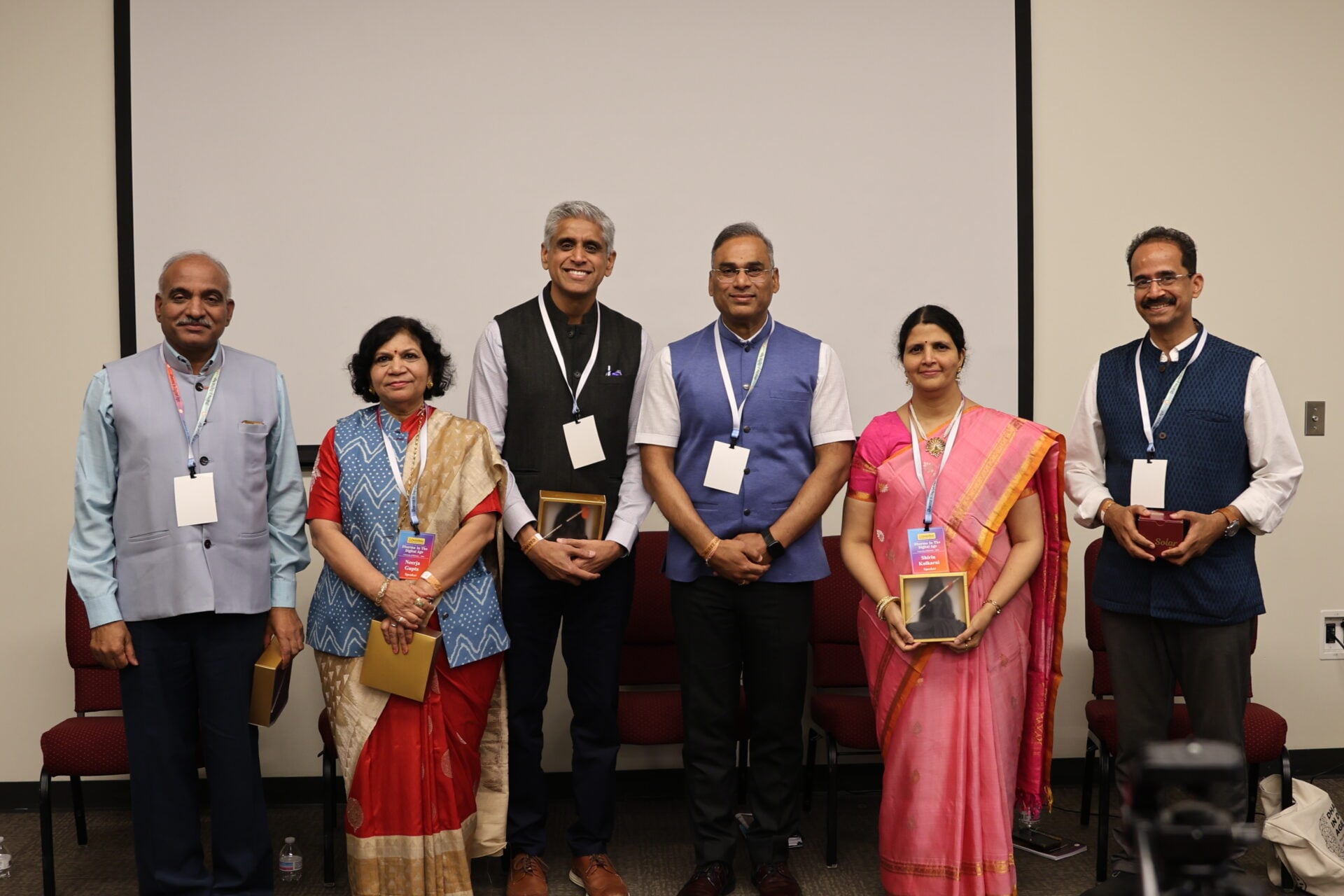
A DDA ’26 panel recounted by Dharma Civilization Foundation explored that responsibility through classroom practice, cultural experience, and Bharatiya ideas about learning. Its most useful lesson is not that schools should reject AI, but that they must become clearer about what technology cannot accomplish for a student.
The gap between information and wisdom
The panel organized learning as a movement from data to information, then to understanding and wisdom. AI can accelerate the early stages, but it cannot automatically supply sound judgment, moral purpose, or the character required to use knowledge responsibly.
Moderator Ashish Pandey connected discernment with decision-making. If a machine performs much of the analysis, the human task becomes more demanding rather than less: someone must examine assumptions, weigh competing values, and accept responsibility for the final choice. Education measured only by recall or answer production therefore assesses precisely what machines increasingly do well, while neglecting the capacities people most need to develop.
Assessment should preserve the struggle to think
The Foundation’s account reports that audience concerns included complacency, reduced thinking ability, hallucinated information, and loss of individuality. These risks share a common cause: students can obtain a finished product without undergoing the intellectual struggle that would make the learning their own.
Panelist Vishal Ahuja illustrated the point through debugging. Finding an error after sustained effort can teach attention, persistence, and technical judgment; outsourcing the entire process may also outsource the lesson. Bhimraya Metri made a related case with examples of correlations that looked persuasive but did not establish meaningful causation. Data could display the pattern, but a person still had to decide whether it made sense.
Metri’s proposal was concise: “Assess for the prompt, not for the answer.” In practice, that means asking students to frame worthwhile questions, identify sources, explain their reasoning, test claims against other evidence, and defend a decision. AI can remain part of the work without becoming a substitute for thought.

Teachers, peers, and experience remain irreplaceable
Several examples shifted attention from content delivery to human relationships. Shirin Kulkarni described Finland’s emphasis on “thinking and learning to learn,” along with self-assessment, peer assessment, teacher autonomy, patience, and practical work with real tools. These methods make understanding visible because students must demonstrate, discuss, revise, and create rather than merely submit an answer.
Neerja Gupta approached the same issue through cultural experience. As reported in the recap, she contrasted generic AI responses with an account of Gandhi learning satya and ahimsa through Kasturba, then performed a scene from Abhigyanashakuntalam to show how rasa must be encountered, not simply defined. Her larger claim was that the guru and fellow learners create dimensions of education that retrieval systems cannot reproduce.
This does not make technology an enemy. It establishes its proper role. A tool may widen access to information, while teachers and learning communities cultivate context, courage, empathy, accountability, and the confidence to apply knowledge.
Key takeaways for a Dharmic education
Across Hindu, Buddhist, Jain, and Sikh traditions, knowledge is joined to disciplined conduct, self-examination, responsibility toward others, and guidance within a community. Their philosophical differences should not be flattened, yet this shared orientation offers a strong civilizational response to education reduced to data processing.
- Use AI for assistance and exploration, while requiring students to verify its claims and disclose their reasoning.
- Assess questions, judgment, courage, patience, and application alongside factual accuracy.
- Protect hands-on work, storytelling, dialogue, and productive difficulty as essential forms of learning.
- Restore dignity and autonomy to teachers so that the guru-shishya relationship can adapt without disappearing.
- Connect livelihood and competence with seva, collective well-being, and ethical responsibility.
A constructive Hindutva, understood as Hindu civilizational renewal, can advance this approach by restoring confidence in Bharatiya categories of knowledge while learning from useful methods elsewhere. The next educational frontier is therefore not faster answer production. It is the deliberate formation of human beings capable of wisdom.
Inspired by this post on Dharma Civilization Foundation.

Leave a Reply
You must be logged in to post a comment.