
You are trying to put one festival on one civil date, but the labels seem to belong to different worlds. A Tamil calendar says Panguni, a family message says Vaishakha Bahula Dashami, and an app shows the relevant tithi crossing midnight. Before you decide that one of them must be wrong, identify what each label is measuring.
South Indian festival calendrics becomes manageable once you separate the solar month, lunar month, paksha, tithi, nakshatra, local time and inherited observance rule. You can then ask a precise question: not merely “What date is the festival?” but “Which calendrical condition does our tradition observe, and when does it occur in our city?”
Key takeaways
- A Tamil solar month and a lunar festival marker are different layers. Panguni can provide the seasonal and temple setting while Pournami, Uthiram or another lunar condition determines the observance.
- A tithi is not a midnight-to-midnight date. It begins and ends according to the changing angular relationship of the Moon and Sun, so it can span parts of two civil dates.
- Location matters. Sunrise, tithi and nakshatra timings must be computed for the city where you will worship, especially if you live outside India.
- Parampara comes before internet consensus. Hanuman Jayanti alone has distinct Chaitra Purnima, Margazhi-Moolam and Vaishakha Bahula Dashami traditions.
- Nalla Neram helps you choose a suitable time within an accepted day; it does not ordinarily determine which festival day your tradition follows.
Identify which calendar layer is naming the date
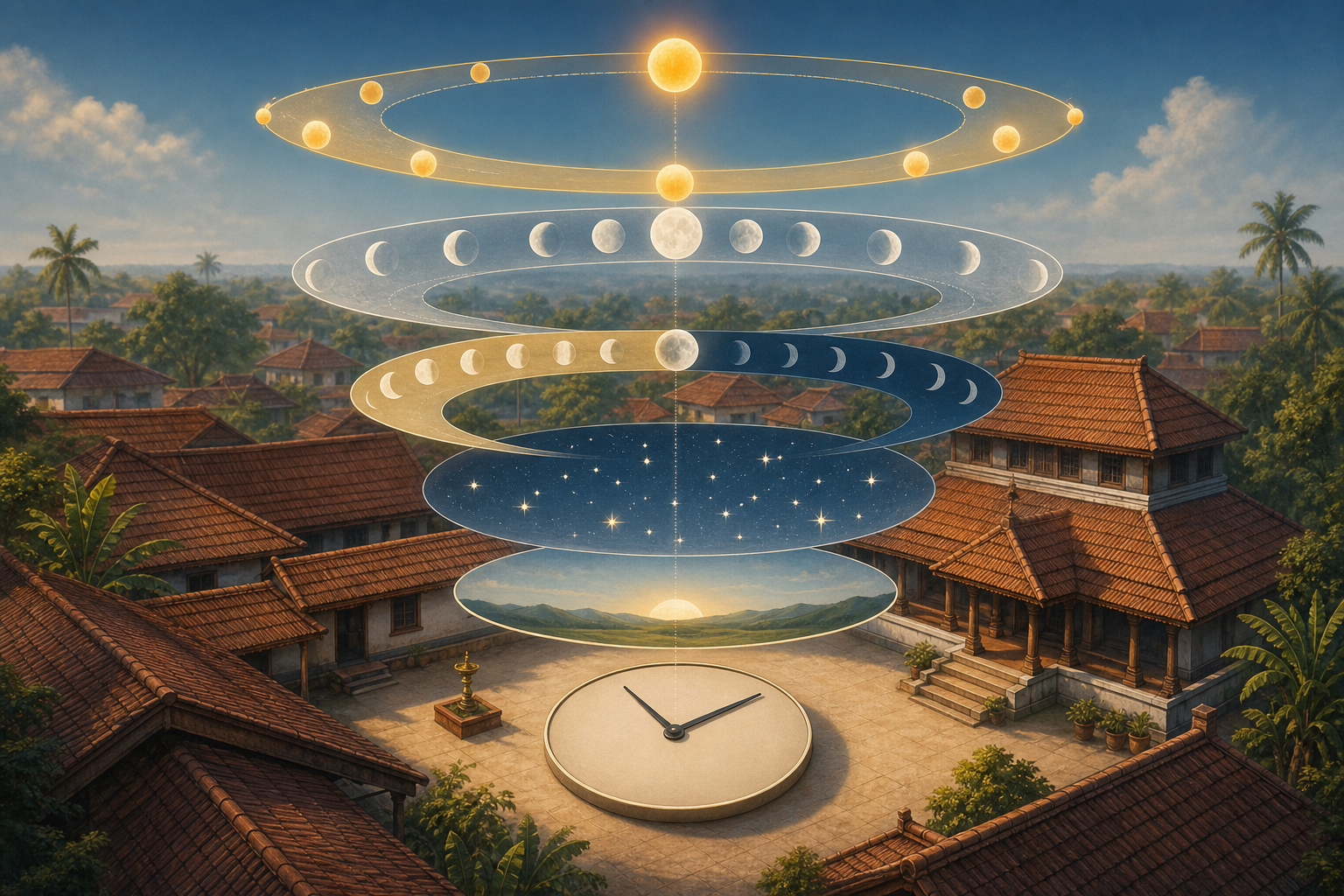
A festival entry often combines several clocks. Trouble begins when we treat every word in that entry as another name for the same Gregorian date. Instead, read the terms as a set of instructions.
| Calendar layer | What changes it | South Indian example | Question it answers |
|---|---|---|---|
| Solar month | The Sun’s entry into a sidereal rashi | Panguni, beginning with Meena Sankranti | Which Tamil month and seasonal temple cycle are active? |
| Lunar month | The lunation under a regional month convention | Vaishakha in an Amanta calendar | Which lunar month contains the vrata? |
| Paksha | The waxing or waning half of the lunar cycle | Bahula or Krishna Paksha | Which half of the lunar month is intended? |
| Tithi | The changing angular separation of the Moon and Sun | Dashami | Which lunar day governs the observance? |
| Nakshatra | The Moon’s position among the lunar mansions | Uthiram | Which stellar alignment is required? |
| Daily muhurta | Locally calculated time divisions and exclusions | Nalla Neram | At what time should an activity begin after the day is chosen? |
| Parampara and deshachara | Lineage, region and temple usage | Vaishakha Hanuman Jayanti or Margazhi Hanumath Jayanthi | Which legitimate observance rule does this family follow? |
Panguni illustrates the solar layer clearly. It is the twelfth Tamil month, commencing when the Sun enters sidereal Meena. In 2026, Panguni runs from March 15 through April 13. Those dates describe the month as assigned in the relevant Tamil reckoning; they do not mean that every Panguni festival is fixed solely by the Sun.
Panguni Uthiram adds lunar selectors inside that solar container. The observance belongs to Panguni, but its defining alignment involves the full moon and Uthiram, also called Uttara Phalguni, nakshatra. If Pournami and Uthiram touch different parts of adjacent civil dates in your city, the month name alone cannot settle the choice. You need the locally applied festival rule.
Vaishakha Bahula Dashami is constructed differently. Vaishakha supplies the lunar month, Bahula identifies the waning fortnight, and Dashami identifies the tithi. In an Amanta system, the lunar month concludes at Amavasya. None of those units is required to begin at civil midnight.
Follow the spring sequence without forcing one calendar
For household planning, think of South Indian spring as overlapping cycles rather than a single row of uniform month boxes. The Tamil solar year is closing during Panguni, while lunar months and fortnightly observances continue according to their own rhythm.
Panguni’s place at the end of the Tamil year gives its festivals a character of completion. Panguni Uthiram brings together temple processions, divine kalyana traditions, vows and family prayers for harmony. The Kapaleeswarar Temple’s Panguni Peruvizha, for example, unfolds across several days and includes the Arubathimoovar procession; Srirangam and Murugan temples maintain their own festival sequences. This distinction matters when you make plans: a multi-day temple utsavam is not necessarily identical to the single calendrical day governing a household vrata.
After Panguni ends, Mesha Sankranti and Chithirai open the next Tamil solar cycle, with Puthandu marking renewal. Do not rename a lunar observance merely because it falls during a particular Tamil solar month. Record both layers when both are relevant.
Later in the spring, many Andhra and Karnataka communities, along with some communities in Tamil Nadu and Kerala, observe Hanuman Jayanti on Vaishakha Bahula Dashami. For this tradition, the India-based 2026 observance falls on May 12. The operative Dashami period, rather than the printed civil date by itself, governs the vrata.
That May date should not be presented as the only Hanuman Jayanti. Many North and West Indian communities use Chaitra Purnima, while several Tamil traditions celebrate Hanumath Jayanthi in Margazhi when Moolam nakshatra aligns with the lunar month’s end. A disagreement separated by several weeks or months is therefore more likely to reflect different paramparas than a faulty calculation.
Your spring calendar should consequently preserve the complete name of an observance. Write “Hanuman Jayanti – Vaishakha Bahula Dashami tradition,” not merely “Hanuman Jayanti.” The extra words prevent a regional tradition from being mistaken for a universal correction of every other tradition.
Resolve calendar disagreements in the right order

The size of a disagreement gives you an initial clue. A gap of weeks or months usually points to a different observance tradition. A shift between adjacent civil dates usually points to location, a tithi or nakshatra boundary, or a calendar’s selection rule. Different hours on the same date usually indicate a muhurta question. Treat this as a diagnostic aid, not as a substitute for checking the actual panchang.
- Name the observance variant before comparing dates. “Hanuman Jayanti” is incomplete when several regional traditions are in use. Add Chaitra Purnima, Margazhi-Moolam or Vaishakha Bahula Dashami as applicable.
- Set the place of worship. Use the city where the puja will occur, not the city where a relative created the invitation and not automatically Chennai, Bengaluru or Hyderabad. A panchang calculated for India can place a boundary on the wrong local civil date for a family in another time zone.
- Compare the underlying interval, not just the large date printed by an app. Note when the relevant tithi and nakshatra begin and end locally. A tithi can start in the afternoon and finish the next morning, which is why two civil dates may appear around the same observance.
- Check the computational framework when the result remains close. Panchangams may use Drik or Surya Siddhanta calculations. Tamil solar calendars use nirayana reckoning, and many contemporary Tamil computations use Lahiri ayanamsha. Differences become most visible near a sunrise or other boundary.
- Apply the festival-specific rule preserved by your temple or family. Some observances require a tithi during a designated part of the day; others depend on a tithi-nakshatra alignment. Do not borrow the selection rule of one festival merely because it produces a convenient date for another.
For the Vaishakha Hanuman Jayanti tradition, households commonly look for Dashami to be operative during the relevant daytime. The main puja is often performed in daylight, with madhyahna or pratah-kala followed according to local usage. If Dashami touches two civil dates, the family panchang or temple’s established rule determines which day receives the observance.
Nalla Neram enters only after this decision. Tamil calendars derive these daily auspicious windows from Gowri Panchangam divisions such as Amrit, Siddha and Shubha, while avoiding spans such as Rahu Kalam, Yamagandam and Gulika Kalam. A favorable Nalla Neram on the wrong festival day does not override the required tithi or nakshatra. First establish the observance day; then use a city-specific Nalla Neram if your family practice calls for one.
Build a calendar entry someone else can verify
A bare civil date is easy to forward and hard to audit. For each important observance, keep the following fields in your family calendar:
- Full observance name and variant.
- Solar or lunar month, if the tradition names one.
- Paksha, tithi and nakshatra conditions that actually govern the day.
- City and time zone used for the calculation.
- Local start and end of the governing tithi or nakshatra.
- The selection rule, such as daylight prevalence or a required full-moon and nakshatra alignment.
- The family panchang or temple schedule being followed.
- The separate puja, vrata, procession or Nalla Neram time, if applicable.
For Panguni Uthiram, a useful entry would identify the Tamil solar month, the Pournami-Uthiram requirement, your city and the temple whose rule you are following. If the temple runs a several-day utsavam, list that program separately from the core observance. This prevents a procession date from being mistaken for the only day on which a household vrata may be kept.
For the Vaishakha form of Hanuman Jayanti, write Vaishakha, Krishna or Bahula Paksha, Dashami and the local Dashami interval. Families following the India-based 2026 schedule can begin with May 12 as the planning anchor, but devotees abroad should confirm whether Dashami remains operative on that civil date in their own city before announcing a puja time.
Once the date is settled, ritual planning becomes straightforward. A household may schedule daylight puja, stotra recitation, Sundara Kanda parayanam, naivedya and seva according to capacity and parampara. A temple may separately announce abhishekam, alankara, vada-mala or collective chanting. Calendrical precision should support devotion and coordination, not reduce the observance to an argument over apps.
Before you send the family message, put the full calendrical marker and worship city on its first line. That one habit turns an ambiguous date into a checkable decision, respects regional continuity and gives relatives in other time zones enough information to calculate their own observance correctly.
References
- DharmaRenaissance Blog – Hanuman Jayanti 2026 (Vaishakha): Auspicious Date, Puja Guide, and South Indian Traditions
- DharmaRenaissance Blog – Panguni Masam 2026 Guide: Auspicious Dates, Panguni Uthiram, Nalla Neram, Temple Rites
