

You may be deciding whether to join a puja, approve a campaign using Hindu imagery, stage a work set in India, or challenge a depiction that feels wrong. The useful question is not simply whether a non-Hindu person is involved. It is whether the encounter preserves context, consent, meaning, and Hindu agency.
Cultural respect does not require sealing Hindu traditions away from the world. It requires treating them as living traditions rather than a supply of costumes, sounds, symbols, and dramatic scenery. That distinction gives you a practical way to welcome sincere participation while opposing caricature and exploitation.
Use this five-question test before you participate or publish
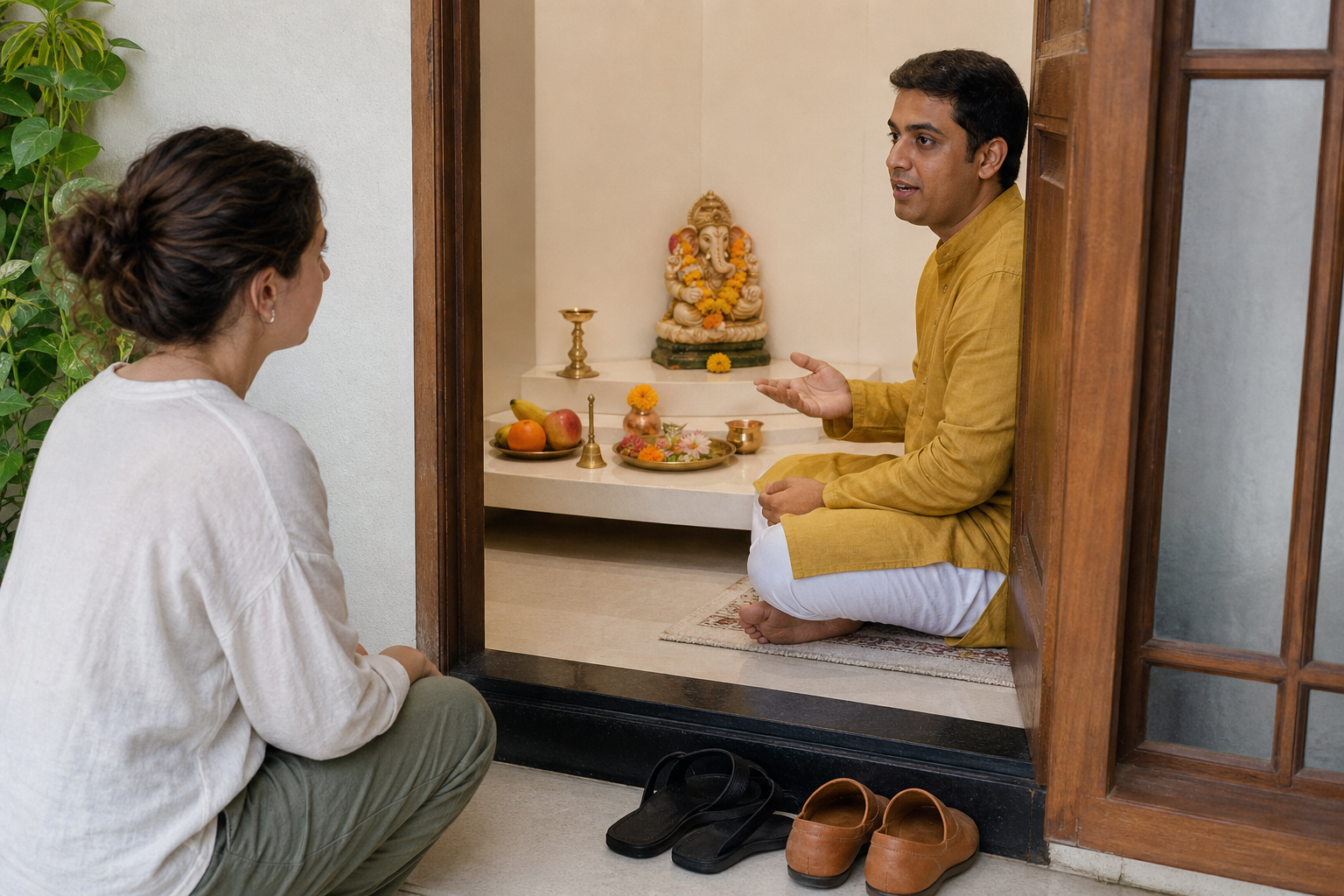
Intent matters, but good intentions cannot answer every representational question. Run the proposed participation, performance, image, scene, or campaign through five tests:
- Context: Is the element being shown in the setting that gives it meaning? A lamp offered before a deity during worship is not interchangeable with a flame used as exotic decoration.
- Consent: Did the relevant host, priest, practitioner, artist, or community partner invite or approve this particular use? Permission to attend a ceremony does not automatically authorize filming, advertising, merchandising, or future reuse.
- Care: Has the participant learned what to wear, where to stand, what may be touched, and how the ritual action is performed? Humility is visible in preparation, not merely claimed afterward.
- Accuracy: Does the depiction identify the actual practice, deity, community, language, and setting, or does it collapse everything into a generic mystical India?
- Agency: Can people from the represented tradition change consequential decisions, or are they present only to endorse choices already made?
A respectful encounter usually has clear answers to all five. An invited guest follows the host’s guidance, the sacred action keeps its meaning, and practitioners retain authority over what happens. Rihanna’s participation in Aarti at the Ambani residence illustrates that pattern: the significant fact was not celebrity involvement but participation within a family religious setting under local guidance.
Warning signs appear when a mantra becomes an atmospheric sound effect, a deity becomes a fashion prop, a temple becomes shorthand for danger or sensuality, or a consultant is approached only after the script, casting, costumes, and publicity have been fixed. The identity of the outsider is not the decisive issue. The relationship to the tradition is.
Consent must also remain specific. One Hindu host can invite you into one puja. That invitation does not make the host the owner of every Hindu symbol, nor does it grant you a permanent cultural licence. Ask again when the purpose, audience, medium, or commercial use changes.
Learn enough ritual context to notice what must not be flattened
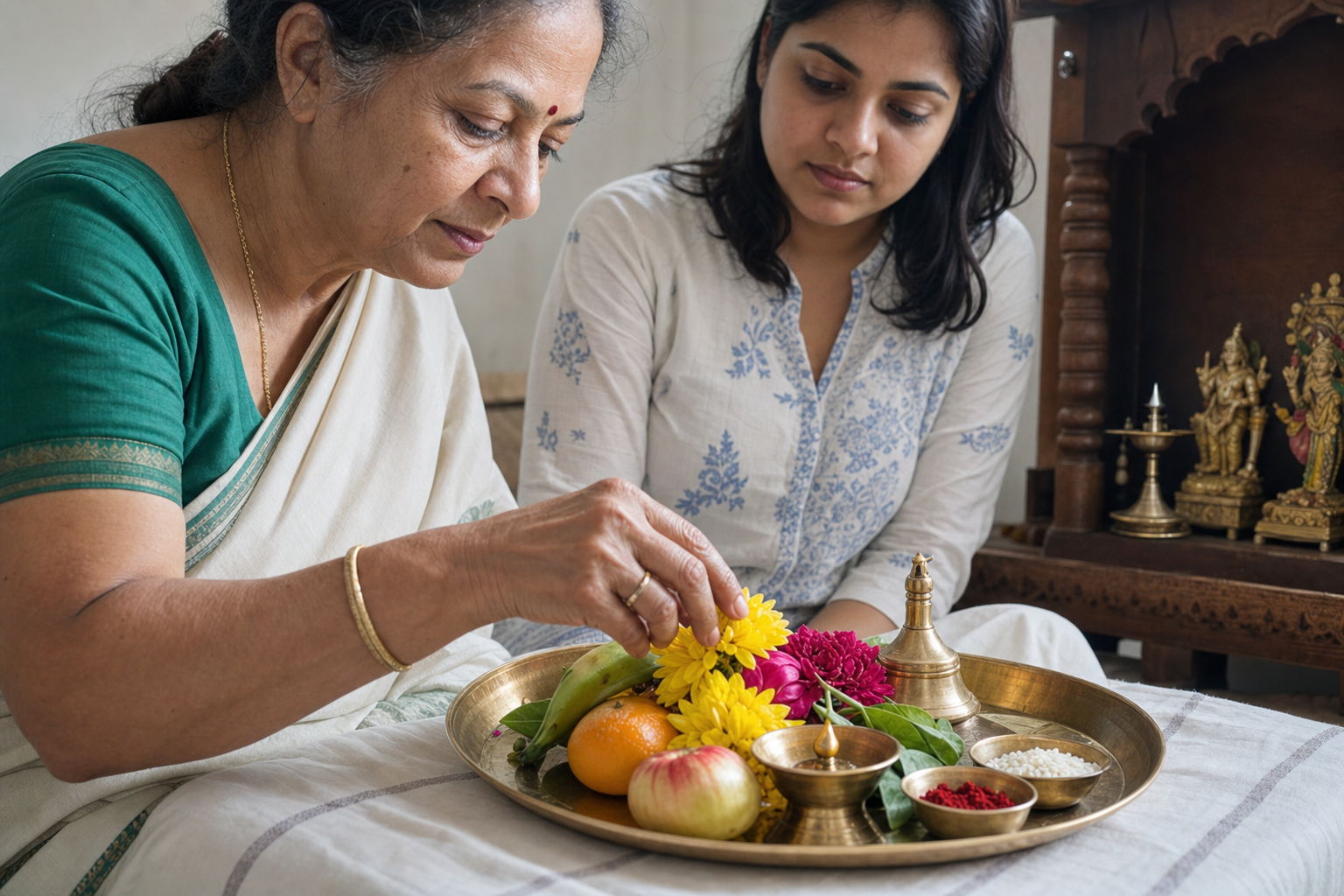
Aarti is a good example of why surface accuracy is not enough. Puja is an act of offering and adoration. It may follow a shorter five-offering form or a more extended sixteen-part form, but its underlying grammar resembles sacred hospitality: the Divine presence is invoked and honoured through such offerings as water, fragrance, flowers, light, and food. Aarti belongs within that devotional sequence; it is not an isolated fire performance.
During Aarti, a ghee lamp or camphor flame is moved before a deity or sacred symbol while hymns may be sung and a bell sounded. The flame signifies illuminating knowledge and the removal of ignorance. Afterward, devotees may pass their hands over the flame and touch their heads, receiving its blessing, before accepting prasada. If a camera records only the circling fire and omits the offering, prayer, and reception of blessing, it turns a reciprocal act of worship into spectacle.
If you are invited to participate in a home or temple ceremony, these actions will keep uncertainty from becoming disrespect:
- Remove your shoes before entering the prayer space, wear modest clothing, wash your hands, and silence your phone.
- Ask the host or priest before touching the lamp, tray, murti, offerings, or other sacred objects.
- Stand where you are directed. Joining your palms during prayer is generally safer than copying unfamiliar gestures.
- If invited to hold the Aarti tray, keep the flame steady, move clockwise, and leave safe space between it and hair or clothing.
- Do not guess the number or size of the circles. Counts and movement patterns vary across regions, families, and sampradayas, so follow the person leading the worship.
- Do not photograph or record people during prayer without explicit permission, even when photography elsewhere at the event is welcome.
- Accept prasada respectfully in the right hand or cupped hands. If you have a dietary or other practical concern, tell the host quietly rather than treating the offering casually.
If you are depicting the ritual rather than joining it, identify the specific tradition before designing the scene. Ask which deity is being worshipped, which language is used, what belongs on the tray, who may handle it, when Aarti occurs, and what happens after the flame is offered. Record the correct names and meanings in the production notes so that later editing does not detach a gesture from its purpose.
Dharmic kinship should not become another form of flattening. Buddhist communities offer lamps and candles as acts of reverence. Jain communities may perform Aarti before the Jinas, with an emphasis on purity and liberation. Guru Nanak’s poetic Aarti imagines the cosmos itself worshipping the Divine, while gurdwara maryada centres Shabad and Ardas rather than ritual lamp Aarti. Shared reverence does not make these practices interchangeable. When you invoke dharmic unity, name both the kinship and the difference.
Build respect, accuracy, and agency into the production
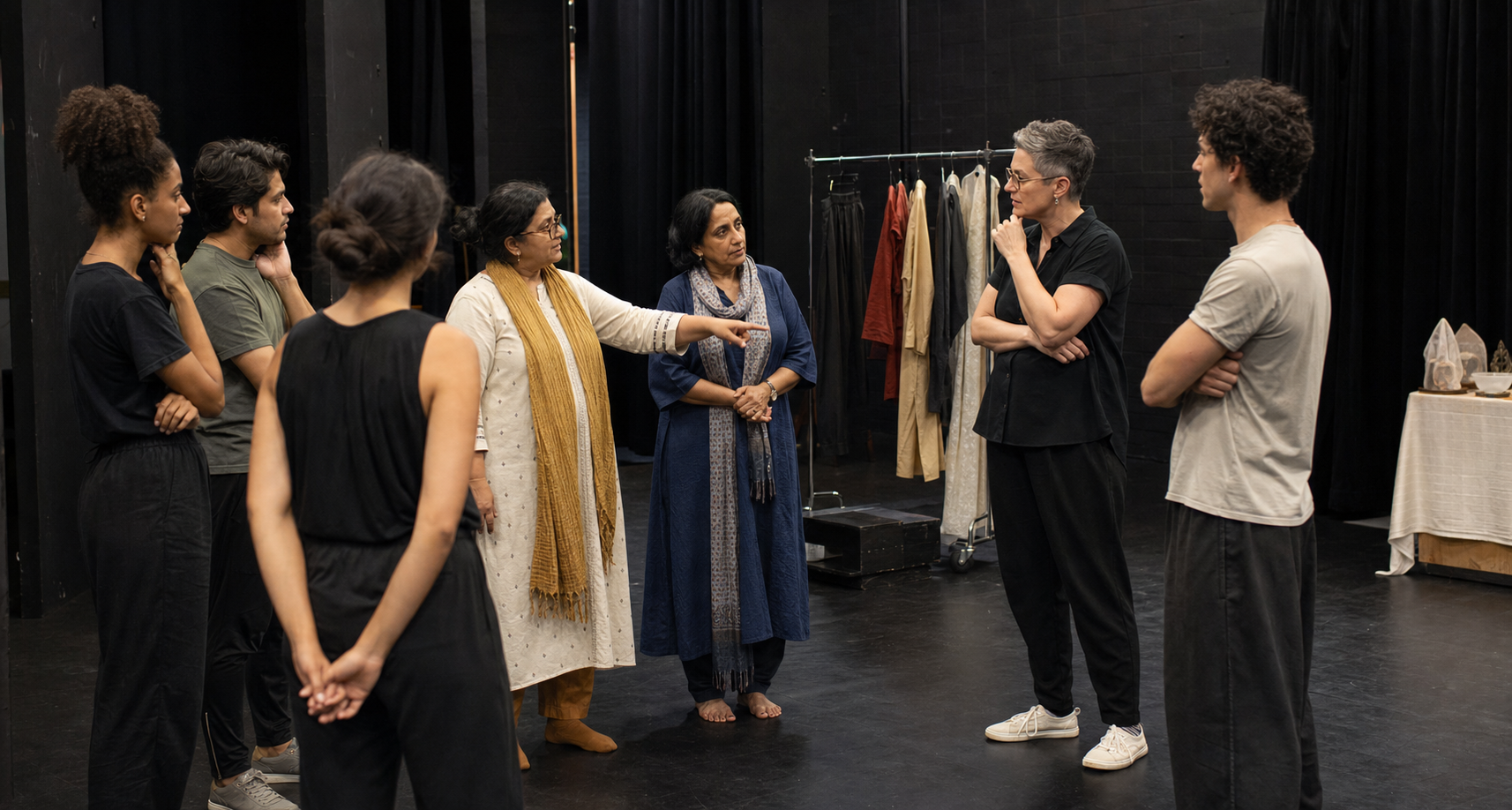
A late sensitivity check cannot reliably repair a concept built on exoticism. If you work in theatre, film, publishing, education, museums, advertising, or events, representation must be addressed while the work can still change. A practical workflow looks like this:
- Map the cultural material. List every deity, mantra, ritual, costume, sacred space, historical claim, accent, gesture, and visual motif in the proposal. Vague labels such as Indian ceremony or Eastern spirituality conceal the questions that need answers.
- Bring in the right collaborators before locking the concept. A Sanskrit scholar cannot automatically speak for every regional ritual, and a performer of Indian ancestry cannot automatically validate every Hindu representation. Match the person’s knowledge to the material being depicted.
- Define decision rights. State what collaborators may revise or reject. Consultation without the power to alter casting, language, choreography, design, or publicity is feedback, not agency.
- Review the whole chain. Accuracy in the script can be undone by brownface, comic accents, invented mudras, generic temple sets, promotional copy, or an edit that isolates sacred action for shock or sensuality. Apply a clear no-brownface, no-caricature rule across departments.
- Rehearse meaning as well as movement. Performers should know what an action signifies, whom it addresses, and what precedes and follows it. Mechanical imitation often becomes exaggerated because the performer has learned a shape without its intention.
- Test the audience lesson. Ask what a viewer unfamiliar with Hinduism will believe after seeing the work. If the likely lesson is that Hindu worship is primitive, magical, menacing, irrational, or merely picturesque, the representation needs structural revision.
- Keep a correction path open. Review a rehearsal, cut, proof, or installation with collaborators before release. After release, give community feedback a named recipient and a process that can produce changes.
Program notes and audience discussions can supply history and acknowledge a production’s choices. They cannot excuse a demeaning scene that remains unchanged. Context belongs around responsible representation, not in place of it.
This approach also avoids tokenism. One person should not be asked to certify what all Hindus think. Hindu traditions include distinct sampradayas, regional customs, philosophical schools, languages, and family practices. When a decision affects several of them, seek more than one relevant perspective and describe disagreement honestly.
Judge inherited works by what a present production will do
Older works can contain artistic achievement and a colonial gaze at the same time. Delibes’s 1883 opera Lakme, for example, contains admired music such as the Flower Duet and Bell Song, yet its romance between a Hindu priest’s daughter and a British officer places Indian religion inside a nineteenth-century European fantasy of colonial India. A beautiful score does not neutralize the representational work performed by plot, casting, gesture, costume, and design.
The Minack Theatre’s withdrawal of a planned Lakme staging after Hindu concerns shows why institutions need a decision process before rehearsal and publicity make every option costly. Withdrawal is one possible answer, but it is not a universal rule for every inherited work. The responsible choice depends on whether the harmful frame can actually be changed.
- Retire the production when the central dramatic mechanism depends on caricature, sacred traditions cannot be separated from exotic spectacle, or the institution lacks the relationships and resources required for responsible reconstruction.
- Reframe the work when the music or other artistic material can survive a changed setting and dramaturgy, and when South Asian collaborators have real authority over the new interpretation. Reframing must reach casting, movement, design, translation, publicity, and audience context; changing costumes alone is cosmetic.
- Commission new work when the institution wants to present Hindu or Indian experience but the inherited vehicle leaves those communities without an interior voice. South Asian composers, librettists, directors, choreographers, designers, and performers can expand the canon rather than spending every season repairing someone else’s colonial imagination.
Do not begin with the question, Can we defend performing this? Begin with, What will this production teach, who gets to interpret the culture, and which changes are we genuinely willing to make? That shift moves the decision from institutional self-protection to artistic responsibility.
Raise Hindu concerns in a form that can produce a remedy

If you encounter a harmful representation, precision gives your objection more force. A general claim that something is offensive may be sincere, but it lets the decision-maker argue about feelings instead of confronting the actual choice. Name the exact scene, symbol, line, costume, casting practice, or ritual action.
- Describe what is present. Identify the timestamp, scene, image, programme description, or marketing asset.
- Name the category of concern. Distinguish factual inaccuracy, sacred misuse, racial caricature, colonial framing, exclusion from authorship, and commercial exploitation. They may overlap, but they do not require identical remedies.
- Explain the false lesson. State what an uninformed audience is likely to conclude about Hindus or Hindu practice.
- Request a proportionate change. Ask for corrected terminology, removal of an image, revised blocking, new casting, a rewritten scene, meaningful collaboration, delayed release, or withdrawal. Do not leave the institution to guess what repair would look like.
- Name the stage at which review is needed. A request made before casting differs from one made after opening night. Ask for consultation early enough to affect the next consequential decision.
- Leave room for internal diversity. Say which tradition, community, or representational principle your concern addresses. Avoid claiming that every Hindu must respond identically.
A concise message can follow this form: In this scene, a specific Hindu practice is used as a sign of danger or exoticism. Within its living ritual setting, the practice has a different purpose. The current staging may teach viewers that Hindu worship is irrational or threatening. We ask you to revise the scene with qualified Hindu collaborators before the production proceeds.
Credible advocacy also recognizes genuine appreciation. Do not condemn an invited guest merely for being an outsider, and do not mistake every imperfect gesture for deliberate hostility. Ask the same five questions consistently. Contextual participation guided by practitioners deserves a different response from brownface, mockery, unauthorized commercial use, or sacred symbols emptied into scenery.
The next time you are asked to participate, approve, perform, or protest, run the five-question test before giving your answer. Then identify the one concrete change that would most improve context, consent, care, accuracy, or agency. That is how cultural respect becomes a working standard rather than a slogan.
References
- DharmaRenaissance Blog — Rihanna Performs Aarti in Mumbai: Ritual Meaning, Cultural Respect, and Dharmic Unity
- DharmaRenaissance Blog — After Hindu concerns, Cornwall’s Minack Theatre drops Lakme, resetting cultural sensitivity in opera