

Your app says one date, your temple notice says another, and relatives in Bharat have sent you a third answer. In May 2026, that mismatch does not automatically mean somebody has the wrong calendar. A tithi can change near sunrise, sunset, pradosha, or moonrise, while different observances use different moments to determine the day.
You can resolve most of these conflicts with a simple order of work: fix the place, identify the observance rule, check the relevant tithi span, and only then attach a Gregorian date. That method gives you a calendar you can use for fasting, puja, parana, temple visits, and family planning without blindly copying India Standard Time.
Let the ritual rule choose the date
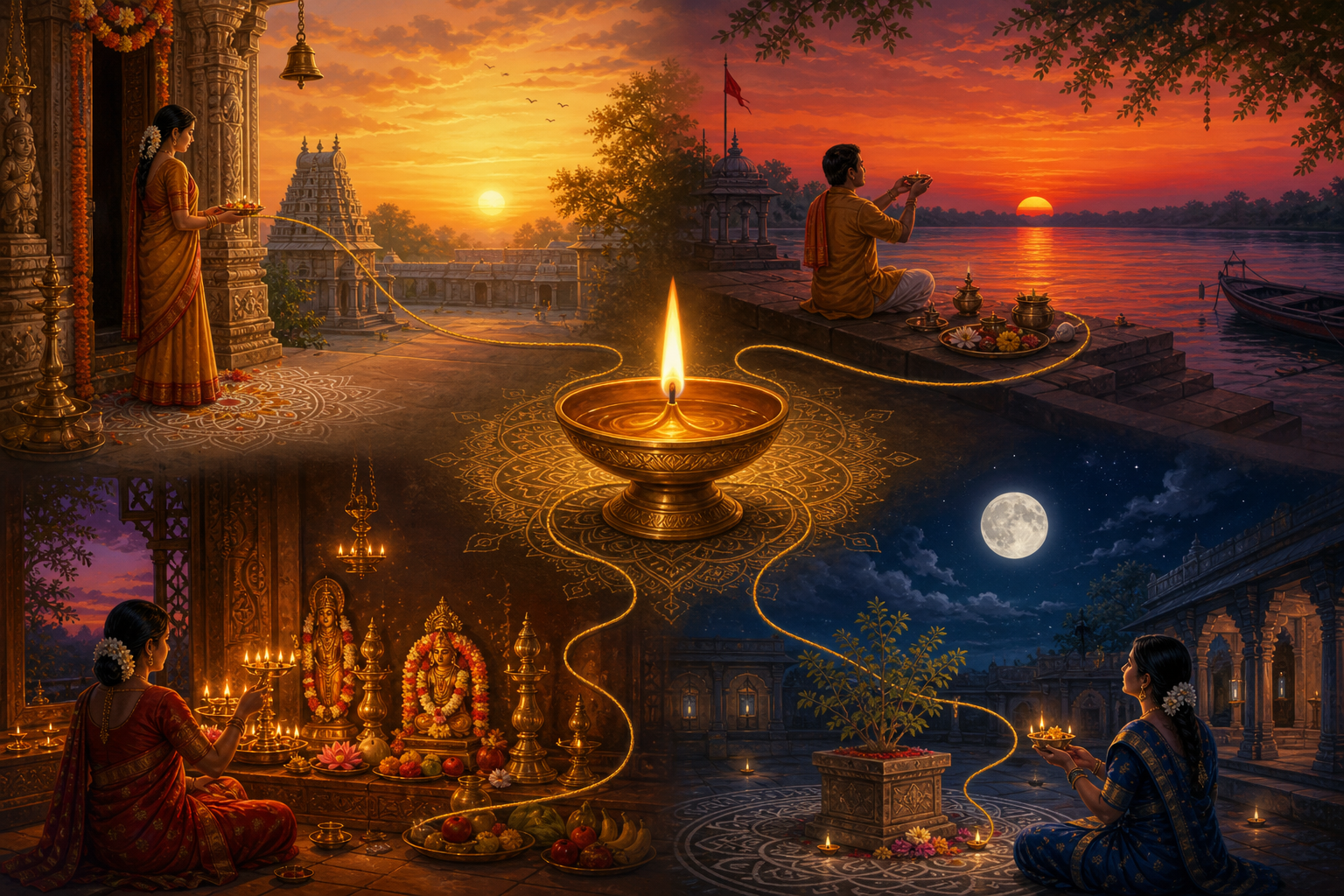
A tithi is determined by the changing angular separation of the Sun and Moon. It does not begin at midnight and does not have a fixed civil-day length. It may start after one sunrise and end before the next, which is why the same Gregorian date cannot govern every kind of vrata.
The decisive question is not merely, “Which tithi occurs on this date?” Ask, “Which tithi prevails during the part of the day required for this observance?” Sunrise commonly governs daytime observances, while sunset, pradosha, moonrise, midnight, or another stipulated span can govern others.
| Observance type | Decisive timing | What to record |
|---|---|---|
| Many daytime vratas and pujas | The tithi prevailing at local sunrise, subject to sampradaya rules | Local sunrise and the tithi’s start and end |
| Narasimha Jayanti | Vaishakha Shukla Chaturdashi during the prescribed pradosha or night span | Sunset, pradosha window, and Chaturdashi end |
| Pradosh Vrat | Trayodashi during the evening worship period | Local sunset and Trayodashi span |
| Sankashti Ganesh Chaturthi | Chaturthi at local moonrise | Moonrise and the Chaturthi end time |
| Ekadashi | The applicable sunrise rule, followed by the prescribed parana period | Fast date, Hari Vasara threshold, and next-day parana window |
| Masik Shivaratri | Krishna Chaturdashi during the relevant night observance | Chaturdashi span and night puja periods |
| Amavasya rites | The local Amavasya span and the rule used for the particular rite | Amavasya start and end, sunrise, and any family or regional convention |
This distinction matters most when a tithi changes close to the decisive moment. If Chaturthi ends after sunrise but before moonrise, a sunrise-based calendar label and a moonrise-based Sankashti decision can point in different directions without contradicting each other.
Differences can also arise from Drik and Vakya computational traditions, the chosen ayanamsha, and regional assignment rules. Do not average two conflicting timings. Confirm that both almanacs are set to the same city, time zone, and calendar tradition; then follow the convention of your family, temple, or sampradaya. For a wedding, griha pravesh, samskara, or major temple event, cross-check at least two reputable almanacs and confirm the final selection with the priest conducting the rite.
Build your May calendar from lunar anchors
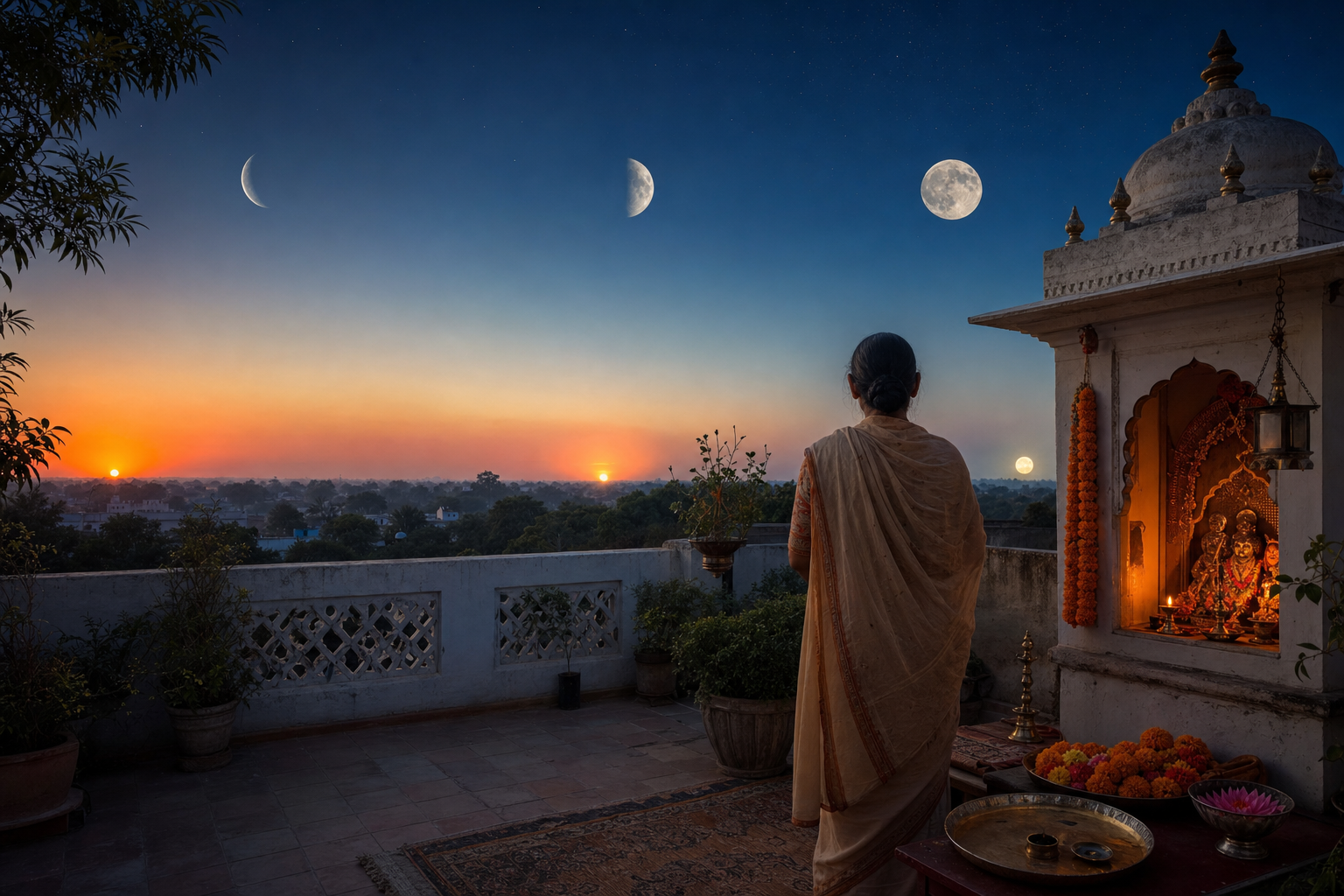
May does not correspond neatly to one Hindu lunar month. In the Purnimanta reckoning used widely in North India, the civil month crosses late Vaishakha and early Jyeshtha. In the Amanta reckoning common in the Deccan, Vaishakha ends at Amavasya and Jyeshtha begins afterward. Tamil families may see Chithirai and Vaikasi, while other regional calendars use their own month boundaries.
For that reason, first enter each observance by its lunar anchor. Add the civil date only after checking a location-aware Panchang. The following planning map shows what you should verify rather than pretending that one universal May date applies everywhere.
| Lunar anchor | Observance to look for | What you should schedule |
|---|---|---|
| Vaishakha Shukla Tritiya | Akshaya Tritiya and Parashurama Jayanti | Confirm Tritiya locally, then plan dana, worship, or a dharmic beginning. Akshaya Tritiya is treated as a Sade-Teen Muhurat, so an elaborate separate muhurat is generally unnecessary. |
| Vaishakha Shukla Saptami and Navami | Ganga Saptami and Sita Navami | Check the sunrise assignment before fixing home or temple worship. |
| Shukla Ekadashi | Mohini Ekadashi | Enter both the fasting day and the next-day parana window. |
| Vaishakha Shukla Chaturdashi | Narasimha Jayanti | Protect the required pradosha or night worship period rather than relying on a sunrise label alone. |
| Vaishakha Purnima | Kurma Jayanti and Vesak or Buddha Purnima | Coordinate the appropriate Vaishnava, Buddhist, family, or community observance without treating their distinct rites as interchangeable. |
| Krishna Chaturthi after Purnima | Sankashti Ganesh Chaturthi | Use local moonrise and record the puja and fast-breaking time together. |
| Krishna Ekadashi | Apara Ekadashi | Verify the sunrise rule, Hari Vasara, and parana before announcing the fast. |
| Trayodashi evenings | The month’s two Pradosh Vrats | Base Shiva worship on local sunset and the relevant Trayodashi span. |
| Krishna Chaturdashi and Amavasya | Masik Shivaratri, Amavasya, and Pitru Tarpana | Keep the night observance distinct from the following ancestral rites, and confirm which tithi prevails during each required period. |
| Regional or conditional alignment | Vaikasi Visakam, Vat Savitri Vrat, and Shani Jayanti where applicable | Follow the regional month, nakshatra, or Jyeshtha Amavasya rule rather than adding the celebration merely because it appears on a generic May list. |
May’s observances also reveal shared dharmic values without erasing differences among traditions. Akshaya Tritiya carries a Jain remembrance of Bhagwan Rishabhanatha’s first ahara after prolonged asceticism. Vaishakha Purnima brings Kurma Jayanti in Vaishnava traditions and Vesak in Buddhist communities. Dana, restraint, ahiṁsa, meditation, and seva form points of civilizational kinship, even though the theology and ritual forms remain distinct.
Your calendar entry should contain more than a festival name. Add the city, lunar anchor, decisive period, puja window, and parana time where relevant. A family member can then see why a date was chosen instead of having to trust an unexplained screenshot.
Use May 6 as a timing test case

May 6 shows how easily a civil-date label can conceal the important transition. In the reckoning used for that day, Krishna Paksha Chaturthi continues until 5:01 AM and Krishna Paksha Panchami follows. Most of the civil day is therefore Panchami, but the ritual conclusion depends on which moment matters and whether that clock time applies to your location.
If local sunrise occurs after the applicable Chaturthi end, Panchami prevails at sunrise. If a Chaturthi observance is determined by moonrise, however, you must inspect the preceding evening: the relevant Chaturthi may have been the one present at that moonrise. The civil date printed at the top of a calendar page cannot settle that question by itself.
- Set your Panchang to the city where the worship will occur, not the city where the calendar was published.
- Record the local start and end of Chaturthi and Panchami.
- Add local sunrise and, for a moonrise-based vrata, the preceding evening’s moonrise.
- Apply the rule of the particular observance and your sampradaya.
- Write the result in the family calendar with the deciding time attached.
Do not export the 5:01 AM figure to another city as though it were universal. Time zones, daylight-saving rules, local sunrise, and location-aware calculations all matter. This is especially important for diaspora households: India Standard Time is not a substitute for a Panchang calculated for Toronto, London, Singapore, or any other place of observance.
If you have no prescribed Chaturthi vrata to resolve, the day’s practical character is much simpler. Panchami in the waning fortnight can be used for completion, editing, account consolidation, decluttering, scripture reading, and quiet service. Because May 6 is a Wednesday, traditional weekday associations also make study, precise communication, and skill refinement fitting choices. These are ways of giving the day a dharmic rhythm, not fatalistic restrictions on necessary work.
Calculate muhurat for the city where you worship

Rahu Kalam, Yamaganda, and Gulika Kala are not fixed clock appointments. Daylight from local sunrise to local sunset is divided into eight equal parts, and the weekday determines which segment receives each designation. Longer or shorter seasonal daylight therefore changes the windows.
For a purely nominal Wednesday with sunrise at 6:00 AM and sunset at 6:00 PM, the daylight period is twelve hours and each eighth lasts ninety minutes. The traditional Wednesday example places Yamaganda at 7:30–9:00 AM, Gulika Kala at 10:30 AM–12:00 PM, and Rahu Kalam at 12:00–1:30 PM.
| Wednesday window | Daylight segment | Nominal 6:00 AM–6:00 PM example |
|---|---|---|
| Yamaganda | Second eighth | 7:30–9:00 AM |
| Gulika Kala | Fourth eighth | 10:30 AM–12:00 PM |
| Rahu Kalam | Fifth eighth | 12:00–1:30 PM |
Use those numbers only to understand the method. If your local day runs from 5:40 AM to 8:20 PM, none of the nominal clock windows should be copied unchanged. Take the sunrise and sunset supplied for your city, calculate one-eighth of that daylight duration, and map the Wednesday segments accordingly. A location-aware Panchang can do this directly, but you should still confirm that its city and daylight-saving setting are correct.
Abhijit Muhurat also should not be pasted into every calendar as “12 noon.” It is centered on local solar noon, whose clock reading varies with place, season, and the equation of time. Use the locally calculated interval. If you are publishing a community schedule, include the city beside it so readers do not assume that the same clock window applies across a country.
Tithi and weekday windows are still only part of the decision. Nakshatra describes the Moon’s stellar setting, while Chandra Rashi adds another qualitative layer. For an ordinary task, you can combine the tithi’s purpose with the nakshatra’s traditional temperament—such as soft, movable, fixed, or fierce. For an irreversible or elaborate religious commitment, do not infer the nakshatra or rashi from a generic daily description; obtain them for the exact city and proposed time.
Key takeaways for your May 2026 calendar
- Choose the place of worship first. Local sunrise, sunset, moonrise, time zone, and daylight-saving rules control the usable clock times.
- Identify the observance’s deciding period before choosing its Gregorian date: sunrise, pradosha, moonrise, night, or another prescribed span.
- Record parana when you record Ekadashi or another fast. A fasting date without its breaking window is an incomplete calendar entry.
- Treat the May 6 transition at 5:01 AM as a timing tied to its reckoning, not as a universal clock time for every city.
- Do not let Amanta, Purnimanta, or regional month-name differences distract you from the underlying tithi and observance rule.
- For weddings, samskaras, griha pravesh, and major temple events, cross-check two reputable almanacs and settle differences through the tradition and priest responsible for the rite.
Before you circulate your May schedule, add four fields beside every observance: city, lunar anchor, decisive period, and worship or parana window. Once those fields are visible, most one-day disagreements become questions you can actually resolve—and your Panchang becomes a tool for disciplined dharmic living rather than a collection of unexplained dates.
References
- DharmaRenaissance Blog — May 6, 2026 Panchang: Chaturthi to Panchami Transition, Key Muhurats, and Vedic Timing Guide
- DharmaRenaissance Blog — May 2026 Hindu Festivals and Auspicious Days: Panchang Guide to Tithis, Muhurats, and Rituals