
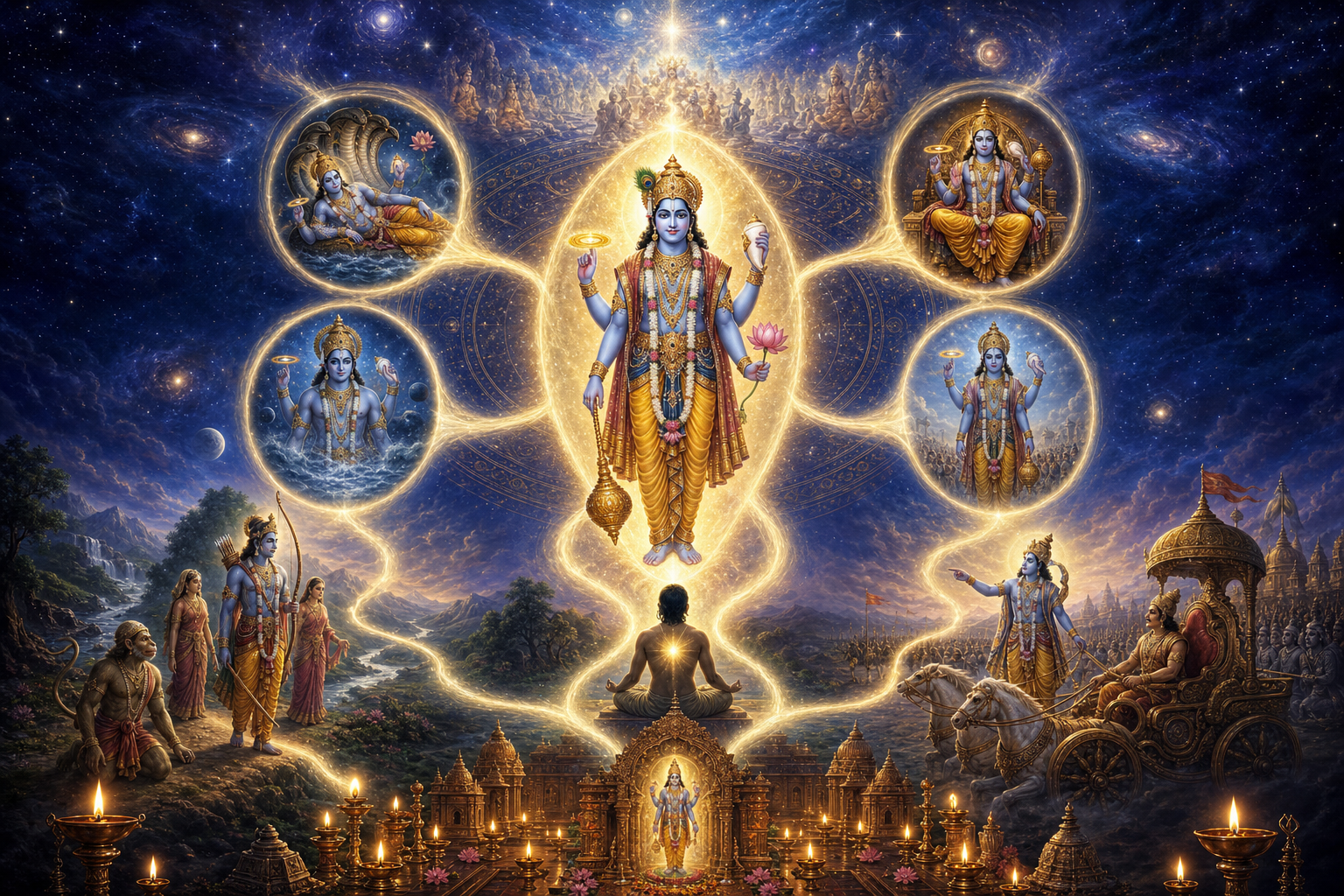
If you have heard that Vishnu has four manifestations and then encountered the names Vāsudeva, Saṅkarṣaṇa, Pradyumna, and Aniruddha, you may wonder why another teacher gives you Para, Vyuha, Vibhava, and Antaryāmin. The difficulty is not a contradiction in Pancharatra theology. It is the accidental mixing of two different classifications.
Once you separate those classifications, the system becomes much easier to use. It shows how the one Lord can remain beyond every limitation, order the cosmos, enter particular times and places, dwell within each being, and become available to the senses in temple worship without being divided into competing deities.
First, separate the two classifications
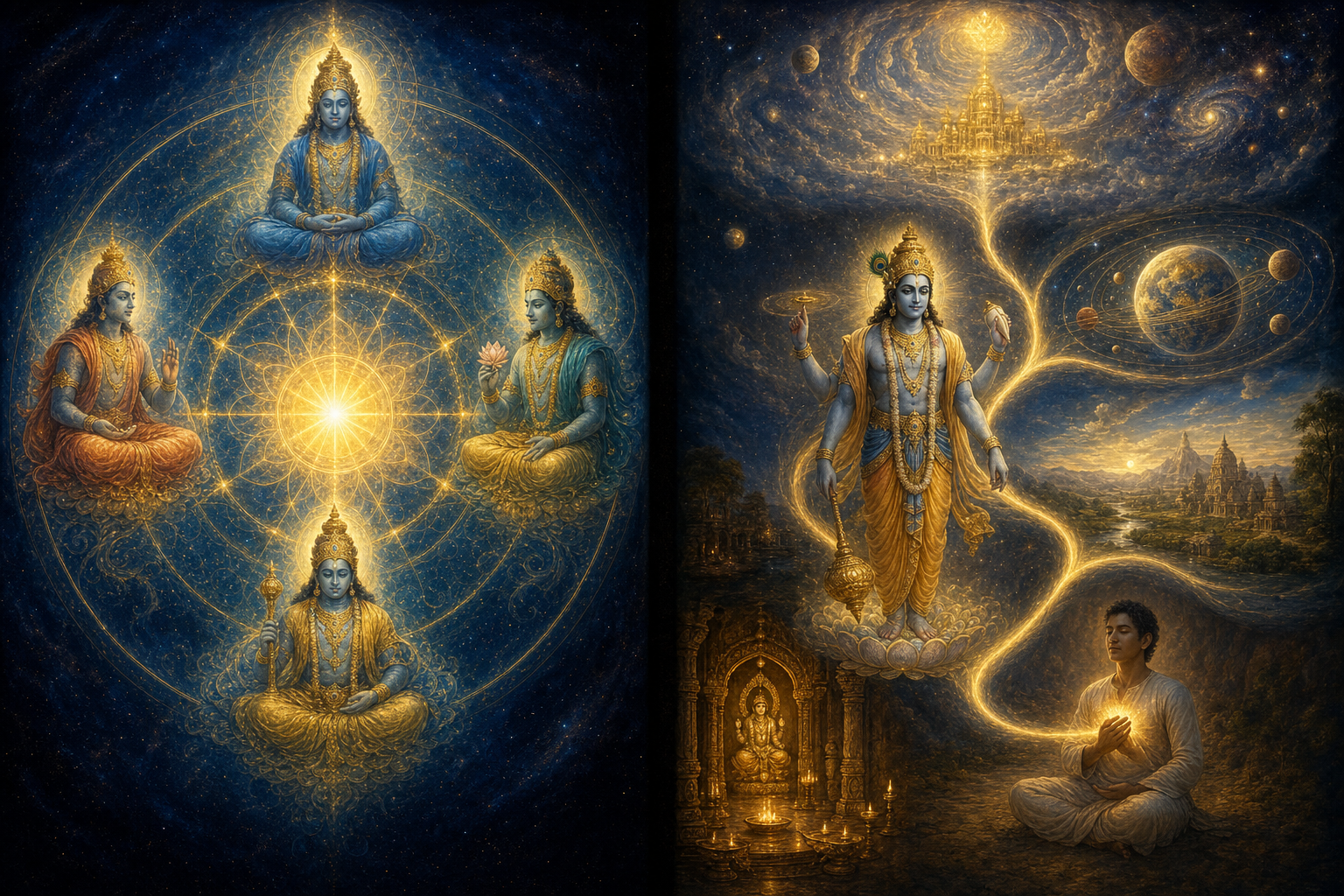
The first classification concerns modes of divine presence. It answers a practical theological question: in what manner is Vishnu present to the cosmos and to the devotee?
- Para: Vishnu-Nārāyaṇa as the transcendent Supreme, unlimited by the universe or by any particular form. Para protects the fundamental claim that no manifestation exhausts or reduces Bhagavān.
- Vyuha: the Lord’s ordered emanational presence. Through Vyuha, divine attributes and cosmic functions become intelligible without turning the Supreme into a collection of parts.
- Vibhava: the avatāras, including Rāma, Kṛṣṇa, Varāha, and Narasiṁha. Here the Lord enters definite circumstances so that dharma, protection, relationship, and divine action can be encountered in narrative and history.
- Antaryāmin: the indwelling Lord, present within the heart as inner controller and guide. This mode makes divine nearness more intimate than an external encounter alone.
- Arcā: the Lord’s iconic presence in a ritually consecrated image. Many lineages count Arcā as a distinct fifth mode; where it is not separately numbered, it remains central to temple practice.
The second classification belongs entirely inside Vyuha. Chaturvyuha means the four emanational forms Vāsudeva, Saṅkarṣaṇa, Pradyumna, and Aniruddha. It does not mean Para, Vyuha, Vibhava, and Antaryāmin.
When you encounter the expression four manifestations, therefore, ask one clarifying question: does the speaker mean four modes of presence, or the four forms within the Vyuha mode? That question resolves most apparent inconsistencies before they become larger theological disputes.
Read the Chaturvyuha as ordered plenitude, not divine partition
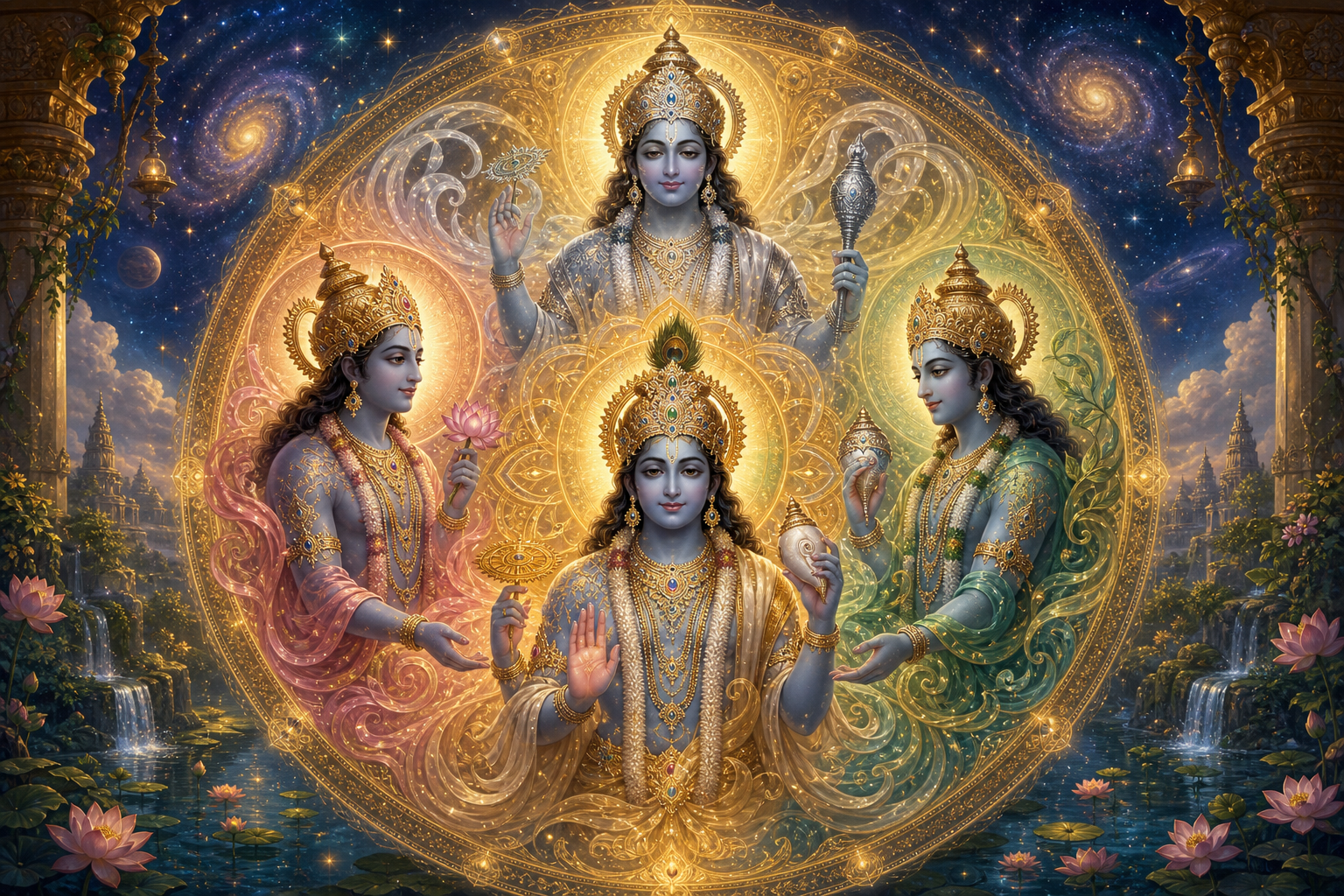
Pancharatra begins with divine fullness. Para is not an isolated deity who later breaks apart in order to manage creation. The emanations disclose an order already grounded in the undiminished Supreme. Vāsudeva is the foremost Vyuha and the accessible center of this order; Saṅkarṣaṇa, Pradyumna, and Aniruddha express particular functional emphases.
The architecture is organized through six excellences associated with Bhagavān: jñāna, aiśvarya, śakti, bala, vīrya, and tejas. These may be rendered as omniscient knowledge, sovereign lordship, power, strength, valor, and splendor. Vāsudeva is the plenary reservoir of all six, while the other three Vyuhas are identified through paired emphases.
| Vyuha | Attribute emphasis | Cosmic and inner association | How to read it |
|---|---|---|---|
| Vāsudeva | All six excellences | The accessible center of supreme consciousness | Begin here: the other Vyuhas express the plenitude of Vāsudeva rather than competing with it. |
| Saṅkarṣaṇa | Jñāna and bala | Jīva-tattva and withdrawal or dissolution; associated with tamas in this cosmic function | Notice the conjunction of knowledge and strength required for withdrawal, detachment, and return. |
| Pradyumna | Aiśvarya and vīrya | Creative intention and manas, or mind; associated with rajas | Read creation as directed intelligence and initiative, not as unstructured activity. |
| Aniruddha | Śakti and tejas | Regulation of the manifest order, ahaṅkāra, and the senses; associated with sattva | Attend to ordered agency: identity and the senses must be governed rather than allowed to rule themselves. |
Do not convert the guṇa associations into a moral ranking of the Vyuhas. Saṅkarṣaṇa’s connection with tamas does not make him spiritually impure, nor does Pradyumna become a merely restless form because of rajas. The guṇas identify roles within cosmic process. They do not reduce divine manifestations to material psychology.
The attribute pairs should likewise be read as a grammar of emphasis, not as four incomplete pieces of God. If you imagine Vāsudeva surrendering portions of divinity as each emanation appears, you have reversed the system’s purpose. Pancharatra uses ordered plurality precisely to preserve undivided divine fullness while explaining differentiated activity.
This vocabulary belongs especially to Pancharatra sources such as the Sātvatasaṁhitā, Ahirbudhnya Saṁhitā, Jayākhya Saṁhitā, and Pauṣkara Saṁhitā. Rāmānuja defended the scriptural standing of the Pancharatra Saṁhitās and integrated their ritual and metaphysical vision into Viśiṣṭādvaita. Gaudiya Vaishnava systems develop related patterns of Vishnu’s successive expansions in their own way. When two lineage charts differ, identify the sampradāya and its purpose before assuming that one chart must be a mistake.
See how one Lord is beyond, cosmic, historical, inward, and visible
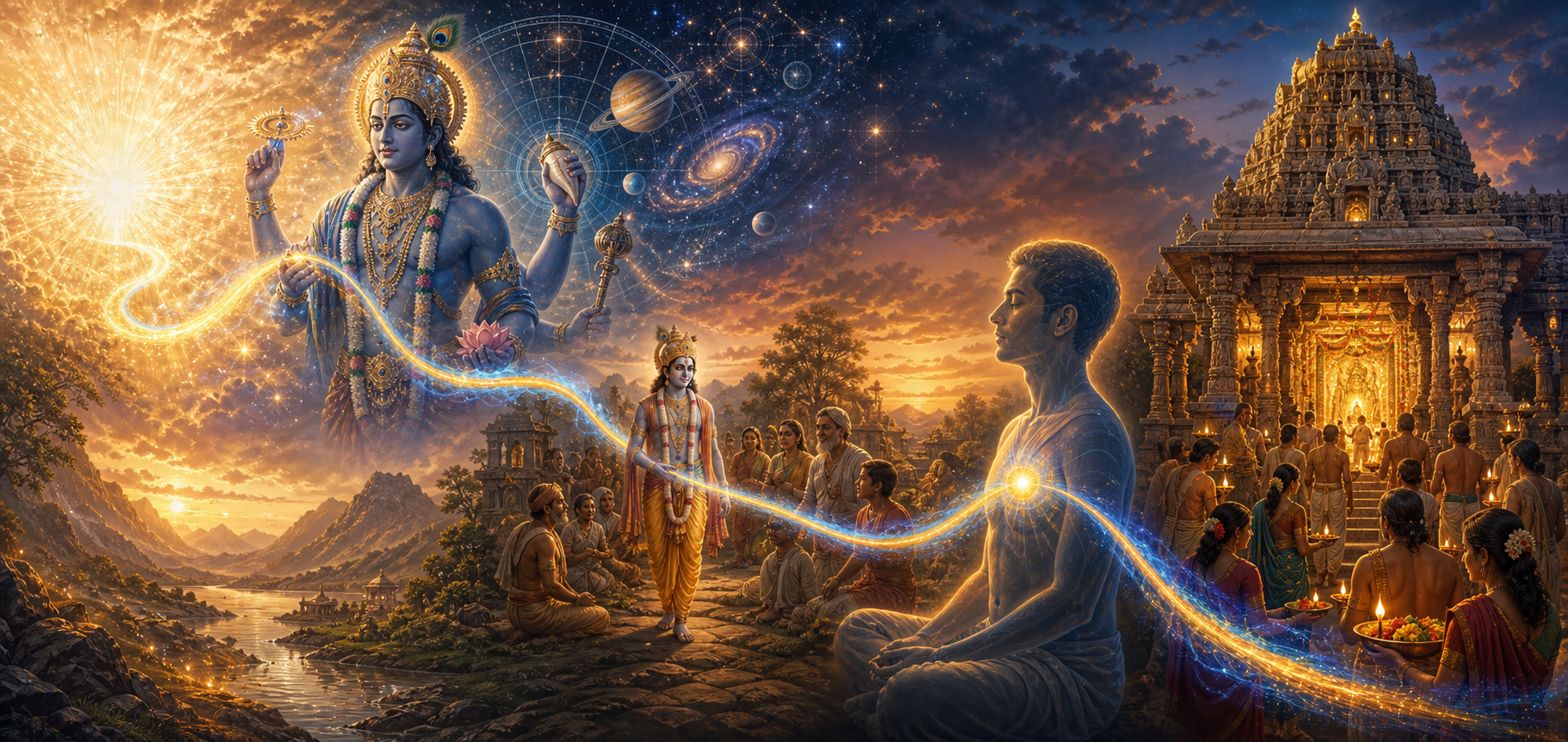
The modes of manifestation are not a timeline in which Para disappears when Vyuha begins, or Vyuha withdraws when an avatāra appears. They are concurrent ways of understanding the same Lord. Each mode prevents a different theological error.
- Para prevents reduction. No avatāra, mental conception, cosmic function, or temple form places a limit around the Supreme. The Lord who accepts relationship remains inexhaustible.
- Vyuha prevents vagueness. Divine immanence is not an undefined claim that God is somehow everywhere. It has an intelligible order connecting attributes, cosmic functions, consciousness, and worship.
- Vibhava prevents remoteness. In Rāma, Kṛṣṇa, Varāha, Narasiṁha, and other avatāras, the Lord is encountered through deeds, relationships, moral demands, protection, and recognizable situations.
- Antaryāmin prevents mere externalism. Temple attendance and scriptural learning do not exhaust divine relationship. The Lord is also present within, where attention, conscience, and ethical discernment are formed.
- Arcā prevents contempt for embodied devotion. Sight, sound, gesture, offering, and sacred space can participate in worship. Within this theology, a consecrated mūrti is not merely a visual aid standing in for an absent deity.
This framework also tells you how to avoid two common category mistakes. An avatāra is not a new god unrelated to Para or Vāsudeva; Vibhava is the same Supreme entering a particular context. Conversely, an inner impression is not automatically authoritative merely because Antaryāmin dwells within. Personal desire, fear, memory, and ahaṅkāra also speak inwardly. Test any supposed guidance against dharma, humility, its likely consequences, and the wisdom of a trustworthy lineage.
Iconography requires the same precision. Vaikuṇṭha Caturmūrti imagery, which may give Vishnu multiple faces with lion and boar associations, celebrates integrated lordship through an iconographic synthesis. It should not automatically be treated as a literal portrait of the four Vyuhas. A visual grouping of four and a theological scheme of four are not identical merely because they share a number.
Comparisons with other Dharmic traditions are most useful when they preserve this precision. Buddhist Trikāya teaching and the Sikh distinction between nirguṇ and sarguṇ also address relations between transcendence and manifestation, while Jain veneration of Tīrthaṅkaras shows how images, perfected beings, and teachings can serve as bridges toward liberation. These are illuminating resonances, not interchangeable diagrams. Compare the question each tradition addresses; do not erase its distinct answer.
Use the theology as a sequence of attention
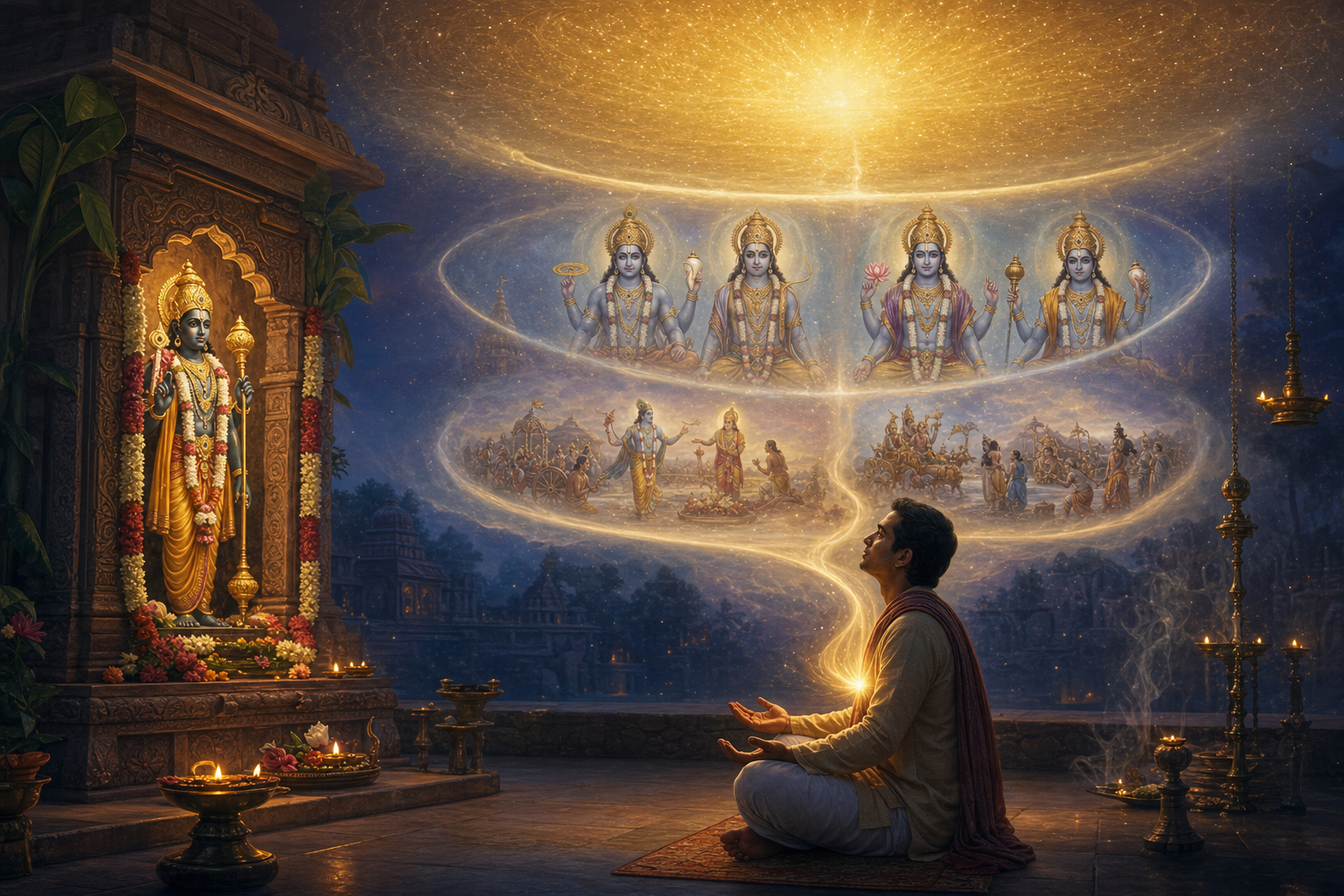
You do not need to master every Saṁhitā before this architecture can improve your sādhana. Use one established mantra consistently: the eight-syllabled Om Namo Nārāyaṇāya or the twelve-syllabled Om Namo Bhagavate Vāsudevāya, following the discipline of your lineage where one has been received. The purpose is not to activate four separate powers. It is to recollect the one Lord through a mind made orderly enough to recognize different dimensions of divine presence.
- Begin with Para. Before japa, loosen your insistence that the Lord must fit your current image, mood, or demand. Attend briefly to the unlimited reality of Nārāyaṇa. This keeps devotion from shrinking into negotiation with a projection of your own preferences.
- Move through Vyuha. Remember that divine nearness has order. Bring to mind knowledge and strength, sovereign purpose and valor, power and splendor. Ask which capacity your present duty requires rather than asking only which outcome you want.
- Contemplate Vibhava. Choose the avatāra to whom you are devoted. Bring one divine quality or dharmic demand associated with that form into the decision before you. The test is concrete: what would fidelity to dharma change in your next action?
- Become quiet before Antaryāmin. After recitation, stop producing answers for a moment. Listen without treating the first thought that appears as a divine command. Clarity that increases responsibility, steadiness, truthfulness, and humility deserves examination; an impulse that merely flatters the ego should not be sanctified.
- Receive Arcā where available. In a temple governed by āgamic discipline, approach the consecrated mūrti as presence rather than decoration. Let darśana end in one specific resolve concerning conduct, service, restraint, or worship. Otherwise the senses may be moved while daily life remains untouched.
After the practice, write one sentence answering three questions: what did you recognize, what must you do, and which attachment may obstruct it? This small discipline prevents metaphysics from remaining an elegant chart. It converts Para into humility, Vyuha into ordered intention, Vibhava into emulation, Antaryāmin into discernment, and Arcā into embodied commitment.
The same method helps when reading or listening to a discourse. Mark each claim with four labels: mode, Vyuha, attribute, and function. If a statement concerns Para, do not force it into the Saṅkarṣaṇa-Pradyumna-Aniruddha table. If it concerns manas or ahaṅkāra, determine whether it is describing an inner correspondence or making a complete metaphysical definition. If a teacher uses a different arrangement, note the lineage before comparing details.
Key takeaways
- Pancharatra uses two different sets that are often confused: modes of divine presence and the four Vyuhas within one of those modes.
- Para, Vyuha, Vibhava, Antaryāmin, and, in many lineages, Arcā explain how the same Vishnu is transcendent, cosmically active, present as avatāra, inwardly indwelling, and accessible in consecrated form.
- Vāsudeva, Saṅkarṣaṇa, Pradyumna, and Aniruddha are the Chaturvyuha. They disclose ordered divine plenitude; they are not four competing gods or four broken portions of the Supreme.
- The six excellences and guṇa associations identify functional emphases. They should not be turned into a hierarchy of purity or a reductive material psychology.
- Vaikuṇṭha Caturmūrti iconography is not automatically a depiction of Chaturvyuha theology, despite the shared use of fourfold imagery.
- In practice, move from transcendence to order, avatāra-centered dharma, inward discernment, and embodied worship. Let the sequence produce one specific change in conduct.
The next time you meet the word manifestation in a temple discourse or Vaishnava text, pause before assigning it a meaning. Identify the level, name the function, and then return the distinction to your practice. Pancharatra becomes clear when its categories are kept distinct, and transformative when those categories reshape how you see, decide, and worship.