
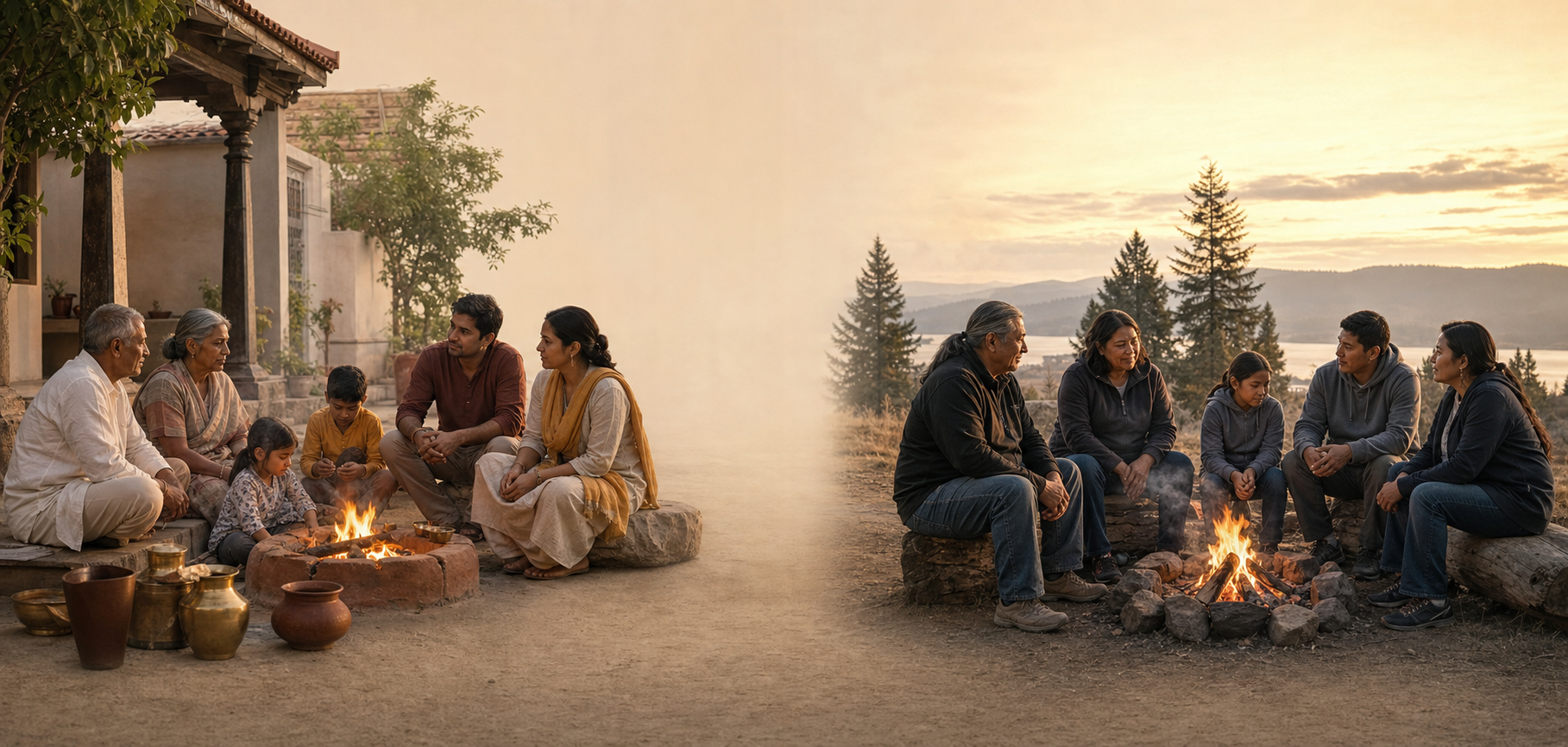
You have probably seen the parallels assembled in a few striking images: a sacred fire, four directions, chant and drum, fasting, elders, and reverence for the Earth. The resemblance is easy to notice. The harder question is what that resemblance allows you to claim.
Here is the answer you can defend: Vedic traditions and some Native American lifeways display meaningful resonances in ritual function, social transmission, and ethical orientation. Those resonances can deepen Dharmic understanding and interfaith respect. By themselves, however, they do not prove common ancestry, migration, or direct borrowing. You do not have to choose between dismissing every similarity and declaring that the traditions are secretly identical.
Resemblance is not the same as historical descent

A responsible comparison separates three questions. Do two traditions use a similar form? Does that form perform a similar function? Is there evidence that one tradition historically transmitted it to the other? These are different levels of inquiry, and a strong answer at one level does not automatically answer the next.
| What you notice | What you may reasonably examine | What the resemblance cannot prove by itself |
|---|---|---|
| Both traditions use sacred fire | How fire carries offerings, purifies, consecrates, or witnesses a rite | That one ceremony descended from the other |
| Both orient ritual space through directions | How spatial order connects a community with a larger cosmos | That the directions have identical guardians, stories, or meanings |
| Both transmit sacred knowledge orally | Why memory, voice, discipline, relationship, and eligibility matter | That their texts, songs, doctrines, or teaching offices are interchangeable |
The practical vocabulary is simple. When you can establish a similar structure or purpose, call it a resonance, analogy, or functional parallel. When independent communities could plausibly have developed similar practices in response to recurring human needs, convergence is a reasonable possibility. Reserve words such as descent, survival, remnant, or proof for cases with actual historical evidence of transmission.
This restraint does not make the comparison empty. It makes it more useful. Fire can mediate between visible and invisible worlds without every sacred fire belonging to one religious genealogy. Directional ritual can order human life within a cosmos without every directional system being the same cosmology. Ancient cultures repeatedly worked with land, kinship, sound, memory, sacrifice, and mortality; similar ritual solutions can therefore emerge without being copies.
Seven resonances worth examining closely
1. Sacred fire: compare the ritual verbs
In Vedic yajna and homa, Agni receives offerings, connects human action with divine order, and makes a prepared space ritually potent. In a number of Native American ceremonial settings, fire or controlled smoke may prepare people and places for prayer, purification, remembrance, or communal witnessing. The clearest resonance lies in the actions surrounding the fire: offering, cleansing, consecrating, connecting, and witnessing.
The limit matters just as much. Agni has a particular place in Vedic revelation and ritual theology. A sacred fire maintained by a Native nation belongs to that community’s own language, history, relationships, and ceremonial authority. Calling the latter a form of Agni worship would replace its meaning with a Vedic category. Calling homa a Native ceremony would commit the same error in reverse.
When you compare fire traditions, ask what participants do, to whom an offering is addressed, who may tend the fire, and what the rite changes. Similar ritual verbs support a careful analogy. Different recipients, narratives, protocols, and authorities preserve the distinction.
2. Sacred sound: compare transmission before musical appearance
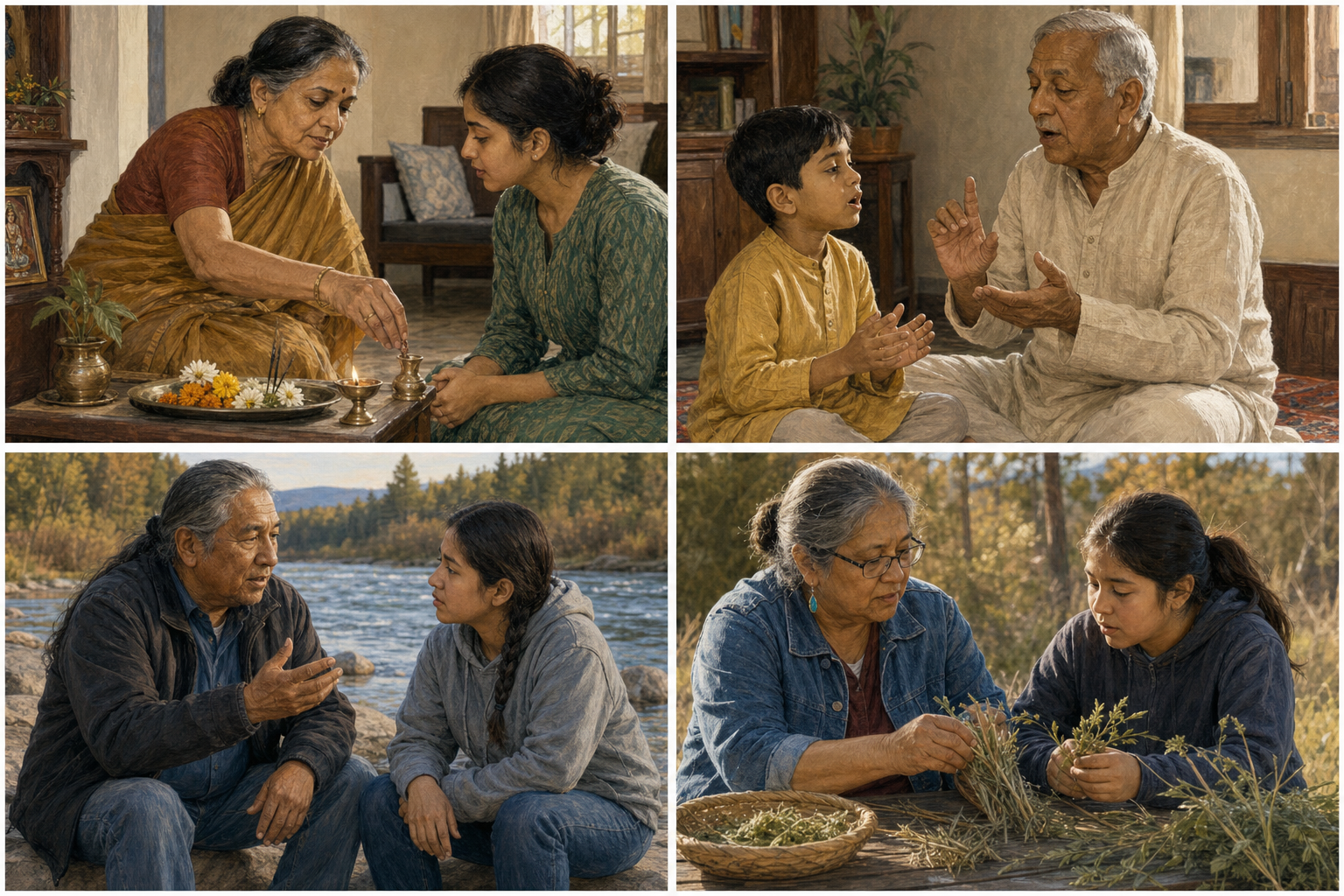
Vedic culture preserved sruti through disciplined recitation, exacting mnemonic methods, and guru-sisya transmission. Mantra, japa, and kirtan use sound for remembrance, concentration, devotion, and alignment with sacred order. In many Native communities, songs and oral narratives are likewise held by elders or designated knowledge keepers and transmitted within seasonal, communal, familial, or initiatory relationships. Rhythm and repeated sound can also coordinate breath, movement, attention, and participation.
A repeated ceremonial phrase is not automatically a mantra, and a drum is not the equivalent of kirtan merely because both gather a community through sound. The more illuminating questions concern custody and purpose: Who is authorized to teach the sound? Must the recipient be prepared? Is it sung publicly, within a family, during a season, or only in a particular rite? What responsibility accompanies learning it?
This moves the discussion beyond the vague claim that ancient peoples liked chanting. The deeper parallel is that voice, memory, discipline, and relationship can serve as trustworthy vessels of sacred knowledge.
3. Directions and sacred space: structure can resemble without meanings matching
Vedic and later Hindu traditions orient altars, temples, mandalas, and ritual actions within an ordered space associated with the directions and, in relevant contexts, the Dikpalas. Numerous Native traditions also orient ceremonies through the four directions and a center, sometimes in medicine-wheel configurations. In both cases, physical space becomes moral and cosmological space: a participant is located within an order larger than personal preference.
Do not jump from structural resemblance to a universal chart. The meaning assigned to a direction can differ among Native nations, ceremonies, and knowledge holders. It also need not correspond to a Vedic directional guardian. If you encounter a neat diagram claiming that every direction, element, color, animal, and deity matches across cultures, check whether each association is actually grounded in the named traditions. Symmetry on a chart is not historical evidence.
4. Sacred geography: the important question is what a place asks of you
Vedic and broader Dharmic traditions recognize rivers, mountains, springs, forests, and pilgrimage places as more than scenery. A tirtha is approached as a crossing point where ordinary and sacred realities meet. Many Native communities likewise maintain inherited relationships with particular waters, landscapes, and ancestral sites as living presences, renewing those relationships through visits, prayer, offerings, stories, and seasonal observances.
The useful resonance is not a generic love of nature. It is the conviction that place can make a claim on human conduct. Ask what forms of gratitude, restraint, remembrance, or stewardship a place requires. A picturesque landscape can be consumed as an experience; sacred geography instead places the visitor under obligation.
This distinction has a practical consequence. Visiting an Indigenous sacred place does not grant permission to conduct a self-designed ritual there. Reverence begins by learning the community’s rules for access, photography, offerings, speech, and physical conduct. A Dharmic pilgrim already understands that not every temple space, mantra, or ritual action is open in the same way to every visitor.
5. Kinship: ancestry carries duties, not just identity
Gotra preserves lineage memory, regulates marriage in relevant Hindu communities, and connects descendants with remembered rishis. Numerous Native peoples maintain clan structures that organize belonging, marriage rules, mutual duties, and inherited memory; some clans are associated with animals. These institutions are not interchangeable, but their social logic can resonate: ancestry limits individual choice because it binds a person to obligations extending across generations.
Compare the work performed by a kinship system, not merely its symbols. Ask how it regulates marriage, assigns responsibility, transmits names or stories, and defines care for relatives. Avoid relabeling a Native clan as a gotra or treating an animal-associated clan as a Hindu vahana concept. Familiar Dharmic words can help you formulate a question, but they should not overwrite the answer given by the community itself.
6. Rites of passage and austerity: thresholds require preparation
Vedic samskaras mark transitions across life, from rites associated with birth and education to marriage and death. Native American communities may maintain naming ceremonies, coming-of-age observances, first-harvest acknowledgments, fasting, solitude, and other forms of guided preparation. Their narratives and procedures differ, yet a recurring structure is visible: instruction precedes a threshold, a vow or disciplined act gives it seriousness, and communal recognition places the changed person within a moral world.
Vedic tapas also provides a limited point of comparison with disciplines involving silence, solitude, fasting, or controlled hardship. The defensible parallel concerns attentional discipline and commitment. It does not authorize you to copy a community’s rite, undertake an ordeal without legitimate guidance, or rename an Indigenous practice as tapas. Similar human disciplines can carry very different covenants and meanings.
7. Elders and knowledge keepers: silence may have a history
The guru in a Vedic setting forms both understanding and character; knowledge is received through relationship, discipline, and eligibility. In Native communities, grandparents, aunts, uncles, elders, and designated knowledge keepers may carry comparable responsibility without occupying the same religious office.
Boarding-school regimes and assimilationist pressure attacked these intergenerational channels. Some elders protected descendants by carrying teachings through daily conduct while withholding explicit instruction that could attract punishment. The resulting archival silence can coexist with embodied continuity: foodways, etiquette, relationships with land, patterns of hospitality, remembered phrases, and family conduct may preserve a lifeway even when written records do not.
Two cautions belong together here. A lack of paperwork should not be used to dismiss a community’s oral history, especially when colonial institutions controlled much of the paperwork. But undocumented personal affinity does not, by itself, establish citizenship, clan identity, or ceremonial authority. Community recognition, family transmission, and accountable relationship matter. Feeling spiritually close to a people is not the same as belonging to that people.
The deepest resonance is a sacred life built from relationships

The most consequential similarity may be less visible than a fire altar or medicine wheel. Dharma is lived through food, speech, hospitality, restraint, family duty, care for place, and the manner in which one receives and gives. It is not confined to a weekly service or a private declaration of belief. Many Native American traditions likewise resist a clean division between religion and ordinary life because land, kin, memory, ceremony, and livelihood remain interdependent.
This is why the label religion can clarify one question and distort another. It may help an outsider recognize prayer or ceremony, yet it can hide the sacred obligations carried in planting, harvesting, eating, speaking, visiting, mourning, teaching, and caring for a place. A lifeway may remain spiritually coherent even when its members do not package every inherited behavior as an explicitly named religious practice.
The ethical resonances extend across the Dharmic family. Hindu thought relates conduct to dharma and rta. Buddhist traditions cultivate karuna. Jainism gives radical prominence to ahimsa. Sikh practice joins seva with concern for the welfare of all. Many Native traditions emphasize gratitude, reciprocity with land, restraint in taking life, and obligations to coming generations. These are credible points of dialogue because each places limits on the isolated ego.
Shared ethical direction does not mean identical doctrine. Jain ahimsa, for example, should not be treated as another name for every Indigenous teaching about hunting or taking life. The stronger comparison is that life-taking is morally bounded rather than imagined as an act without consequence. The traditions can converge on gratitude and restraint while differing over diet, livelihood, metaphysics, ritual repair, and the precise duties owed to other beings.
When evaluating an ethical resonance, look for the obligation behind the attractive phrase. Before taking from the natural world, what gratitude or restraint is required? Who teaches the rule? How is a broken relationship repaired? Which duties fall to an individual, a family, or the whole community? A comparison becomes substantive when it identifies practices of accountability, not merely shared words such as harmony or oneness.
Use a six-step test before sharing a cultural comparison

You can apply the following test to a lecture, social-media graphic, classroom discussion, or essay. It takes only a few minutes and catches most forms of false equivalence.
- Name each tradition at the narrowest supported level. Say Vedic homa when that is what you mean. Name a Native nation or community when you have reliable community-specific knowledge. If your information supports only a broader statement, write some Native traditions rather than all Native Americans.
- Describe each practice on its own terms first. Establish its participants, purpose, authority, setting, and restrictions before introducing the comparison. This prevents the better-known tradition from becoming the measuring stick for the other.
- Compare one function at a time. Purification, offering, initiation, remembrance, orientation, and kinship regulation are specific functions. A vague claim that two cultures are spiritual hides more than it reveals.
- State at least one meaningful difference. Different deities, stories, ritual custodians, eligibility rules, or understandings of land are not minor exceptions. They tell you where the analogy stops.
- Separate resemblance from history. If you do not have evidence of contact or transmission, do not turn a typological parallel into a migration narrative. The words resonance and convergence preserve what you can actually show.
- Respect access boundaries. Publicly visible does not necessarily mean freely reproducible. Do not record, teach, remix, or perform a song, prayer, design, or ceremony merely because you encountered it online or at a public event. Learn whether the relevant community treats it as open, restricted, familial, seasonal, or initiatory.
A careful comparison might therefore read like this: Vedic homa and sacred-fire practices found in some Native communities can both use fire to consecrate space and connect an offering community with a more-than-human order. Their ritual authorities, sacred narratives, recipients, and protocols remain distinct, and the functional resemblance alone does not establish a historical connection.
That formulation does not weaken either tradition. It identifies a real similarity, draws the boundary, and leaves historical questions open. It also allows practitioners to meet as custodians of living paths rather than as exhibits in somebody else’s theory.
Claims that Native peoples are really Vedic, that a medicine wheel is simply a mandala, or that every ancient culture possessed one hidden religion fail this test. They convert dialogue into annexation. A Dharmic affirmation of plurality should make us more precise about difference, not less.
Key takeaways
- Fire, sacred sound, directional space, pilgrimage, kinship, rites of passage, elder-led transmission, and ecological responsibility provide meaningful fields of comparison.
- A shared ritual function can support an analogy, but it cannot establish common ancestry or direct cultural transmission without independent historical evidence.
- Native American is not the name of a single religion. Use the most specific nation, community, ceremony, and knowledge holder your information permits.
- Oral history and embodied family practice deserve serious attention, especially where coercive assimilation produced gaps in written records.
- Respectful dialogue identifies both resemblance and difference, honors community authority, and does not copy restricted practices.
The next time you encounter a dramatic Vedic-Native parallel, write down what each practice means within its own lineage. Circle the one function they genuinely share. Then remove every ancestry claim that lacks separate evidence. If the resonance still teaches you something about right relationship, sacred memory, or human obligation, it is strong enough to keep.
References
