
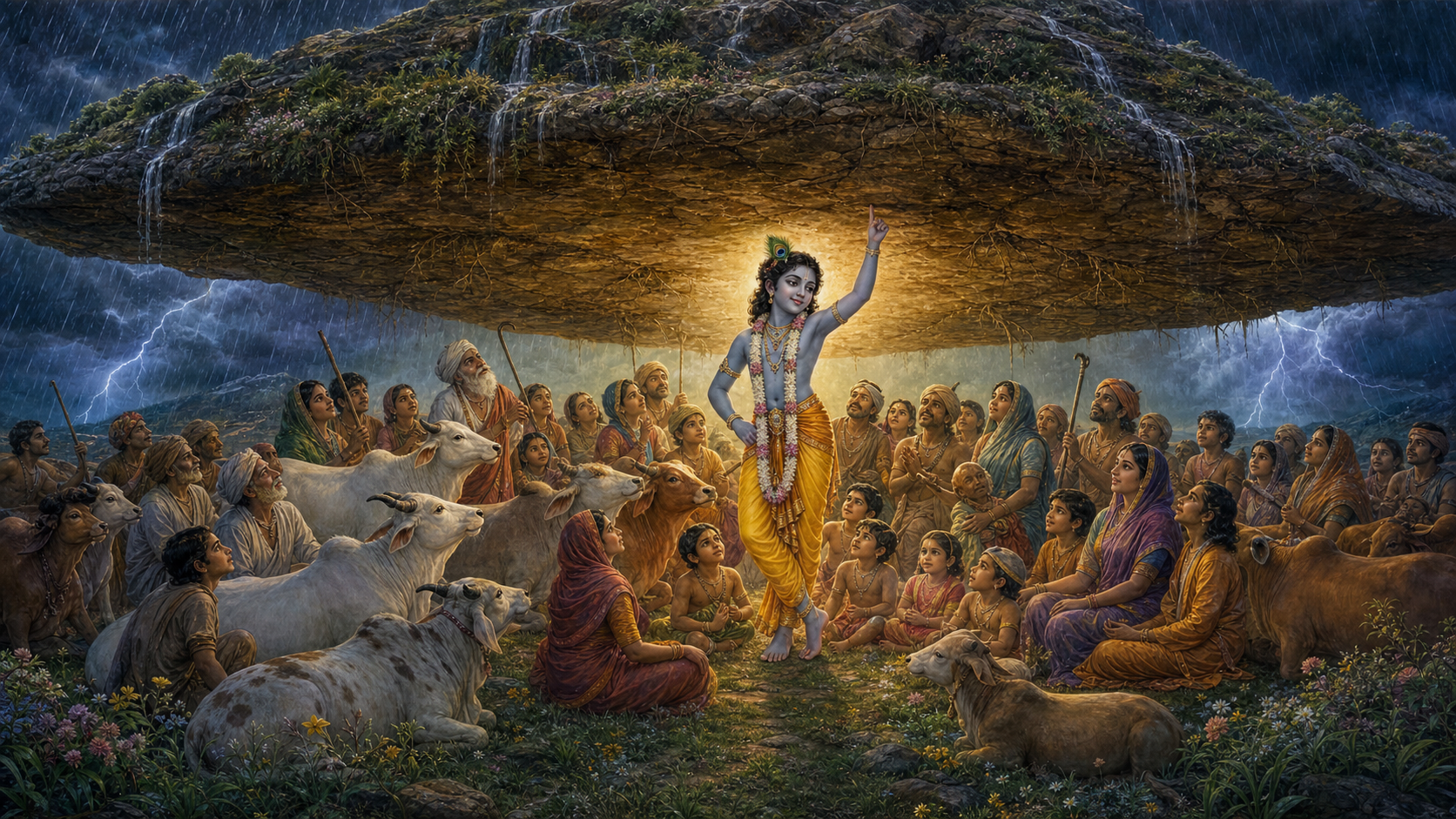
You may know Govardhan-lila as the miracle in which Krishna lifts a mountain. But if you look only for supernatural power, you miss what makes the scene so important to bhakti: Krishna bears an impossible weight without ceasing to be the beautiful, playful, approachable beloved of Vraja.
To contemplate the lila rather than merely recognize it, ask three questions. What does Krishna’s body reveal about divine power? Which relationship with Him is alive in each person under the hill? What kind of surrender should this beauty produce in you?
Read Krishna’s posture before explaining the miracle
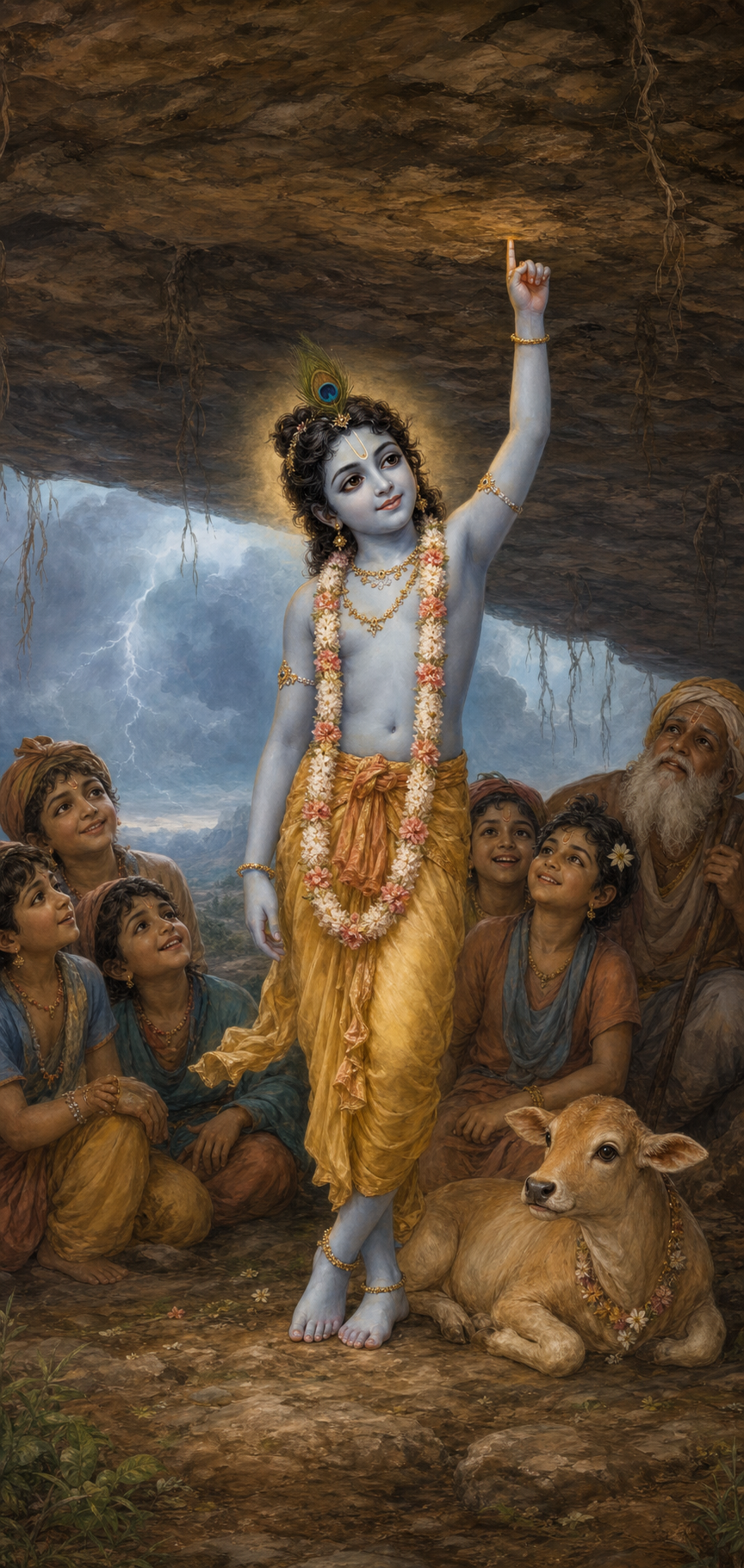
Begin with what the Vrajavasis see. Krishna’s raised left arm supports Govardhan, yet His body does not look crushed by the load. The left side is long and open. The left knee contracts slightly, the waist bends, the right heel rises, and the left foot seems to meet the earth with tenderness. A forest garland and thin caddar move to the left while His body remains composed. Pollen rests on His right cheek. He smiles.
This is tribhanga, the three-fold bending form familiar in sacred art. Here it does more than make Krishna graceful. It gives visible form to a theological paradox: the bearer of a mountain does not become rigid. Divine strength appears as relaxed vitality rather than strain.
Follow the composition from bottom to top. The foot remains close to the earth while the lifted arm holds the hill. The foot communicates presence among cows, friends, parents, children, and beloveds. The arm reveals a power beyond theirs. Transcendence and intimacy therefore occupy one body. Krishna is capable of being everyone’s refuge because He exceeds the crisis, yet He gives refuge while standing inside their shared world.
Four contrasts will help you read a painting, murti, or remembered image of Giridhari:
- Weight and ease: Govardhan is overhead, but Krishna’s posture remains graceful.
- Stillness and movement: His arm is steady while cloth, garland, heel, and curved waist preserve rhythm.
- Majesty and sweetness: He performs a cosmic act with pollen on His cheek and affection in His smile.
- Height and nearness: His hand reaches above the community, but His feet remain among them.
The smaller details matter because they prevent the miracle from becoming an impersonal display. Krishna’s ankle-bells, imagined as melodious throughout the day, fall silent as though wonder has absorbed even them. Then the stillness changes: Krishna raises His flute, laughter moves through the gathering, and Madhumangala worries that this is no time for music because the melody might cause Giriraj to melt.
The joke is not a prediction about stone. It is devotional poetics. Wonder, or adbhuta, is expressed through personification; poetic projection, or utpreksha, imagines what the enchanted mountain might do; hyperbole, or atisayokti, lets love speak beyond ordinary measurement. The humor also protects a central truth: Krishna’s supremacy does not make Him remote from His friends.
Use a simple order when viewing the scene: notice first, interpret second, and pray third. If you begin with an abstract doctrine, you may overlook the heel, the smile, or the silent bells. Yet those details are precisely how the doctrine becomes perceptible.
Rasa tells you who is seeing Krishna
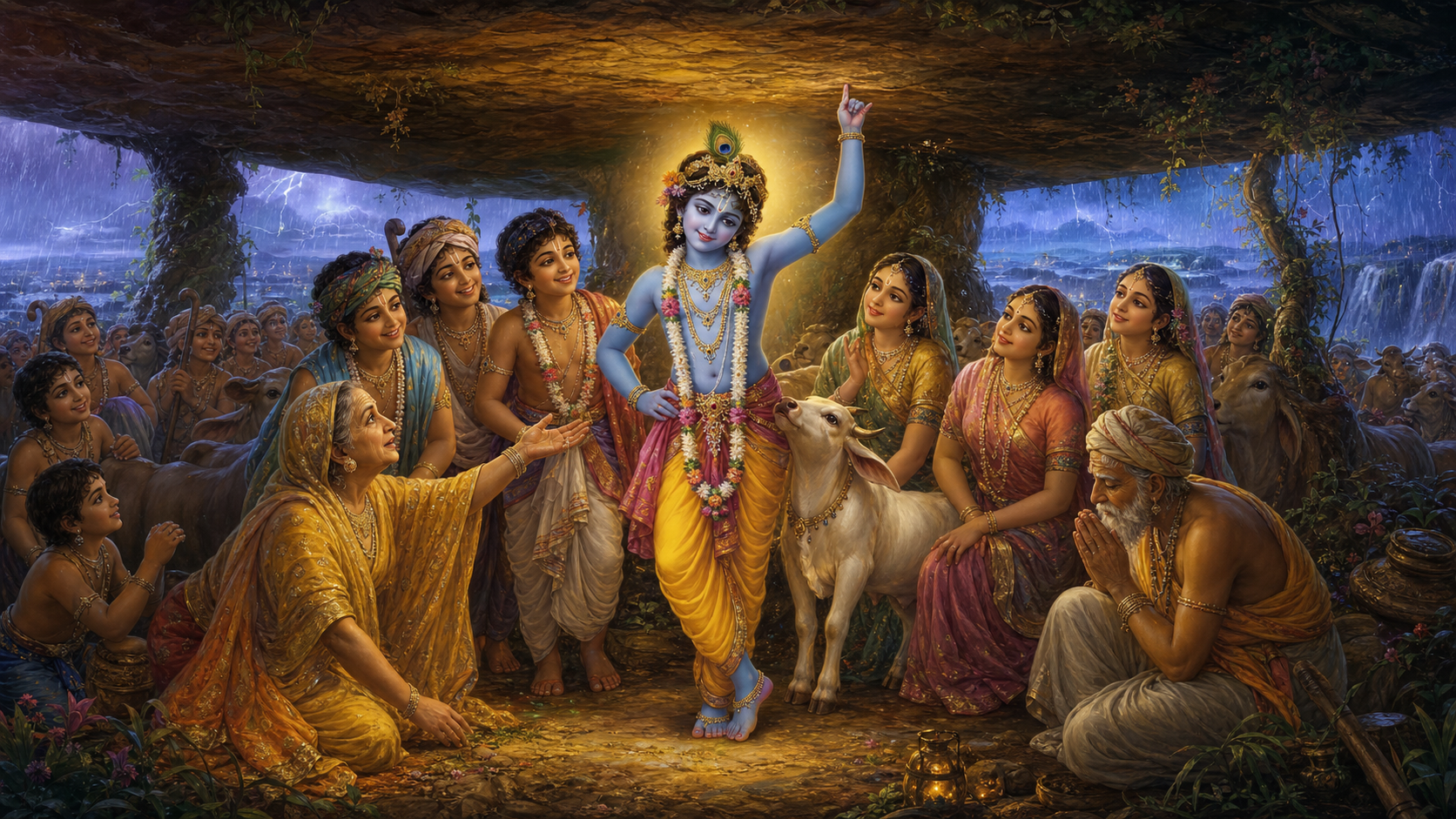
Rasa is sometimes reduced to emotion, as though a devotional image merely tries to make you feel something intense. In bhakti aesthetics, rasa is more exact. It is the relishable quality of a relationship with Krishna. The decisive question is not only what is happening, but who is beholding Him and how that person belongs to Him.
Govardhan-lila, narrated in the Srimad-Bhagavatam 10.25-27, is especially rich because the residents of Vraja assemble beneath one shelter. Their relationships do not dissolve into a uniform crowd. Shanta, dasya, sakhya, vatsalya, and madhurya can all arise around Krishna at once without cancelling one another.
- Shanta: quiet steadiness and wonder rest in Krishna’s presence.
- Dasya: devotion takes the form of service and readiness to act for Him.
- Sakhya: the cowherd boys continue to meet the mountain-lifter as their friend.
- Vatsalya: elders behold the same Krishna through parental affection and concern.
- Madhurya: the gopis remain joined to Him through intimate, beloved love.
These are relational lenses, not labels to attach mechanically to every figure in a painting. Nor should the gathering be used to turn rasa into a competition. For this lila, ranking the devotees misses the compositional point: Krishna permits distinct forms of love to remain distinct while giving them one refuge.
When you contemplate the assembly, choose one standpoint at a time. Ask whose eyes you are looking through. What would a cow notice? What reassures a child? What makes a friend laugh rather than bow from a distance? What does an elder still feel responsible for, even while Krishna protects everyone? What does the beloved see that a neutral spectator cannot?
This method keeps rasa grounded in relationship. It also corrects a common misreading of sacred beauty. Krishna is not beautiful merely because His body has harmonious lines. He is beautiful because every gesture is received within love. Tribhanga becomes bhakti-rasa when the beholder’s relationship gives the posture its devotional flavor.
Surrender beneath Govardhan is active shelter
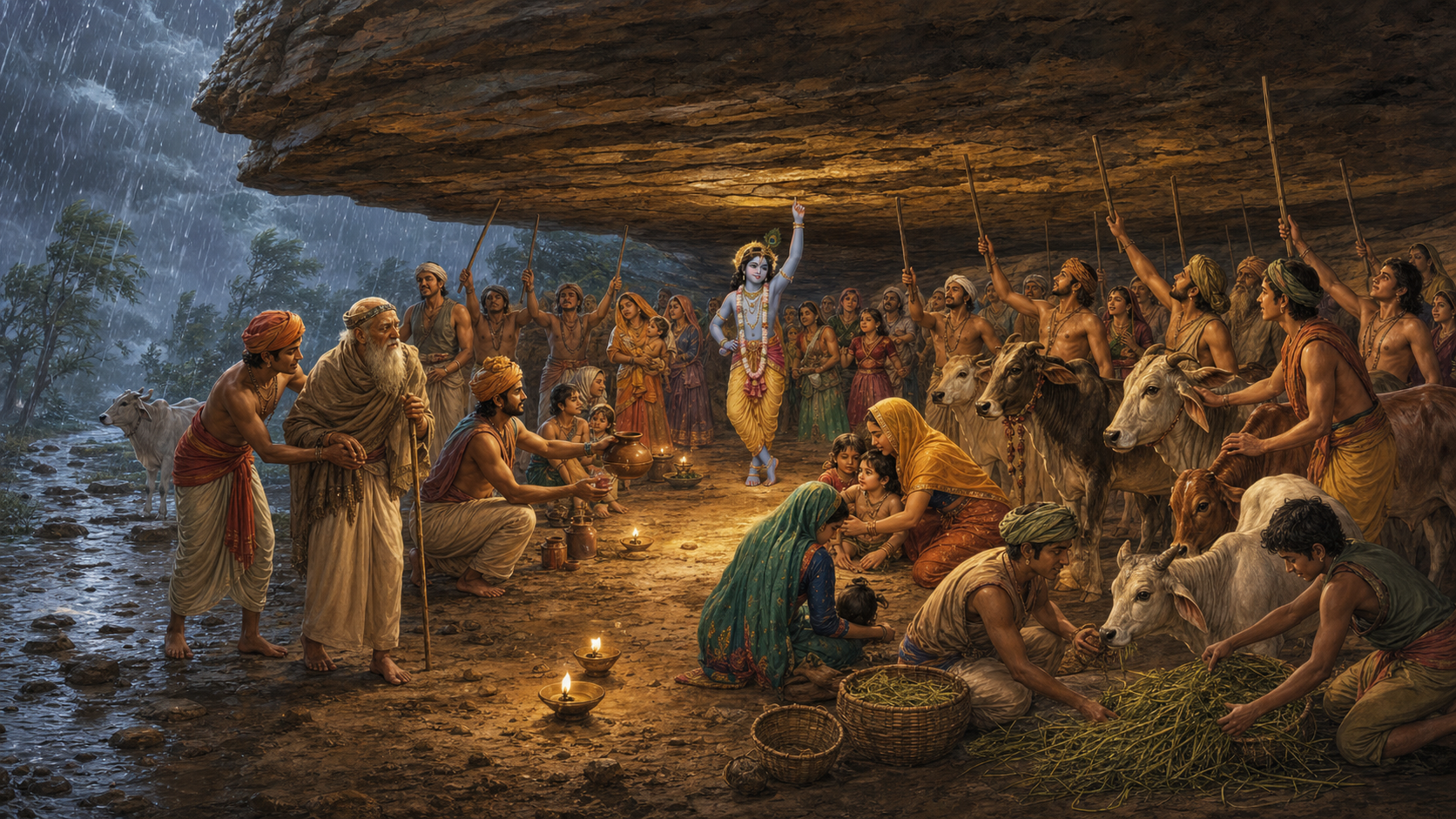
The storm matters. Surrender would mean little if danger were denied, and refuge would mean little if no vulnerable being required protection. Govardhan-lila does not teach you to pretend that circumstances are weightless. It shows how the weight is relocated: Krishna bears what the community cannot, while the community gathers around Him rather than scattering in fear.
This is why the scene can illuminate Bhagavad Gita 9.22 and 18.66, verses often invoked when speaking about divine provision, protection, and surrender. The lila should not be turned into a formula promising that devotees will never meet a storm. Its claim is relational. Crisis does not have the final authority to define the devotee’s consciousness when Krishna becomes the center of refuge.
The body of Giridhari makes that surrender concrete. His lifted arm says that protection ultimately depends upon a power beyond the frightened community. His grounded foot says that divine protection is not abandonment of the world. Refuge occurs among kin, animals, land, laughter, music, and responsibility.
That last point gives Govardhan-lila an ethical edge. Cows, people, and place are sheltered together. Worship is redirected from prestige toward care for a living community. The names Gopala, Govinda, and Giridhari therefore ask something of the worshipper: if you praise the protector of cows, land, and Vraja, your conduct should become more protective.
You can test a devotional reading by its fruit. If your contemplation makes you attentive to someone who lacks shelter, more careful with animals, more responsible toward land, or steadier in service, the image has begun to shape conduct. If it produces fascination with divine power but indifference to vulnerable beings, you have seen the raised arm and overlooked the foot touching the earth.
Readers across the dharmic family may recognize related ethical accents. Jain ahimsa sharpens the obligation of non-harm. Buddhist karuna and upekkha illuminate compassion joined to steadiness amid a storm. Sikh simran underscores the power of remembrance. These resonances need not erase the traditions’ differences. Govardhan-lila remains a Krishna-bhakti revelation in which shelter is personal, relational, and centered upon Bhagavan.
A disciplined way to contemplate Govardhan-lila
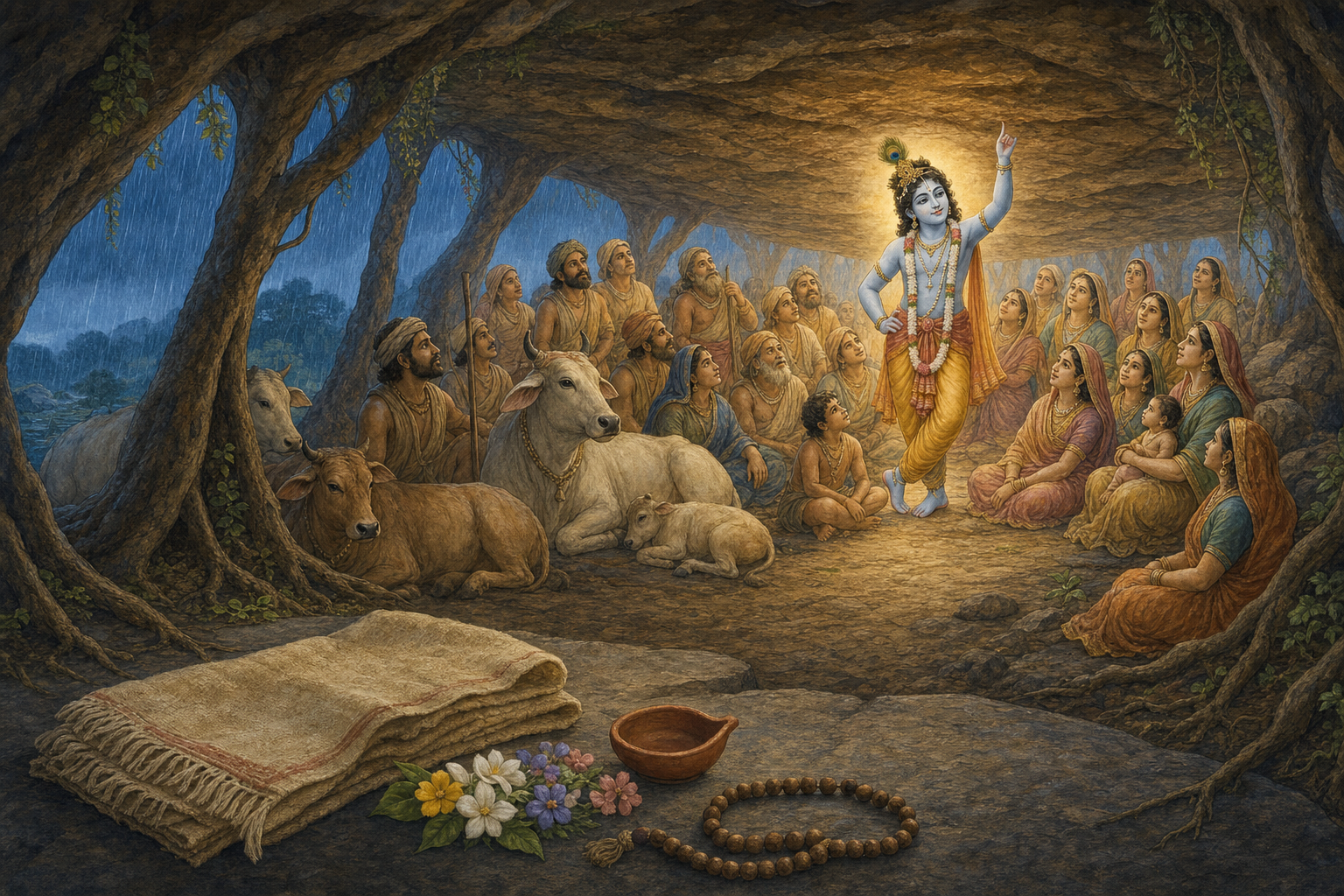
Lila-smarana is not a contest in visual imagination. Its purpose is recollection with attention. You do not need to manufacture an extraordinary state. You need enough steadiness to let form, relationship, and responsibility remain together.
- Begin with the narrative. Read Srimad-Bhagavatam 10.25-27 so the remembered image remains anchored in the lila rather than in disconnected symbolism. Notice the danger, the gathering, the protection, and the restoration of safety.
- Construct the image from the ground upward. Attend to the left foot, raised right heel, gently contracted knee, curved waist, lifted arm, moving garland and caddar, pollen-marked cheek, smile, and silent ankle-bells. If an inner image does not arise clearly, look at a traditional depiction and describe only what you can actually see.
- Select a relational standpoint. Contemplate one resident of Vraja rather than trying to feel every rasa at once. Ask what that devotee fears, what in Krishna gives assurance, and how an established relationship changes the meaning of His power.
- Join remembrance to nama-japa. Let the breath remain ordinary and unforced. When attention wanders, return to Krishna’s Name and then to one stable feature of the scene, such as the grounded foot, gentle smile, or supporting hand.
- Complete remembrance through service. Identify one act of shelter appropriate to your duties: reassure a person, serve the devotional community, care for an animal, or protect a shared place. Do not use contemplation as a substitute for a responsibility already in front of you.
In sangha, the same practice can reveal the lila’s plurality. Let each participant name one visual detail, the relationship through which it becomes meaningful, and the service it calls forth. Do not force agreement about which rasa is highest. The gathering beneath Giriraj teaches how different devotional relationships can share one center without becoming identical.
A useful measure is precision rather than intensity. Are you noticing more of Krishna’s form? Can you distinguish majesty from sweetness without separating them? Does remembrance leave you more willing to serve and protect? These questions are more reliable than chasing a dramatic feeling.
Key takeaways
- Tribhanga is theological as well as beautiful: Krishna’s relaxed posture reveals strength without strain and transcendence without distance.
- Rasa arises through relationship. The same Giridhari is encountered through quiet wonder, service, friendship, parental affection, and beloved love.
- Pollen, moving cloth, silent bells, the flute, and Madhumangala’s humor keep divine majesty intimate and playful.
- Surrender beneath Govardhan is not withdrawal from the world. It gathers people, cows, land, memory, and duty beneath Krishna’s protection.
- Lila-smarana becomes complete when careful seeing, nama-japa, and a concrete act of shelter reinforce one another.
The next time you stand before Giridhari, pause before asking only how Krishna lifted the hill. Trace the form from His earthbound foot to His mountain-bearing hand. Look through one devotee’s eyes, repeat His Name, and decide what or whom you can help shelter. That is the movement by which sacred beauty becomes theology, remembrance, and lived bhakti.
References
