
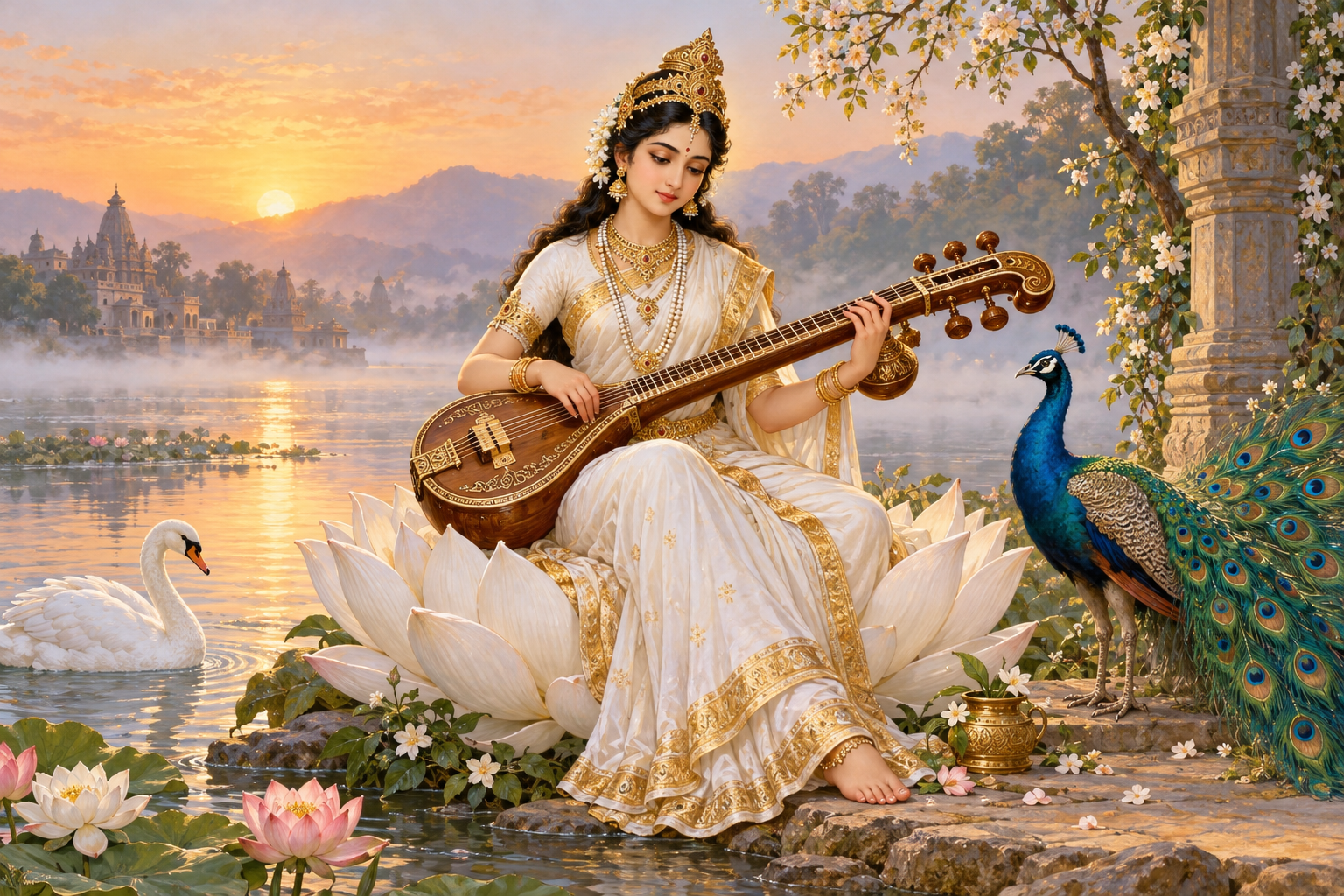
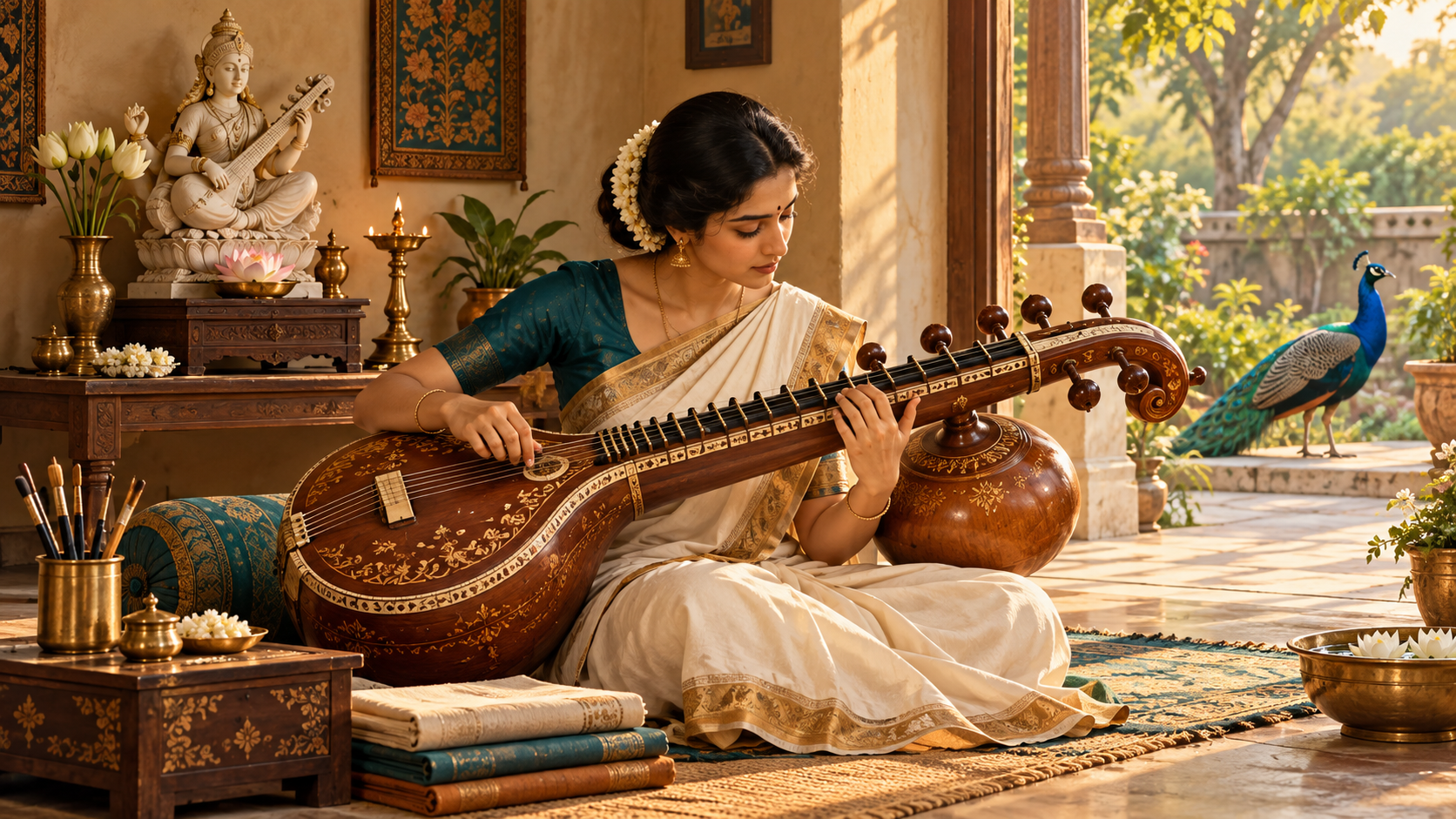
You have seen a peacock beside Saraswati and may be wondering what it is doing there. Is it another vehicle of the goddess, a decorative flourish, or a warning about pride? The safest answer begins with what the image actually shows, because a bird beside a deity does not always perform the same symbolic role as a bird carrying that deity.
Saraswati is most commonly pictured with the swan, while some depictions also place a peacock beside her. The two birds need not compete. The swan points toward discernment; the peacock raises a different question: what will you do with beauty, talent, attention, and the desire to be admired?
Read the peacock’s position before naming its role
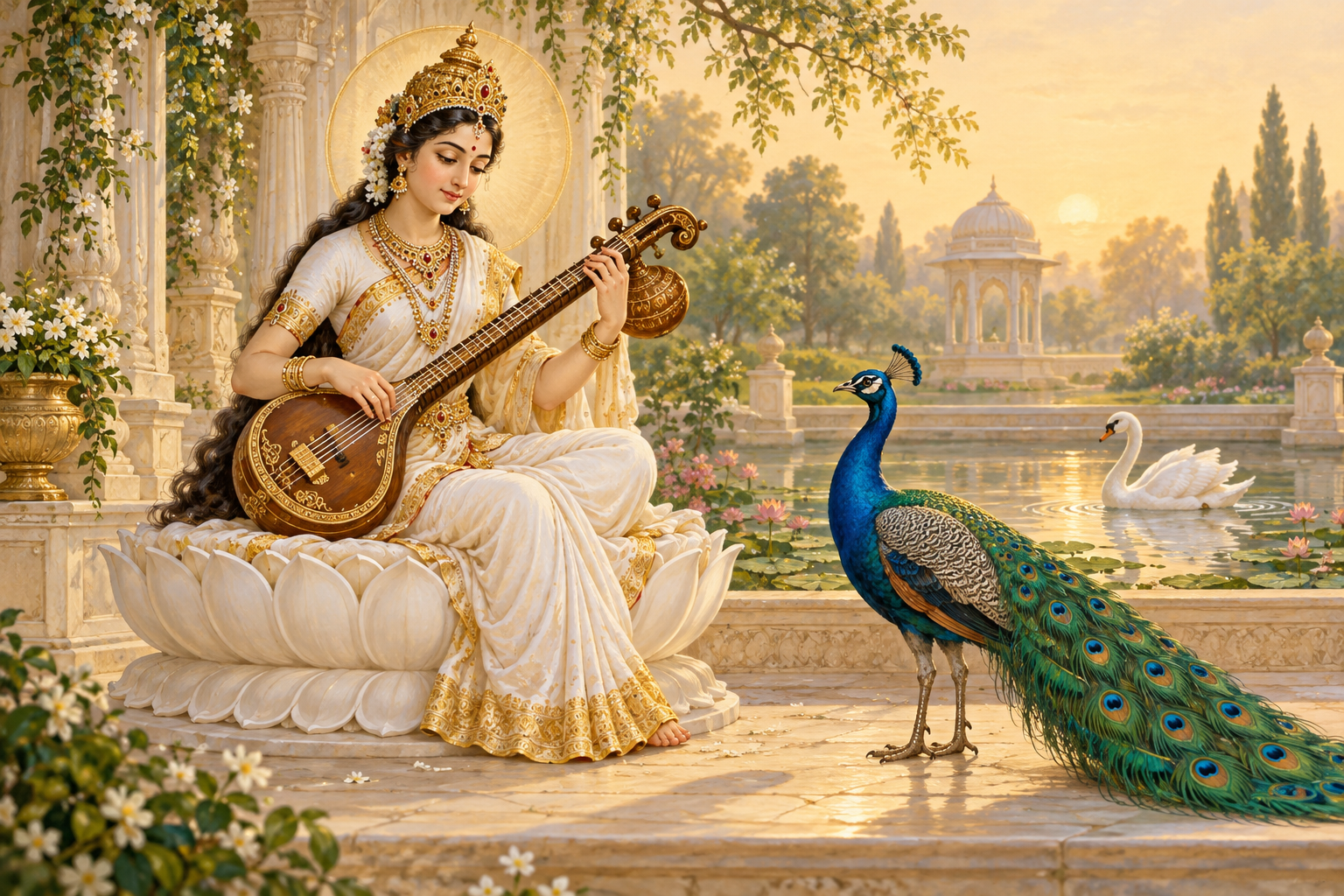
Begin with observation rather than a fixed explanation. If Saraswati is seated upon a bird, that bird functions differently within the composition than one standing nearby. If the swan and peacock both appear, the most useful reading is usually complementary: one symbol has not necessarily displaced the other.
- Look beneath Saraswati first. Is a bird visibly bearing or supporting her?
- Then look beside her. Is the peacock an attendant presence rather than the physical seat?
- Check whether a swan also appears. Its presence makes a two-part symbolic reading more plausible.
- Notice the kind of image you are viewing. A traditional devotional composition and a freely arranged modern illustration may use the same motifs with different levels of precision.
If the peacock merely stands near Saraswati, calling it an associated symbol or companion is more careful than declaring it her universal vehicle. This distinction matters because Hindu iconography is not decoded by identifying an animal in isolation. Placement, relationship, and the qualities of the deity all shape the meaning.
The peacock turns beauty into a test of attention
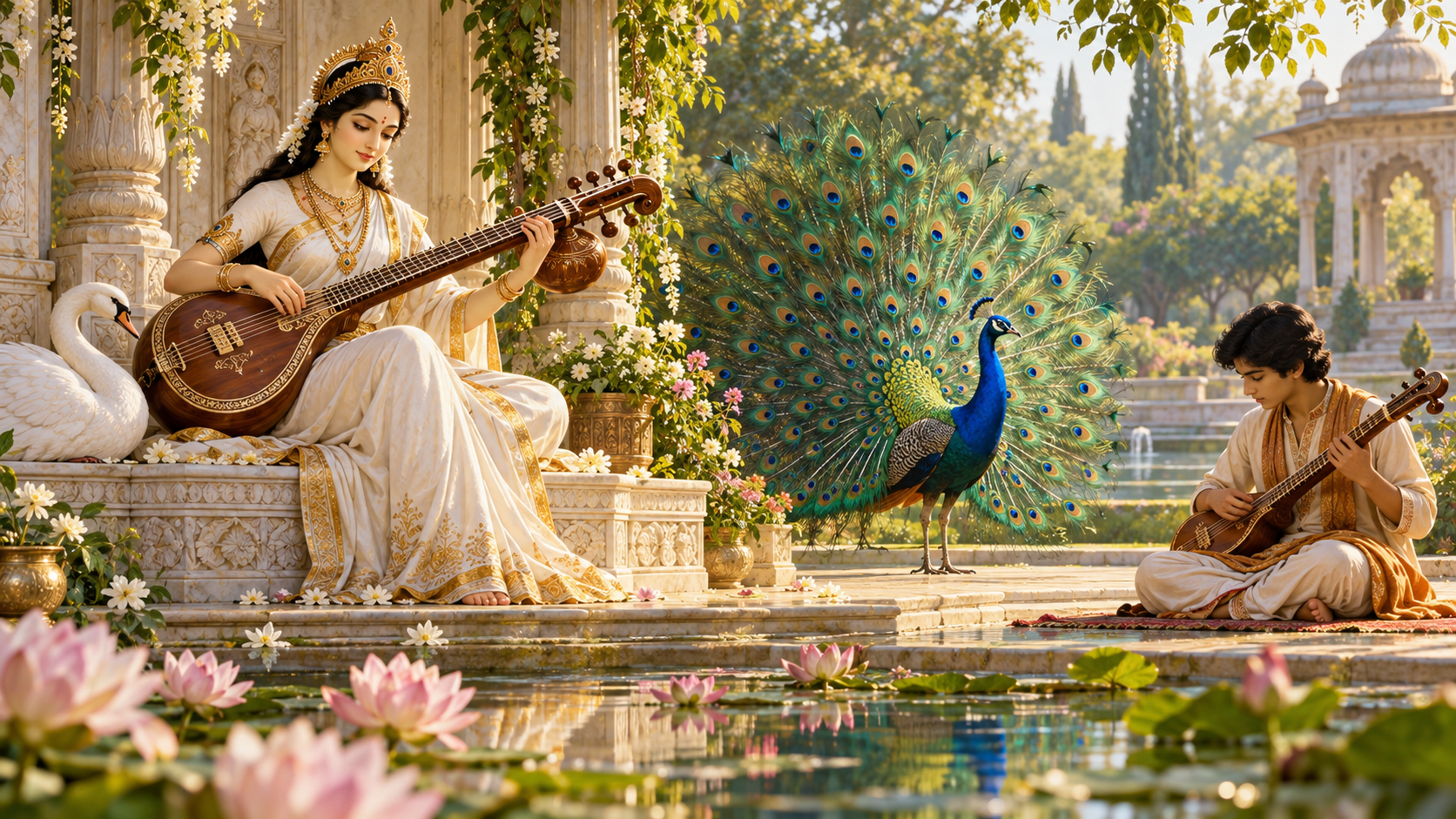
The peacock draws the eye. Its splendour makes it an apt symbol for beauty, display, and the fascination of appearances. Beside Saraswati, however, that attraction is placed within the domain of knowledge, art, and wisdom. The question is not whether beauty is bad. The question is whether beauty serves understanding or replaces it.
This is where illusion enters the symbolism. Illusion here need not be treated as an abstract claim that everything beautiful is unreal. It is the ordinary error of mistaking presentation for substance: polished language for sound reasoning, information for wisdom, applause for artistic worth, or visible sophistication for genuine learning.
The peacock therefore acts less like a condemnation and more like a diagnostic mirror. Knowledge can become an ornament for the ego. Artistic skill can become a performance aimed only at admiration. Eloquence can hide confusion. Even devotion can stop at an attractive image without moving toward the quality represented by that image.
Saraswati’s presence changes the direction of the symbol. Beauty is not expelled; it is educated. Talent is not suppressed; it is given purpose. The capacity to attract attention becomes valuable when it guides attention toward truth, clarity, learning, or a worthy expression. In that movement, ignorance is not merely rejected. It is converted into insight.
The swan and peacock ask different questions
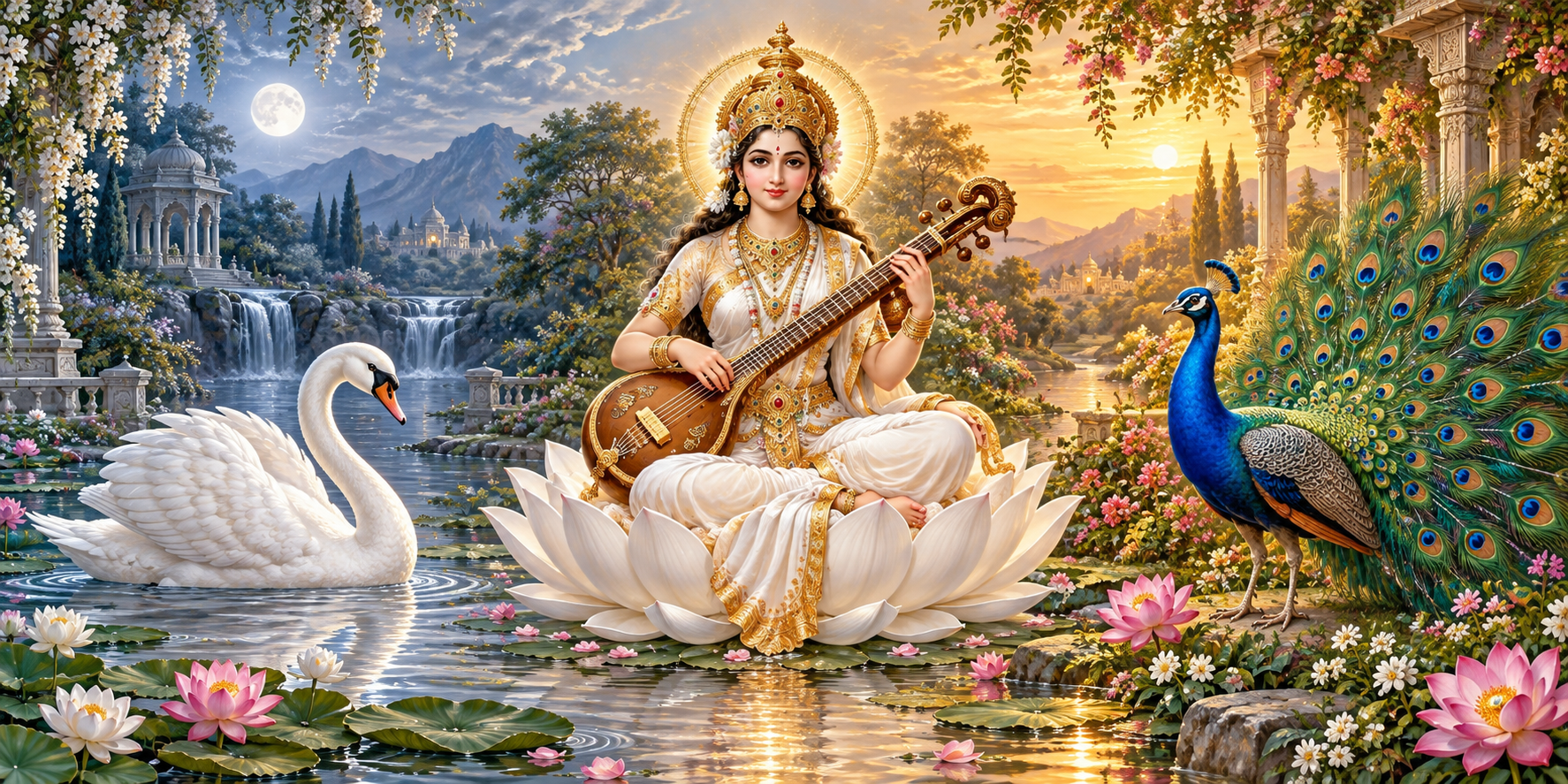
The swan is traditionally associated with the ability to separate milk from water, a metaphor for discernment. It asks you to distinguish the essential from the incidental and the true from the misleading. The peacock asks what happens before that distinction: why did a particular appearance capture your attention so strongly?
Used as a contemplative pair, the birds offer two related disciplines:
- In learning: the swan asks whether a claim is sound; the peacock asks whether impressive language made you accept it too quickly.
- In art: the swan clarifies the work’s purpose; the peacock tests whether ornament strengthens that purpose or distracts from it.
- In speech: the swan selects accurate and necessary words; the peacock reveals when the desire to impress has taken control.
- In devotion: the swan seeks the meaning behind a sacred form; the peacock asks whether you have allowed the form to become the endpoint.
This pairing avoids two shallow conclusions. The first is that wisdom must reject colour, pleasure, or artistic excellence. That cannot fit a goddess who embodies art as well as knowledge. The second is that whatever delights the senses must therefore be spiritually useful. Attraction may open the door, but discernment decides where the door leads.
The practical standard is service. Does the beautiful form serve meaning? Does talent serve truth? Does learning produce clarity, or merely a more elaborate identity? The peacock alerts you to the power of appearance; the swan helps you judge what that appearance carries.
Use the image as a practice of disciplined creativity
You can turn this symbolism into a brief reflection before studying, writing, speaking, performing, or making art. This is a contemporary contemplative exercise, not a claim about a scripturally required ritual.
- Name the work. State plainly what you are trying to understand, create, or communicate.
- Notice the peacock pull. Ask which part of the work is designed mainly to attract praise, signal sophistication, or protect your self-image.
- Make the swan’s distinction. Separate what carries the meaning from what merely decorates it. If you cannot explain an idea plainly, do not let polished wording conceal that gap.
- Put beauty back in service. Keep the colour, elegance, or flourish that helps another person attend to the truth. Revise what competes with it.
- Finish with an act of learning. Correct a weak claim, practise a difficult passage, clarify a sentence, or seek the meaning you have not yet understood.
A student can apply this by removing any phrase from their notes that they cannot explain in ordinary language. An artist can identify which detail deepens the work and which detail exists only to demonstrate skill. A speaker can ask whether an elegant sentence makes the thought clearer or merely makes the speaker sound clever. A devotee can let the beauty of Saraswati’s form gather attention, then direct that attention toward disciplined study and truthful expression.
The aim is not austerity for its own sake. A plain but confused work is no wiser than a beautiful but empty one. Saraswati’s peacock invites integration: beauty that attracts, discernment that examines, and wisdom that directs.
Key takeaways
- The swan remains Saraswati’s more familiar bird, while the peacock appears in some depictions as a meaningful secondary presence.
- The peacock can represent beauty, display, and the danger of mistaking appearance for understanding.
- Its symbolism does not require rejecting beauty. It asks whether beauty and talent are governed by wisdom.
- The swan tests what is true and essential; the peacock tests why something dazzling captured your attention.
- Before calling the peacock Saraswati’s vehicle, inspect whether she is seated upon it or it is standing beside her.
The next time you encounter Saraswati with a peacock, do not stop after identifying the bird. Let the image question your own use of knowledge and talent. Keep what helps truth become visible, and loosen your attachment to whatever asks only to be admired.
References

Leave a Reply
You must be logged in to post a comment.