
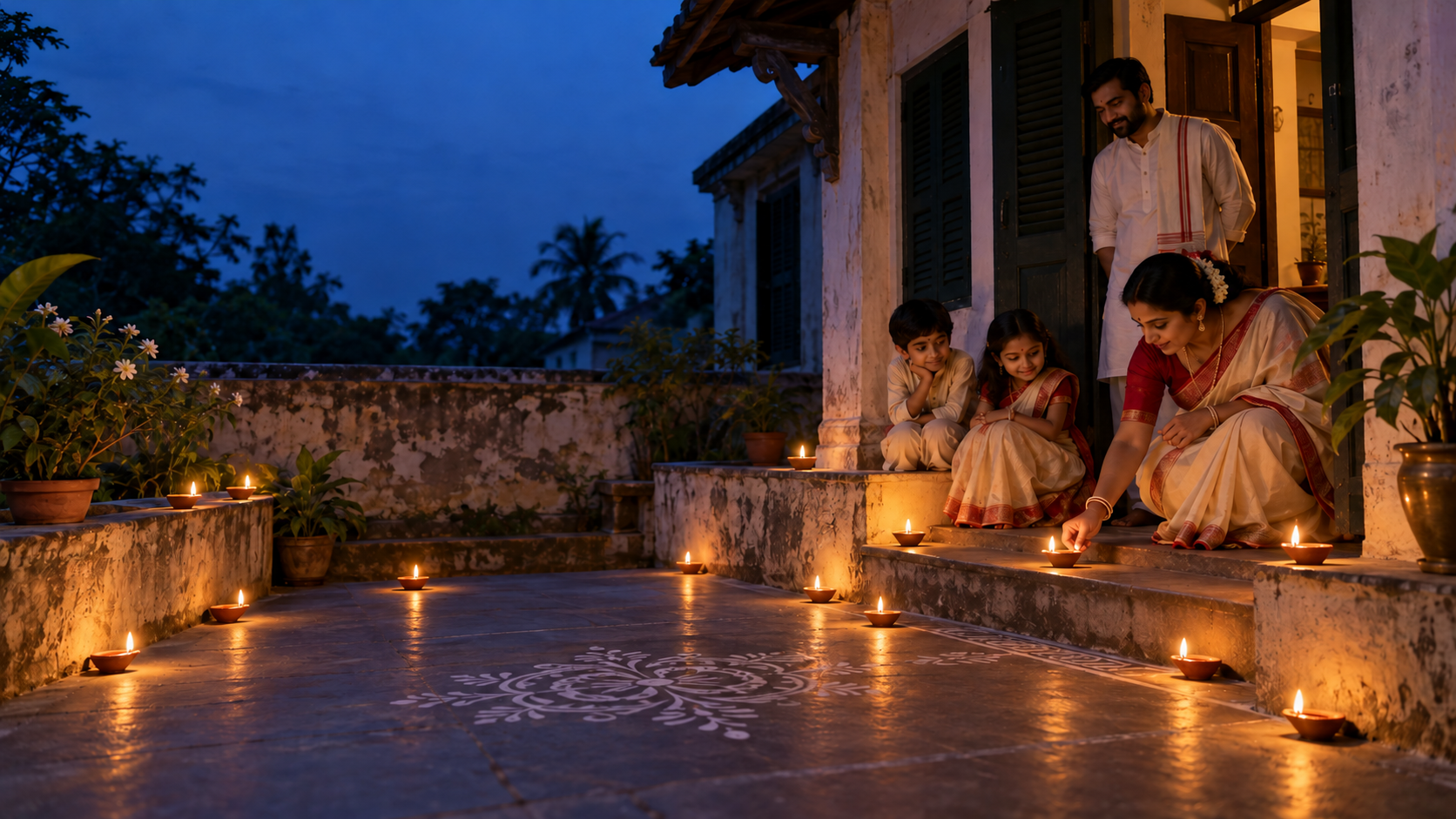
You want to observe Bhoot Chaturdashi properly, but the instructions you have heard may not agree. One person speaks of protection, another remembers the ancestors, and someone else insists that every lamp has a prescribed place.
Start with what the Bengali observance clearly asks of you: light fourteen lamps around the home on the evening before Kali Puja. Then let your family’s inherited practice determine the details that are not universal.
One observance carries three related meanings
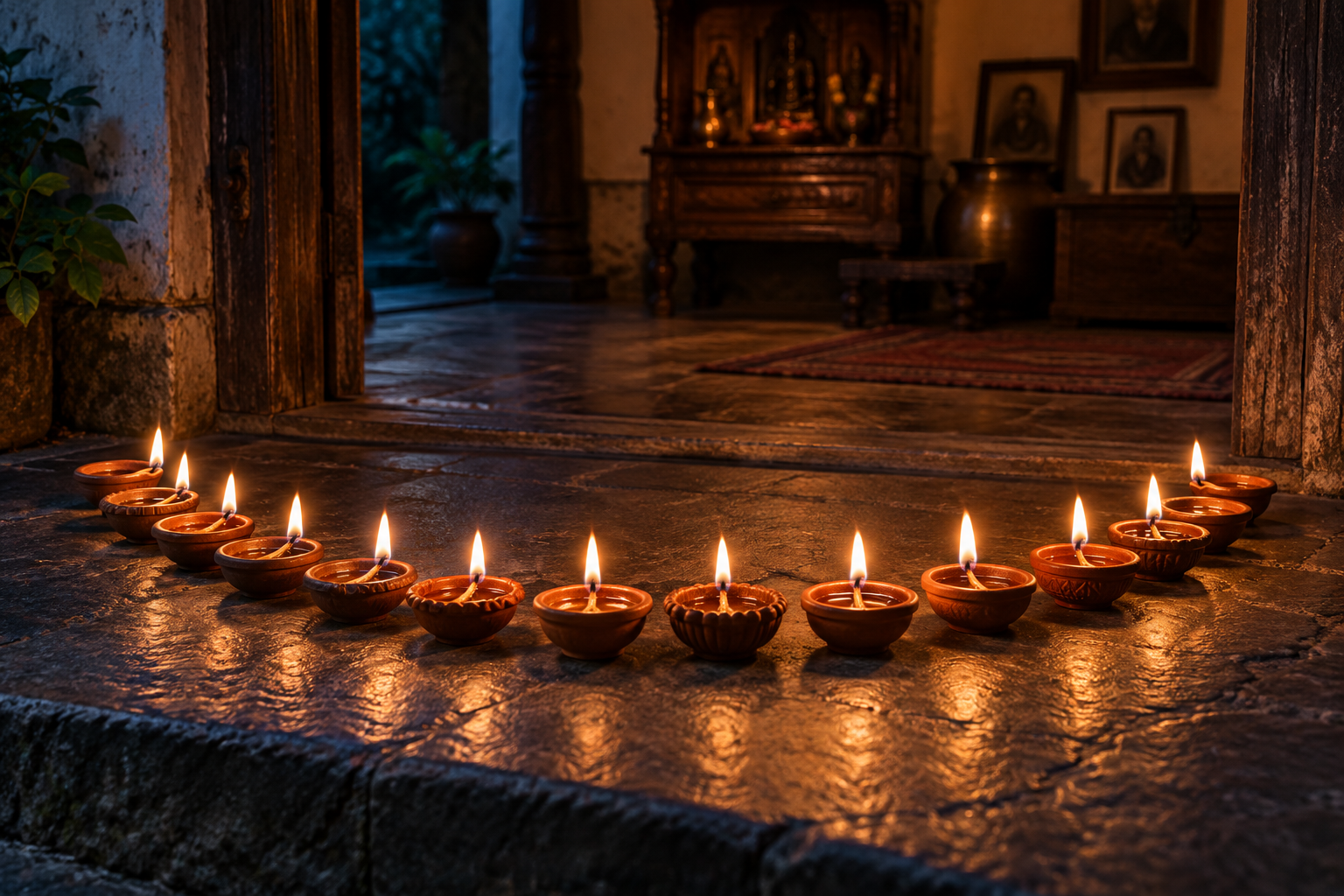
The fourteen flames are understood in more than one way. Some Bengali Hindus light them to keep harmful spirits away. Others treat the light as a means of clearing negative influences from the household. A further tradition holds that ancestors from both the paternal and maternal lineages return to the earthly realm on this evening and are welcomed or pleased by the lamps. These three understandings of the fourteen lamps need not be forced into a single explanation.
That distinction matters when you explain the ritual at home. If you reduce Bhoot Chaturdashi to a frightening story about ghosts, children may remember the fear and miss the reverence. If you describe it only as generic positivity, you may erase its connection to lineage. A fuller explanation is simple: the household places light against darkness while remembering those from whom the family descends.
You do not have to declare one interpretation false in order to follow another. A family may emphasize protection, remembrance, or both. What should remain visible is the deliberate act of bringing fourteen points of light into the domestic space.
Keep the shared core separate from family custom
The common elements are limited but clear: the observance belongs to the evening before Kali Puja, the number is fourteen, and the lamps are placed around the home. Exact locations, the kind of lamp, the fuel, the order of lighting, accompanying words, and the length of time the flames remain lit may be governed by household custom.
If your family already has a method, do not replace it with a confident-looking checklist found elsewhere. Ask an elder which details were actually followed at home. A useful question is not merely, “How do people do this?” Ask, “Where did our family place the fourteen lamps, and what did we remember while lighting them?” That wording helps recover practice as well as meaning.
If no inherited instructions are available, resist inventing a supposedly ancient rule. Observe the supported core plainly: prepare fourteen lamps, distribute them safely around the household, and light them during the appropriate evening with an intention of protection, purification, ancestral remembrance, or a combination of these. Simplicity is more honest than attaching unsupported claims to every location.
A respectful sequence for the evening
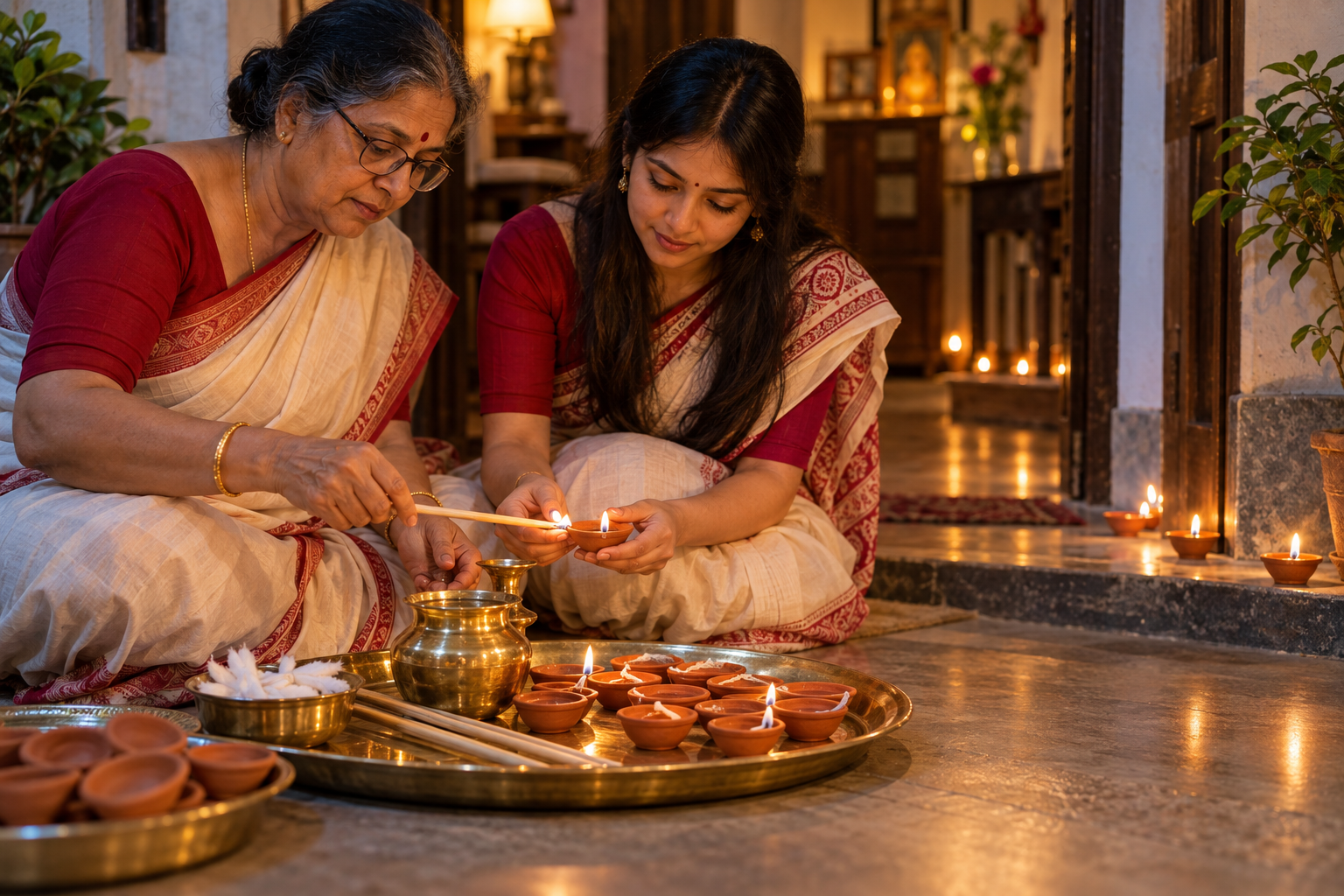
You can prepare the observance without turning it into an elaborate production. The important work happens before the first flame is lit: confirming your family custom, counting correctly, and choosing safe positions.
- Confirm the evening. Bhoot Chaturdashi is observed on the evening before Kali Puja. Check the calendar followed by your household or local community rather than guessing from a civil date.
- Ask about inherited details. If an elder or knowledgeable family member is available, confirm where your household traditionally puts the lamps and whether any prayer or remembrance accompanies them.
- Prepare and count all fourteen lamps first. Arrange them before lighting anything. This avoids discovering midway that a lamp, wick, or safe position is missing.
- Inspect every location. Use stable, heat-resistant surfaces. Keep flames clear of curtains, paper decorations, door movement, loose clothing, and places accessible to children or animals.
- Light with a clear intention. You may hold the household’s customary understanding in mind: protection from harmful influences, the removal of negativity, remembrance of both sides of the ancestral lineage, or all three.
- Supervise the flames continuously. Decide in advance which adult will remain responsible. Do not leave burning lamps unattended to satisfy an assumed ritual duration.
If you are observing away from Bengal or outside the family home, the same principle applies: preserve the count, occasion, and purpose, then adapt only what circumstances require. Where a residence prohibits open flames, ask a family elder or community authority how they handle the restriction. Do not present a modern substitute as an inherited rule unless it genuinely belongs to your tradition.
Fire safety is part of responsible observance
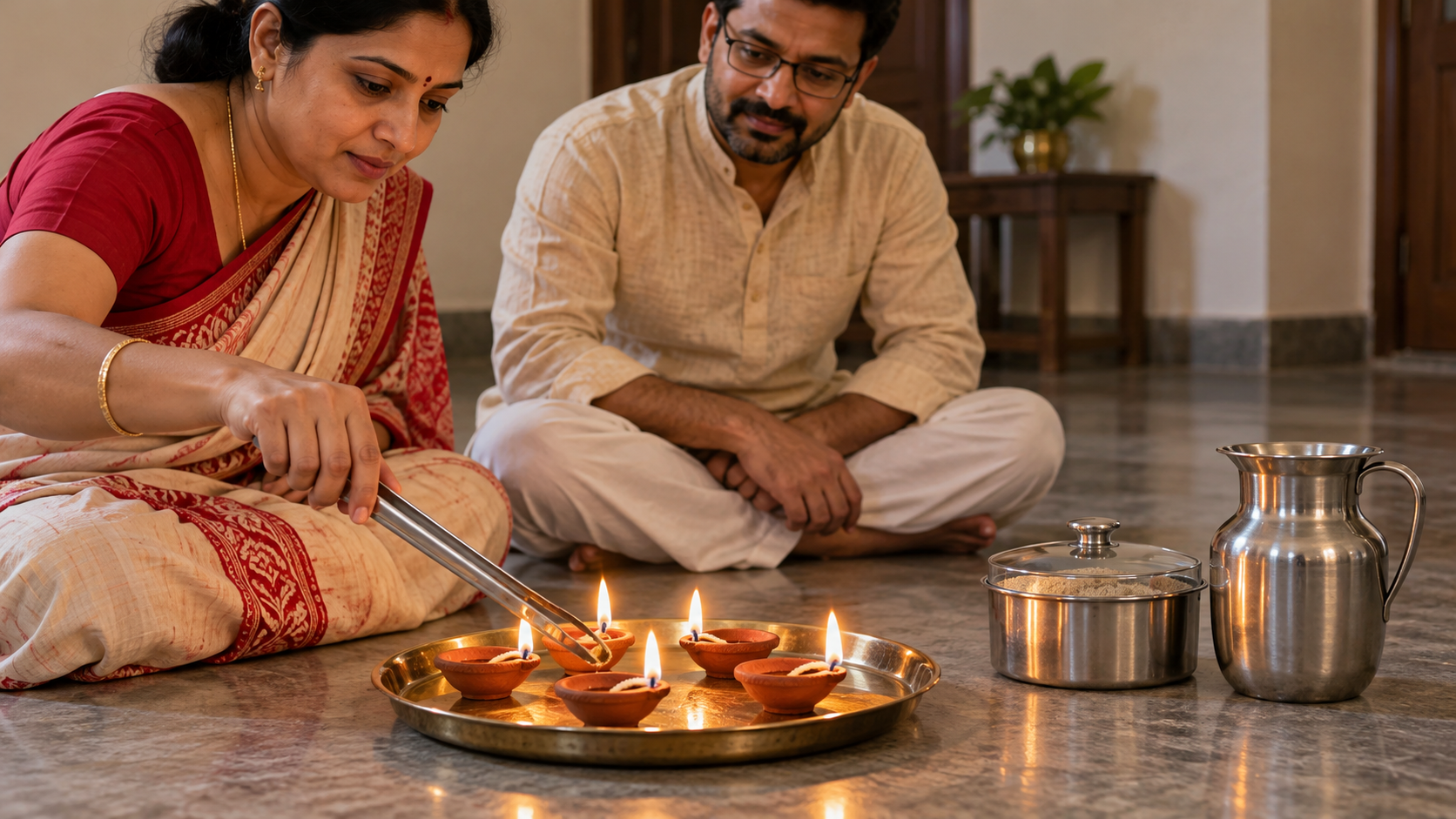
Fourteen separate flames create fourteen separate points of responsibility. A location that appears harmless before lighting can become unsafe when a curtain moves, a door opens, or someone walks past in loose clothing. Choose positions for how the household will actually move during the evening, not merely for symmetry.
Keep a suitable means of extinguishing a small flame close at hand, and make sure the supervising adult knows where every lamp has been placed. If one position cannot be watched or protected from contact, move the lamp. Ritual precision never requires accepting an avoidable fire risk.
Do not assign supervision to a child. Children can participate in counting, arranging unlit lamps, or remembering ancestors under adult guidance, but an adult should handle and monitor the flames. Before everyone leaves the area or goes to sleep, check each location rather than assuming all fourteen lamps have gone out.
Key takeaways
- Bhoot Chaturdashi calls for fourteen lamps around the home on the evening before Kali Puja.
- The lamps may signify protection from harmful spirits, the clearing of negative influences, a welcome to paternal and maternal ancestors, or a combination of these meanings.
- Keep the shared core distinct from details supplied by your own household tradition.
- If family instructions have been lost, follow a simple observance without inventing universal rules about placement or procedure.
- Prepare all fourteen lamps before lighting and keep every flame under continuous adult supervision.
Before the next Bhoot Chaturdashi, speak to the person in your family most likely to remember the old arrangement. Write down the placements and the meaning they were given. Lighting the lamps preserves one evening; preserving that knowledge gives the next generation a tradition it can understand and continue.
References

Leave a Reply
You must be logged in to post a comment.