
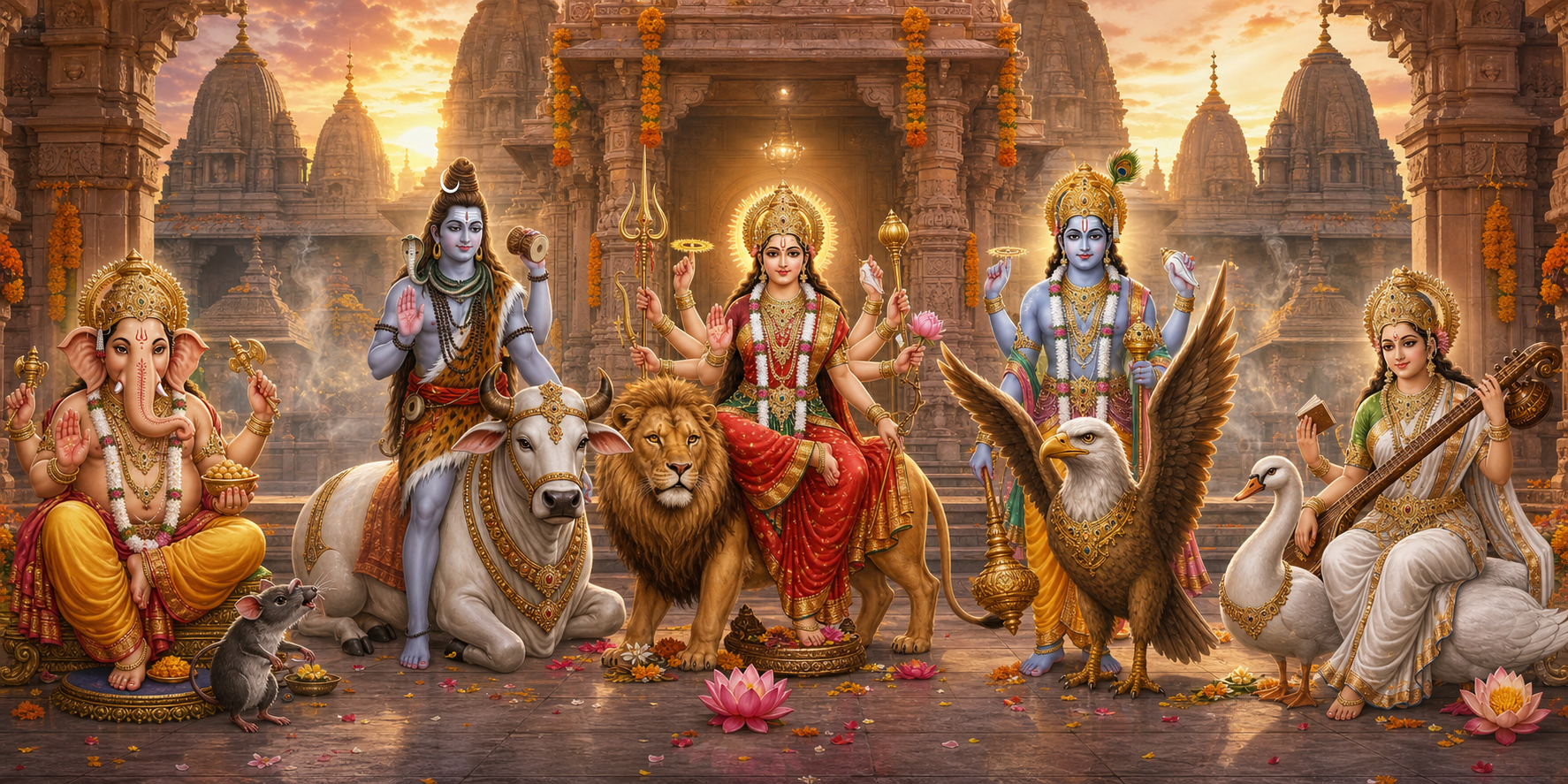
You may recognize Ganesha’s mouse, Śiva’s bull, or Devī’s lion and still wonder what you are meant to see. Is the animal simply transport, an identifying emblem, or a spiritual instruction? It can serve all three functions, but the most useful meaning lies in the relationship between the deity and the creature.
Learn to read that relationship and the image becomes practical. The animal gives visible form to an energy you already know: restless desire, strength, pride, speed, fear, vigilance, or discernment. The deity shows what happens when that energy is brought under dharmic direction.
The quick answer: a vāhana makes invisible qualities visible
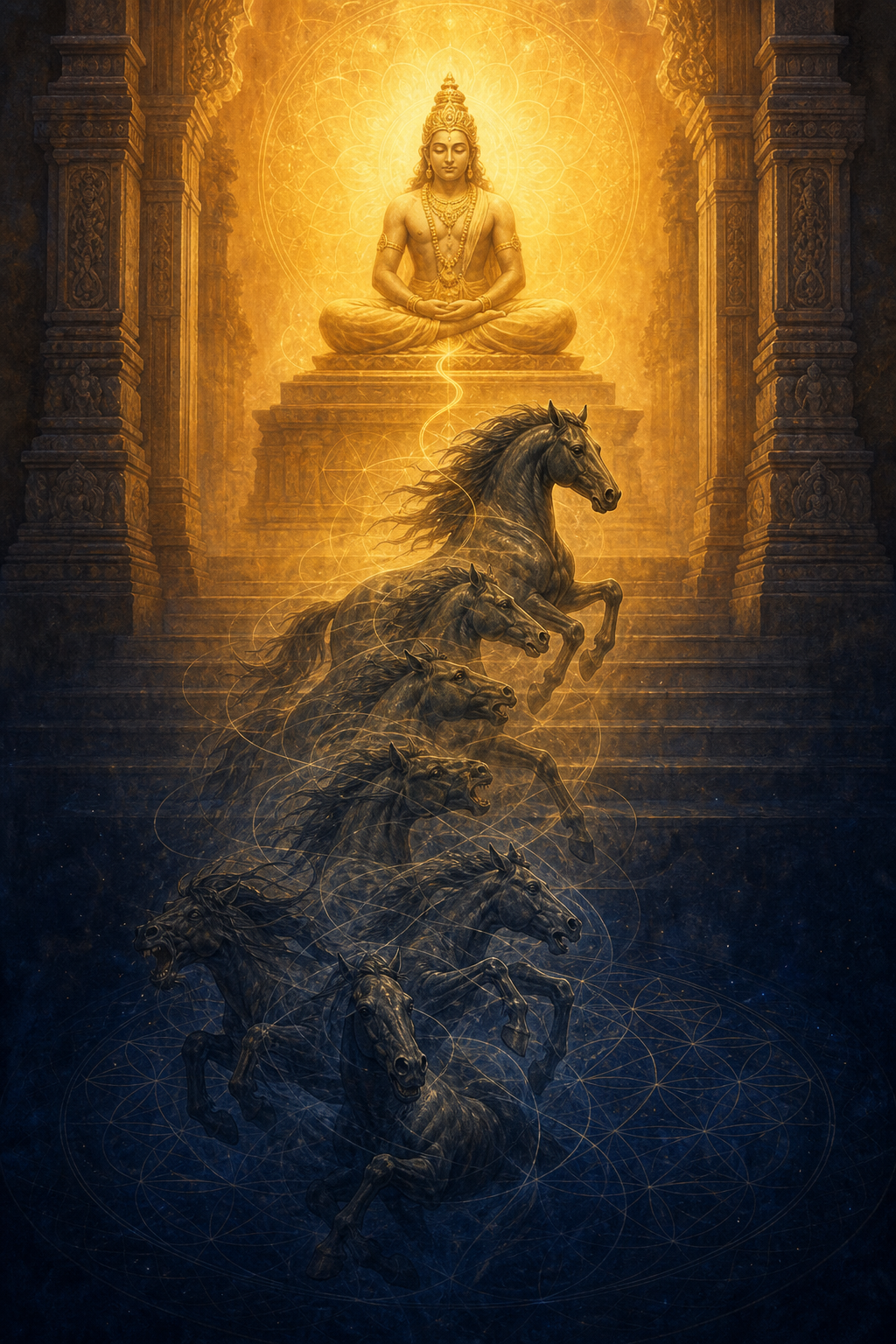
The word vāhana comes from the Sanskrit root vah, meaning to carry or convey. A divine vehicle therefore carries more than the deity’s form. It conveys the deity’s function into a language the eye can grasp.
This is why a vāhana should not be reduced to a decorative animal or a fixed dictionary entry. Purāṇas, Āgamas, the Citrasūtra of the Viṣṇudharmottara Purāṇa, and śilpa-śāstra traditions such as the Mayamata, Mānasāra, and Aparājitapṛcchā place these companions within an organized iconographic grammar. The animal, its posture, its scale, its direction, and its position relative to the deity all contribute to the meaning.
Key takeaways
- A vāhana is not merely a means of transport. It makes a divine power, responsibility, or mode of action visible.
- Begin with the creature’s energy, then ask how its relationship with the deity redirects that energy.
- Read the image through three connected lenses: the psychological and ethical, the cosmological and ecological, and the devotional and pedagogical.
- Mastery does not necessarily mean rejection. Restlessness can become alertness, strength can become steadiness, and ferocity can become protection.
- Temple placement and regional tradition matter. The same animal cannot always be decoded through one isolated keyword.
When you encounter a vāhana, start with what the animal does rather than with a memorized symbolic label. A mouse enters hidden spaces and nibbles persistently. A bull possesses immense strength but can also stand in complete stillness. An owl remains alert in darkness. A peacock displays extraordinary beauty. These traits provide the raw material; the deity reveals their dharmic possibility.
Then examine the relationship. Is the deity riding the animal, standing above it, accompanied by it, or facing it across a temple axis? Does the creature appear agitated, attentive, swift, or composed? Finally ask the question that turns iconography into practice: what unmanaged force in you is being shown, and what would it look like under wise guidance?
Ganesha’s mouse and Skanda’s peacock reverse ordinary expectations
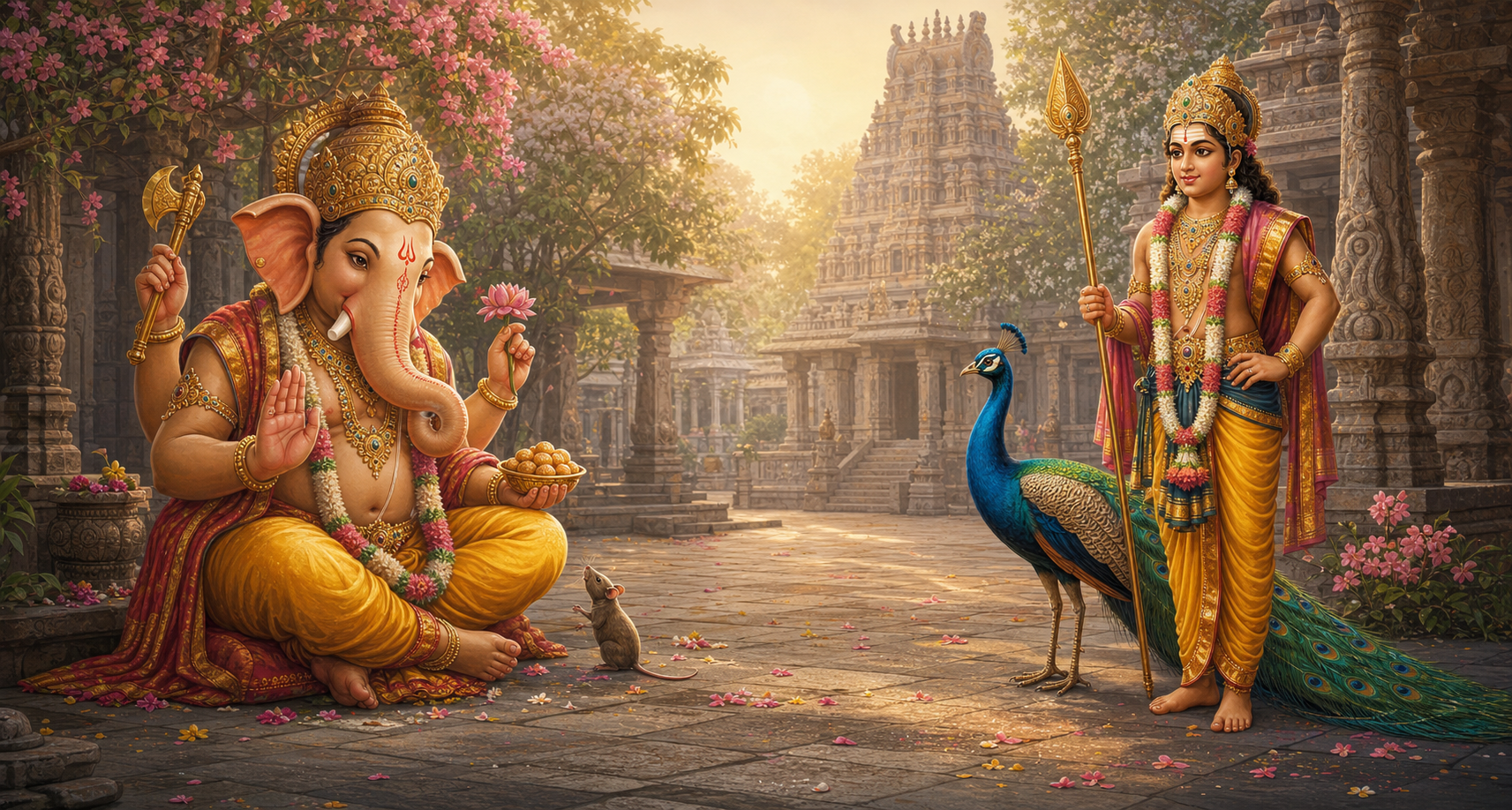
Ganesha and his mouse present an intentional disproportion. Vast elephant-headed intelligence is paired with a tiny, nocturnal creature that slips through openings and consumes things bit by bit. The mouse can therefore evoke the mind’s scattered movements, hidden appetites, and small habits that quietly undermine a larger purpose.
The Ganesha Purāṇa and Mudgala Purāṇa preserve narratives in which the disruptive Mūṣakāsura is transformed into Ganesha’s carrier. That transformation is the key. The troublesome force is not merely crushed and discarded; it is made to serve wisdom. The mouse remains small and active, but it now moves under the direction of buddhi and viveka, intelligence and discernment.
This gives you a precise way to understand Ganesha as Vighneśvara, the lord who removes obstacles. The image directs your attention to the obstacles that are easy to dismiss: the tab repeatedly reopened, the resentment mentally revisited, the appetite indulged in secret, or the minor duty postponed until it blocks everything behind it. Large plans often fail through these mouse-sized openings.
To use the image, name today’s mouse in behavioral terms. Do not settle for a vague label such as distraction. Identify what you actually do. Then give that energy a boundary and a useful task. Restless checking can become a deliberate review at a chosen point. Suspicion can become careful verification. Curiosity can be directed toward the work instead of every interruption. The lesson is not to become inert; it is to let intelligence decide where movement belongs.
Skanda, also known as Subramanya or Murugan, and his peacock teach a different form of transformation. The peacock’s splendor can suggest mada, the pride that grows around beauty, status, talent, or victory. Yet the bird also consumes snakes, making it an image of poisonous forces and concealed fears brought under control. Beside the commander of the divine forces, magnificence is joined to discipline.
The pairing does not demand dullness in place of beauty or weakness in place of martial power. It asks for splendor without vanity, speed without agitation, and courage without intoxication. This is especially visible in Tamil Murugan traditions, where the peacock contributes to an aesthetic of poised, disciplined energy rather than being an incidental accessory.
Before using authority, talent, or force, ask a peacock question: is this action protecting dharma, or displaying the person who acts? If the display has become the purpose, the peacock is carrying you. If skill serves a necessary and proportionate duty, Skanda is riding the peacock.
A practical atlas of major vāhanas
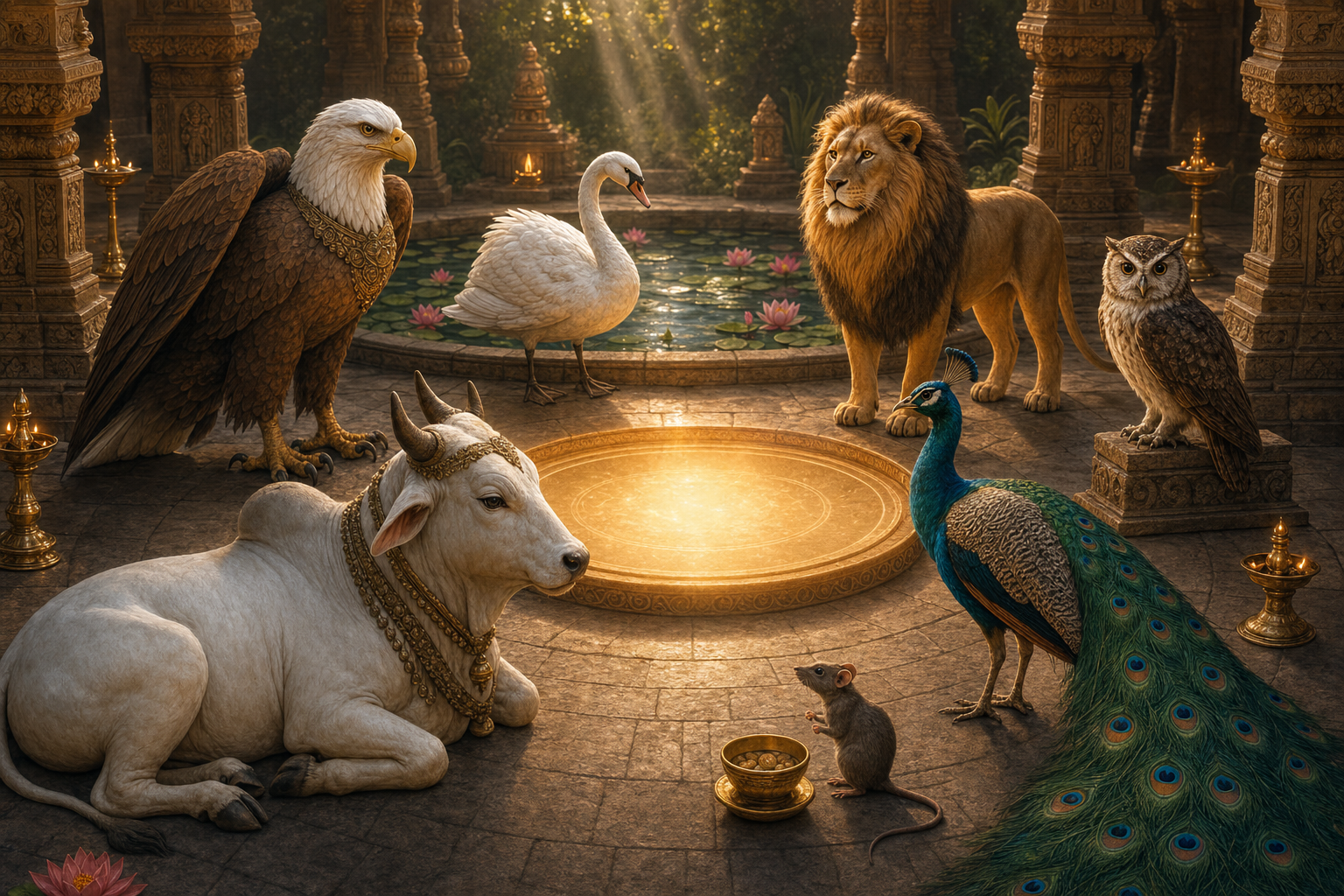
Once you recognize the pattern of transformation, the better-known pairings stop being disconnected pieces of mythology. They form a moral and psychological atlas. Use the following readings as disciplined starting points, not as claims that every image has only one permissible interpretation.
| Divine form | Vāhana | Raw or natural force | Dharmic direction | Question for you |
|---|---|---|---|---|
| Śiva | Nandi, the bull | Strength, vitality, and concentrated power | Steadfast devotion, conserved energy, and receptive attention | Can you remain still and attentive without becoming passive? |
| Viṣṇu | Garuḍa | Speed, altitude, and fearless movement | Discrimination, timely protection, and precise action | What requires swift action rather than hurried agitation? |
| Devī | Lion or tiger | Ferocity, sovereignty, and wilderness | Courage used to protect balance and confront adharma | Where is strength required for protection rather than domination? |
| Lakṣmī | Owl | Night vision, watchfulness, and composure in darkness | Vigilance in the acquisition and use of prosperity | What are you refusing to see about the way wealth is gained or spent? |
| Sarasvatī | Haṃsa, or swan | The traditional capacity to distinguish within a mixture | Viveka, clarity, and separation of essence from noise | Can you distinguish what you know from what you merely prefer? |
| Śani | Crow | Sobriety, watchfulness, and association with difficult consequence | Patience and accountability under karma | Which consequence must you face without evasion or self-pity? |
| Yama | Buffalo | Weight, inevitability, and formidable presence | The impartial operation of order across life and death | What unavoidable truth should govern your decision now? |
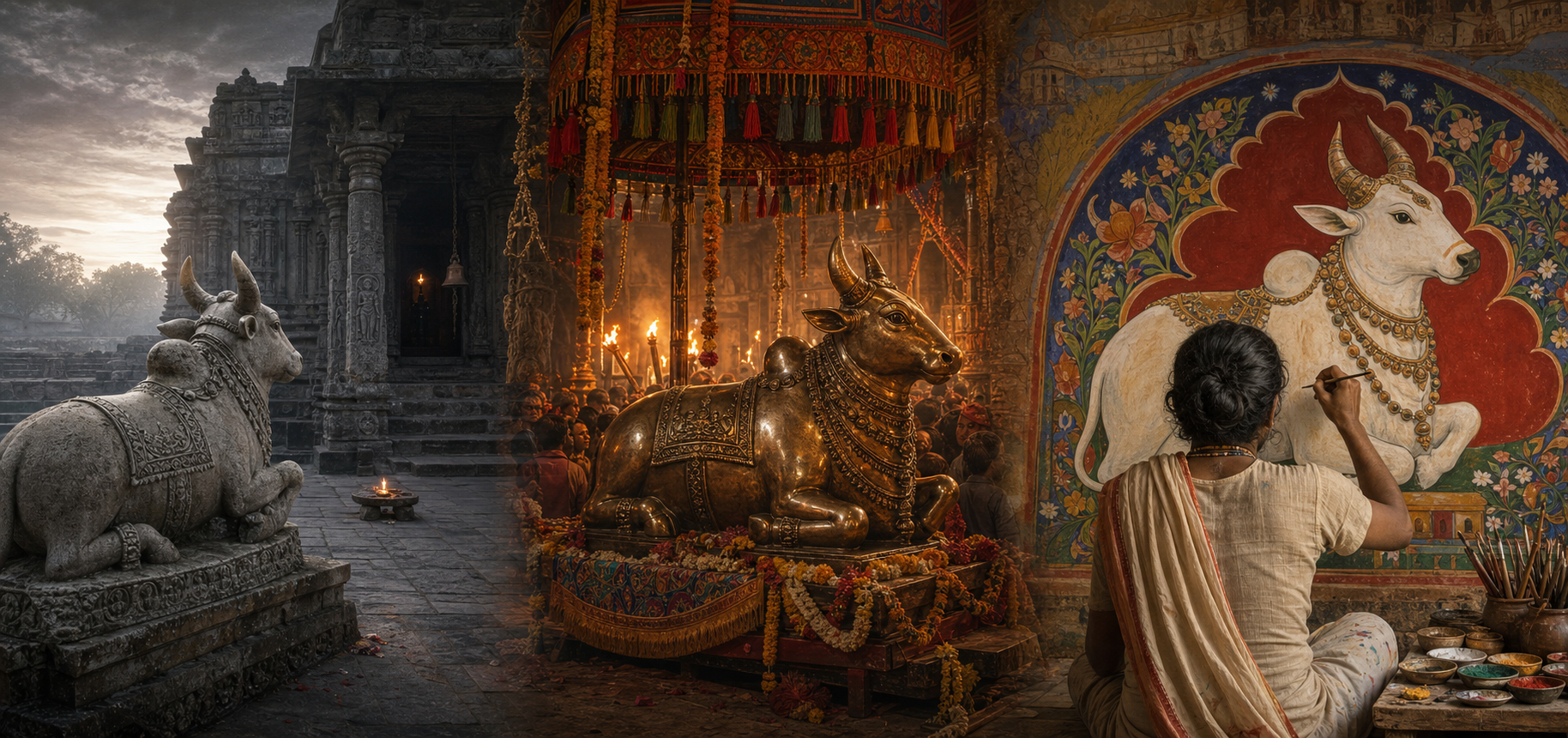
Nandi deserves particular attention because he is not merely shown beneath Śiva. In a Śiva temple, the bull commonly faces the liṅga. His power has become attentiveness. He models the śiṣya who is still, receptive, and alert. Read yogically, the image is not about exhausting vitality but conserving and directing it. If your strength cannot remain steady in the presence of truth, it has not yet become Nandi’s strength.
Garuḍa adds a vertical dimension to Viṣṇu’s preserving power. The mythic eagle crosses the heavens and retrieves the nectar of immortality. Speed here is valuable because it answers danger with discrimination and arrives in time to protect. The lesson is not that every problem demands haste. It is that preservation sometimes requires movement that is both fearless and exact.
Devī’s lion or tiger makes an equally important distinction between aggression and ethical ferocity. In the Devī Māhātmya, śakti confronts adharma through sanctified power. The animal’s force becomes fearless care: the capacity to defend the vulnerable, restore balance, and refuse accommodation with destructive conduct. A roar used to inflate the ego is noise. A clear intervention made because protection is required expresses a different quality.
Lakṣmī’s owl corrects the idea that prosperity is self-justifying. The capacity to see in darkness points toward vigilance while fortune changes. Wealth without awareness can conceal exploitation, vanity, or waste; wealth directed by discernment can nourish family, community, and just purposes. When Lakṣmī and the owl appear together, ask not only whether prosperity is present but whether anyone is awake enough to govern it.
Sarasvatī’s haṃsa carries the traditional image of separating milk from water. The point is viveka, not a zoological claim to test literally. Education becomes sacred when it distinguishes substance from accumulation, meaning from volume, and truth from attractive noise. This is why the pairing remains useful in an age of abundant information: access to more material is not the same as purified understanding.
Other pairings extend the grammar beyond individual psychology. Indra’s Airāvata joins rulership to rain and renewal. Sūrya’s seven horses have been interpreted through Vedic meters, colors of light, and vital airs, demonstrating that a single image can hold several compatible cosmological mappings. Candra’s antelope evokes gentle luminosity and the changing rhythms of mind. Agni’s ram expresses quick, transformative heat, while Vāyu’s antelopes suggest speed joined to delicacy of movement. Ayyappa’s tiger, in popular lore, brings holiness and wilderness into companionship.
These variations teach interpretive humility. Say that an animal may signify a quality in a particular setting, not that it always means one thing everywhere. At the same time, do not turn animals into disposable metaphors. Placing creatures beside divine forms nurtures reverence for living beings. An interpretation that produces contempt for the mouse, crow, owl, or buffalo has missed the ecological and ethical force of the image.
Context changes the image: temple, region, and tradition
In a temple, direction is part of the teaching
A vāhana is often built into sacred space rather than added as an afterthought. Nandi’s gaze establishes an axis toward the Śivaliṅga. A Garuḍa-stambha or Garuḍa mandapa announces entry into Viṣṇu’s sacred field. Lion or tiger platforms signal forms of Devī. During an utsava, the vehicle carries theology into movement, allowing a quality normally encountered in the sanctum to travel through the community.
When you next enter a temple, pause before looking only at the central mūrti. Scan the approach and pedestal. Notice which way the animal faces, whether its body is alert or restful, and whether it looks toward the deity or outward. Compare its scale with its prominence, but do not assume that smaller size means lesser worth. Sacred hierarchy can distinguish roles without degrading the creature.
Then consider whether you are seeing a stationary arrangement or a processional form. A still Nandi teaches receptive attention through posture. A moving Garuḍa vāhana emphasizes the swiftness of preservation. The physical relationship prevents symbolism from floating free of the actual image.
Regional variation should also sharpen your reading rather than trouble it. Chola bronzes, Pāla-Sena stone images, and later regional traditions developed different visual accents while retaining an intelligible sacred grammar. Lakṣmī’s owl is especially prominent in Bengal, Murugan’s peacock shapes Tamil temple landscapes, and Devī may appear with a lion or tiger in different regions. Variation is not automatically contradiction; it can reveal which dimension of a divine power a community has brought forward.
Across Dharmic traditions, similar animals do not always have the same role
The broader Dharmic world shares a confidence that animal imagery can disclose spiritual qualities, but precision matters. In Buddhist settings, lions can support thrones and express the fearlessness of the Dharma’s lion-like proclamation. Garuḍa, known as khyung in Himalayan traditions, can appear as a protector. These uses may resonate with Hindu imagery without becoming identical to a Hindu deity-vāhana relationship.
Jain Tīrthaṅkaras are identified by lāñchanas, including the bull of Ṛṣabha and the lion of Mahāvīra. These are emblems, not mounts. That distinction is worth preserving, especially because Jain animal symbolism belongs within a tradition whose radical ahiṃsā gives every form of life serious moral standing.
Sikh worship does not depend on images of deities and their vehicles. Gurmat nevertheless uses animal metaphors to expose restlessness, pride, and yearning, then directs the seeker toward nimratā, disciplined courage, and service. Calling every Dharmic animal image a vāhana would flatten these differences. A more faithful approach notices the shared ethical movement while retaining each tradition’s own grammar.
The shared movement is clear enough to guide your conduct: instinct is not necessarily an enemy to be hated, but an energy that must be educated; nature is not merely scenery, but a teacher; and spiritual maturity cannot be separated from compassion toward living beings. The lion of Devī, the Buddhist lion of fearless Dharma, and Mahāvīra’s lion emblem can converse across traditions without being treated as interchangeable signs.
Turn the vāhana into a daily discipline
You do not need to invent a private mythology or claim that a reflective exercise is a canonical ritual. Simply let the established relationship between deity and vāhana examine one real decision. The following method keeps the reflection concrete.
- Choose the pair that matches the difficulty. Use Ganesha and the mouse for persistent distraction, Nandi for undirected vitality, Skanda and the peacock for pride around talent or power, the owl for wealth that requires scrutiny, or the lion for a necessary act of protection.
- Describe the energy without condemning it. Restlessness contains movement. Pride may contain genuine ability. Anger may reveal that a boundary has been violated. The aim is to see the force accurately before deciding how it should serve.
- Name its unmanaged form as a behavior. Replace broad statements such as my mind is restless with an observable action: I abandon the chosen task whenever a new message appears. A precise behavior can be governed; a vague self-judgment cannot.
- Identify the deity’s governing quality. For Ganesha, bring in discernment. For Śiva and Nandi, steadiness. For Skanda, disciplined courage. For Lakṣmī and the owl, wakeful responsibility. For Sarasvatī and the haṃsa, discrimination between essence and noise.
- Give the energy a dharmic job. Direct restless attention toward checking the work at an appropriate point. Let pride support excellent preparation but not the demand for praise. Let anger state a clear boundary without becoming cruelty. Let the desire for prosperity investigate hidden costs before committing resources.
- Carry the lesson into your treatment of life. A mouse, crow, buffalo, owl, or tiger is not made sacred merely so humans can borrow its traits. Let the image strengthen ahiṃsā, ecological attention, and refusal of needless harm.
This practice also prevents a common misreading of self-mastery. The goal is not to mutilate the personality until nothing energetic remains. Ganesha still has an active mouse. Skanda still has a radiant peacock. Devī still rides a powerful lion or tiger. Dharma changes who directs the force, what purpose it serves, and where it stops.
The next time you stand before a mūrti or encounter a sacred image, do not stop at asking whose animal it is. Notice the creature’s nature, its posture, and its relationship with the divine form. Name the corresponding force in yourself, then give that force a dharmic task in your next decision. At that point, the vāhana is no longer only at the deity’s feet; it has begun to carry the teaching through you.