
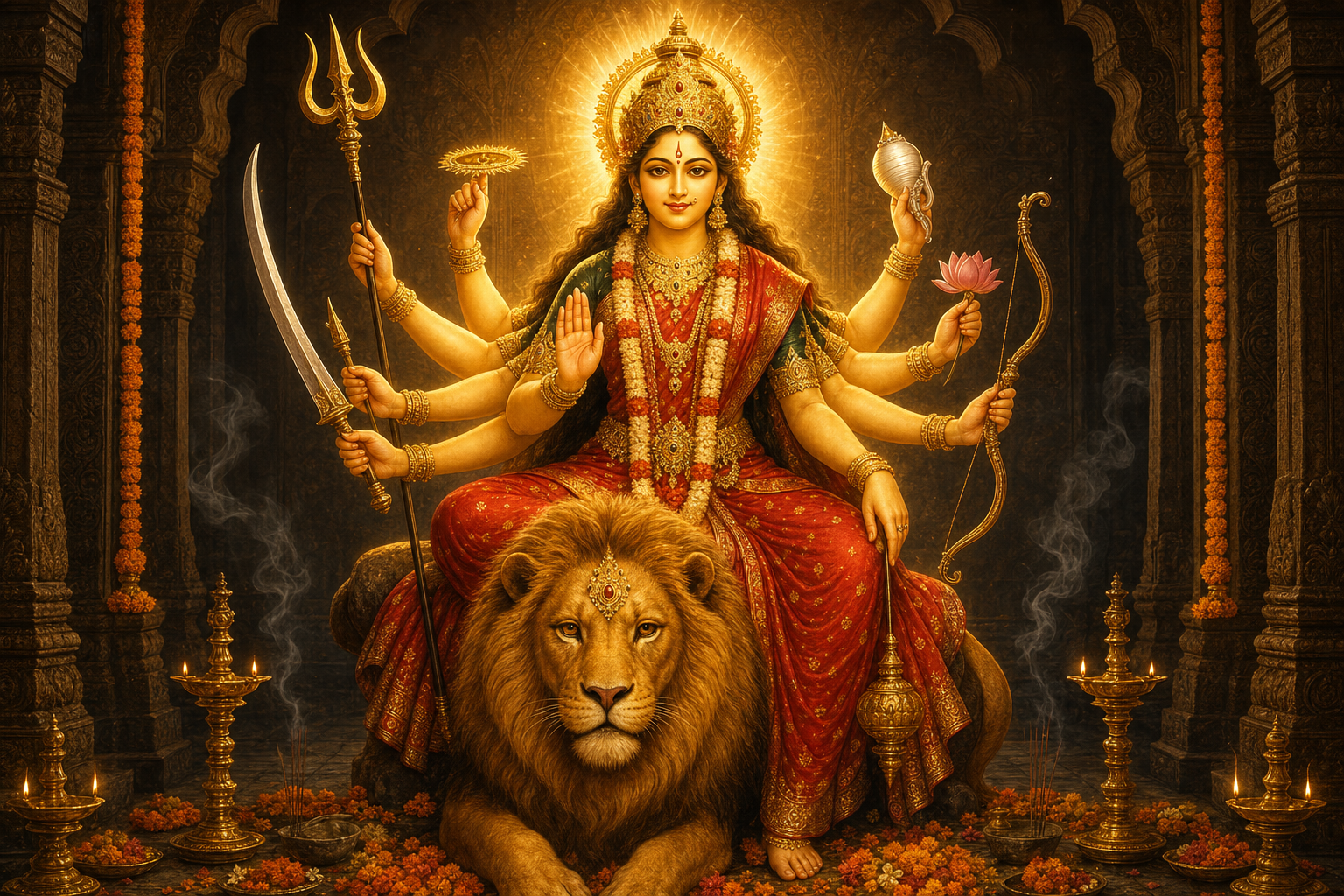
If you have stood before a Durga murti whose face seems to glow like heated gold, you may have wondered what you are actually being asked to see. Is the gold a skin colour, a sign of wealth, an artistic convention, or a statement about divine power?
These meanings can meet in one image, but they are not interchangeable. Read the gold first as radiance made visible. That distinction helps you understand the murti, explain it to someone else, and carry its teaching into practice without reducing Maa Durga to ornament, luxury, or a hierarchy of human complexions.
Gold means radiance before it means wealth
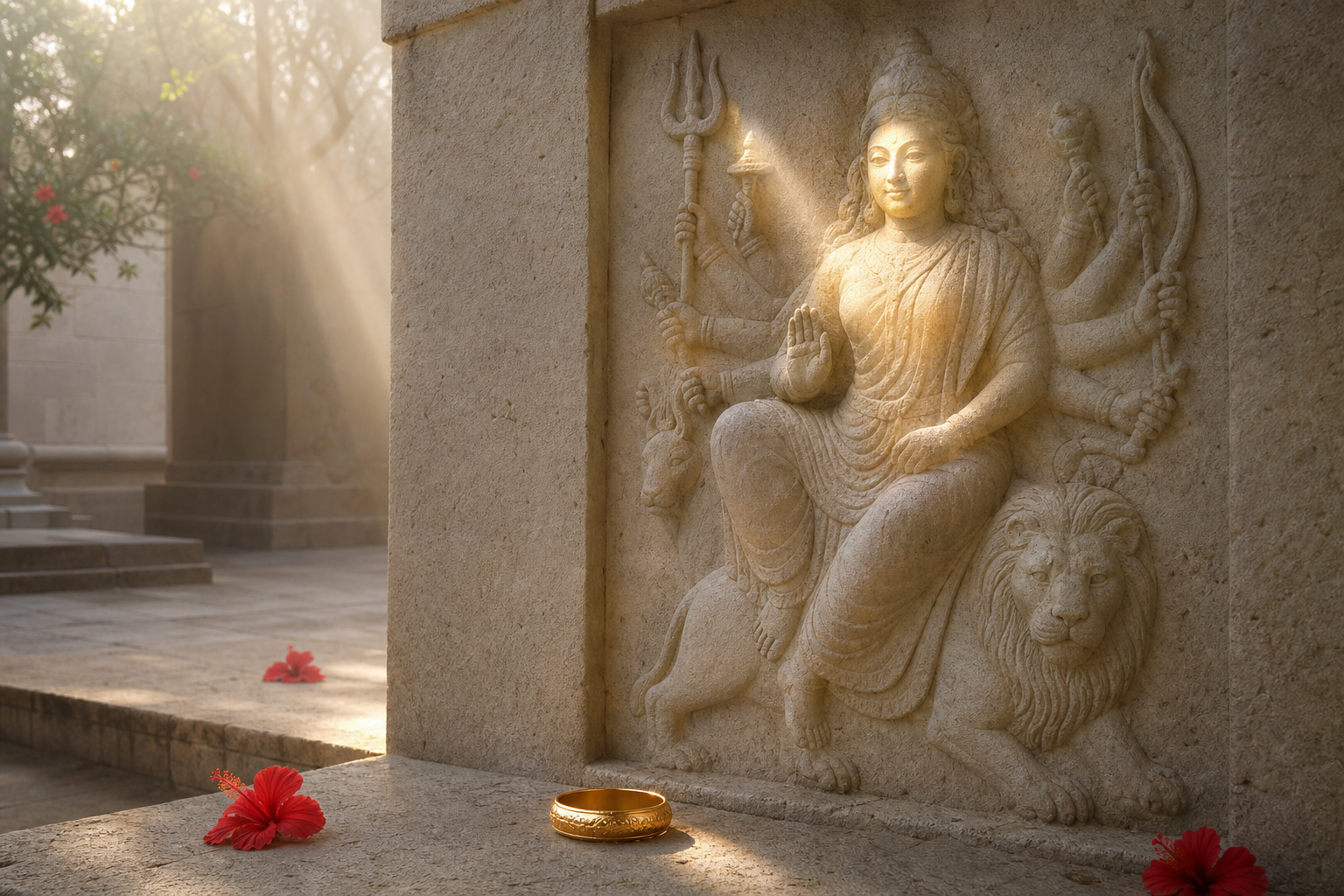
Durga’s golden complexion gives visible form to tejas: spiritual brilliance with the power to dispel darkness. The Devi Mahatmya, contained within the Markandeya Purana, belongs to the scriptural world in which her luminosity is protective, restorative, and difficult for disorder to withstand.
The distinction between gold and molten gold matters. Descriptions such as tapta-hemābha, a molten-gold glow, and kanaka-varṇa, a golden hue, do more than supply an artist with a colour. Molten metal carries heat, movement, and transformation. The image therefore suggests power at work, not a cold metallic surface or a decorative coating.
Gold also resists tarnish and decay. In Durga’s iconography, that physical quality becomes a moral analogy: truth remains sound under pressure, wisdom cannot be corrupted, and dharma can endure periods of apparent darkness. Her radiance is beautiful, but beauty is not its final purpose. It reveals a presence capable of refining what has become clouded by avidyā, or ignorance.
When you look at a golden depiction of Durga, separate three visual layers before interpreting the whole:
- The complexion: Gold appearing as her very form presents luminosity as intrinsic. Durga does not merely stand near a light; she embodies the power that makes darkness visible and overcomeable.
- The ornaments and adornment: Gilded jewellery and alankara express auspiciousness, dignity, and sovereignty. They reveal divine abundance, but they should not be mistaken for the entire meaning of her golden form.
- The surrounding light: An aureole, temple lamps, or the moving flame of ārati lets radiance extend beyond the body. The image becomes relational: light reaches the space, the community, and the person standing before her.
This layered reading prevents a common mistake. A depiction need not use literal gold paint, gilding, or one standardized shade to express the same theology. The important question is not, “Is this the correct gold?” Ask instead, “How has the artist made Durga’s active luminosity perceptible?”
Her golden power joins clear sight to fearless action
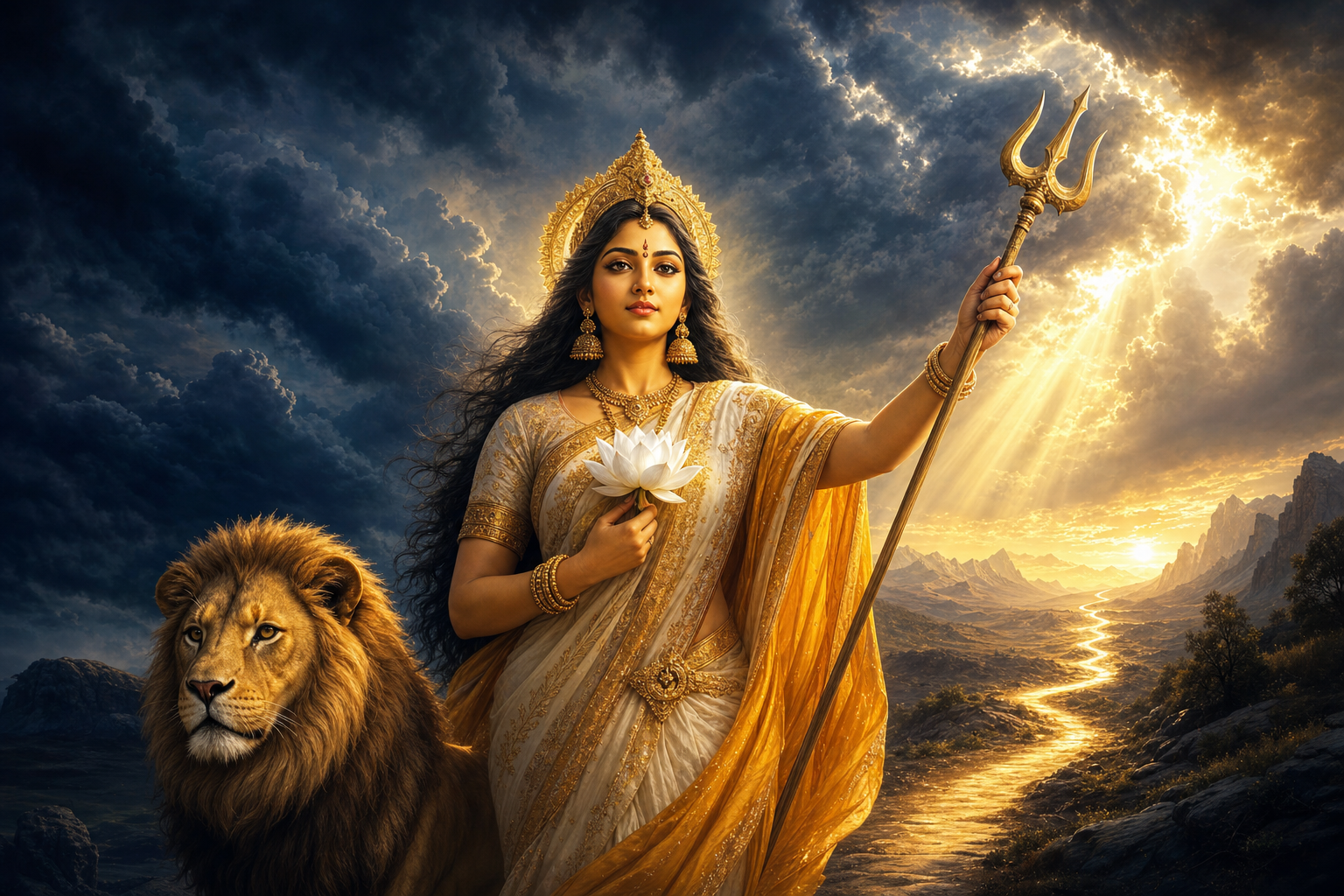
Durga’s radiance holds together two capacities that are often separated in ordinary life: jñāna, clear knowledge, and kriyā, effective action. Wisdom that never acts leaves the vulnerable unprotected. Force without wisdom becomes another form of disorder. The golden form presents power governed by discernment.
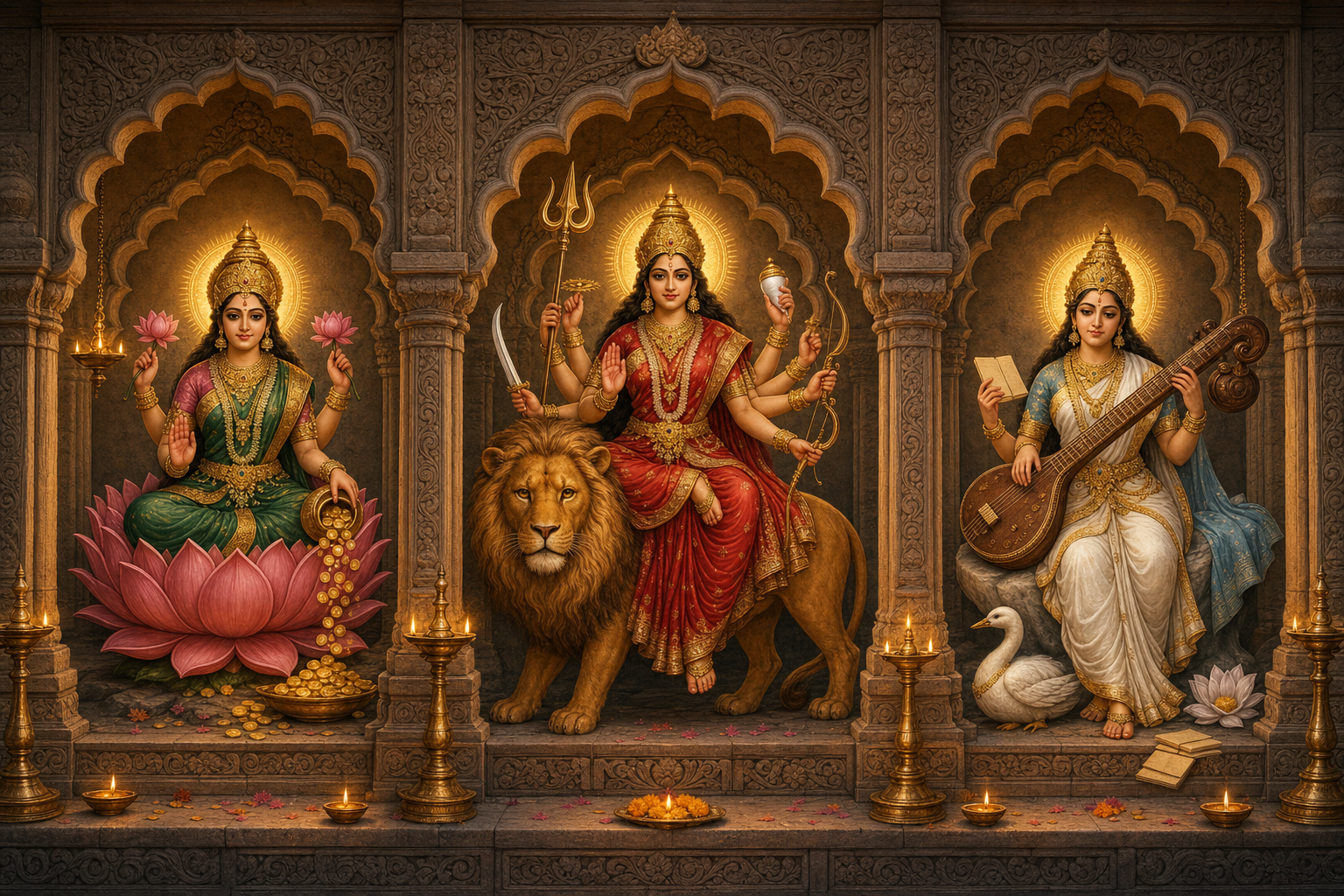
This is why the image can harmonize the abundance associated with Lakshmi and the insight associated with Saraswati without dissolving Durga’s distinct character. Abundance supplies what life needs. Insight recognizes what must be done. Durga’s protective śakti gives that recognition courage and direction.
You can test an interpretation of her iconography with three questions:
- Does it unite strength with compassion? If the interpretation glorifies domination, anger, or cruelty for its own sake, it has lost Durga’s restorative purpose.
- Does it turn illumination into responsibility? Seeing clearly should change conduct. The practical signs are truthfulness, protection of the vulnerable, patience in sustaining community, and refusal to let hatred dictate action.
- Does it preserve courage without hardening the heart? Fearlessness is not numbness. Durga’s radiance supports action that is firm precisely because it remains aligned with dharma.
The word “golden” can otherwise remain flattering but empty. Its ethical content becomes visible when you ask what must be refined in your own conduct. Resentment may need to become disciplined resolve. Confusion may need to become careful judgement. Passive sympathy may need to become protection. That movement from an unformed impulse to dharmic action is the human counterpart of molten gold being refined.
Ritual turns the symbolism into a way of seeing
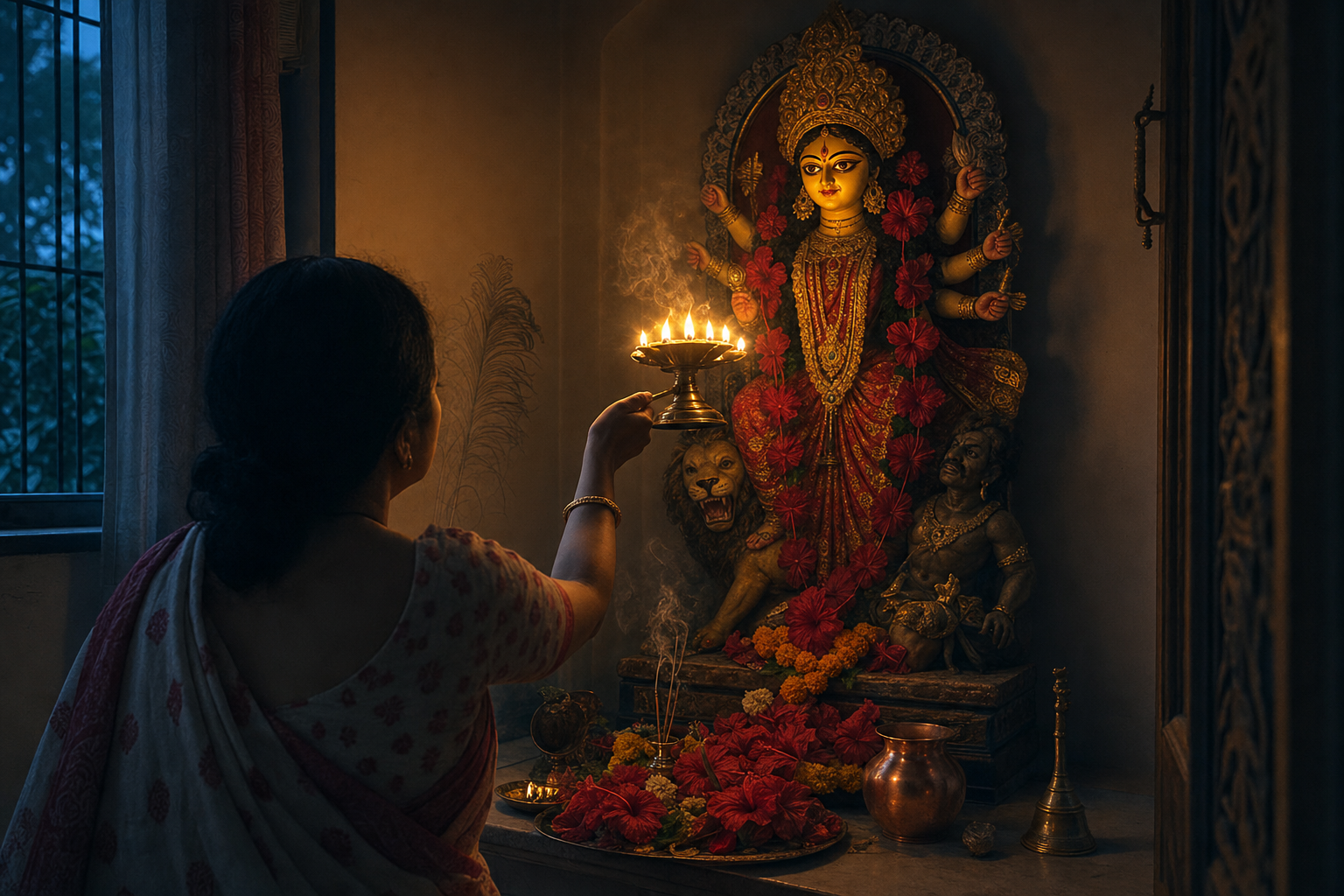
During Navaratri and Durga Puja, the meaning of the golden form is not confined to explanation. The shimmer of alankara, the light of dīpas across the murti, and the contrast of kumkuma and turmeric against her visage make theology perceptible through colour, warmth, and movement. Recitation of the Devi Mahatmya, offerings of light and fragrance, and adornment of the murti train attention as well as express devotion.
That training is easy to miss if you treat ritual as a series of objects to be presented. The lamp is not merely placed before a golden image. Its flame reveals changing highlights, shadows, and expressions, allowing you to encounter radiance as active presence rather than static colour.
You can use the following reflection alongside your family or temple’s established practice. It is not a replacement for inherited vidhi; it is a way to attend more carefully to what you are already doing.
- Look before interpreting. Notice whether the gold appears primarily in Durga’s face, her ornaments, an aureole, or the light falling across the entire murti. Let the actual form guide your reading.
- Name the darkness precisely. Instead of thinking only about evil in the abstract, identify one form of confusion, fear, neglect, or resentment that is affecting your conduct.
- Pair insight with one action. Decide what clarity requires of you: speak truth without humiliation, support someone being excluded, complete a neglected duty, or set a firm boundary without hatred.
- Judge the action by its balance. Ask whether it combines courage, compassion, and discernment. Intensity alone is not evidence of śakti aligned with dharma.
Regional art can lead you through the same process by different visual routes. A shimmering Bengal Puja tableau may make luminosity immediate through colour, decoration, and many lamps. A South Indian temple bronze may reveal radiance through reflective metal and the movement of flame. Do not force these forms into one fixed visual formula. Notice the shared principle: sacred craft makes auspicious power present to a particular community in a particular devotional setting.
Shared dharmic imagery requires precise comparison
Light and golden radiance also carry spiritual meaning across the wider dharmic family. Buddhist traditions can describe an awakened presence through radiance associated with purity and compassion. Jain narratives can present the Tirthankaras with luminous serenity. Sikh teachings use the language of the eternal jyot, the guiding divine light.
These resonances are valuable, but they should not be used to claim that every tradition teaches the same theology. Shared imagery is a bridge, not a licence to erase distinctions. If you are explaining Durga’s golden form in an inter-dharmic setting, use this order:
- Begin with Durga’s own Hindu vocabulary: śakti, tejas, dharma, protection, and the removal of ignorance.
- Then identify the genuine parallel: light can communicate awakening, purity, compassion, serenity, or divine guidance across several dharmic paths.
- Keep the traditions distinct. Do not translate Durga into a Buddhist, Jain, or Sikh category, and do not treat another tradition’s luminous imagery as a disguised form of Durga.
- End with the ethical kinship: inner illumination should produce clearer, more compassionate, and more disciplined conduct.
This approach lets you affirm a shared dharmic imagination without flattening its many forms. Unity becomes more credible when it is built through respectful recognition rather than forced equivalence.
Key takeaways
- Read Durga’s gold first as tejas, an active spiritual radiance, rather than as a simple display of wealth.
- “Molten gold” conveys heat, refinement, and transformation; it presents divine power as dynamic rather than ornamental.
- Distinguish her golden complexion from her jewellery, aureole, and ritual lighting. Each layer contributes a related but different meaning.
- The image joins jñāna with kriyā: clear understanding must become courageous action governed by compassion.
- Regional depictions can look very different while expressing the same principle of auspicious, protective luminosity.
- Use comparisons with Buddhist, Jain, and Sikh imagery to recognize dharmic kinship, not to erase theological differences.
The next time you stand before Durga’s golden form, watch how the light moves across her face, ornaments, and surrounding space. Then leave with one decision in which courage answers to clarity and compassion. That is how radiance moves from iconography into conduct.
References
