
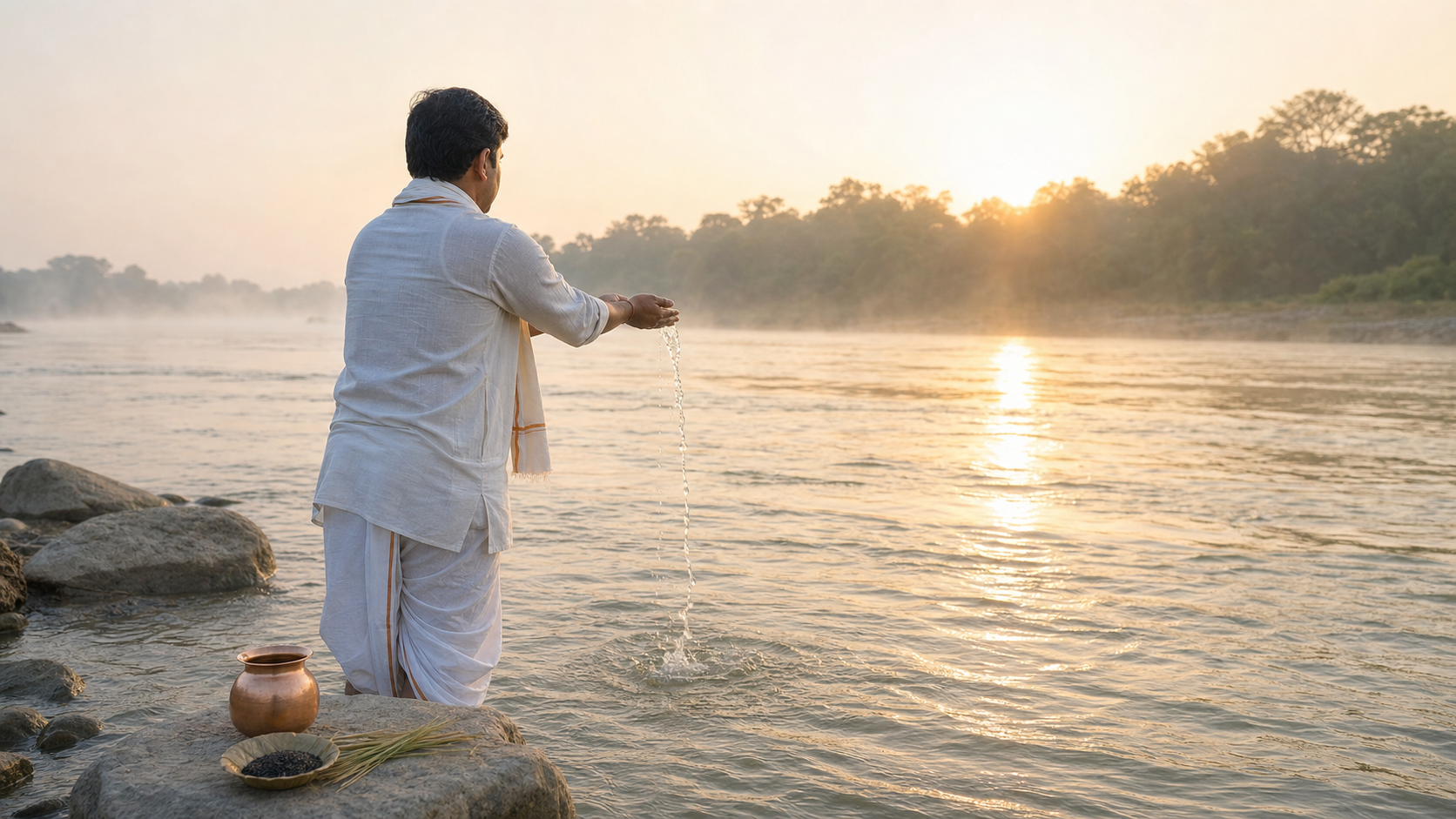
Perhaps Amavasya or Pitru Paksha is approaching, and you want to offer Tarpan properly. But the nearest river is far away, the local water is polluted, or you aren’t sure whether a home observance will carry the same dignity.
The practical answer is clear: clean, flowing sacred water remains the traditional ideal, but responsible alternatives are available. Geography need not become guilt. Choose the cleanest suitable setting you can reach, follow your family’s inherited practice where one exists, keep the offering restrained, and make sure remembrance of your ancestors doesn’t become harm to a river, plant, animal, or public place.
Why moving water belongs in an ancestral rite
Tarpan is not simply water being poured away. Within Shraddha traditions, it expresses remembrance, gratitude, and filial duty toward the Pitrs. The offering acknowledges that your life did not begin with you. It came through parents, grandparents, teachers, communities, and an ancestral inheritance that deserves conscious recognition.
Rivers such as the Ganga and Yamuna, along with other tirthas, are traditionally preferred because sacred, moving water joins several meanings in one physical act. It cleanses, travels, sustains life, and passes beyond the place where you release it. The current gives visible form to continuity: generations arrive and depart, yet life moves onward.
That movement also disciplines the person making the offering. You release the water without retrieving it or demanding a return. The action can therefore embody gratitude without possession. What is offered moves on, just as an ancestor’s body, circumstances, and historical moment have moved beyond your control.
This is why flowing water should not be reduced to a decorative ritual ingredient. The current is part of the teaching. On Amavasya and during Pitru Paksha, the libation places family memory within a larger rhythm of time, nature, and renewal.
Yet sacredness does not make pollution irrelevant. Ritual purity and ecological cleanliness are not identical, but neither can be used to excuse disregard for the other. A revered river may still be physically contaminated. If a bank is visibly polluted, unsafe, or closed to ritual activity, adding more material does not honor it. In that situation, choose a cleaner and lawful alternative.
Choose the water by meaning, cleanliness, and access
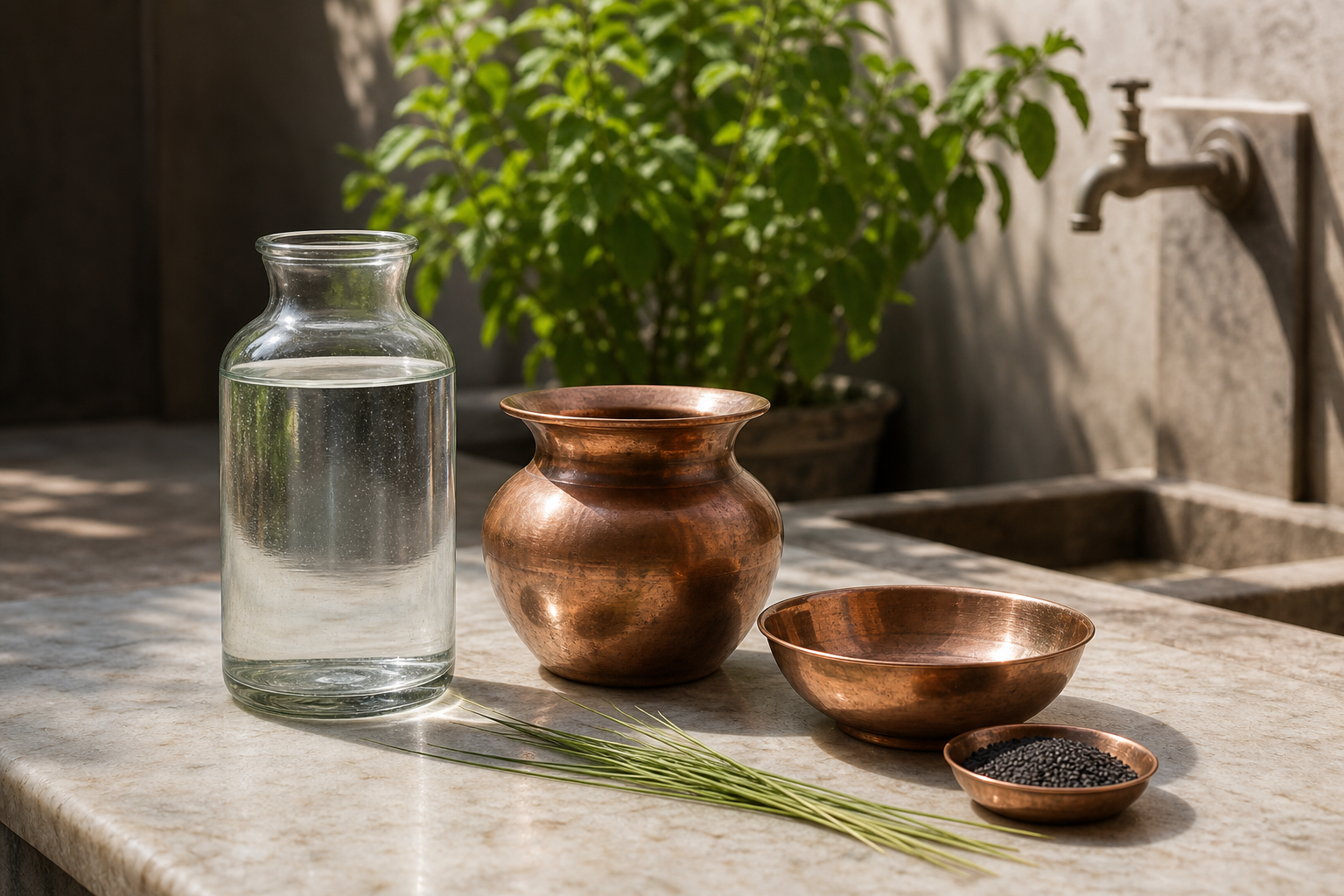
You do not need to treat the choice as an all-or-nothing test of devotion. Use the following order as a practical decision aid, not as a universal replacement for the instructions of your family, sampradaya, or acharya.
- A clean sacred river or established tirtha: Choose this when it is reasonably accessible, the approach is safe, and local rules permit the rite. The place already carries ritual memory, and the natural current preserves the full symbolism of passage.
- A clean local river or moving waterway: A distant pilgrimage should not make you overlook a living river near your own community. Approach it as a shared lifeline, not as a disposal channel.
- A well, lake, or seashore: These are recognized alternatives when river access is limited. Confirm that public access and ritual offerings are allowed, and do not enter unsafe water.
- Clean water offered to earth or a plant: This is the most workable contemporary option when no appropriate natural body of water is available. Pour the water steadily and reverently onto clean earth or near a plant, using a quantity and ingredients that will not damage the place.
If two options are available, ask three questions: Is the water or receiving ground clean? Can I perform the rite without danger or disturbance? Will everything I introduce be harmless in this setting? The option that answers all three well is usually more dharmic than a famous location where your offering would add waste or break conservation rules.
A household drain or roadside gutter should not be mistaken for sacred flowing water merely because liquid passes through it. When observing at home, collect clean water in a vessel and direct the libation to suitable earth or a plant. If your family practice includes sesame, use it sparingly and make sure the receiving place can accept it without creating a mess, attracting pests, or harming the plant.
If your family maintains a particular procedure, preserve it. Mantras and ritual sequences can vary by lineage and region. Ask a knowledgeable elder, priest, or acharya before the observance rather than assembling a supposedly universal procedure from disconnected instructions. The choice of location can be adapted without casually rewriting the inherited form of the rite.
Perform a complete rite without leaving a burden behind
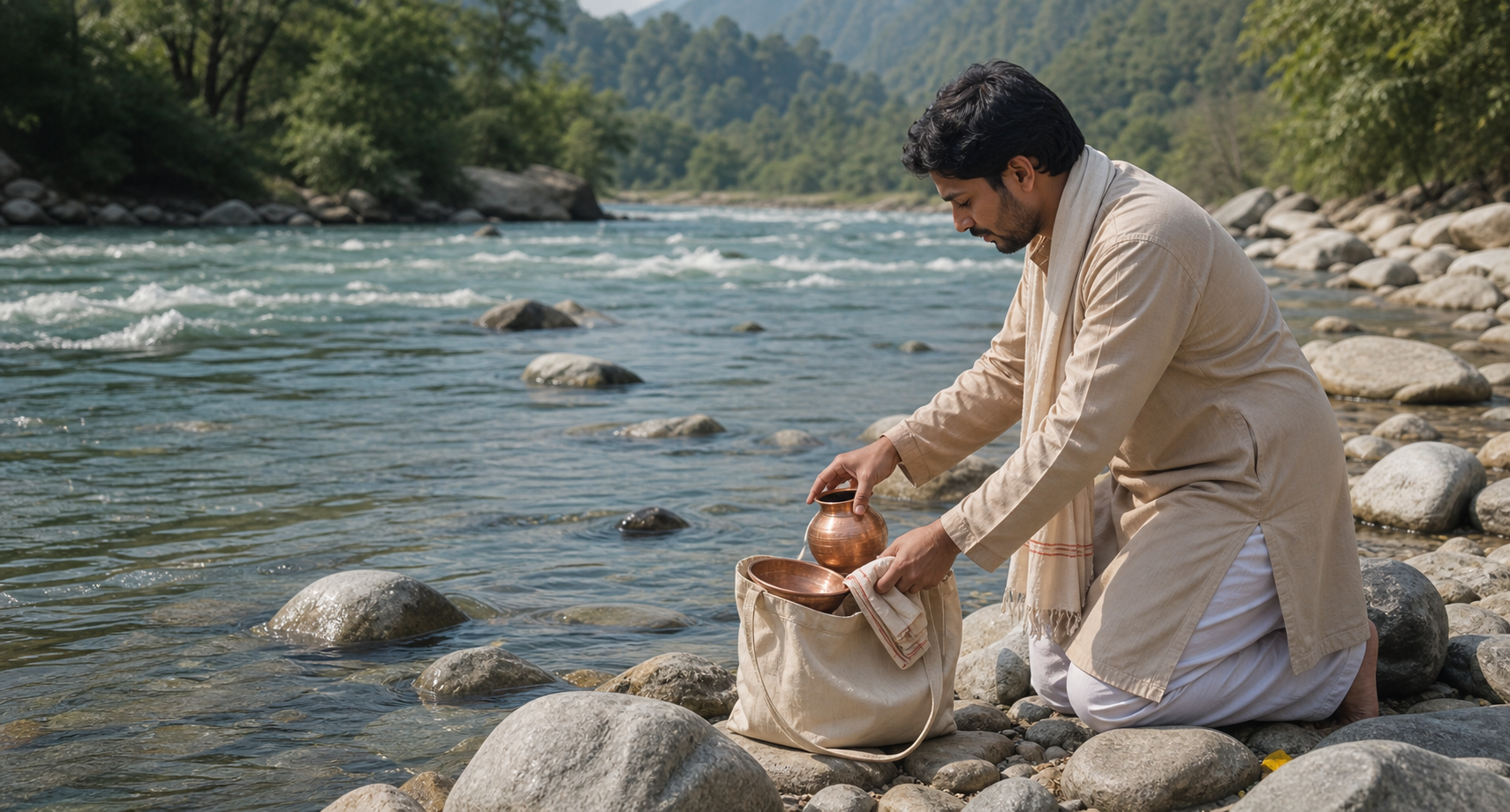
The simplest preparation is often the strongest. Water, sesame where prescribed, and minimal biodegradable offerings keep attention on remembrance rather than display. More material does not make the libation more sincere.
Before leaving home, prepare only what you will actually use:
- Clean water in a reusable vessel if the site itself does not provide suitable water.
- Sesame or another customary biodegradable element only if it belongs to your family practice.
- The mantra, names, or ancestral remembrance you have been taught, reviewed in advance so the rite is not interrupted by searching on a phone.
- A reusable bag for carrying every container, wrapper, and non-ritual item home.
- Safe footwear and any support needed for steps or an uneven bank; reverence does not require risking a fall.
At the site, look before you begin. Choose stable ground away from fast currents, eroded edges, nesting areas, and places where your presence would obstruct other worshippers. Children should remain on secure ground and should never be asked to enter water for the sake of completing the ritual.
Then perform the recitation and libation according to the form you know. Keep the offering measured. A small, attentive release is more faithful to the rite’s purpose than a large display that leaves residue. Do not introduce plastic, synthetic dyes, packaging, or other polluting material. The label “biodegradable” is not permission to leave excessive quantities behind.
When the rite is complete, account for everything you brought. Take vessels, bags, flowers wrapped for transport, and all packaging with you. Do not leave a lamp, tray, or container at the bank on the assumption that someone else will collect it. If a local temple or ghat provides a designated collection point, use it as directed.
This final cleanup is not separate from Tarpan. It completes the ethical logic of the act. A river that carries ancestral prayers also carries drinking water, habitat, livelihoods, and the daily needs of communities downstream. To honor the Pitrs while degrading that shared inheritance would divide ritual intention from conduct.
Let the rite transmit memory, not just procedure
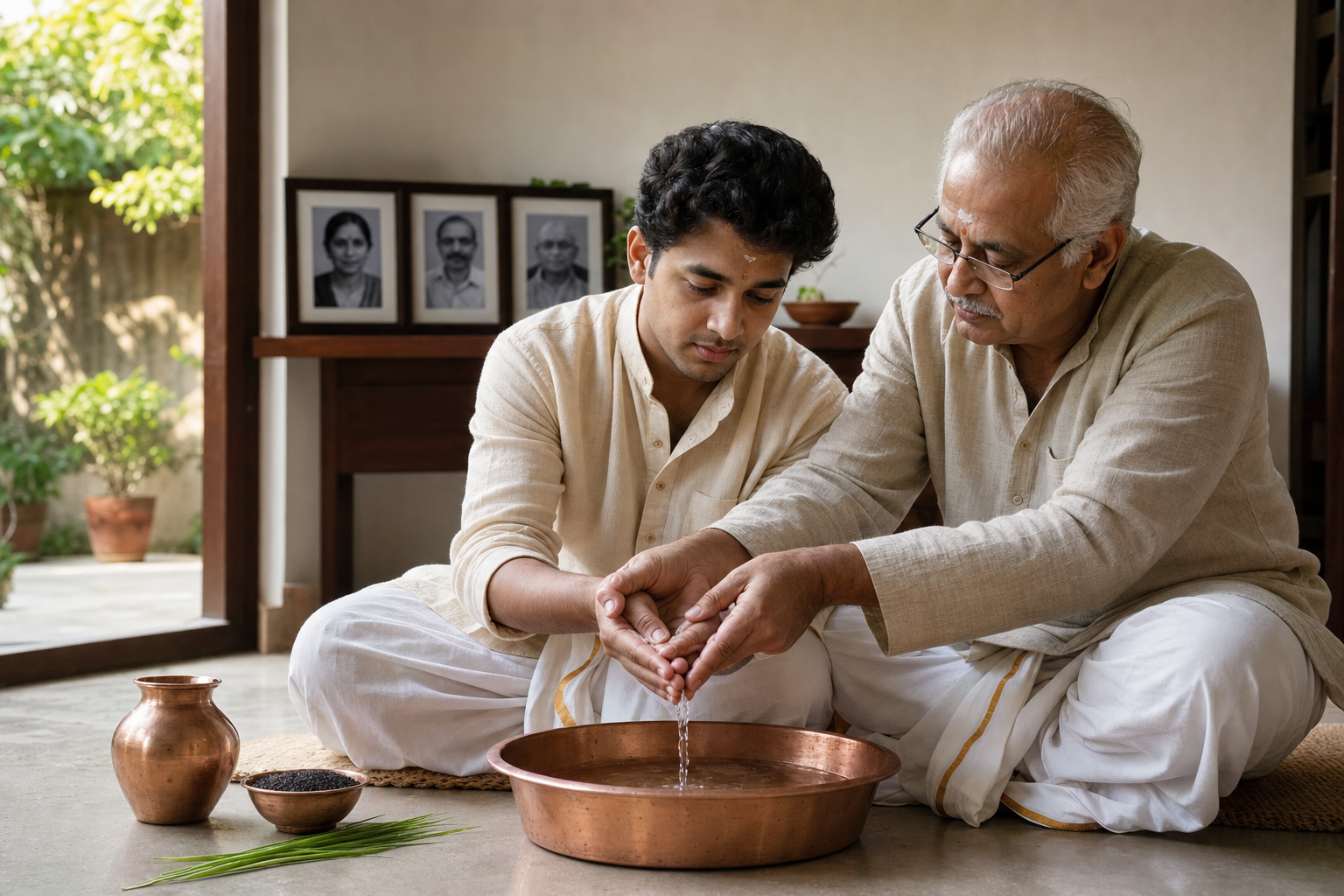
A child watching Tarpan may remember the water and gestures but miss the reason for them. Before the observance, tell the younger members of your family whose memory is being honored. Give them at least one name, relationship, or quality connected to an ancestor. That turns an unfamiliar action into a family responsibility they can understand.
Keep the explanation concrete. You can say: this water expresses gratitude; its movement reminds us that life continues through change; keeping the river clean prevents our worship from injuring what sustains others. Those three ideas – gratitude, continuity, and restraint – are easier to carry forward than a long lecture delivered during recitation.
Riverbank observances also show children that dharma is lived in public. They see elders remembered with dignity, nature treated as sacred, and a family acting together rather than treating ancestry as a private sentiment. If they help, give them a safe and definite responsibility such as carrying the reusable vessel or checking that no packaging remains.
The wider dharmic family offers related, though not interchangeable, uses of water. Buddhist water bowls evoke purity and clarity of intention; Jain abhisheka joins purity with the discipline of ahimsa; Sikh sarovars and isnaan connect water with remembrance, equality, and disciplined practice. These are not versions of Hindu Tarpan. Their value here is to reveal a shared civilizational intuition: water is approached not as inert matter but as a medium of purification, ethical attention, and relationship.
That distinction matters when you explain the rite. Honor kinship among dharmic traditions without flattening their practices into sameness. A tradition is respected when its particular form is named accurately and its shared values are recognized without appropriation.
Key takeaways
- Choose a clean, accessible sacred river when possible, but do not treat distance from a famous tirtha as a failure of devotion.
- When no suitable river is available, a well, lake, seashore, or clean water directed responsibly to earth or a plant can preserve the intention of the rite.
- Follow your inherited ritual form where you have one; ask a trusted elder, priest, or acharya about mantras and sequence rather than improvising them.
- Use restrained offerings: water, sesame where customary, and only minimal biodegradable material appropriate to the location.
- Carry away every container and wrapper. A sacred river is a recipient of reverence, not a place to abandon ritual objects.
- Teach younger family members an ancestor’s name and the meaning of the flowing water so that Tarpan transmits memory as well as gestures.
Before the next ancestral observance, settle three things: who will guide the ritual form, where the water can be offered cleanly, and how every non-organic item will return home with you. Once those decisions are made, you can give your attention to what Tarpan actually asks of you – sincere remembrance, disciplined gratitude, and care for the inheritance that will pass to those who come after us.
References
