
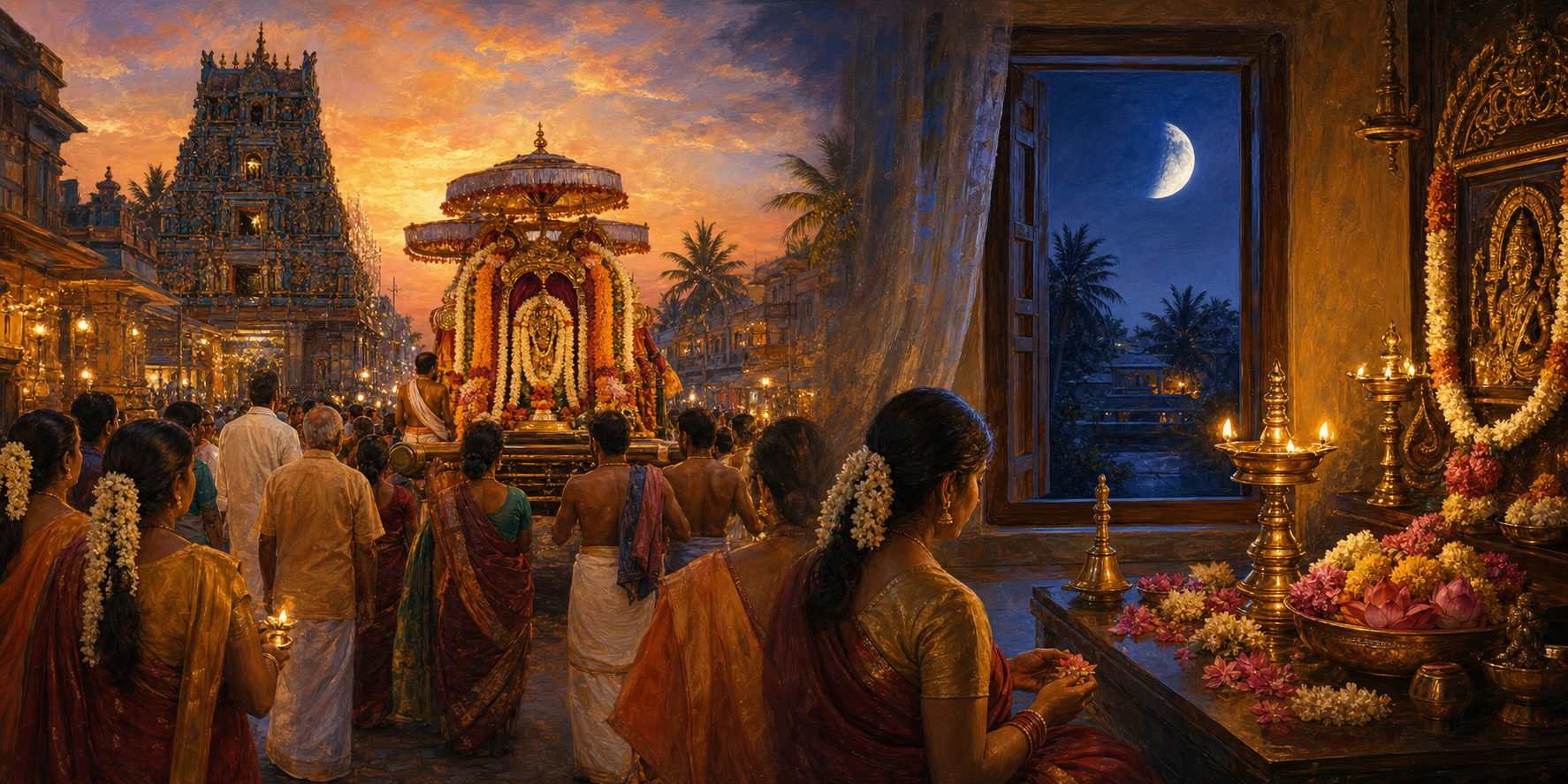
You have two very different appointments with sacred time in February 2026. One asks you to be present for a public temple procession at a stated place and time. The other asks you to notice that a lunar day changes while the civil date remains the same. Treat both as ordinary all-day calendar entries and you can easily arrive late to one and misread the other.
A reliable plan therefore needs two kinds of precision: logistical precision for the Peta Utsavam on February 2, and Panchang precision for the Sashti-to-Saptami transition on February 8. Here is how to observe each without inventing timings, flattening local custom, or turning devotion into a scheduling exercise.
Key takeaways for February 2 and February 8
- On February 2, the utsava murtis of Sri Kodandarama Swamy, Sita, and Lakshmana were scheduled to travel from Tirupati to Kupuchandra Peta, approximately 8 km away, for a 9:30 a.m. village welcome followed by Snapana Tirumanjanam.
- The 9:30 a.m. time refers to the welcome at the village. It is not a stated departure time from Sri Kodandarama Swamy Temple, so confirm departure and access arrangements locally rather than calculating them from the distance.
- Sunday, February 8 begins with Krishna Paksha Sashti until 3:38 a.m.; Krishna Paksha Saptami follows in most regions. For most waking hours of the civil date, Saptami is therefore the relevant tithi.
- The 3:38 a.m. transition is a planning reference, not a universal time for every location. Use the Panchang or temple almanac followed by your household or sampradaya when a vrata depends on the exact boundary.
- No Nakshatra, Rashi, rising Lagna, or specific Shubh Muhurat is established here. Do not declare a time auspicious from the tithi alone when your intended act requires a formal muhurta.
February 2: plan around the deity’s arrival
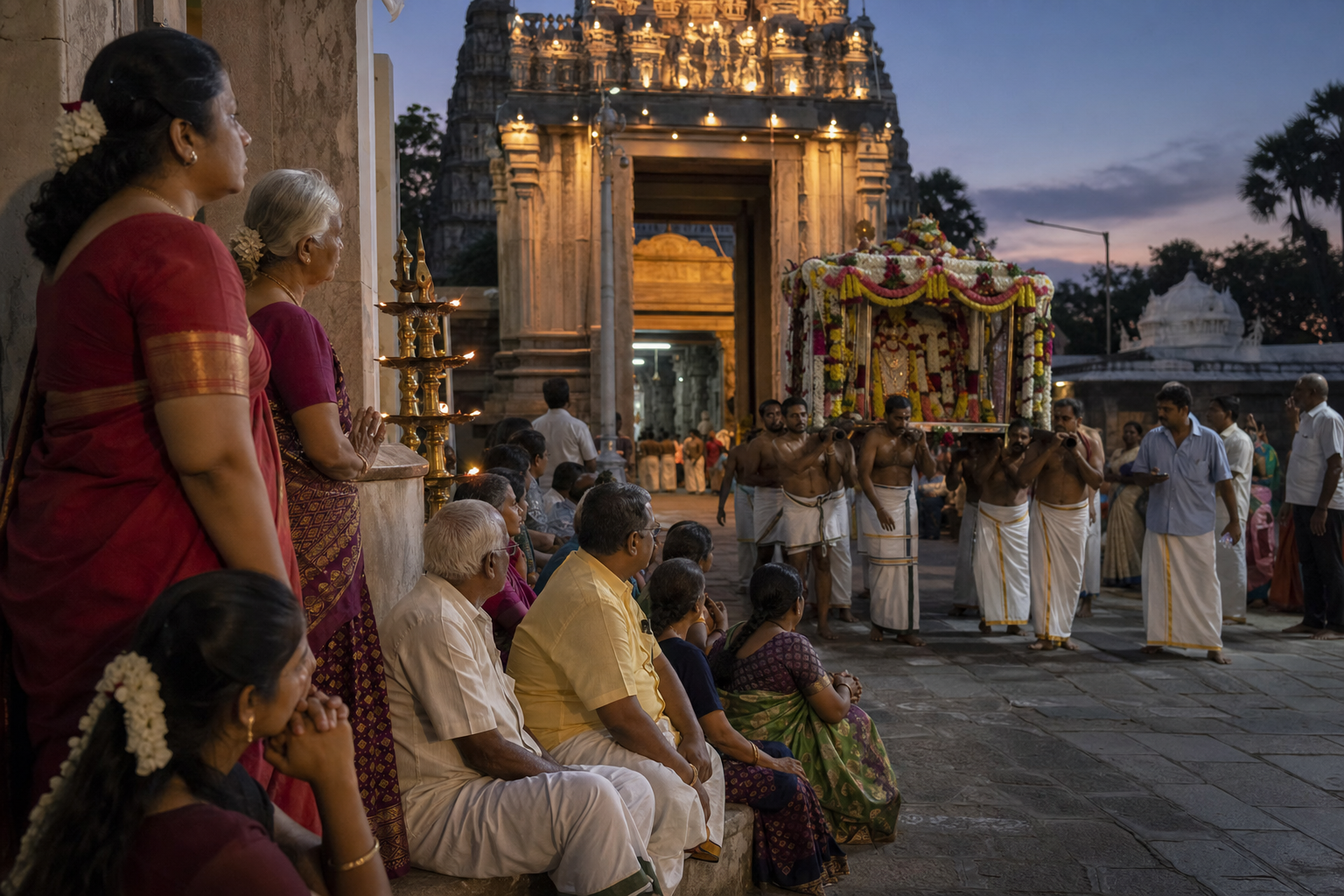
Peta Utsavam is more than a temple festival conducted outdoors. The utsava murtis move beyond the temple precincts so that the surrounding community can receive Sri Rama, Sita, and Lakshmana. The journey joins sacred space to civic space: the village does not merely watch a procession pass but participates in receiving the deities.
The crucial scheduling distinction is simple. The fixed public anchor is the 9:30 a.m. welcome at Kupuchandra Peta, followed by Snapana Tirumanjanam. A departure time from Tirupati is not fixed in the available event details. If you are arranging transport, accompanying elders, or coordinating a family group, plan backward from the village welcome and verify the missing information locally.
- Confirm the operational details. Ask the temple or local volunteer network about the departure point, procession route, vehicle restrictions, and accessible approach. Notices may use either Kupuchandra Peta or Kupucandrapeta, so recognise both spellings.
- Aim to be settled before the welcome. The devotional moment is the arrival of the deities, not your own arrival. Allow enough time to find the designated standing area without crossing the route or pushing through worshippers.
- Assign practical care before leaving. Carry water, decide who will remain with children, and make one person responsible for assisting an elderly or mobility-limited relative. These small decisions prevent the family from becoming separated when attention turns toward the procession.
- Let volunteers govern movement. Follow barriers and local instructions even when another position appears to offer a better view. Keep pathways clear, take all waste with you, and never place photography ahead of ritual flow.
- Become still for Snapana Tirumanjanam. The sacred ablution carries an orientation toward purification and renewal. Use it to examine what needs to become clearer in your own conduct rather than treating the rite merely as a visual finale.
If you cannot be physically present, do not pretend that a home practice is identical to procession darshan. You can still keep the date meaningfully through Rama-nama japa, a familiar reading connected with Sri Rama, or an act of seva or dana consistent with your family tradition. The point is remembrance and ethical alignment, not imitation of a temple ritual for which you have neither the materials nor the customary guidance.
The procession invokes the dharmic steadiness associated with Sri Rama, the fidelity represented by Sita, and the devoted service of Lakshmana. Choose one quality before the observance and give it a concrete expression afterward. Steadfastness might mean completing a neglected duty; service might mean quietly taking responsibility for someone else’s comfort. That is how a public festival enters private conduct.
February 8: let the tithi govern the practice

A wall calendar gives February 8 one name and one span. The Panchang does not. Krishna Paksha Sashti continues only until 3:38 a.m. on February 8, after which Saptami prevails in most regions. Calling the whole date Sashti would therefore obscure the transition. Applying 3:38 a.m. everywhere without checking locality would create a different error.
What you should do depends on the kind of observance in front of you:
- If your family observes a rule-bound vrata: consult the local Panchang or temple almanac used by your sampradaya. A vrata rule may depend on which tithi prevails at a tradition-specific point in the day, and a timing printed for another place may not settle that question.
- If you want a voluntary day of sadhana: treat the Saptami portion as a quiet anchor for japa, dhyana, scriptural reading, or reflection. Choose one practice you can complete attentively instead of assembling an elaborate routine that your household cannot sustain.
- If you are choosing a muhurta for an important undertaking: do not promote Saptami into a complete auspicious-time calculation. Tithi is one component; Nakshatra, weekday, Lagna, locality, and lineage custom may also matter. Obtain a calculation suited to the actual place and purpose.
This distinction prevents two common extremes. The first is false precision: treating one published transition as if it overrides every regional almanac. The second is avoidable vagueness: saying that timing does not matter at all. If a vow has formal rules, verify them. If you are undertaking ordinary daily dharma, let the lunar transition deepen a manageable practice rather than becoming a reason to do nothing.
Krishna Paksha often supports a quieter devotional rhythm. On this Saptami, you might reduce unnecessary distraction, complete a settled period of japa, read a passage already respected in your household, and end by identifying one habit that weakens inner clarity. No invented auspicious hour is needed for such ordinary discipline.
Build one calendar that respects both kinds of time

The practical mistake is to keep a single note called sacred dates. A public procession and a tithi transition require different fields, different reminders, and different kinds of confirmation. Give each its own entry.
- Create the public-event entry: February 2 – Kupuchandra Peta – 9:30 a.m. village welcome – Snapana Tirumanjanam afterward. Add a separate line stating that the Tirupati departure time and route require local confirmation.
- Create the lunar-time entry: February 8 – Sashti until 3:38 a.m. – Saptami afterward in most regions. Mark the timing as locality-dependent so it is not copied blindly into a family vrata plan.
- Add a confirmation field: distinguish a fixed event detail, a locally verified instruction, and your personal devotional choice. This makes it immediately clear which blanks need a temple, almanac, or sampradaya answer.
- Add a practice field: write what you will actually do. For February 2, that may be attendance, route seva, care for a relative, or home remembrance. For February 8, it may be japa, dhyana, study, or another established household practice.
This simple separation protects both accuracy and devotion. You no longer mistake an arrival time for a departure time, a tithi transition for an all-day label, or a personal preference for a rule of tradition. It also keeps unknown information visibly unknown, which is far better than filling the gap with a confident guess.
Keep shared dharmic values rooted in particular practice
A Hindu temple procession has its own theological and regional grammar. Respect for shared dharmic inheritance does not require us to claim that Hindu, Buddhist, Jain, and Sikh communities perform the same rites or follow one ritual calendar. Unity becomes credible when it honours those distinctions while recognising ethical affinities.
Seva, ahimsa, dana, and satya provide a practical vocabulary for that shared ground. At a procession, seva means helping without seeking the best position for yourself. Ahimsa means controlling the body and voice in a dense gathering. Dana means giving without making generosity a performance. Satya means refusing to circulate an unverified departure time, route, or ritual claim merely because it sounds plausible.
You can now make two clean entries for February 2026: one centred on the 9:30 a.m. village welcome on February 2, and one recording the Sashti-to-Saptami transition on February 8. Then seek local guidance only for the details that genuinely govern your participation. Sacred time becomes usable when accuracy, humility, and practice remain together.
References
- DharmaRenaissance Blog – February 8, 2026 Panchang Guide: Exact Tithi Timing, Auspicious Cues, and Daily Dharma
- DharmaRenaissance Blog – Peta Utsavam: Tirupati Kodandarama Swamy’s Sacred Procession to Kupuchandra Peta, 2 Feb 2026
