
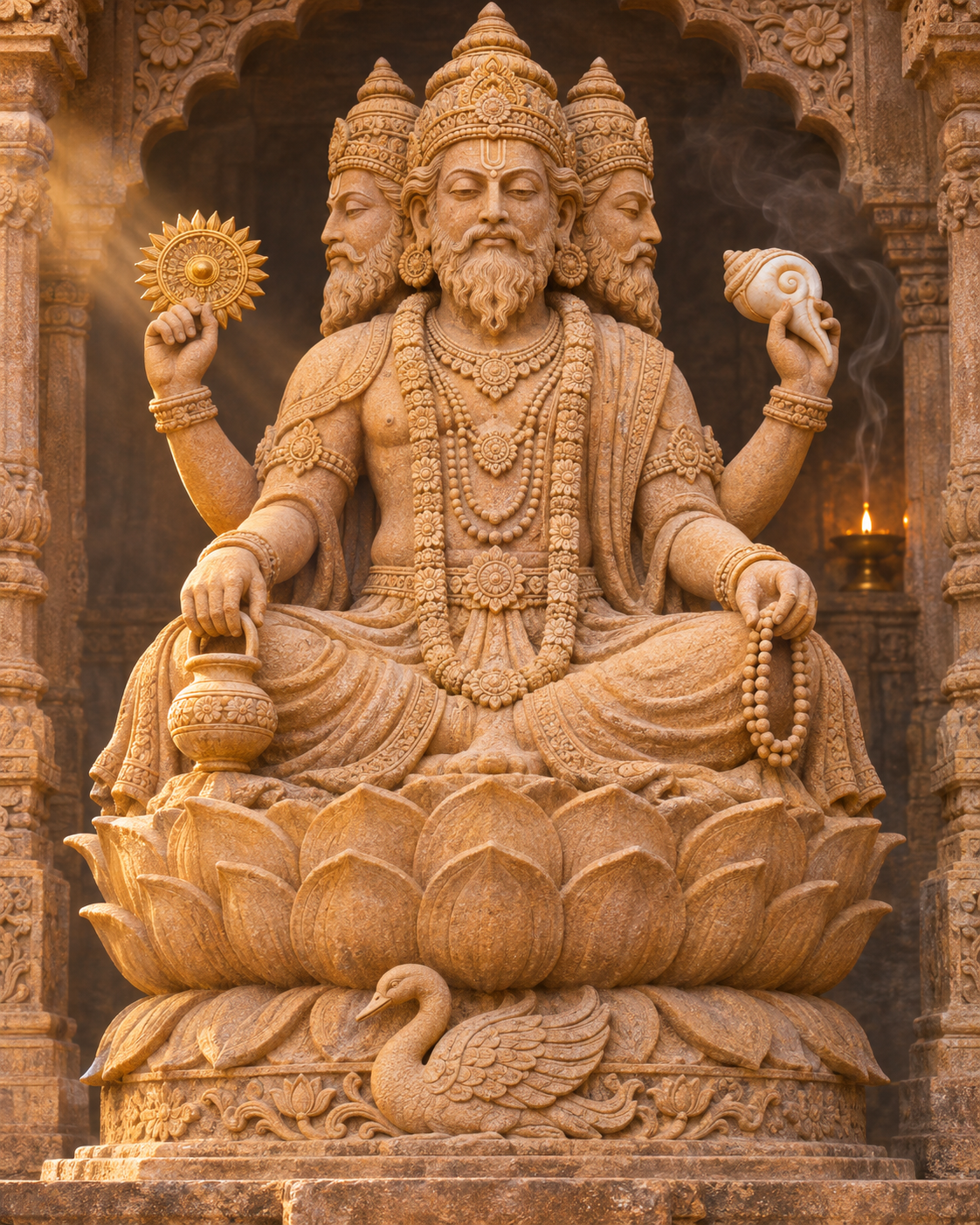
You have found an image identified as Brahma, yet two objects in his hands seem to belong to Vishnu: the conch and the discus. Is the caption wrong, is the figure really Vishnu, or is the image expressing something more deliberate?
Do not identify the deity from those two emblems alone. A Brahma figure can bear Vishnu-associated attributes without ceasing to be Brahma. The responsible reading begins with what the entire image shows, then separates firm observation from theological interpretation.
The short answer: the attributes are unusual, not accidental
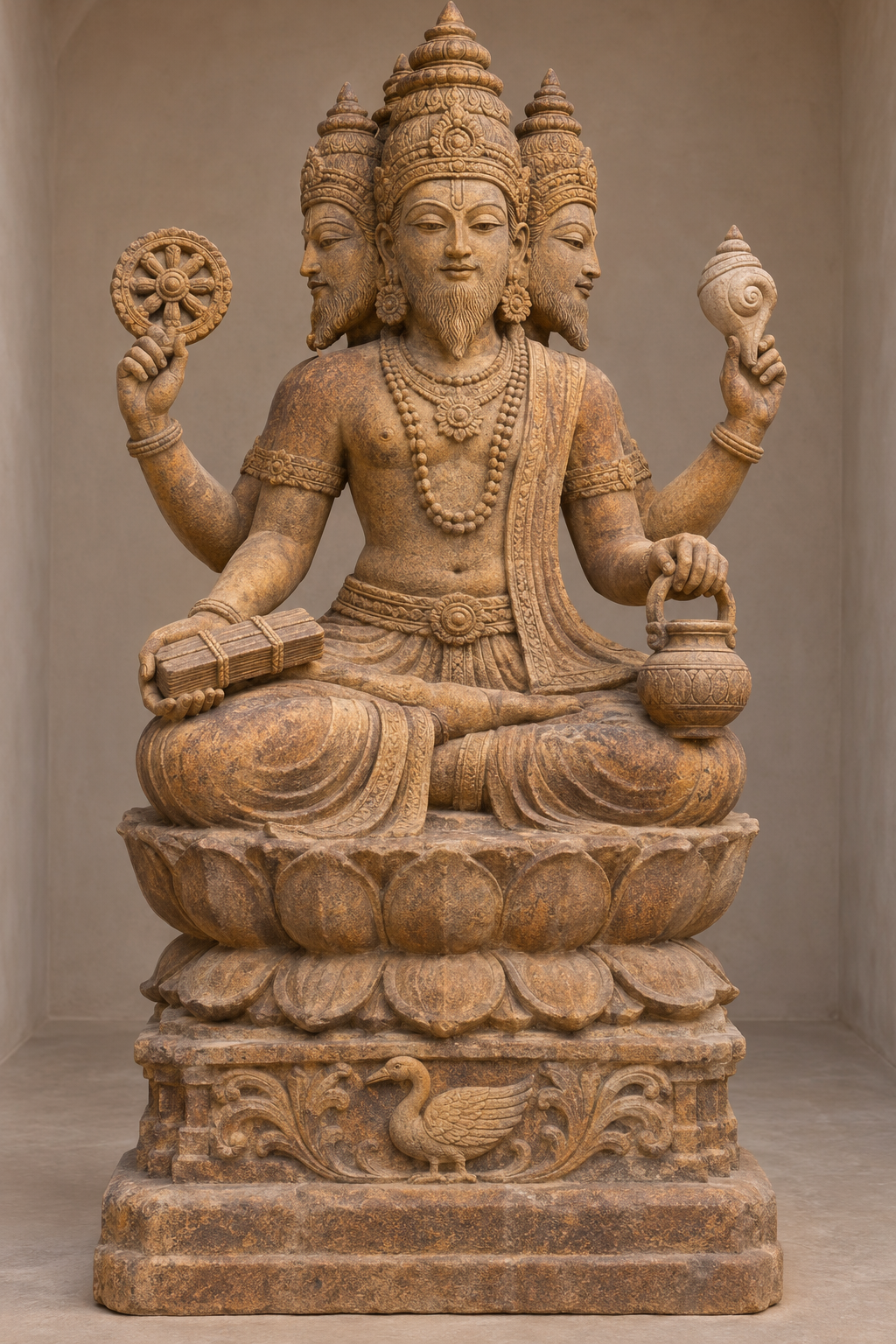
The shankha, or conch, and the chakra, or discus, are among Vishnu’s most familiar emblems. Brahma is more commonly represented with objects connected to sacred knowledge and disciplined creation, including the Vedas, a japa mala and a kamandalu. The less familiar form called Shankhu Chakradhari Brahma places the shankha and Sudarshana Chakra in Brahma’s hands.
That combination changes the emphasis of the representation; it does not automatically change the identity of the deity. An emblem can help identify a figure, but it can also express a power, relationship, role or particular theological idea. Hindu sacred art must therefore be read as a complete composition rather than as a matching exercise in which one object always yields one name.
The exact reason for the conch and discus cannot be recovered from the attributes alone. If an image has no known temple context, inscription, traditional caption or named scriptural connection, a confident explanation may say more than the surviving evidence permits.
Read the whole form before naming the deity
If you encounter such an image in a shrine, book or devotional print, use the following order. It prevents Vishnu’s two recognisable emblems from overwhelming every other clue.
- Identify the figure’s own markers. Look at the heads or faces, the remaining hands, the posture, the seat and any accompanying figures. Brahma’s multiple faces are a stronger clue than one isolated handheld object.
- Identify the objects carefully. Confirm that the supposed chakra is actually a discus and that the other object is a conch. A stylised wheel, lotus, manuscript or ritual vessel can be misread in a damaged sculpture or low-resolution reproduction.
- Look for the image’s context. A temple name, panel sequence, pedestal inscription, printed caption or established local tradition may tell you whether this is Brahma in an uncommon form, a narrative scene or another deity altogether.
- Rank your conclusions by certainty. You may be able to identify Brahma and the two emblems with confidence while remaining uncertain about why he carries them. That is a sound reading, not an incomplete one.
This method also matters when only one face is visible. A frontal photograph can conceal faces directed to the sides or rear, and a cropped image can remove the attributes that would otherwise settle the identification. Before correcting a caption, find an uncropped view if one is available.
What Vishnu’s emblems may communicate in Brahma’s hands
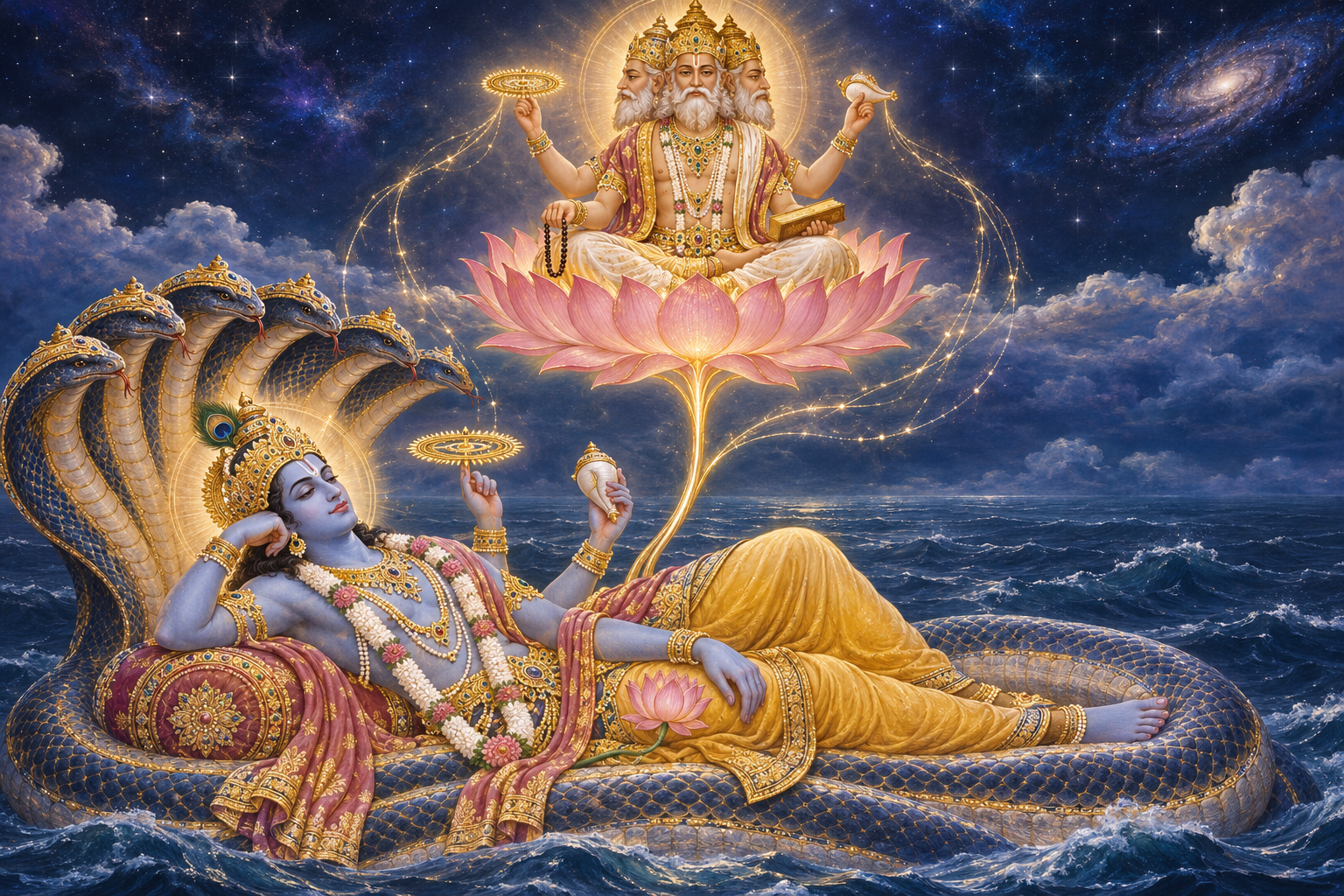
The first meaning is visual and certain: the image brings Brahma into an unusually direct relationship with symbols ordinarily associated with Vishnu. Anything beyond that is interpretation and should be presented as such.
One possible reading is coordination among divine functions. Brahma and Vishnu are commonly connected with creation and preservation respectively. Placing Vishnu’s emblems in Brahma’s hands can invite the devotee to see those functions as related rather than sealed into independent compartments.
Another possibility is the communication of divine power through a borrowed or shared attribute. In sacred art, possession of an emblem need not mean that the bearer has become its usual owner. It may indicate authority exercised in a particular setting, a close theological relationship or the presence of one deity’s power in the activity of another.
A third possibility is narrative compression. A single image may preserve the decisive idea of a longer sacred account without illustrating every event. In that case, the unusual objects are not general rules about Brahma’s appearance. They belong to a particular episode or teaching. You need the image’s provenance to distinguish this possibility from a broader theological statement.
These readings are compatible possibilities, not interchangeable facts. Choose among them only when the surrounding tradition gives you a reason. Without that context, the most defensible conclusion remains modest: Brahma is being represented with Vishnu-associated emblems, and the unusual pairing is meaningful even though its precise intended meaning is not established.
How to describe the image without overstating it
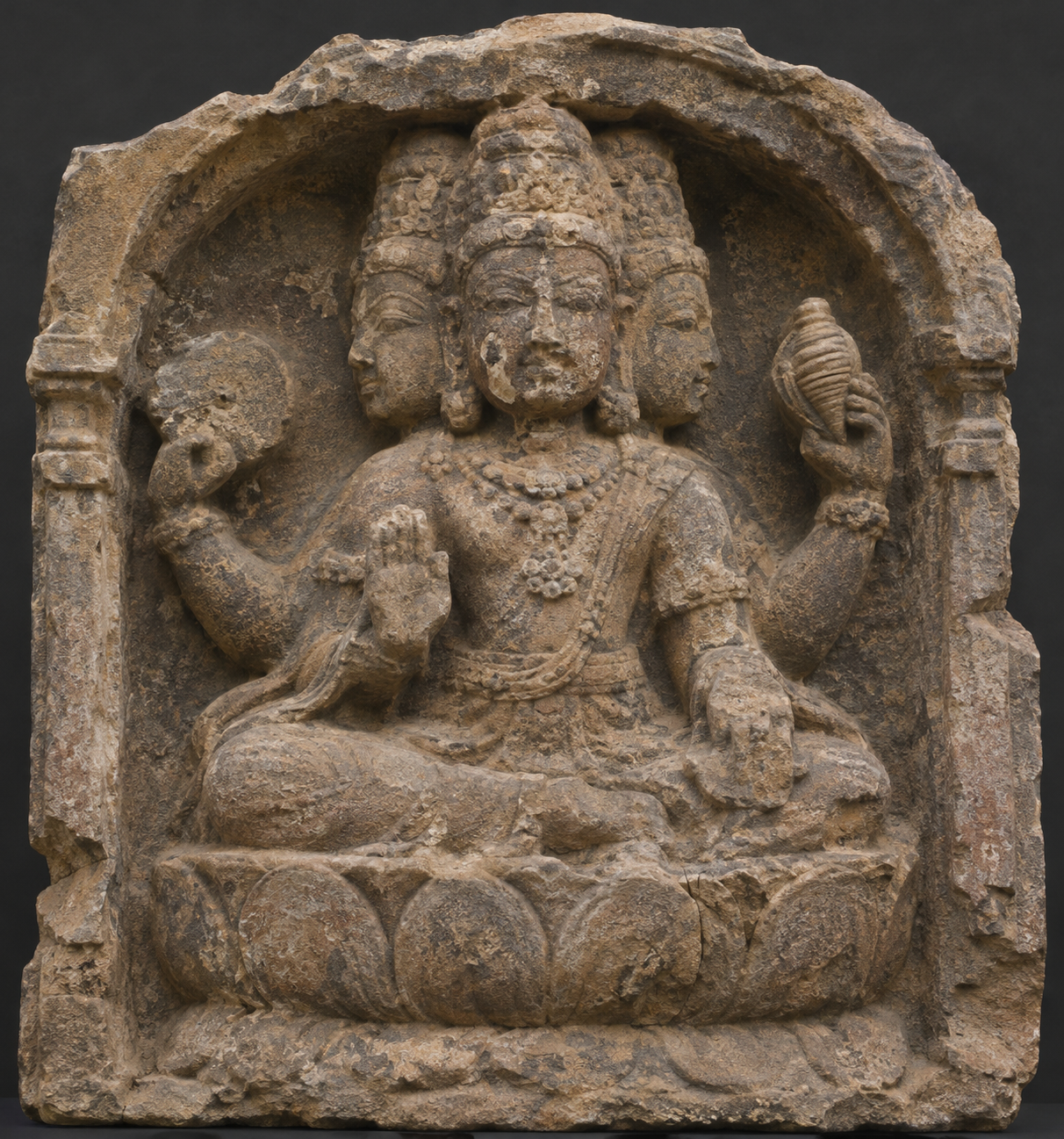
A useful description has three layers. First state what is visible. Then state the conventional association. Only then offer an interpretation, clearly marked as a possibility.
- Observation: The figure identified as Brahma holds a conch and a discus.
- Association: These emblems are ordinarily associated with Vishnu; the discus may be identified as the Sudarshana Chakra.
- Interpretation: Their presence may express a relationship between Brahma’s creative role and Vishnu’s preserving power, or may belong to a particular narrative tradition.
For a museum note, temple photograph or educational caption, you could write: “Brahma is shown holding a shankha and chakra, emblems more commonly associated with Vishnu. The representation is sometimes called Shankhu Chakradhari Brahma; its more specific meaning depends on the image’s textual and ritual context.”
Avoid calling the figure a mistake merely because its attributes are unfamiliar. Avoid identifying it as Vishnu solely from the weapons. Do not label it a composite deity unless the image or its tradition supports that conclusion. Most importantly, do not attach a precise Purana episode to it unless you can name and verify the passage.
The distinction between identification and interpretation is the key. Identification asks, “Who is represented?” Interpretation asks, “Why is this deity represented in this way?” The first question may have a firm answer even when the second remains open.
Key takeaways
- The conch and discus strongly evoke Vishnu, but they are not sufficient by themselves to turn every bearer into Vishnu.
- Brahma is usually shown with the Vedas, japa mala and kamandalu, making the Shankhu Chakradhari form an intentionally unfamiliar variation.
- Use the figure’s faces, remaining attributes, companions and setting before deciding whether a caption is wrong.
- Separate what you can see from what you infer: the presence of Vishnu’s emblems is observable, while their exact theological purpose requires context.
- When provenance is missing, describe the unusual iconography accurately and leave the specific narrative explanation open.
The next time you see Brahma holding a conch and discus, begin with the complete form and record where the image came from. That small act of attention often preserves the context needed to move from a plausible reading to a well-grounded one.
References

Leave a Reply
You must be logged in to post a comment.