
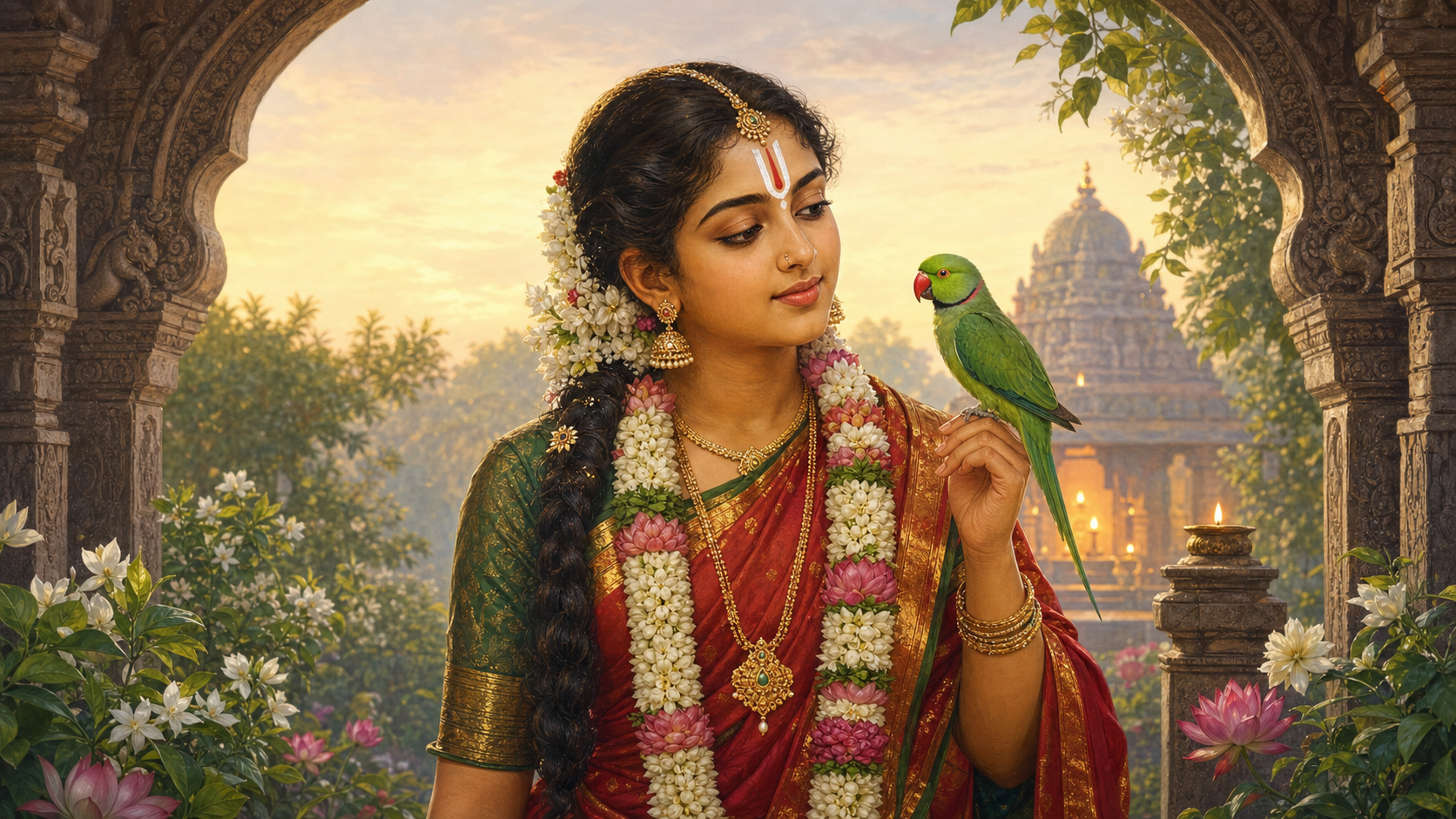
You are looking at an image of Andal, and the small green parrot beside her seems almost too charming to be theological. Yet it is one of the clearest clues to the image. The bird helps you see Andal’s longing for Vishnu not as private emotion, but as a message carried through poetry, remembrance, and sacred speech.
The most useful way to interpret the parrot is to read the whole composition in order. Begin with Andal, then notice the bird’s position, recall what parrots do, and only then consider its color and wider associations. That sequence keeps the symbol rooted in Vaishnava bhakti instead of turning it into a free-floating emblem with any meaning we choose.
Read Andal before isolating her parrot
Andal is the cherished Tamil poet-saint and the only woman among the Alvars. Her devotional identity therefore comes before the bird. She is commonly shown as a youthful, richly adorned figure whose composure conveys both intense love and spiritual assurance. Garlands, a lotus, fine ornaments, and the parrot together establish the setting in which the symbol must be read.
The garland is especially important. It recalls the Srivilliputhur tradition in which Andal prepared flower garlands for Vishnu. In the visual language of her icon, devotion is not merely felt; it is fashioned into an offering. The parrot extends the same principle into the realm of speech: what the garland does with flowers, the bird does with voice.
This is why identifying the parrot as a generic sign of beauty or fertility is incomplete. Those associations may contribute to the image, but they do not establish its centre. Andal’s relationship with Vishnu does. Her bridal mysticism, her yearning for Ranganatha, and her poetic voice give the bird its specifically Vaishnava force.
When you encounter a particular murti, painting, or procession image, look first for the relationships among its elements. Is the parrot resting on Andal’s hand, placed close to her cheek, or visually joined to her garland and gesture? The precise arrangement may vary, so the absence of one familiar detail does not invalidate the image. Iconography works as a grammar of related signs, not as a checklist in which every item must always appear.
The messenger turns longing into a relationship
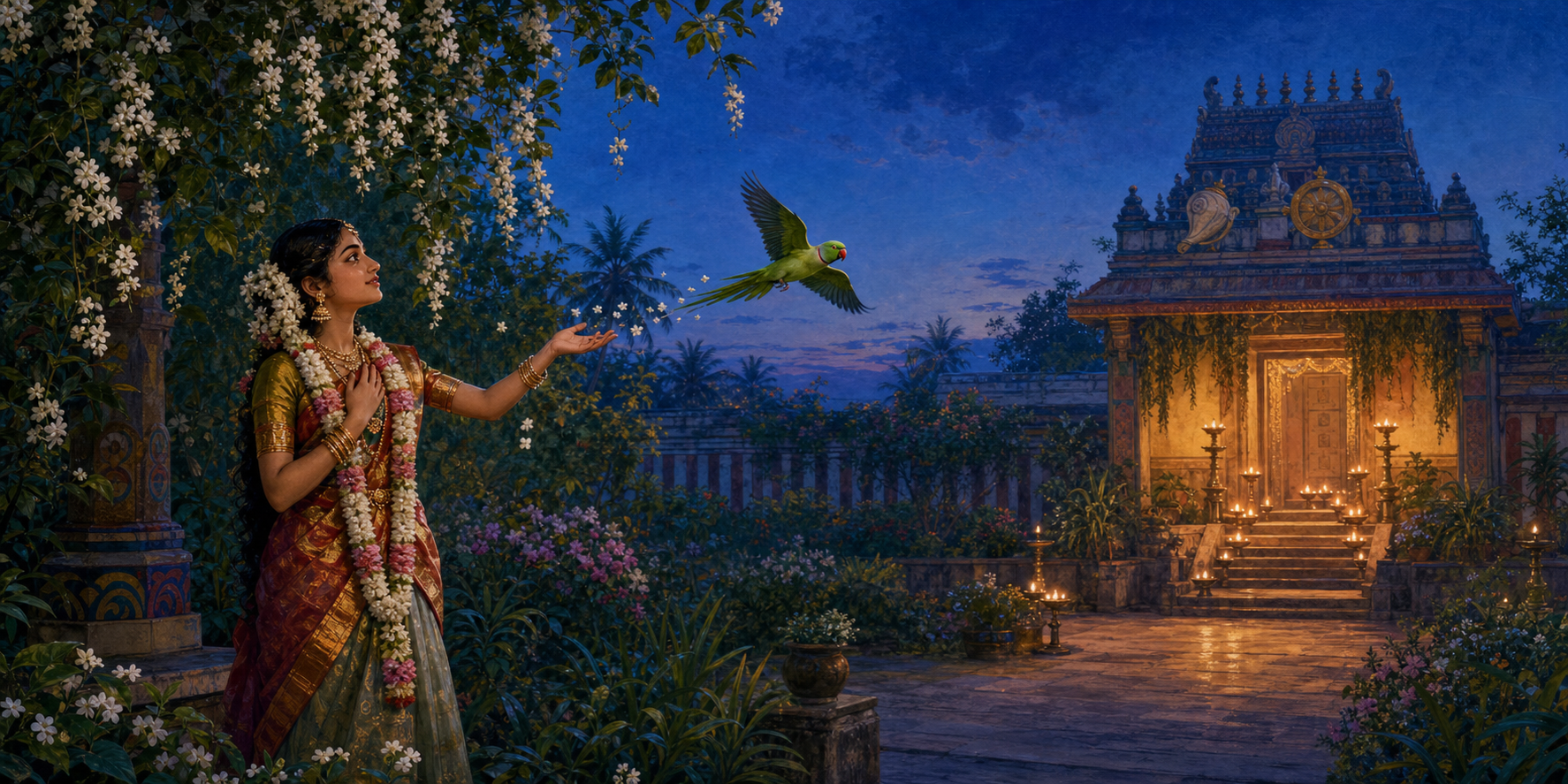
In the Tamil poetic world surrounding Andal’s devotional works, the parrot can serve as a messenger of love. That familiar poetic role acquires a deeper purpose beside a Vaishnava saint. The distance to be crossed is the apparent distance between the devotee and the Lord, and the message is the devotee’s longing for divine nearness.
This reading protects Andal’s longing from two opposite errors. It is not merely human romance decorated with religious language, and it is not an emotion that must be discarded before spiritual life can begin. Longing becomes a form of address. It moves outward, seeks the Beloved, and establishes a living relation between soul and Lord.
The parrot’s position makes that movement visible. Near Andal’s cheek, it draws your attention to utterance and intimacy. On her hand, it appears entrusted with something that must be borne. In either case, the bird is not best understood as a biographical pet. It gives visible form to communication that would otherwise remain invisible.
You can apply this insight when reading the Tiruppavai or Nachiyar Tirumozhi. Instead of treating expressions of desire as decorative lyricism, ask three concrete questions: Who is being addressed? What separation is the verse trying to cross? What does the act of speaking change in the devotee? Those questions reveal bhakti as disciplined relationship rather than passive sentiment.
Mimicry becomes mantra, memory, and transmission
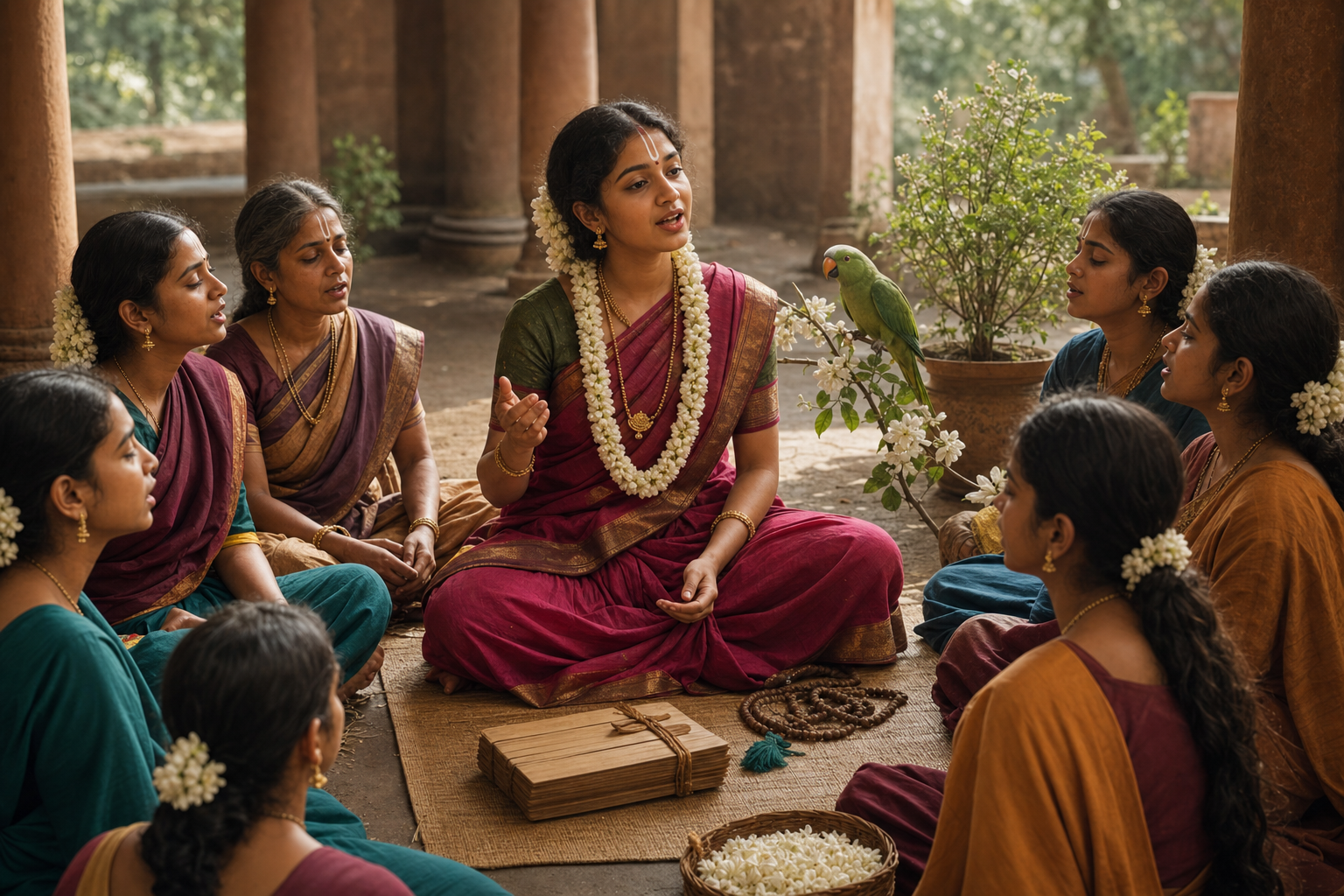
A parrot is known for repeating the human voice. Beside Andal, that ordinary capacity becomes a reflection on mantra, nama-sankirtana, and the repetition of the Divine Name. The image poses a demanding question: does repeated speech remain an echo, or does it reshape the person who speaks?
Vaishnava practice does not value repetition because novelty has failed. Repetition keeps the name present. Attention returns to the Lord each time the name is spoken, sung, remembered, or heard. Andal’s poetry participates in this movement: a verse can be literature, prayer, communal song, and remembered teaching without ceasing to be poetry.
The parrot therefore marks a progression you can use in your own reading:
- Hear the words accurately. Begin with what the verse or Divine Name actually says.
- Repeat without rushing past familiarity. Familiar language can disclose more when attention deepens instead of searching constantly for novelty.
- Remember the one being addressed. Repetition becomes devotional when it remains relational.
- Let speech govern conduct. Sacred utterance matures when remembrance affects how you act, not only how you sound.
The name Shuka also recalls the sage Shuka, renowned as the narrator of the Bhagavata Purana. This is a resonance, not an identification. Andal’s parrot should not be labelled as the sage in avian form. The more careful connection is thematic: bird, narrator, poet, and devotee all draw attention to sacred truth carried by a living voice and preserved through remembrance.
That distinction matters whenever you explain the icon to someone else. Say that the parrot can evoke the oral transmission of scripture; do not claim that it secretly represents a specific sage unless the particular artistic or ritual context establishes that claim. A responsible interpretation distinguishes a meaningful association from a fixed identity.
Green color and physical closeness deepen the reading
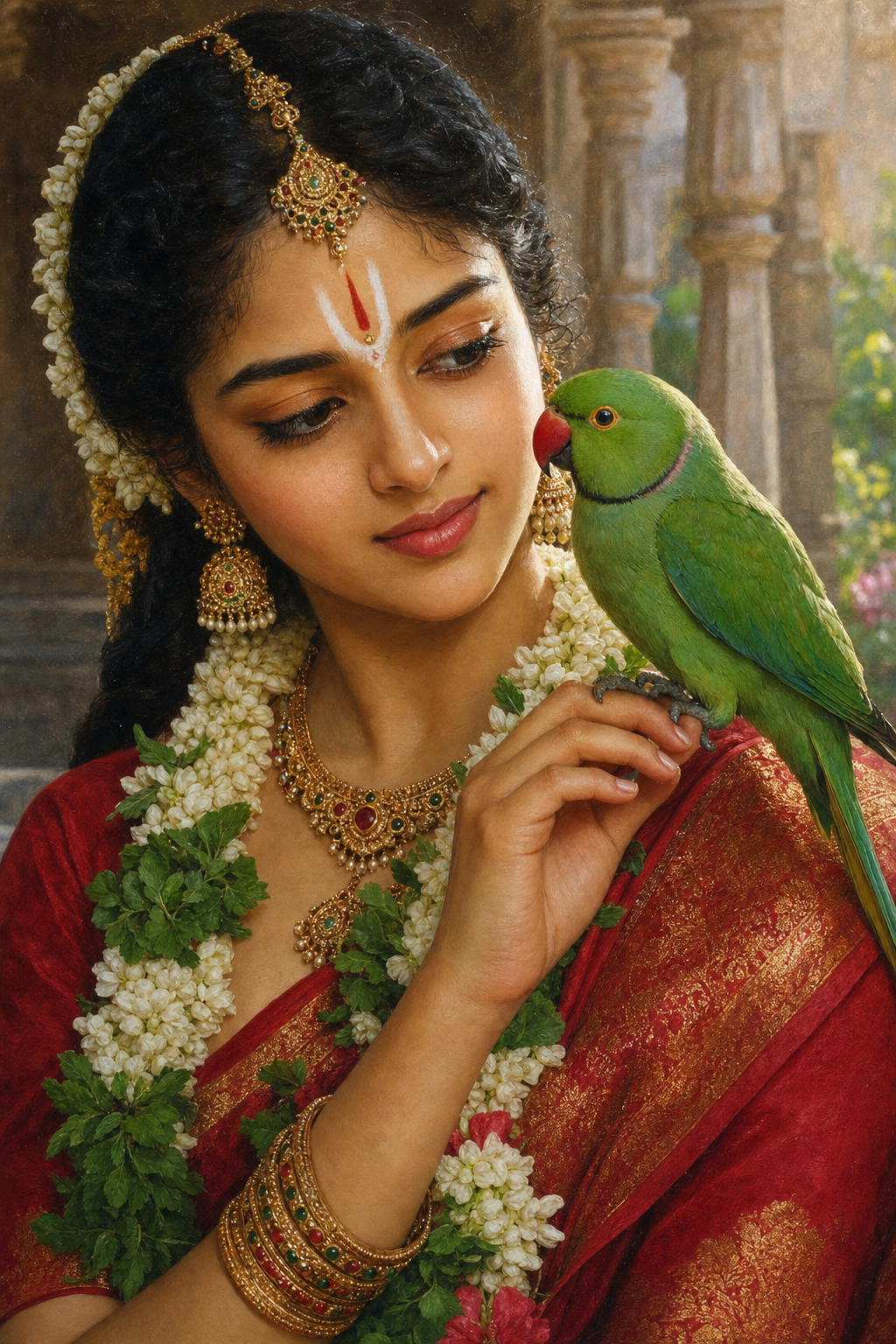
The parrot’s green color adds vitality, fertility, auspiciousness, and renewal. These are supporting meanings rather than a substitute for the messenger and voice symbolism. Green makes the bird appear alive with the freshness of bhakti: devotion remembered and renewed, not preserved as a lifeless relic.
The seasonal world of Andal’s devotion strengthens this reading. The contemplative atmosphere of Margazhi, inseparable from the reception of the Tiruppavai, can be understood as movement toward spiritual flowering. The green bird quietly holds that promise within the icon. A vow undertaken in stillness is meant to become living nearness to the Beloved.
For some devotees, the bird can also represent the devoted soul itself. Its smallness suggests dependence rather than weakness; its closeness suggests the security of remembrance; its voice suggests the soul sustained by the Divine Name. This interpretation works best as contemplation, not as an exclusive decoding that cancels the messenger motif.
Context remains decisive. A parrot accompanying Andal in temple art or a festival procession carries a more definite Vaishnava frame than a parrot woven into a textile or formed in palm-leaf craft. The decorative form can preserve an echo of the sacred motif, but you should not assume that every green bird in Tamil visual culture expresses Andal’s complete theology.
A reliable way to explain the icon without overreading it
If you are teaching a child, guiding a temple visitor, writing a caption, or simply clarifying the image for yourself, use a layered explanation. Start with the meaning most securely anchored in Andal’s devotional setting, then add the secondary associations and their limits.
- Name Andal’s identity. She is the Tamil woman Alvar whose devotion finds expression through poetry, garlands, and bridal longing for Vishnu.
- Identify the parrot’s first role. It is a messenger carrying love across apparent separation.
- Connect the bird to voice. Its mimicry evokes repeated Divine Names, sung poetry, and sacred memory.
- Add the supporting visual meanings. Its green color contributes freshness, vitality, and auspicious renewal.
- State the boundary. The bird may recall sage Shuka and scriptural transmission, but it is not automatically an image of the sage.
- Return to practice. Ask whether your own words carry remembrance, truth, and devotion, or merely repeat religious language without attention.
Wider Dharmic parallels can enrich this explanation when they are handled precisely. Parrots in Buddhist Jataka narratives can embody loyalty, compassion, and tireless care. Birds in Jain narrative art can serve ethical teaching concerned with ahimsa, restraint, and clarity. Sikh reverence for shabad and simran affirms the transforming importance of truthful sacred speech and remembrance, even though the parrot is not thereby a shared Sikh icon.
These parallels disclose a family resemblance, not an interchangeable code. Hindu, Buddhist, Jain, and Sikh traditions retain their own texts, practices, and theological commitments. What converges is a civilizational intuition: voice has moral and spiritual consequence, disciplined remembrance changes the one who remembers, and compassion must be carried into action. Recognising that kinship should make each tradition clearer, not blur their differences.
Key takeaways
- Andal’s parrot is first a Vaishnava symbol of love communicated between devotee and Lord.
- Its ability to repeat speech connects the icon with mantra, nama-sankirtana, poetry, and sacred memory.
- The name Shuka may recall the narrator of the Bhagavata Purana, but association is not literal identity.
- The bird’s green color adds vitality, renewal, fertility, and auspiciousness to the central devotional meaning.
- The safest interpretation begins with Andal’s whole icon and treats broader associations as layers, not replacements.
The next time you stand before Andal, do not begin by asking what parrots mean everywhere. Watch where this parrot rests, remember whose voice it accompanies, and listen for the question the icon directs to you: what message are your own repeated words carrying toward the Divine?
References
