
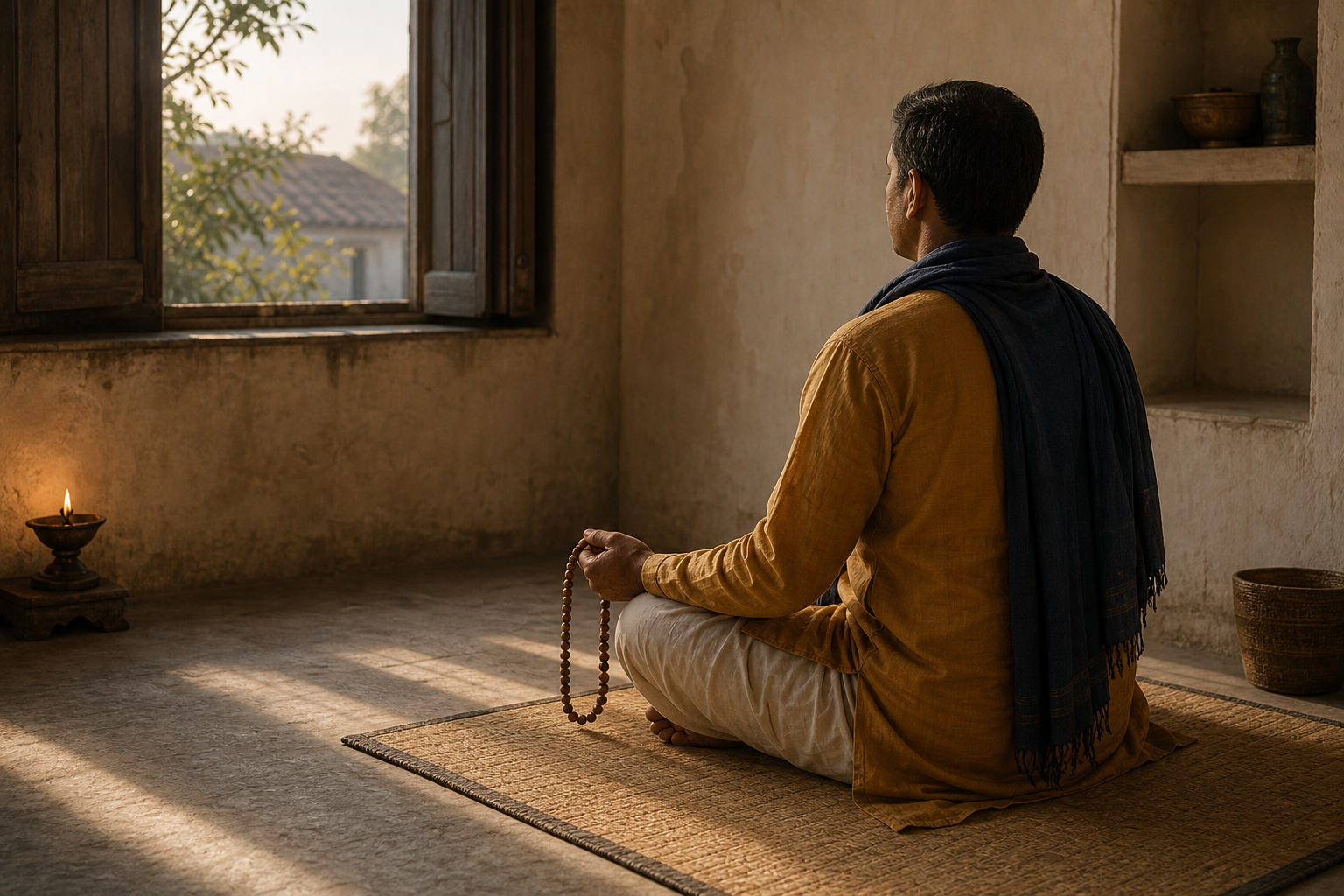
You choose a mantra, arrange a place to sit, and begin with conviction. Then work runs late, the mind refuses to settle, or one missed session becomes a week. The problem may not be your spiritual capacity. More often, an intense plan has been asked to do the work of a sustainable discipline.
Abhyasa Yoga gives you a more useful objective: establish a practice you can return to under ordinary conditions. You are not trying to overpower the mind in one heroic sitting. You are training the ability to choose a direction, notice when attention has left it, and return without drama.
Continuity matters more than an impressive session

Abhyasa means practice or repetition, but neither English word fully conveys its discipline. Within Raja Yoga, it is the sustained effort through which attention becomes steadier over time. It is not a separate technique competing with asana, pranayama, mantra, or meditation. It is the principle that turns any suitable technique into a path of training.
The classical formulation pairs abhyasa with vairagya, or non-attachment. The pair matters because mental discipline has two movements. Abhyasa returns you to the chosen direction. Vairagya releases the demand that this return must immediately produce calm, pleasure, insight, or proof of advancement.
Practice without non-attachment easily becomes bargaining: you sit only when meditation feels rewarding, or you condemn yourself when it does not. Non-attachment without practice can become passivity. Held together, they let you work sincerely without making every passing mental state into a verdict on your progress.
Patanjali’s Yoga Sutra describes stability as the fruit of practice maintained for a long time, without interruption, and with dedication. The Bhagavad Gita likewise joins repeated practice with freedom from attachment. Neither principle asks you to manufacture a blank mind. They ask for fidelity to the work.
That distinction changes how you evaluate a sitting. At the beginning, ask two questions: Did you begin as intended? When distraction appeared, did you return? A quiet session may be pleasant, but quietness alone does not prove discipline. A restless session containing many sincere returns may train exactly the capacity you came to cultivate.
“Without interruption” should not become a weapon against yourself. If you miss a session, do not compensate with an exhausting marathon or spend the next sitting rehearsing guilt. Resume at the next available practice period. Continuity is restored through the next action, not through self-accusation.
Build a routine that can survive an ordinary day
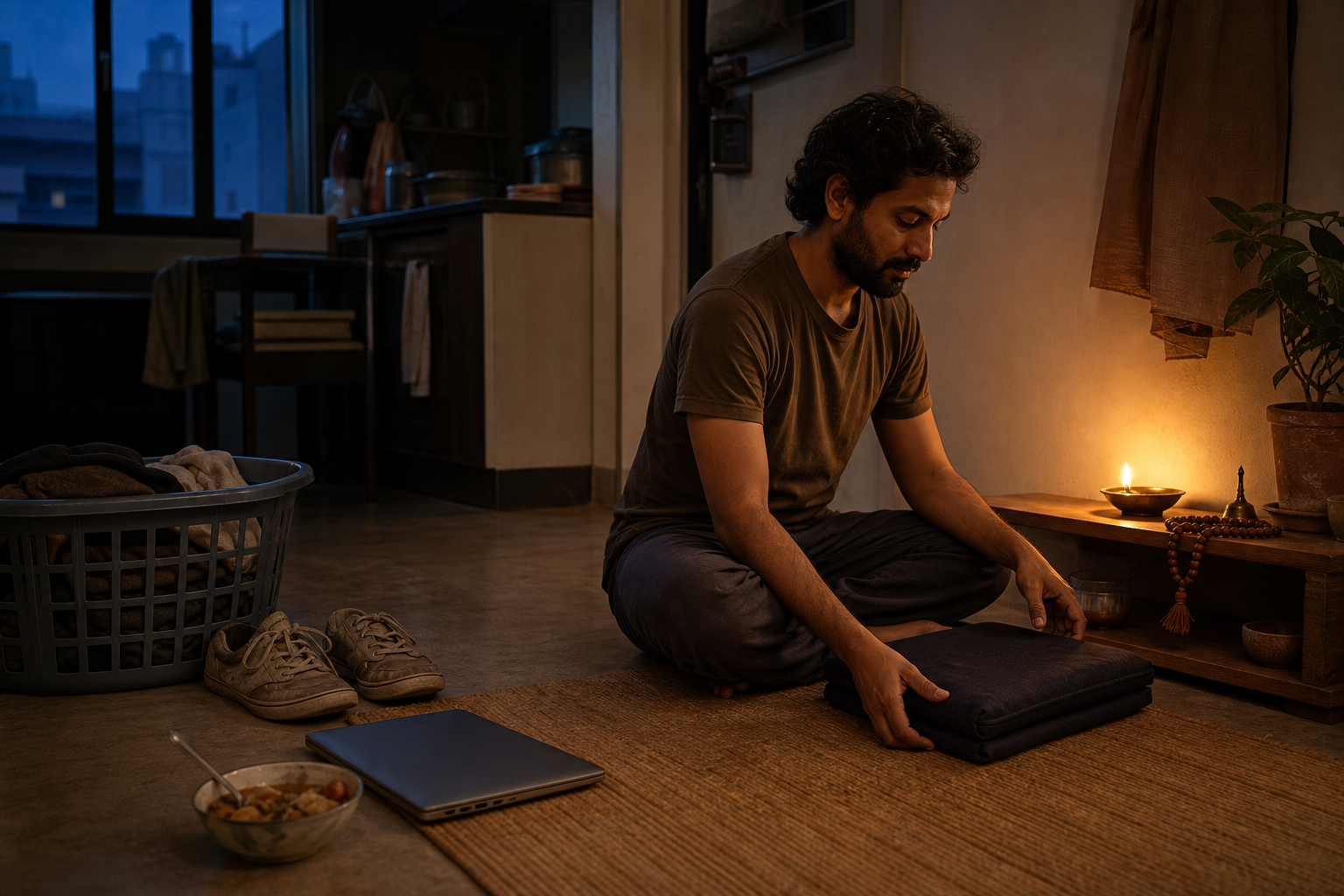
A householder’s discipline must coexist with work, family, study, service, and unforeseen demands. A sequence of 20–30 minutes of daily asana, breath work, and quiet sitting can accumulate meaningful change when it is genuinely repeatable. An elaborate routine performed occasionally does not provide the same continuity.
Before choosing more techniques, remove recurring decisions. Give the practice four stable elements:
- One time: choose a dependable period linked to a regular transition in your day, such as waking or finishing your evening responsibilities.
- One place: use the same simple, prepared space whenever possible. The space does not need to be elaborate; it needs to be available.
- One sequence: decide the order before you sit so that restlessness cannot renegotiate the practice halfway through.
- One anchor: use a chosen mantra, the natural breath, or another established contemplative focus appropriate to your path.
Then move through a consistent sequence. The purpose of each stage is practical: it prepares the condition needed by the next one.
- Set the sankalpa. State one operational intention for this sitting. A useful form is: During this practice, I return to the chosen anchor. Avoid a grand promise about attaining peace, eliminating thought, or having a special experience.
- Prepare through asana. Use brief, familiar, non-straining movement to make the body steady enough to sit. This is preparation for attention, not a performance within the session.
- Settle the breath. Let pranayama gather attention through comfortable, measured breathing. Do not improvise forceful breathing or retention ratios merely to make the practice feel advanced. If deliberate breath control feels uncomfortable, return to natural breathing and seek qualified instruction before attempting it again.
- Turn inward through pratyahara. Stop following every sound, sensation, or impulse into a new line of thought. You do not need to fight the senses. Notice their objects without continually feeding them with commentary.
- Consolidate attention through dharana. Place attention on the selected mantra, breath, or contemplative object. Each time attention wanders, bring it back to the same anchor.
- Allow dhyana to develop. When attention begins to remain with its object more continuously, reduce unnecessary interference. Dhyana is not produced by pretending concentration is unbroken. It matures as the repeated returns of dharana become steadier.
This layered movement through ethical grounding, bodily steadiness, breath, sense-withdrawal, concentration, and meditation also prevents a common mistake: trying to solve every difficulty by forcing the mind. Sometimes the obstacle is upstream. An uncomfortable body may need better preparation. A hurried breath may need to settle. An attention continually fed by external stimulation may need pratyahara before it can sustain dharana.
End at the boundary you planned. Do not keep extending a pleasant sitting to possess the experience, and do not abandon a noisy sitting because it failed to reward you. Samadhi belongs to the culmination of deepening steadiness; it is not another box to force into today’s routine.
Make the return itself your basic mental repetition

Many people treat distraction as time stolen from meditation. In Abhyasa Yoga, distraction reveals the exact moment when training becomes possible. You cannot practise returning until you notice that attention has moved.
Use the same response each time:
- Recognise the movement. Notice that attention is now occupied by a memory, plan, sound, sensation, or judgement.
- Do not continue the story. You do not need to argue with the thought, solve it, or establish why it appeared.
- Release the verdict. Drop conclusions such as this session is ruined or I am bad at meditation. This is vairagya applied at the point where it is needed.
- Return to the same anchor. Re-establish attention gently but deliberately. Do not shop for a more interesting technique whenever the present one becomes ordinary.
- Continue without keeping score. If attention leaves again, repeat the process. The number of distractions does not change the required response.
This method keeps you from making a second disturbance out of the first. The original distraction may last only a moment. Anger about being distracted can occupy the rest of the sitting. A calm return prevents that secondary reaction from taking command.
The same skill extends beyond the cushion. During work, you notice attention scattering and return to the task. During a difficult exchange, you notice the impulse to react and return to considered speech. During worship, study, or seva, you notice mechanical participation and renew your intention. Abhyasa becomes a way of living when the return is no longer confined to a formal session.
Keep a plain record if consistency is difficult. Record only what helps you adjust conduct:
- whether you began at the intended time;
- whether you followed the agreed sequence;
- which obstacle appeared most strongly;
- what practical change could reduce that obstacle next time.
Avoid rating each session by how spiritual, blissful, or silent it felt. Those ratings invite attachment to temporary states. The record should make your discipline more honest, not turn meditation into a contest with yesterday.
Fix the source of inconsistency instead of blaming character
Fatigue, restlessness, doubt, and irregularity are ordinary obstacles within sustained practice. Calling them laziness or spiritual failure rarely tells you what to change. Name the actual friction and respond at that level.
- If fatigue repeatedly defeats the session: move practice to a period when you are less depleted, use brief asana to prepare for sitting, or simplify the sequence while retaining its anchor and order. Do not use aggressive breath work to overpower genuine exhaustion.
- If restlessness dominates: reduce novelty. Keep the same place, sequence, and anchor instead of adding techniques. The restless mind often seeks another decision; a predetermined structure removes that opportunity.
- If doubt keeps changing the method: define a fair test as faithful repetition, not one dramatic sitting. Hold the method steady long enough to observe whether returning becomes more natural. Constantly replacing the practice prevents continuity from being tested.
- If the routine is irregular: prepare the seat, text, mala, or other needed item beforehand. Tie the session to a stable event in your day. The fewer negotiations required at the starting moment, the easier it is to begin.
- If attachment to progress creates frustration: return to controllable actions. You can choose to begin, follow the sequence, and redirect attention. You cannot command a particular inner state to appear on schedule.
- If one missed session becomes abandonment: resume without adding punishment. The next sincere session repairs continuity more effectively than a long internal argument about the missed one.
Your record will usually expose patterns. If fatigue appears every time, the schedule may be unrealistic. If setup consumes the practice period, the routine has too many moving parts. If you change anchors whenever boredom appears, the sankalpa is not governing the session. Make one practical correction and preserve the rest of the structure.
Discipline should make practice dependable, not harsh. A plan designed only for unusually energetic days will repeatedly collapse under ordinary duties. A simpler discipline that you can honour has more value than an ideal routine that exists mainly in your imagination.
Choose one Dharmic form and practise it faithfully

The logic of steady cultivation appears across Dharmic traditions without making their doctrines interchangeable. Hindu paths may organise practice around mantra japa, breath awareness, contemplative reading of the Bhagavad Gita, or silent dhyana. Buddhist bhavana emphasises mental cultivation. Jain samayik trains equanimity through regular devoted sitting. Sikh nitnem and simran sustain disciplined recitation and remembrance.
These parallel disciplines share confidence in repeated cultivation, but their theological settings and intended meanings should still be respected. Dharmic unity does not require stripping a practice from its lineage or pretending that every tradition describes the final goal identically.
If you already belong to a lineage or community, begin with the discipline it has given you. Learn its purpose, form, and ethical setting rather than collecting disconnected methods. If you are establishing a personal routine, choose one suitable, non-straining anchor and build continuity before adding complexity. The decisive question is not which practice looks most advanced. It is which authentic discipline you can perform with sincerity, regularity, and non-attachment.
Key takeaways
- Measure early progress by whether you begin and return, not by whether the mind becomes blank.
- Pair abhyasa with vairagya: repeat the chosen action while releasing your demand for a particular experience.
- Use a stable time, place, sequence, and anchor so that practice does not depend on fresh motivation.
- Treat distraction as the occasion for training; recognise it, release the judgement, and return.
- Diagnose obstacles precisely. Adjust the schedule, preparation, or complexity without discarding the whole discipline.
- Honour the shared Dharmic principle of cultivation while practising each tradition within its own framework.
Choose your next practice period now. Decide the time, prepare the place, select the anchor, and write down the sequence. When the appointed moment arrives, begin before asking whether you feel ready. Your task is not to conquer the mind in one sitting. It is to make the next sincere return.
References
