
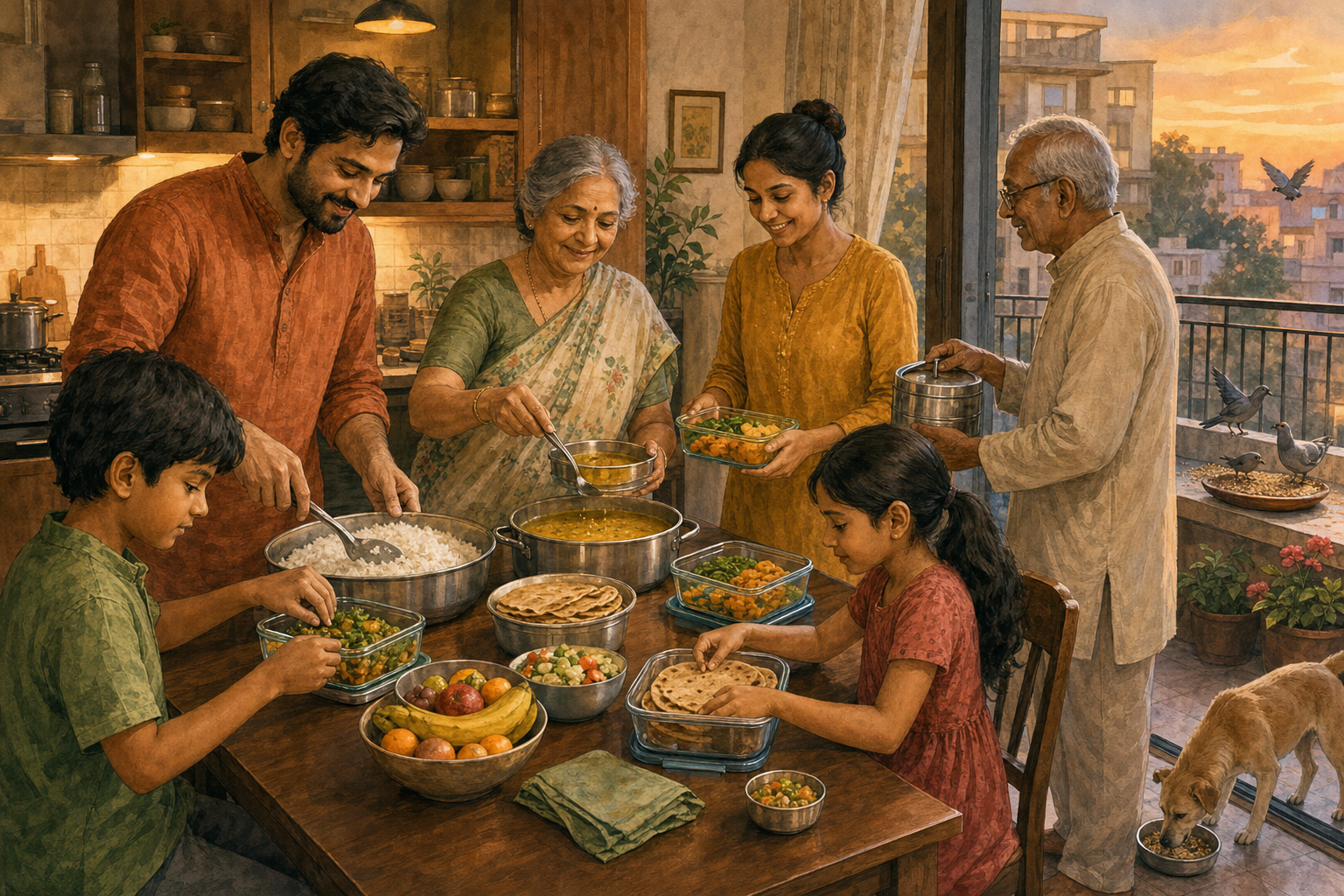
You may want your family to treat food as sacred, yet the old setting is gone. You live in an apartment. No cow waits near the doorway, strangers rarely ask for flour, and the nearest community kitchen may be across the city. The choice is not between reproducing every inherited gesture and abandoning the ethic behind it.
Begin with one clear rule: decide who else will be fed before you serve yourself. That small change turns generosity from the disposal of leftovers into a first claim on the household’s abundance.
Food becomes sacred when another being has a claim
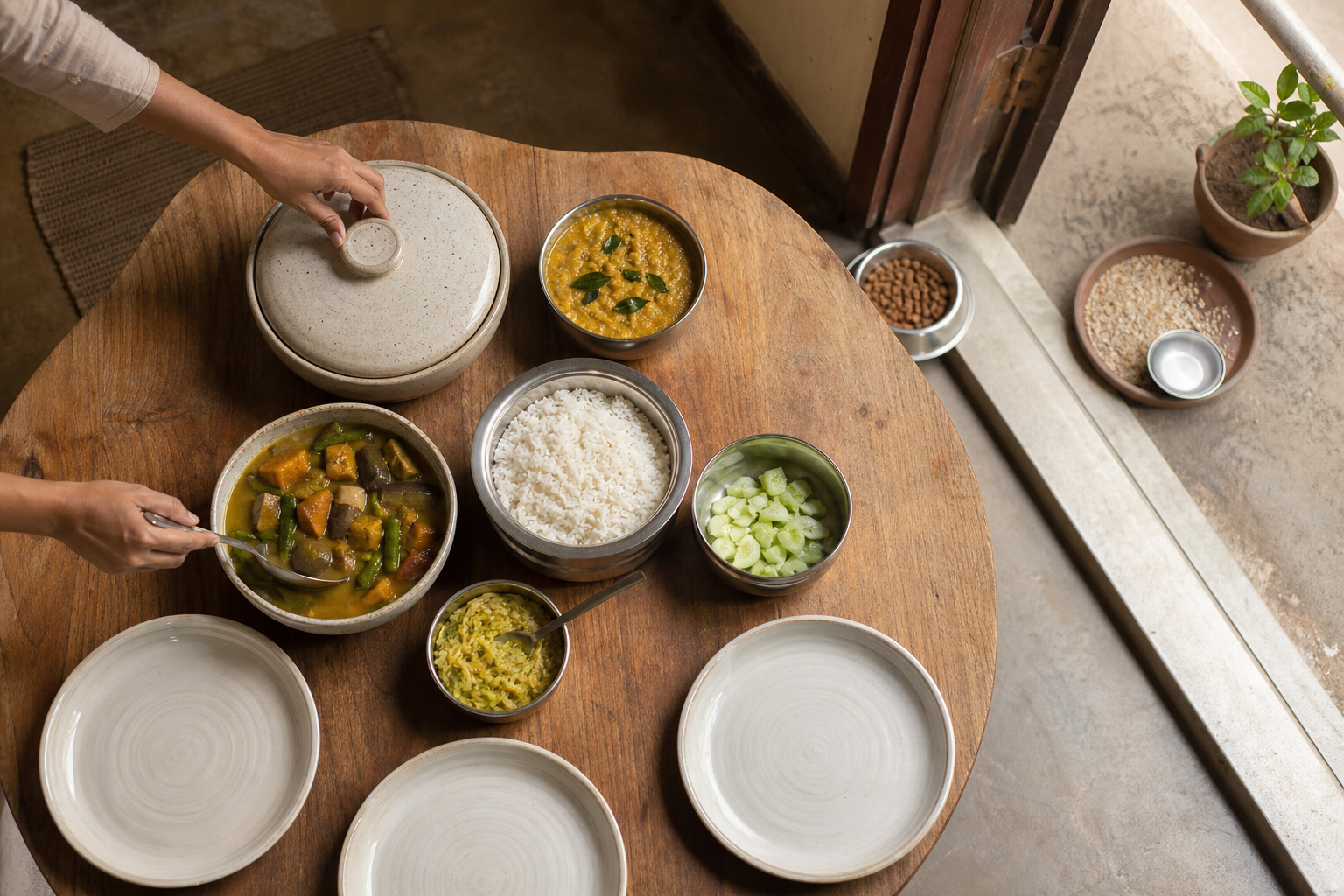
Sanctity is not established by calling food sacred. It appears in the way you cook, distribute, receive, and refuse to waste it. If everyone outside the household receives only what the household no longer wants, consumption still occupies the centre. Setting aside a share first changes the order of obligation.
Within living memory, many Indian homes made that order visible through a sequence of offerings before the family ate. Dough went to a cow. A first roti was prepared for a dog. Small morsels were left for ants or crows. Rotis accompanied by dal or sabzi were reserved for the Gurudvara. A person asking at the door might receive flour, while a household worker received rotis and sometimes part of the cooked meal.
The crucial detail was not the particular menu. It was the timing. Hungry children saw that appetite did not automatically outrank duty. They handled the flour, carried the food, encountered the recipient, and learned that feeding another being belonged to ordinary household life. Generosity was not confined to a festival, a public appeal, or whatever remained after dinner.
You do not need to copy that sequence mechanically. A ritual separated from local conditions can produce waste or even harm. Preserve its three working principles instead:
- Priority: set aside the share before members of the household choose their portions.
- Circulation: give food through a reliable route so that it reaches a person, community kitchen, or living creature that can actually use it.
- Continuity: repeat a modest practice often enough that giving becomes part of how the household operates.
Some families once kept the flour vessel or roti box from becoming completely empty, even leaving a small piece at the end of the day. You need not treat that custom as a prediction of fortune or misfortune. Its practical insight is still useful: abundance is understood as a flow to be maintained, not a pile to be exhausted privately.
Four Dharmic paths give the shared ethic distinct forms
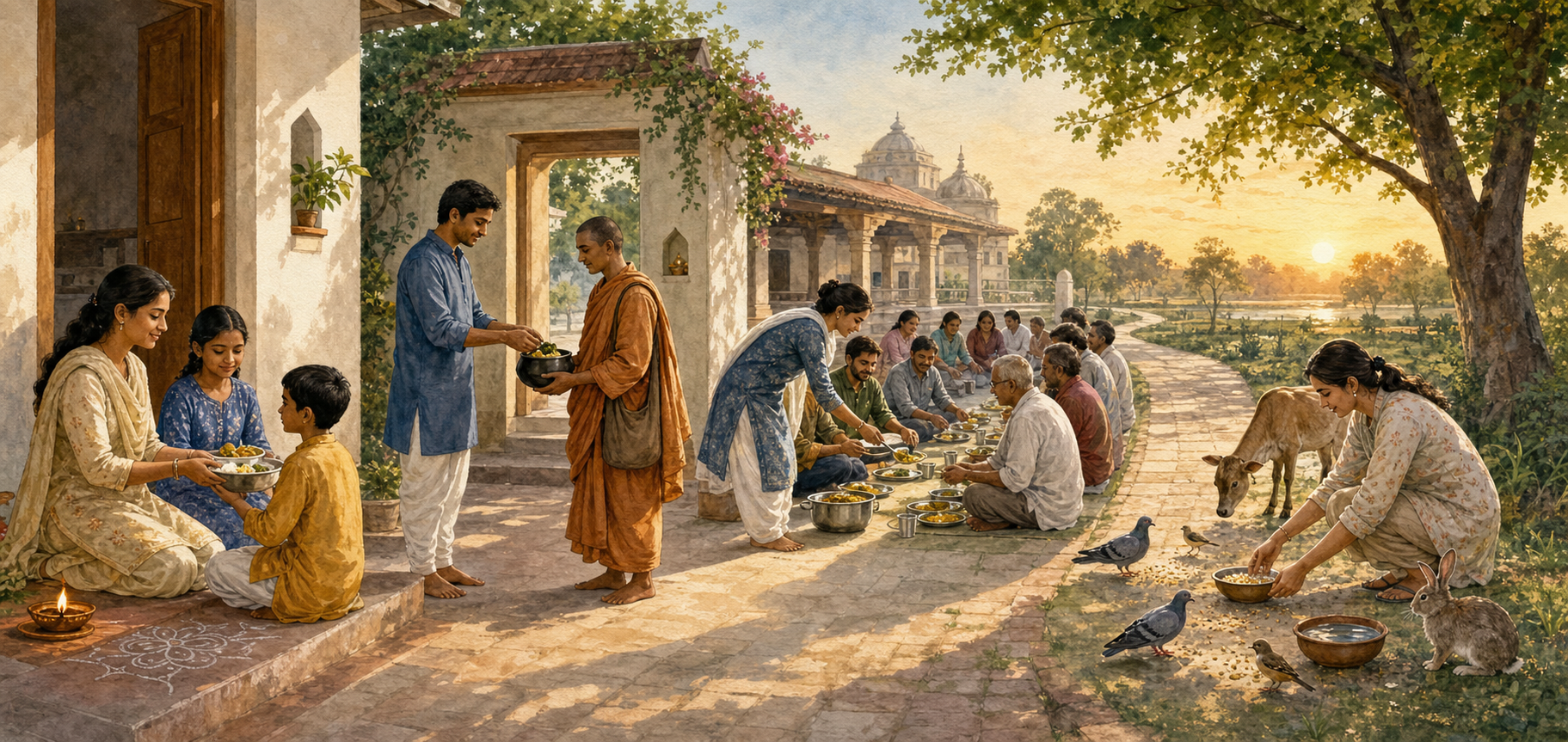
Hinduism, Sikhism, Jainism, and Buddhism should not be compressed into one indistinct teaching. Each tradition gives generosity its own vocabulary, discipline, and spiritual setting. Their convergence matters precisely because their differences remain real.
- Hindu household discipline: hospitality, offerings, restraint, and feeding before self-consumption place the householder inside a larger field of obligations. Dharmasastra texts attributed to Manu describe Pancamahayajna, the five great duties directed toward deities, sages, ancestors, fellow human beings, and other living creatures.
- Sikh langar: food is joined to seva and equality. People sit within a shared institution of service rather than receiving charity as an inferior class. A household that contributes ingredients, money, labour, or prepared food participates in a continuing communal responsibility.
- Jain ahimsa: moral concern reaches animals and even the smallest forms of life. The relevant question is not merely how generously you give, but whether your food choices and methods of giving reduce injury.
- Buddhist dana: generosity loosens possessiveness and supports spiritual development. The giver is also being trained; the act is not measured only by the material received.
The common question is concrete: Who has a legitimate claim on this food before I consume it? That question interrupts the assumption that whatever enters your kitchen belongs exclusively to you.
If your family follows a particular sampradaya or panth, root the practice there. Use its prayers, institutions, and understanding of seva, dana, ahimsa, or yajna. In a mixed Dharmic household, you can state the common household vow without pretending that every tradition is identical: Before we eat, we remember and feed beyond ourselves.
Build a household practice that can survive modern life
A demanding programme that lasts three days teaches less than a small act sustained for years. Choose one route first. Add another only after the first has become dependable.
- Choose a fixed occasion. Attach the practice to a meal you usually prepare, to the weekly grocery shop, or to one regular day of community service. Do not rely on remembering whenever you happen to feel generous.
- Name the recipient before preparing extra food. It might be a neighbour recovering from difficulty, a local family that welcomes the arrangement, a Gurudvara langar, a community kitchen, a food bank, or a responsibly managed animal-feeding effort. A destination prevents a symbolic portion from becoming waste.
- Ask what is useful. A langar may need ingredients, volunteer labour, or money more than another container of cooked food. A food bank may accept only particular unopened goods. A neighbour may need one staple but already have another. Let actual need shape the offering.
- Set aside good food first. Use a clean container and reserve an edible portion before the household plates are filled. Giving spoiled food, unwanted scraps, or items nobody in the home would eat does not honour anna or its recipient.
- Assign responsibility. Decide who carries the food, where it goes, and when the handoff happens. A vague family intention usually leaves the work to one person at the last minute.
- Give children a real task. A child can place a pantry item in the donation bag, help pack rotis, serve at a community kitchen where permitted, or fill an appropriate feeding bowl under adult supervision. Explain the relationship, not merely the motion: this food was set aside because another being also matters.
- Review the arrangement after four weeks. Check whether the food arrived fresh, whether the amount was useful, whether any portion was wasted, and whether one person carried all the labour. Adjust the quantity or route while preserving the commitment.
Three models work especially well because they have a clear trigger. A meal-based practice reserves one serving before plating. A shopping-based practice puts a requested staple aside as groceries are unpacked. A community-based practice schedules a recurring contribution or period of service. Select the model that fits your actual household rhythm, not the one that looks most impressive.
If your contribution is financial, move it to the beginning of the household budget rather than waiting to see what remains. Then retain one physical act of attention: pack a requested item, serve periodically, or pause before the meal to remember where the contribution goes. Money can improve reliability, but an entirely invisible transaction may not teach children or adults the discipline that direct participation once carried.
Protect dignity, safety, and the meaning of the gift

Good intention is not enough. Food sharing must respect the recipient and the conditions in which the food will be used. Several boundaries keep generosity from becoming self-congratulation, waste, or harm.
Food never replaces what you already owe
If someone works in your home, food is not a substitute for the full wage you have agreed to pay. Offer a meal or take-home portion separately, without reducing compensation and without pressure to accept. The same principle applies to debts and other obligations: dana begins after fairness, not in place of it.
Ask before making a recurring arrangement. Some people will value cooked food; others may have dietary, storage, scheduling, or household reasons to decline it. Respecting that answer is part of respecting the person. Do not photograph a recipient, turn need into a lesson performed for an audience, or require visible gratitude.
Animal care requires more than leaving food outside
A ritual intention does not make unsuitable food safe. Do not give mouldy leftovers, food mixed with packaging, or anything you cannot confidently identify as appropriate for the animal. Do not place food where animals will be drawn into traffic, conflict, or a hostile location.
If you lack the knowledge or setting to feed animals responsibly, support an established feeder, shelter, or animal-care group instead. They can provide continuity, suitable food, clean feeding points, and follow-up care. This preserves the purpose of the offering without treating an animal as a temporary object in your ritual.
Do not manufacture surplus in the name of sharing
Cooking extra food without a recipient is not generosity yet. It is an unresolved distribution problem. Confirm the route first, prepare an appropriate amount, store it safely, and deliver it while it remains fit to eat. If plans change, use the food in the household or redirect it promptly instead of preserving a symbolic portion until it spoils.
A household under financial strain should not deprive a dependent to imitate the scale of a wealthier family’s observance. Reduce the amount, share less frequently, contribute time to a community kitchen, or help move food that others have provided. The discipline is measured by sincerity, regularity, and care, not by public size.
Key takeaways
- Reserve a share before serving yourself; timing is what gives another being a prior claim rather than a claim on leftovers.
- Choose one repeatable channel: a person you know, a community kitchen or langar, a food bank, or a responsibly managed animal-care effort.
- Ask what is needed, agree on the handoff, and give food of a quality you would accept yourself.
- Keep food gifts separate from wages, debts, and other duties already owed to the recipient.
- Let children participate through useful work, while protecting every recipient from display or humiliation.
- Review the practice after four weeks and correct waste, inconvenience, or unequal household labour without abandoning the underlying commitment.
For your next meal, do not prepare an extra portion until you know where it can go. Choose the recipient first. At the next suitable cooking time, place a clean container beside the stove and fill it before anyone chooses a serving. Repeat the same act for four weeks. That is long enough to move food sanctity out of the realm of good intentions and into the operating rhythm of your home.
References
