
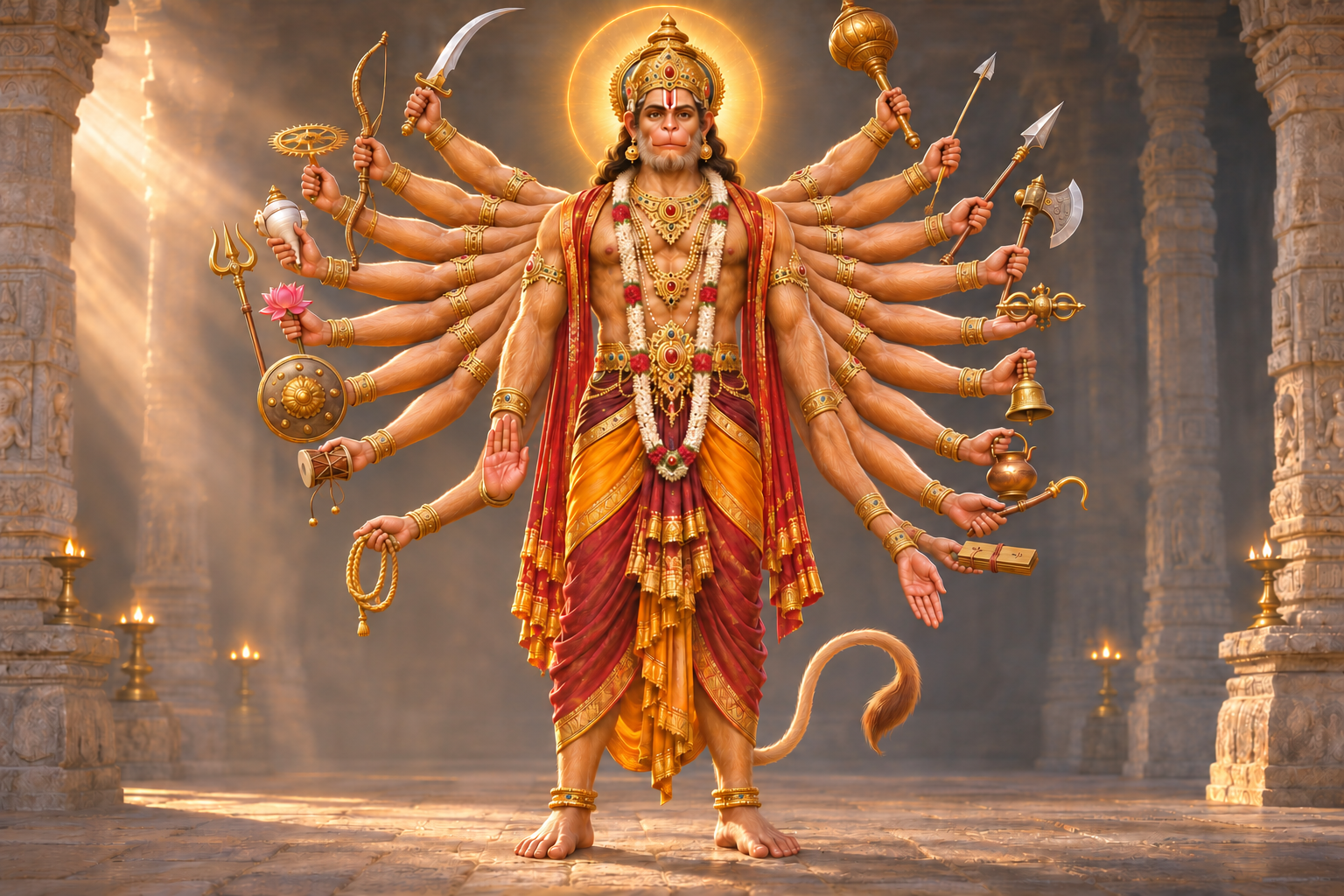
You are looking at an unusually complex image of Hanuman. The face is familiar, but the many arms and crowded arrangement of objects make the identification uncertain. Before you try to name every object, establish the form’s basic visual grammar.
Vimshatibhuja Hanuman is identified by a precise combination: one face, twenty arms, and a different weapon, emblem, or gesture in each hand. That structure gives you a reliable way to recognize the form and a disciplined way to interpret it without turning uncertainty into invented symbolism.
Identify the form by three non-negotiable features
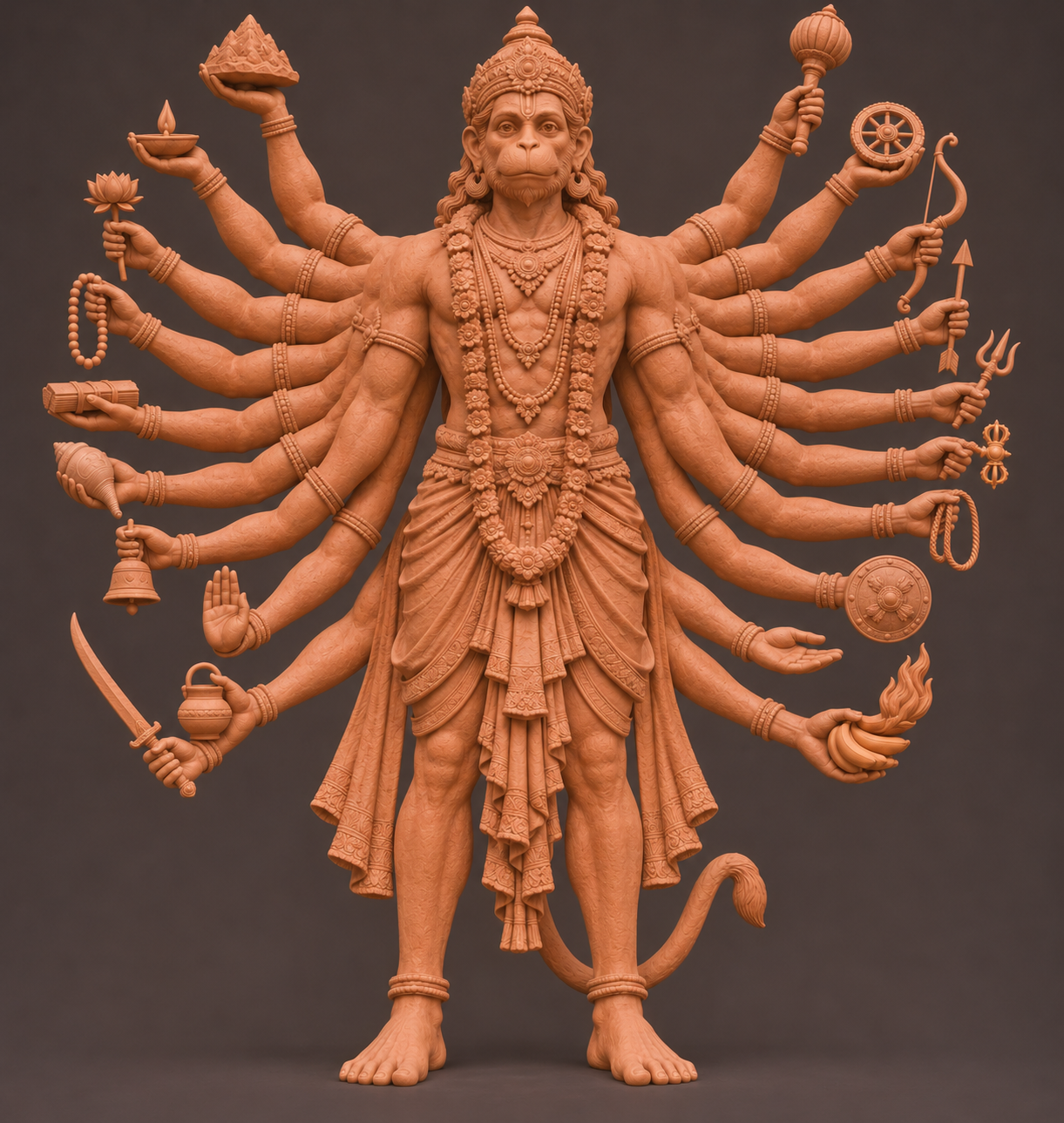
The name itself provides the first test. Vimshatibhuja means twenty-armed. English transliterations may also appear as Vimsatibhuja or Vimsathi Bhuja, but the defining number does not change.
- Count the faces. Vimshatibhuja Hanuman has a single face. If the image presents several faces, you are dealing with a different iconographic arrangement, even if it also has numerous arms.
- Count the arms, not the objects. Trace each limb from the shoulder outward. Ornaments, weapons, banners, and decorative flourishes can create false lines in a photograph or a densely carved murti.
- Check the hands. The twenty hands carry distinct weapons and emblems or form meaningful gestures. The variety is part of the identity of this rare form, not incidental decoration.
Use all three tests together. A many-armed Hanuman image is not automatically Vimshatibhuja Hanuman, and twenty apparent objects do not prove the presence of twenty arms. The face count, arm count, and differentiated hands must support the same identification.
Damage, garlands, clothing, or a poor viewing angle may conceal part of a temple image. When that happens, mark the count as uncertain. A label, temple record, or explanation from the temple’s custodians is better evidence than forcing a complete count from an obstructed view.
The twenty hands are not simply an arsenal
It is easy to see many arms and reduce the entire image to overwhelming martial power. The iconography itself calls for a more careful reading because the hands do not all perform the same function. Weapons, emblems, and gestures belong to different kinds of visual language.
- A weapon directs your attention toward protection, resistance, or the overcoming of an obstruction. Its exact meaning still depends on what the object actually is.
- An emblem identifies or evokes a quality, responsibility, sacred association, or sphere of action. It should not be casually relabelled as another weapon merely because it is held in a raised hand.
- A gesture communicates through the position of the hand itself. It may change the tone of the whole composition by introducing assurance, blessing, instruction, devotion, or another relationship with the worshipper.
This distinction matters. If you call every object a weapon, you turn a layered sacred image into a picture of force alone. If you ignore the weapons, you erase the form’s protective and active dimension. Read the three categories together.
The contrast between one face and twenty arms also offers a sound devotional reading. The face gives the composition a unified centre, while the arms display many simultaneous capacities. You can therefore contemplate the form as concentrated purpose expressed through abundant action: many powers, but no fragmentation of resolve.
For a devotee of Hanuman, that visual logic naturally recalls seva directed by unwavering attention. Treat this as contemplation rather than a mechanical code. The number of arms is iconographic fact; the inward lesson you draw from their coordinated activity is devotional interpretation.
Examine the hands without guessing at their names
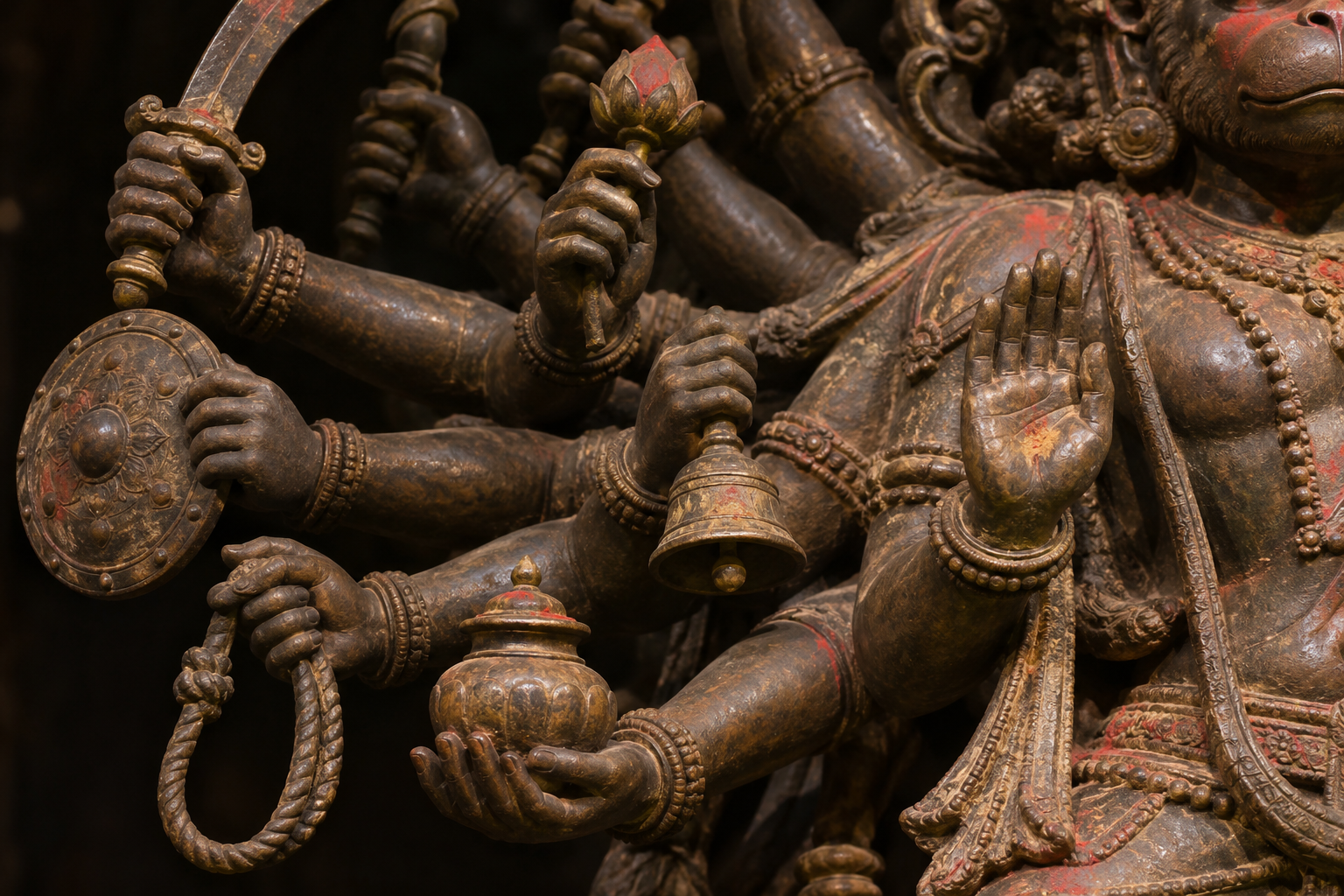
A crowded image encourages fast recognition: you notice a shape, connect it with a familiar object, and build an explanation around the guess. Reverse that order. Record what is visible before deciding what it signifies.
- View the entire figure first. Confirm that the image has one face and appears to have twenty arms before concentrating on individual attributes.
- Choose a fixed direction. Start with the highest visible hand on the viewer’s left, work downward, and then repeat on the viewer’s right. State that you are using the viewer’s perspective so another person can follow your notes.
- Describe before naming. Write down visible features such as curved, pointed, circular, open palm, closed hand, long shaft, or partially concealed. A description can remain accurate even when identification is uncertain.
- Classify each hand provisionally as weapon, emblem, gesture, or unclear. This prevents an uncertain shape from silently becoming a confident theological claim.
- Only then attach a name or interpretation. Prefer an inscription, an established temple description, or a clear visual match. If those are unavailable, retain the word unclear.
A useful field note might read: “Viewer’s left, third hand from the top: long object with a widened end; possibly a weapon; identification unconfirmed.” That is more valuable than a confident but unsupported label because another reader can revisit the observation.
Do not assume that a hand on one side must mirror a hand on the other. The defining feature is differentiation among the twenty hands. Record the arrangement you can see rather than completing it from imagined symmetry.
If you encounter the form in a temple, let darshan come before cataloguing. Do not move garlands, cloth, ornaments, or ritual objects to expose a concealed hand. Ask whether the temple has a printed description or a clearer image, and use the name by which that temple knows the murti.
Avoid the four most common reading errors
- Do not confuse many arms with many faces. Vimshatibhuja identifies the number of arms, while the form described here remains single-faced.
- Do not count attributes instead of limbs. One large object may cross several arms, while a small gesture may hold no object at all.
- Do not treat every hand as martial. The presence of emblems and gestures means the composition cannot be read accurately as a collection of weapons alone.
- Do not invent an exact list from an unclear image. Saying that an object is unidentified preserves the integrity of the observation and leaves room for better evidence.
You can also grade your identification. Call it confirmed when the name is supplied by the temple or image context and the single face, twenty arms, and differentiated hands are visible. Call it probable when the visual structure fits but no reliable label is available. Call it unconfirmed when damage, ornamentation, or cropping prevents an accurate count.
This small discipline protects two things at once: the specificity of Hindu iconography and the humility appropriate to sacred art. Reverence does not require you to pretend that you can see what is hidden.
Key takeaways
- Vimshatibhuja means twenty-armed; the form has one face and twenty hands.
- Each hand bears a distinct weapon or emblem, or forms a meaningful gesture.
- Confirm the face count, arm count, and differentiated hands before assigning the name.
- Separate direct observation from interpretation, especially when an attribute is damaged or concealed.
- Read the form as more than martial force: weapons, emblems, and gestures contribute different dimensions to the whole.
- In a temple, follow the temple’s identification and established practice rather than disturbing adornments to inspect the murti.
The next time you meet this form, begin with one face, count twenty arms, and map the hands patiently. Once the visible structure is secure, you can contemplate what the image places before you: immense capacity gathered around a single, steadfast centre.
References

Leave a Reply
You must be logged in to post a comment.