

You may have encountered a serene, four-armed goddess holding a manuscript, rosary, water pot, and small staff, then wondered whether she should simply be identified as Saraswati. That answer can be too quick. When these attributes appear together, they point to Vageshwari, a distinct expression of Devi whose image teaches what makes speech worthy of being heard.
Her iconography is especially useful if you teach, write, recite mantra, speak publicly, or face a conversation in which words will have consequences. Read correctly, the murti presents a discipline: learn before speaking, purify your intention, govern your words, and accept responsibility for what they set in motion.
Begin with her name and the complete set of attributes
Vageshwari, also written Vageshvari, joins Vak, speech, with Ishwari, mistress or sovereign. She is therefore not merely a patron of eloquence. She is the ruling power of meaningful sound and articulate expression. The name directs your attention beyond a pleasant voice or clever phrasing to the intelligence, restraint, and truth that ought to govern speech.
To recognise her, look for a cluster rather than one isolated object. A book can belong to several knowledge-bearing deities, and a rosary can appear in many contemplative forms. The characteristic Vageshwari form brings four attributes into one coherent image:
- A small staff or danda in the lower right hand
- An akshamala, or rosary, in the upper right hand
- A kamandalu, or water vessel, in the upper left hand
- A grantha, book, or manuscript in the lower left hand
She is single-faced and four-armed, with a composed rather than martial presence. That full combination is more reliable than colour, clothing, ornament, or one hand-held object, all of which may be rendered differently by regional artists.
If you are identifying a temple sculpture or painting, record what is actually visible before naming it. Note the number of faces and arms, the objects, their hand positions, the seat, and any inscription or local name. When an attribute has been broken or obscured by garlands, the remaining arrangement and the living temple tradition matter more than resemblance to a modern calendar print.
Her four hands reveal a complete discipline of speech
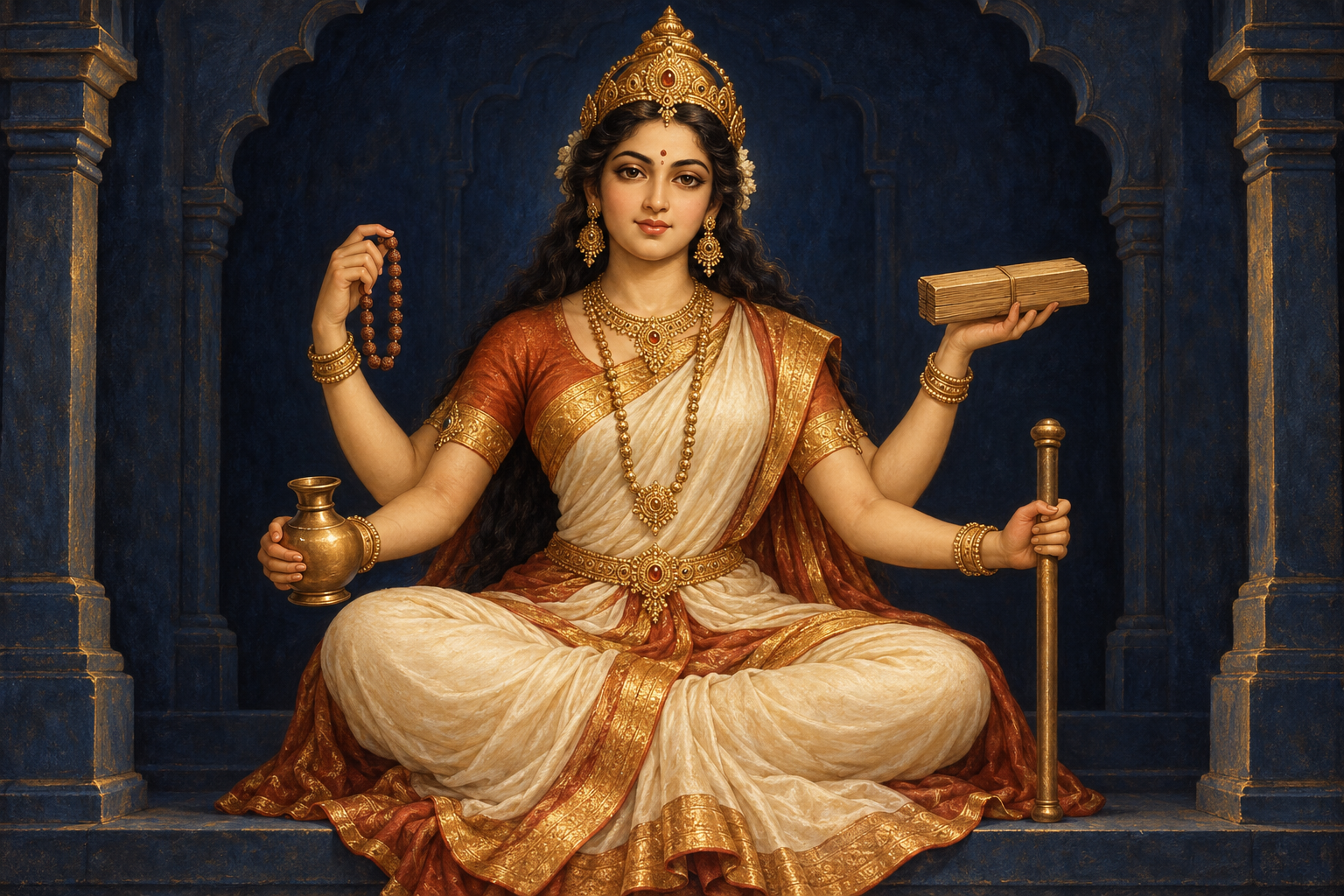
The objects in Vageshwari’s hands are not four unrelated signs of learning. They form a sequence. The staff establishes order, the rosary trains sound, the water vessel purifies, and the manuscript grounds speech in preserved knowledge. Together they answer four practical questions: Is the word governed? Has it been disciplined? Is its intention clean? Is it rooted in understanding?
The danda: speech must be governed
The danda is a staff of authority and discipline. In Vageshwari’s hand, it tells you that speech is an exercise of power. A promise can bind. An accusation can injure. A teaching can direct another person’s life. Even a technically true statement can become adharmic when delivered to humiliate, manipulate, or inflame.
The staff therefore asks a question that should come before eloquence: who or what governs the speaker? If anger, vanity, or the desire to dominate is holding the staff, verbal skill only makes the damage more efficient. Vageshwari’s sovereignty begins with self-command.
The akshamala: sound becomes clear through disciplined repetition
The akshamala associates Vageshwari with counted recitation, mantra, attention, and repetition. A rosary does not reward haste. Each bead receives one complete utterance before the hand moves to the next. That rhythm turns sound from an impulsive discharge into a deliberate practice.
This has an immediate application beyond formal japa. Before delivering an important sentence, repeat it inwardly. Listen for exaggeration, needless sharpness, and words that conceal your real intention. The pause is not weakness. It is the point at which raw reaction can become articulate speech.
The kamandalu: expression needs a clean source
The kamandalu is a contained vessel of water. Its symbolism joins purity with careful holding: what is valuable is gathered, protected, and used with purpose rather than spilled indiscriminately. Placed in the iconography of speech, it directs attention to the source from which words arise.
You can state a correct fact for a corrupt reason. You can offer advice to display superiority rather than to help. The water vessel asks you to inspect motive as carefully as content. Before speaking, ask whether the words are meant to clarify, protect, teach, reconcile, or merely satisfy the urge to react.
The grantha: words must answer to knowledge
The grantha represents preserved and transmissible knowledge. It places speech within a lineage of learning rather than treating every personal impression as wisdom. Vageshwari rules both the living voice and the knowledge that the voice receives, studies, remembers, and passes forward.
This distinction matters whenever you explain dharma. Memory can fail, paraphrases can drift, and a familiar claim can become detached from its proper setting. The manuscript instructs you to check the text, name the tradition, distinguish quotation from interpretation, and say plainly when you do not know. Reverence for sacred speech requires accuracy, not confident improvisation.
Her posture distinguishes authority from aggression
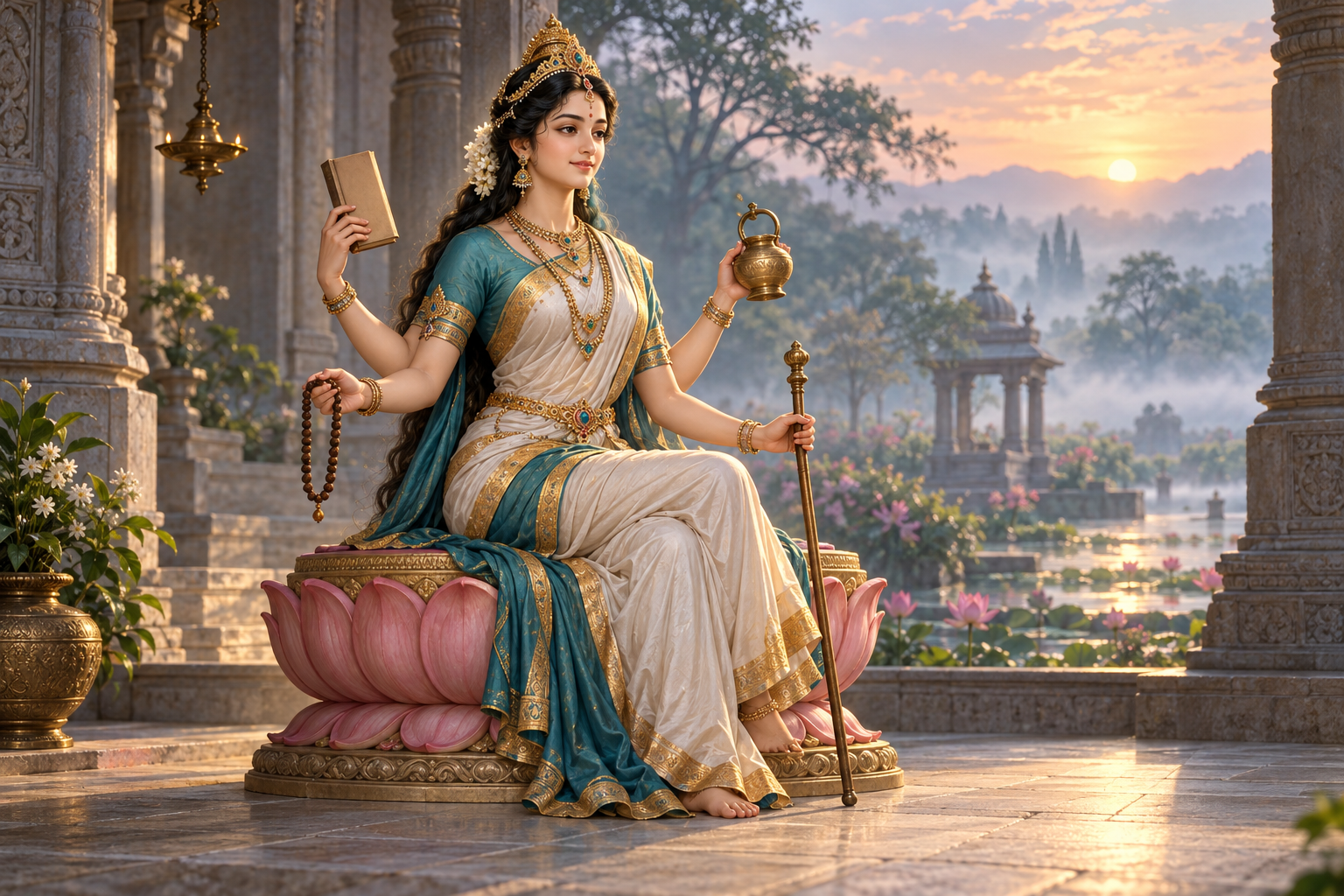
Vageshwari’s composed seated posture completes the teaching of the four objects. She is often shown with one leg folded and the other resting in a relaxed pendant position, a graceful arrangement associated with ease and approachable sovereignty. She does not need a battle stance to establish authority. Her command lies in collected awareness.
Her single face reinforces that integration. Knowledge, intention, discipline, and expression are not pulling in separate directions. What she knows, what she wills, and what she voices belong to one centred consciousness. For the viewer, this offers a precise standard: your speech becomes trustworthy when thought, motive, and word cease contradicting one another.
This also helps distinguish Vageshwari without forcing an artificial separation from Saraswati. Both belong to the sacred world of speech and knowledge, and the names or visual forms may overlap in devotional settings. Yet a familiar vina-bearing Saraswati image foregrounds music, learning, and the arts, while this Vageshwari form places unusual emphasis on governed speech through the staff, rosary, water vessel, and manuscript.
Do not identify an old murti by one missing vina, however. First examine the entire ensemble. Then check the shrine’s own name, inscription, oral history, or established worship. Iconography can narrow an identification; it should not be used to overrule a living tradition on the strength of a single photograph.
Key takeaways
- Vageshwari means the sovereign or mistress of Vak: speech, sound, and articulate expression.
- Her strongest identifying cluster is a four-armed, single-faced, serenely seated form holding a danda, akshamala, kamandalu, and grantha.
- The four attributes express a sequence: govern speech, discipline sound, purify intention, and ground words in knowledge.
- Her image should not be reduced either to generic Saraswati imagery or to a rigid label imposed without checking local tradition.
- For a devotee, the practical teaching is responsibility: words become sacred through truth, restraint, clarity, and right purpose.
Use the image before your next consequential conversation

You do not need to invent a new ritual to make this iconography useful. Unless you have received a lineage-specific practice, treat the following as visual contemplation rather than formal Vageshwari puja. Sit before the image, or recall its four attributes, and move through them in order:
- Look to the grantha. Identify what you actually know. Separate verified knowledge from memory, assumption, and opinion.
- Look to the kamandalu. Examine why you want to speak. Remove the wish to wound, impress, or win at any cost.
- Look to the akshamala. Form the essential sentence inwardly. Shorten it until it says what is necessary without distortion.
- Look to the danda. Accept responsibility for the likely effect of your words. Then speak with steadiness, or remain silent if the sentence cannot yet be governed.
This practice is particularly apt before teaching scripture, publishing commentary, correcting another person, making a promise, or entering a dispute. It does not guarantee agreement. It does make you less likely to confuse speed with clarity, force with authority, or verbal cleverness with wisdom.
The next time you see Vageshwari, do not stop at naming the objects in her hands. Follow their instruction. Let the manuscript test your knowledge, the vessel test your motive, the beads test your attention, and the staff test your self-command. Then allow your words to leave you.
References

Leave a Reply
You must be logged in to post a comment.