
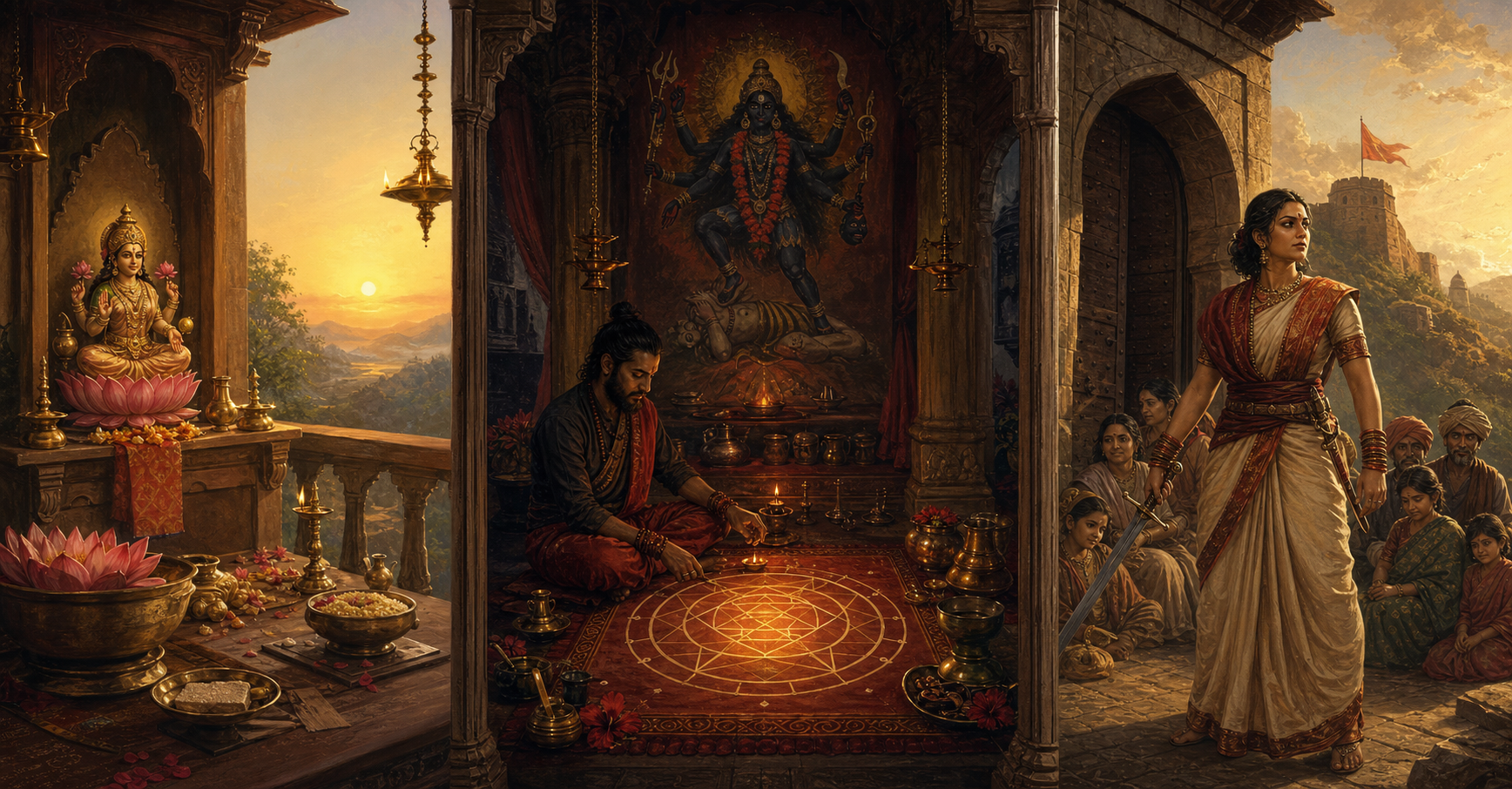
You may honor Lakshmi at a quiet household altar, encounter Kali in Tantric teaching, and feel the force of Shakti in the memory of women who defended their people. The difficulty is not seeing the connection. It is knowing how to make that connection without turning every goddess, ritual, and warrior into the same vague symbol of female power.
A sound reading begins with three distinct registers: devotional relationship, disciplined transformation, and ethical protection. Shakti moves through all three, but each asks something different of you. Once you know which register you are in, gentleness no longer looks weak, fierceness no longer looks inherently violent, and warrior memory no longer needs exaggeration to inspire.
First identify the register in which Shakti is speaking
Shakti is sacred power: the capacity through which life is generated, sustained, transformed, and protected. That broad meaning creates continuity among forms, but it does not make those forms interchangeable. The first question is therefore not whether Lakshmi, Kali, and a woman warrior are all powerful. Ask what kind of relationship to power is being expressed.
| Register | Question to ask | Evidence to notice | Common distortion |
|---|---|---|---|
| Household worship | What relationship with Devi is being enacted? | Form, offering, family custom, hospitality, and conduct | Treating nourishment and prosperity as passive or merely material |
| Tantric contemplation | Which manifestation and discipline are involved? | The exact name, function, textual setting, and lineage context | Using fierce imagery as a generic aesthetic |
| Warrior memory | What human action protected people or upheld Dharma? | Named lives, concrete leadership, trained capability, and ethical purpose | Substituting divine symbolism for historical evidence |
This distinction also protects devotion itself. A devotee does not have to reduce Devi to a metaphor for psychological qualities. Ethical and contemplative meanings flow from worship; they do not replace the goddess with an abstraction. At the same time, reverence for a fierce form does not convert the image into a literal instruction to imitate violence.
Use a simple test whenever you hear a broad claim about Shakti: identify the form, the setting, and the responsibility it creates. If any one of those is missing, the claim is probably too loose to guide either practice or public memory.
At the household altar, Shakti makes prosperity accountable
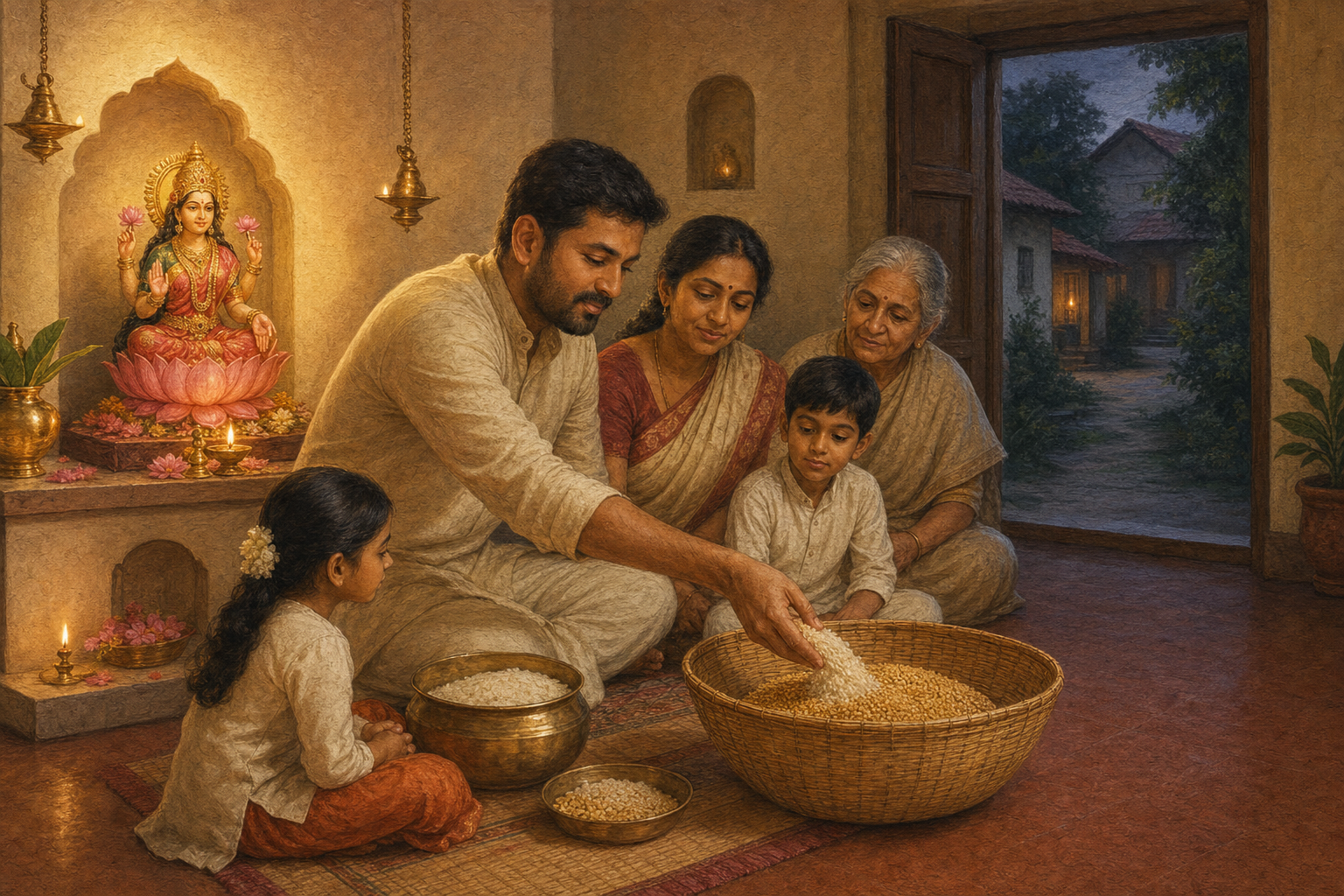
Lakshmi’s gentleness is sometimes mistaken for a lesser degree of power than Kali’s fierceness. Bengali worship shows why that is a mistake. The power to sustain a household, nourish a community, preserve craft, and keep wealth moving toward worthy purposes is not decorative. It is civilizational work performed through ordinary materials and repeated conduct.
Three Bengali forms make this especially visible. Sarapot Lakshmi appears on a flat, circular clay plaque, often placed on a kulo with paddy, durba grass, haldi, rice, lamps, and rice-paste alpana. The arrangement brings the goddess into direct relationship with grain, household labor, local clay, and the threshold of the home. Its modest scale is part of its meaning, not evidence of lesser devotion.
Kolabou makes the ecology of abundance impossible to ignore. The banana plant is bathed, dressed in a white sari with a red border, and appears within the Nabapatrika cluster of nine sacred plants during Durga Puja. Popular household understanding often receives Kolabou as Lakshmi, while her place in Nabapatrika belongs to Durga’s wider Shakta field. You do not need to force one layer to erase the other. The living plant can carry household associations of fertility and prosperity while remaining embedded in a larger ritual structure.
The clay idol offers another devotional grammar: Lakshmi upon the lotus, the owl as her vahana in Bengali iconography, vessels of grain, lamps, conch forms, and footprints drawn at the entrance. These signs do more than invite acquisition. The lotus points toward purity amid worldly life, grain makes dependence on land and labor visible, and the threshold asks what sort of home prosperity is being invited to enter.
The Kojagari vigil sharpens this point. Remaining awake is not best understood as a contest in staying out of bed. It represents alertness to the conditions under which abundance remains auspicious: cleanliness, hospitality, gratitude, charity, and responsible conduct. The contrast between Lakshmi and Alakshmi warns that wealth without order, generosity, or care can cease to be a blessing.
If you are shaping a household observance, four decisions keep that ethical structure visible:
- Begin with family lineage and local practice. A sara, Kolabou, or clay murti need not be supplemented with every available form merely to make the puja look complete.
- Let the offerings reveal their origins. Paddy, rice, coconut, jaggery, and homemade food connect prosperity to cultivation, skill, time, and shared labor.
- Consider who made the ritual objects. Purchasing from a neighborhood potter and choosing clay, natural dyes, and biodegradable materials allow festival spending to support the world the worship honors.
- Give abundance a destination beyond the shrine. Share prasad, extend hospitality, and include dana or support for others so that prosperity circulates rather than stopping at private possession.
For the precise ritual sequence, follow your family tradition or a trusted ritual guide. The broader principle is already visible in the materials: Lakshmi’s Shakti does not separate spiritual auspiciousness from the way a household earns, uses, and shares what it receives.
Tantra treats divine forms as precise maps of transformation

Tantric plurality can look confusing when every image of Kali is treated as an interchangeable emblem of darkness, rebellion, or intensity. The names matter because they direct attention toward different dimensions of reality and practice. A ninefold presentation associated with the Toral Tantra and the Mahakala Samhita names Dakshina Kali, Krishna Kali, Siddha Kali, Shri Kali, Bhadra Kali, Chamunda Kali, Smashan Kali, Maha Kali, and Akali.
This is not a collector’s catalogue of dramatic images. Bhadra Kali places auspicious protection in the foreground. Chamunda Kali expresses fierce compassion directed against destructive forces. Smashan Kali brings fear, death, and the instability of embodied life into contemplative view. Maha Kali opens toward cosmic sovereignty beyond ordinary limitation. The remaining names likewise belong to particular ritual and meditational orientations; the safe assumption is specificity, not interchangeability.
Akali provides the clearest example of why a name cannot be reduced to appearance. Read as a-kala, Akali points to that which is beyond time and temporal causation. The form invites you to examine how memory of the past and anticipation of the future condition present awareness. Its practical fruit is not an escape from duties but greater steadiness within change.
The resonance with the Sikh language of Akal, the Timeless, can support a meaningful Dharmic conversation. It should not be used to declare Kali theology and Sikh theology identical. A linguistic or philosophical bridge is valuable precisely when both shores remain visible. Shared reflection on time, change, courage, and liberation does not require one tradition to be absorbed into another.
If you want to study a Kali form responsibly, use this sequence:
- Name the manifestation exactly. Do not begin with a generic category such as fierce goddess if a specific name is available.
- Locate its setting. Distinguish public iconography and philosophical reflection from ritual instructions belonging to a particular tradition or lineage.
- Ask what condition the form confronts: fear, mortality, limitation, destructive tendency, temporal anxiety, or the need for protection.
- Test the interpretation by its ethical effect. Greater clarity, steadiness, compassion, and purposeful conduct are better signs of understanding than fascination with transgression or visual shock.
A public description of a Tantric form is not automatic authorization to improvise its ritual practice. Where a lineage sets requirements, learn within that lineage rather than assembling mantras, visualizations, and rites from disconnected fragments. Study can begin openly; specialized practice should retain its proper context.
Warrior memory asks what power was used to protect
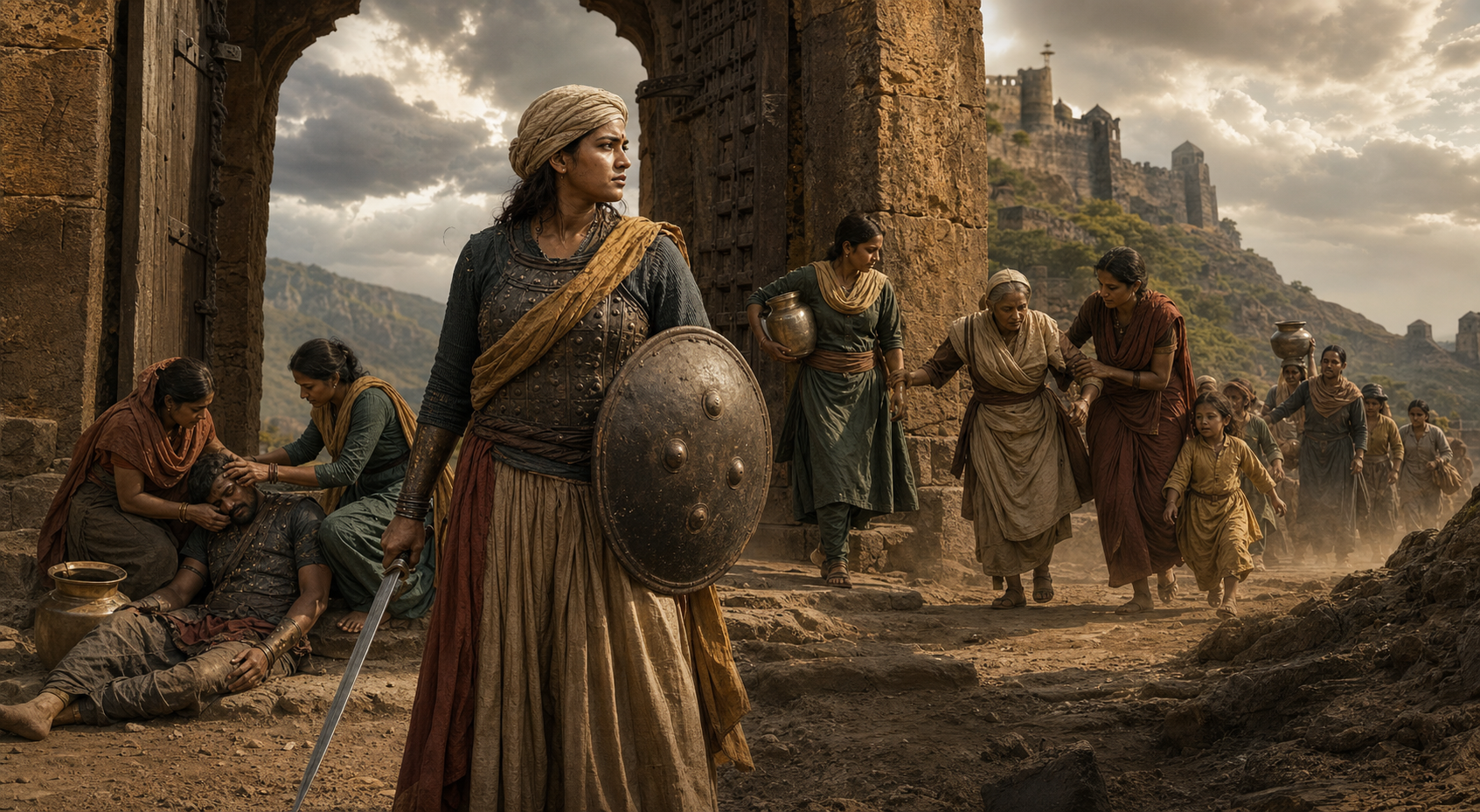
Warrior Shakti becomes credible through human agency, not costume alone. Rani Durgavati, Rani Abbakka Chowta, Kittur Chennamma, and Rani Lakshmibai are remembered as women who resisted aggression, led forces, and defended political communities. Sikh memory holds Mai Bhago within the sant-sipahi ideal, joining spiritual commitment to disciplined courage. Their importance does not depend on claiming that every woman must become a warrior. It lies in refusing the assumption that command, resistance, and public protection are alien to Indian womanhood.
Modern women serving in the Indian Army and the Central Armed Police Forces stand in a different institutional setting. Their place rests on professional training, constitutional equality, and merit-based selection. When their skill is visible at a Republic Day parade on Kartavya Path, cultural memory may deepen the public meaning of the moment, but memory does not replace training. Heritage can inspire capability; it cannot certify it.
That distinction matters when you watch or share a stirring clip. Separate four layers before making a claim:
- Describe what is directly visible: discipline, coordination, physical competence, technical skill, or service in uniform.
- Name the historical parallel precisely: a particular leader, resistance, command role, or act of defense. Do not use ancient tradition as a substitute for a named example.
- State the symbolic connection as symbolism: Durga or Kali can provide a vocabulary of courage, moral clarity, and protective resolve.
- Keep the ethical end in view. Dharmic valor is not aggression for its own sake; it is strength disciplined by responsibility, restraint, and protection of the vulnerable.
This is also where Ahimsa needs care. Non-harm does not make courage unnecessary, while courage does not suspend moral limits. Hindu, Buddhist, Jain, and Sikh communities articulate these matters through different theologies and disciplines, yet service, compassion, resilience, restraint, and defense of the innocent provide real grounds for conversation. Shared virtues should build solidarity without flattening distinct traditions into a single doctrine.
A pro-Dharmic telling of warrior history becomes stronger when it distinguishes documented leadership, devotional symbolism, and present-day institutions. Exaggeration makes all three easier to dismiss. Precision allows a daughter looking at a woman in uniform to inherit more than an inspiring image: she can see a path involving study, fitness, discipline, qualification, teamwork, and service.
Key takeaways
- Shakti is continuous across nourishment, transformation, and protection, but the devotional, Tantric, and historical registers are not interchangeable.
- Lakshmi worship makes prosperity accountable through household conduct, ecological dependence, artisan labor, hospitality, dana, and the circulation of abundance.
- Kali’s Tantric manifestations have specific names and functions. Identify the form and its context before drawing a philosophical or practical lesson from it.
- Akali and the Sikh language of Akal offer a genuine bridge around timelessness, not permission to collapse distinct theologies into one.
- Warrior memory is most persuasive when divine symbolism is joined to named historical agency, ethical protection, and the trained merit required by modern institutions.
At your next puja, pair the offering with one act of circulation: support an artisan, share prasad, or make hospitality visible. When studying Kali, write down the exact manifestation, its function, and its textual or lineage setting. When teaching warrior memory, place one named life beside the goddess image and explain the discipline that turns courage into service.
If you do only one thing, name the register before making the claim. Then ask what responsibility that expression of Shakti places on you. That small discipline keeps worship from becoming decoration, Tantra from becoming spectacle, and civilizational memory from becoming a slogan.
References
- DharmaRenaissance Blog — Sarapot, Kolabou, and Clay Idols: A Deep Dive into Bengal’s Living Lakshmi Traditions
- Hindu Human Rights — Indian Female Soldiers Reclaim an Ancient Warrior Legacy: Shakti, History, and National Pride
- DharmaRenaissance Blog — Akali, the Timeless Kali: Exploring Nine Manifestations in the Tantra Purana and Mahakala Samhita
