
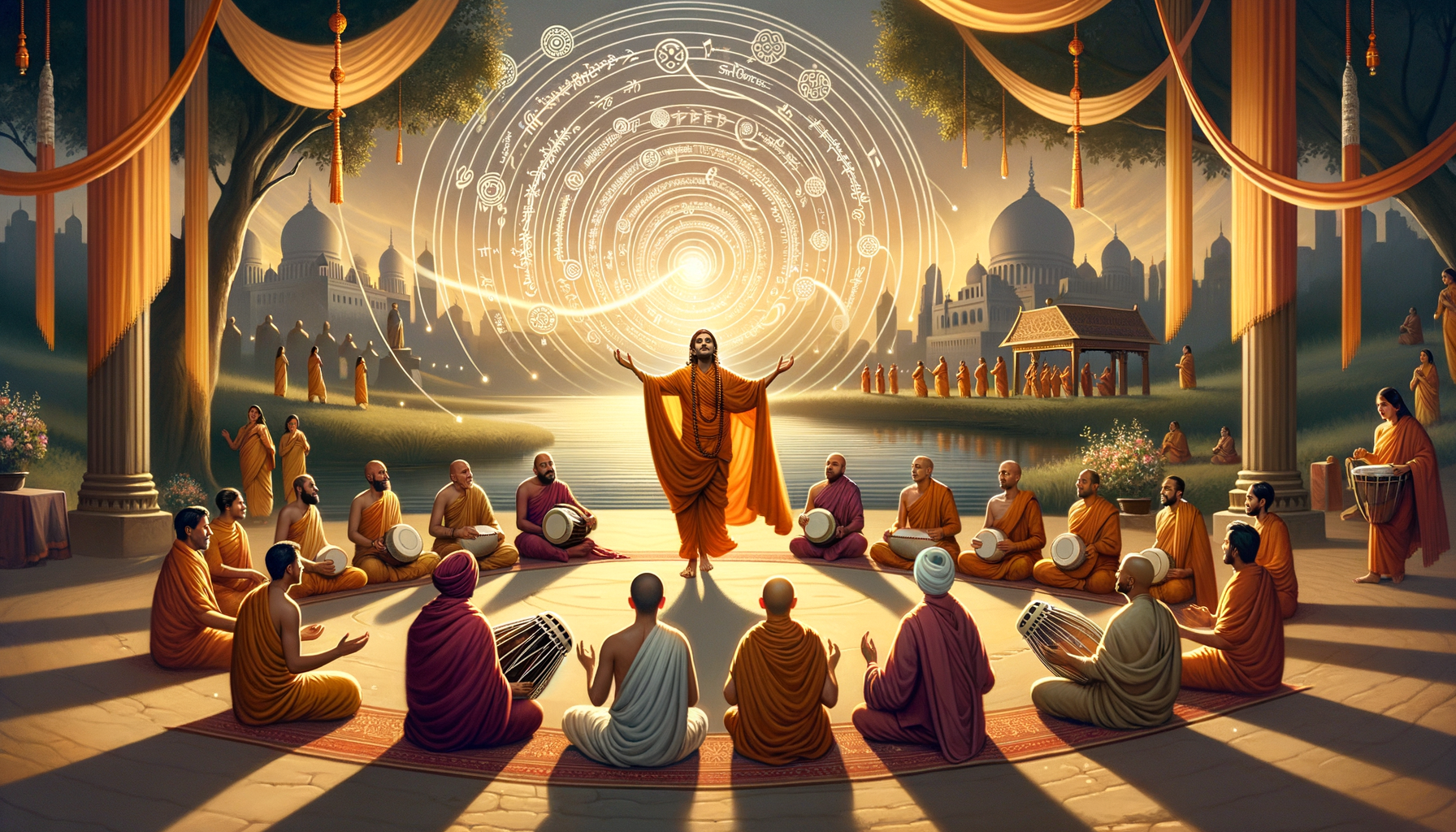
Sri Caitanya inaugurated the sankirtana movement of congregational chanting, establishing a devotional practice centered on the holy names of God. While residing in Nadia, He traveled from village to village chanting Hare Krsna, Hare Krsna, Krsna Krsna, Hare Hare/ Hare Rama, Hare Rama, Rama Rama, Hare Hare. Within the Vaishnava tradition, this practice is understood to reawaken the innate love of the Divine that rests dormant in the heart. Through the simple yet profound acts of chanting and dancing, this devotional current advanced as an expression of compassion and accessible spirituality.
After entering the renounced order (sannyasa), Sri Caitanya journeyed across the Indian subcontinent, continuing to chant and dance in ecstatic love of God. His public sankirtana inspired others to participate, and their participation in turn moved broader communities to join. In this cumulative way, the sankirtana movement expanded from village pathways to urban centers, a trajectory that continues as the practice reaches cities, towns, and villages around the world.
Viewed in a wider dharmic context, congregational remembrance through sacred sound resonates with shared values across Hinduism, Buddhism, Jainism, and Sikhism. While each tradition maintains distinct theology and liturgy, the communal rhythm of devotional song and recitationkirtan, nama-smarana, stavan, and shabadcultivates compassion, humility, and service (seva). Sankirtana thus exemplifies a living model of unity in spiritual diversity: it invites participation without compulsion, honors plurality, and strengthens bonds across the dharmic family through a common ethic of mindful devotion.
Contemporary gatherings reflect these enduring dynamics. Participants frequently report a deepened sense of inner peace, collective joy, and belonging, along with heightened focus and emotional balance. Communities across India and the global diaspora host regular kirtan assemblies that are open, welcoming, and intergenerational, often becoming shared spaces for reflection, learning, and mutual respect. In this way, sankirtana supports both personal well-being and social cohesion, reinforcing values cherished throughout the broader dharmic traditions.
As sankirtana continues to flourish in public squares, temples, community halls, and digital forums, Sri Caitanya’s vision endures: sacred sound as a transformative force accessible to all. This timeless practice blends devotion with inclusivity, providing a pathway that is academically recognizable for its historical continuity and socially relevant for its capacity to foster unity, ethical living, and compassionate action across diverse spiritual communities.
Inspired by this post on Dandavats.
