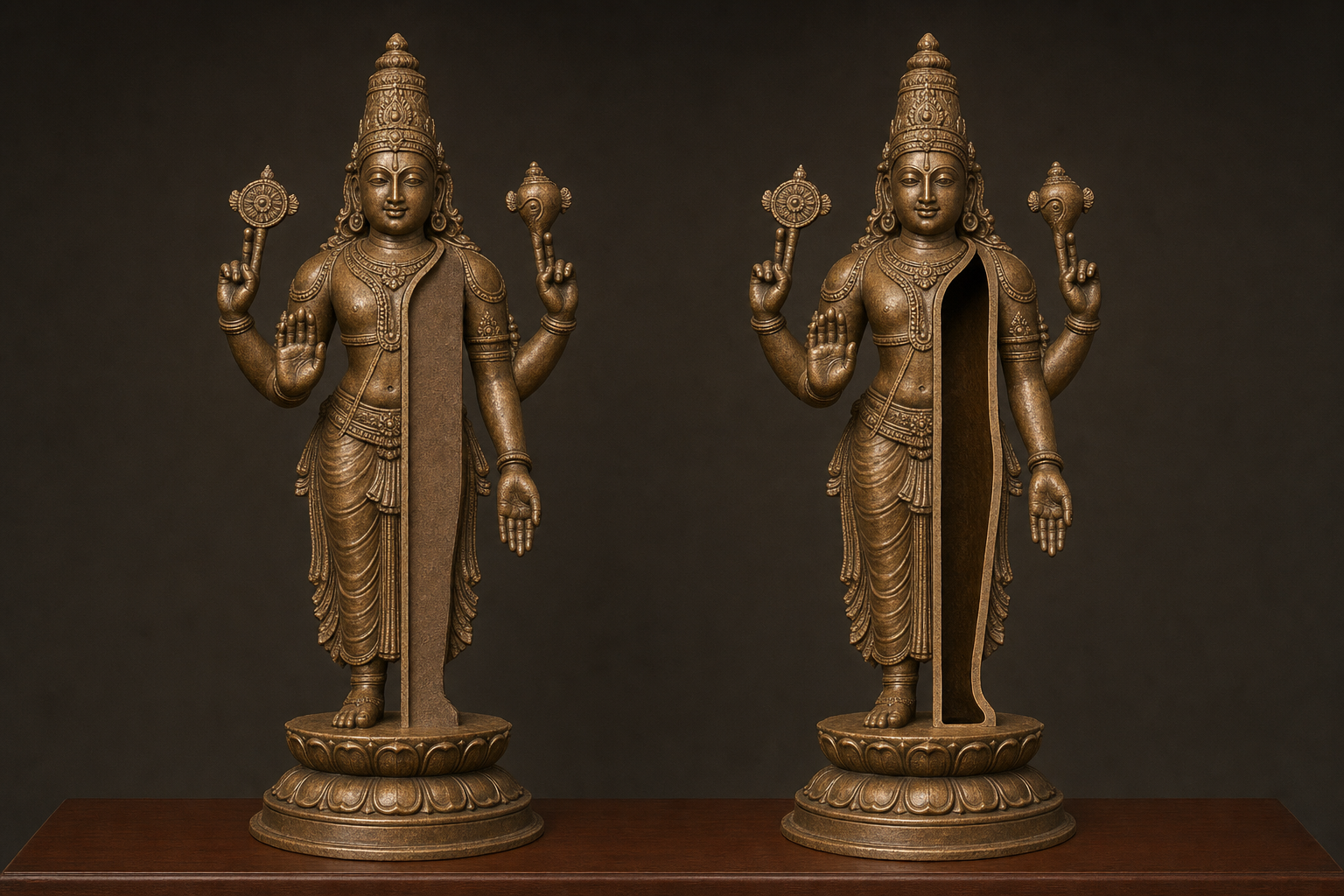
You may be choosing between two Hindu bronze icons that look almost identical, yet one is unexpectedly heavy and the other is hollow. A seller may present weight as proof of quality, while a workshop may recommend hollow casting because the icon will be carried. Neither claim settles the decision.
Begin with the seva the mūrti must support. Will it remain on a home altar, receive frequent abhiṣekam, travel in procession, contain ritual deposits, or stand primarily as a work of sacred art? Once you answer that, construction, craftsmanship, documentation, and care become much easier to judge.
Let ritual use decide before weight does
The traditional distinction is between ghana-bimba, a solid image, and suṣira-bimba, a hollow image. Both can be made through lost-wax casting. Both can be ritually consecrated. The internal structure changes handling, thermal response, repair needs, and the possibility of placing deposits inside; it does not, by itself, make one image more sacred than the other.
Consecration is the decisive sacred transition. Prāṇa-pratiṣṭhā, nyāsa, mantra, mudrā, and netronmīlanam, the opening of the eyes, establish the icon within a living ritual relationship. A hollow icon can additionally receive garbha-nyāsa: mantras on copper plates, yantras, herbs, navaratna, or other deposits prescribed by a particular lineage. The opening is then sealed. A solid icon cannot accommodate a large internal chamber, but it is not thereby excluded from sanctification.
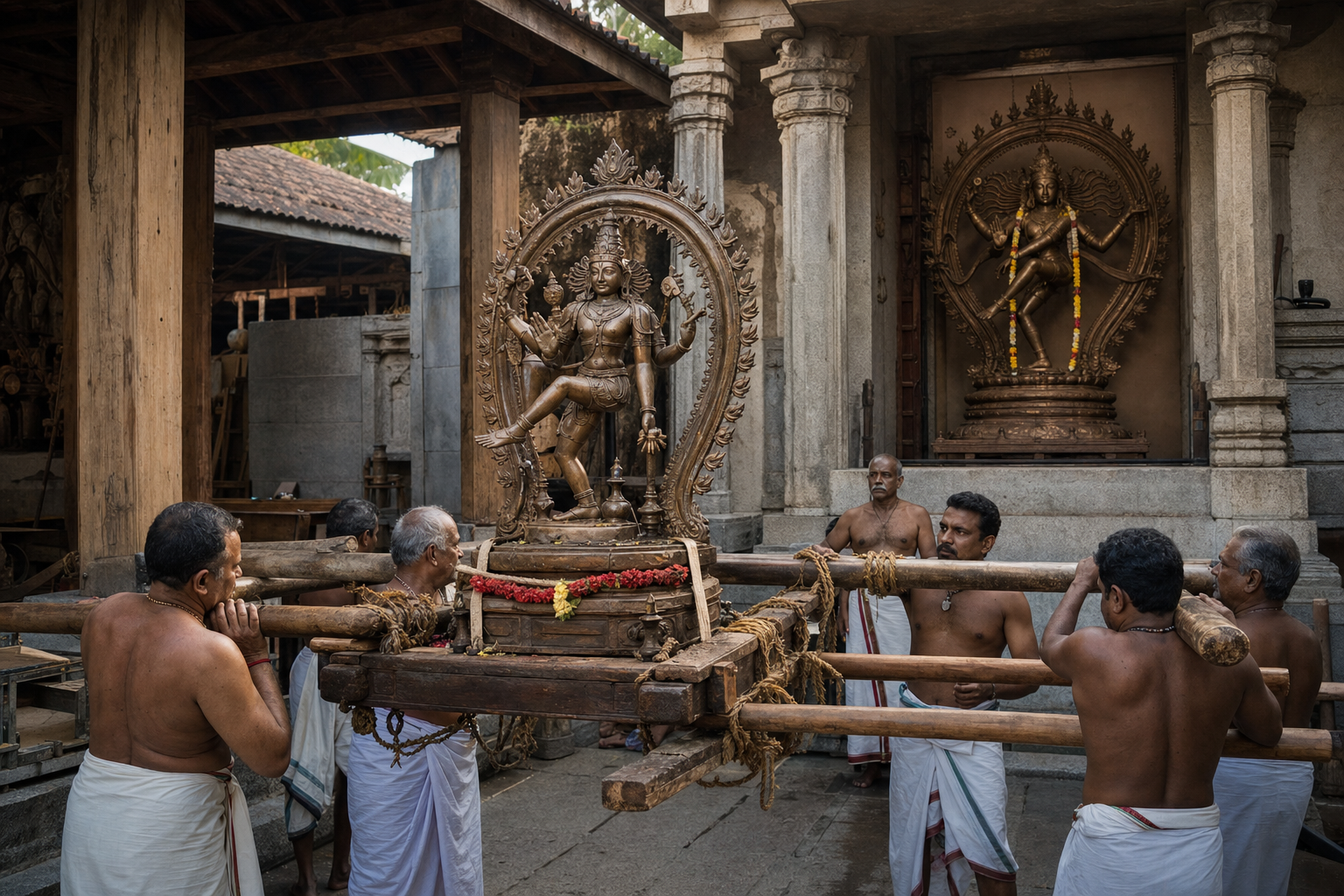
Regional practice matters. In many temple traditions, a fixed mūla-bera may be stone while a metal utsava-bera is designed for movement. Larger processional bronzes are therefore often hollow to control weight. Small Gaṇeśa, Lakṣmī, or other domestic pūjā icons are often solid because their compact mass remains manageable. These are tendencies, not universal rules. The relevant āgama, temple custom, priestly direction, and sthapati lineage take precedence over a generalized shopping rule.
| Intended use | Sensible starting point | What you still need to verify |
|---|---|---|
| Small, stationary home altar | Solid is often practical | Canonical proportions, stable base, finish, alloy, and ease of daily handling |
| Regular processions or festival movement | Hollow is often preferable | Finished weight, carrying balance, wall continuity, and reinforcement at ankles, wrists, and projecting parts |
| Garbha-nyāsa or prescribed internal deposits | Hollow construction is required | Cavity access, the deposit sequence, priestly coordination, and the method of sealing |
| Frequent abhiṣekam | Either method can serve | Sound joints, a properly sealed hollow cavity, surface care, and safe drying after worship |
| Large or dynamically posed icon | Hollow is usually more manageable | Wall thickness, centre of balance, gating quality, and structural support in narrow load-bearing areas |
Hollow bronze changes temperature more quickly during abhiṣekam, while a solid icon has greater thermal inertia and a pronounced sense of mass. Neither characteristic is an automatic advantage. Match it to the frequency of ritual handling and to the people who must safely lift, bathe, dress, and carry the image.
What the molten metal must accomplish in each method
Lost-wax casting is unforgiving because the metal must reach every ornament, finger, attribute, fold, and strand before it stops flowing. Gates deliver the molten alloy, vents allow gases to escape, and the investment must withstand firing and pouring without losing the modeled detail. After casting, the outer mold is broken away and the surface is chased, filed, and refined.
How a solid icon is cast
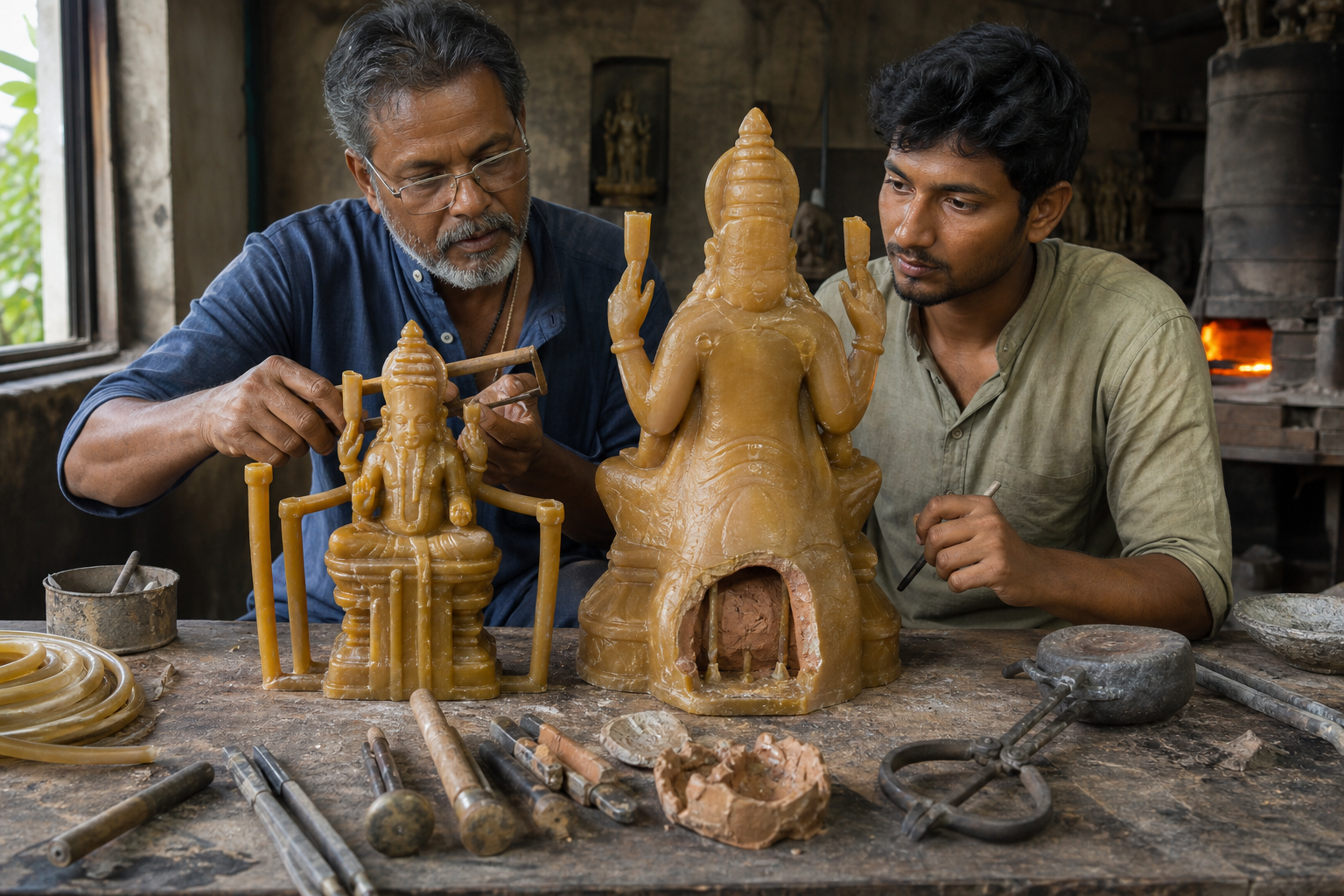
- The sthapati models the complete icon in solid wax, including its anatomy, ornaments, clothing, mudrās, and major attributes.
- Wax runners, gates, and vents are attached so metal can enter the form and displaced gases can leave it.
- The model is enclosed in layers of investment, traditionally using combinations of clay, organic fibre, and grog.
- Firing hardens the mold and removes the wax, leaving an empty image-shaped cavity.
- Molten alloy fills that entire cavity. After cooling, the investment is removed and the bronze is chased and finished.
The result is dense and substantial. That mass can be reassuring in a compact altar icon, but it also makes scale expensive in metal and demanding in handling. Dense sections still need carefully designed gates and controlled cooling; solidity does not prevent porosity, shrinkage defects, incomplete filling, or blowholes.
How a hollow icon is cast
- A clay core is formed to approximate the interior volume of the finished icon.
- Wax is applied over the core. The thickness of this wax layer establishes the bronze wall thickness.
- The final anatomy and ornament are modeled in that wax surface, after which gates and vents are attached.
- The assembly is invested and fired. The wax leaves a shell-shaped cavity between the inner core and the outer mold.
- Molten alloy fills that shell. Once it has cooled, the outer investment is broken away and remnants of the internal core are removed through planned openings.
- Core-pin holes and access points are plugged and finished. If garbha-nyāsa is prescribed, deposits are placed before the main opening is ritually sealed.
The wall is not supposed to be as thin as possible. It must be thin enough to control weight but thick and continuous enough to survive handling. Small hollow works may use walls of only a few millimetres, while larger or highly stressed forms require more robust sections. A universal wall-thickness number would be misleading; size, pose, alloy, projections, and intended movement all change the requirement.
Ask how the workshop protects the vulnerable zones. Ankles in a tribhaṅga stance, wrists supporting āyudhas, extended fingers, the junction between figure and pedestal, and the curve of a prabhāvali all interrupt easy metal flow or carry mechanical stress. A technically mature casting gives these areas enough continuity without making the icon visibly heavy or distorting its canonical form.
Gates and vents are part of the hidden intelligence of the work. Poor delivery can leave a cold shut where two fronts of metal failed to unite. Trapped gas can produce blowholes. Weak feeding can leave porous or incomplete passages in projecting details. Chasing can clean a surface, but it cannot turn structurally disconnected metal into a sound casting.
Read pañcaloha as a lineage, not a universal recipe
Pañcaloha or pancha-dhātu does not identify one standardized formula used by every workshop. Traditional formulations are centred on copper and can include tin, zinc, lead, and iron; some regional prescriptions introduce silver or gold in trace quantities. Those additions affect fluidity, hardness, colour, shrinkage, resonance, patination, and long-term behaviour.
Do not accept the word pañcaloha as the entire material specification. Ask the maker which ingredients its lineage uses, whether the recipe varies for size or function, and what documentation will accompany the finished work. Colour and weight alone cannot verify a claimed alloy because composition, surface finishing, and patination all affect what you see and feel.
Inspect the sacred form before searching for casting clues
A bronze can be technically neat and still fail as a Hindu icon. Begin with darśana. The tāla system, proportions of mukha, hasta, and pāda, placement of āyudhas, mudrās, ornaments, vāhana, pedestal, and aureole should convey the deity clearly. Casting method cannot rescue confused iconography.
Do not mistake intentional movement for poor symmetry. Tribhaṅga and other dynamic stances distribute the body across several axes. What matters is controlled equilibrium: the figure should look alive without appearing as though the metal has sagged or the pedestal is struggling to hold it.
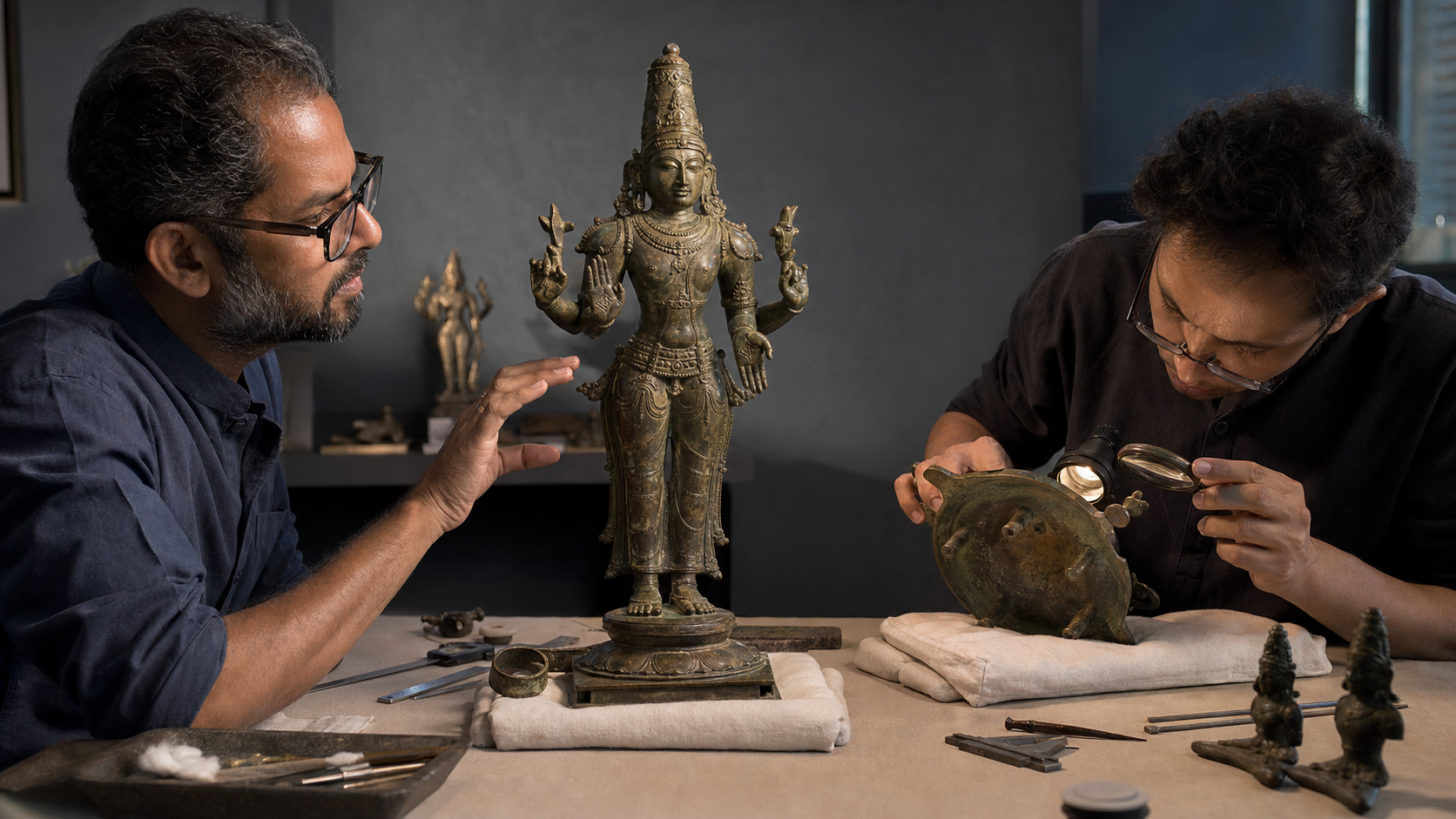
- View the icon from several angles. Examine the front, both profiles, the back, and a three-quarter view. Check whether the face, torso, limbs, aureole, and pedestal resolve coherently beyond the display angle used in a sales photograph.
- Place it on a level surface. The base should sit without rocking. A dynamic figure may be visually asymmetrical, but the physical object still needs a secure stance.
- Trace the iconography. Confirm every hand, attribute, gesture, crown, vehicle, attendant, and emblem required for the intended form of the deity. Ask which iconometric canon or established workshop pattern was followed.
- Inspect narrow load paths. Look closely at ankles, wrists, fingers holding attributes, the figure-to-base junction, and the attachment points of the prabhāvali. Cracks, open lines, movement, or heavy corrective grinding in these areas matter more than a harmless isolated surface mark.
- Use raking light on broad surfaces. The chest, thighs, back, and pedestal should not be covered with clusters of pits or irregular depressions. Hair, jewelry, and textile edges should remain legible rather than blurred by over-polishing.
- Judge the chasing. Tool work should clarify eyes, ornaments, locks of hair, nails, garment borders, and transitions between forms. Excessive abrasion that flattens anatomy or makes every surface uniformly soft may be hiding a weak cast rather than completing a strong one.
- Check separate components. Detachable āyudhas and aureoles are not automatically defects. They should fit securely, align correctly, and be documented as intentional assemblies. Unexplained solder, looseness, or distorted tenons deserves professional assessment.
- Ask about plugs and closures. A hollow bronze may have discreetly finished core-pin holes and a sealed access aperture. Their presence can be normal. Do not pry at a plug, scratch the surface, drill the base, or force open a ritual closure to prove that the icon is hollow.
Weight is evidence of mass, not evidence of excellence. A thick-walled hollow icon can feel heavy, while a small solid icon may still be easy to lift. Compare weight only after accounting for dimensions, pedestal size, aureole, attached attributes, and the icon’s intended role.
A solid casting may produce a bell-like response when lightly tapped, but a ring is not an authenticity test. Alloy, geometry, wall distribution, attachments, and contact with the base can all change the sound. Never strike an old, consecrated, cracked, or delicately projecting icon merely to hear its tone.
Give the sthapati or seller a written brief
A commission goes wrong when decisions that belong at the wax stage are postponed until metal has already been poured. Give the workshop a brief that defines ritual function as precisely as appearance.
- Name the exact deity and form. Include the required mudrās, āyudhas, attendants, vāhana, pedestal, prabhāvali, and regional iconographic tradition.
- State the ritual role. Say whether the icon is for domestic pūjā, a fixed shrine, festival display, or repeated processional use. Mention who must lift it and how often it will be moved.
- Specify whether internal deposits are planned. If garbha-nyāsa is required, connect the sthapati with the officiating priest before the access opening and sealing sequence are finalized.
- Request finished dimensions and expected weight. Do not approve scale from a single front elevation. Ask for side and rear views and make sure the pedestal, aureole, and removable attributes are included in the stated dimensions.
- Record the construction method. Ask whether the body, pedestal, aureole, and attributes will be solid, hollow, separately cast, or mechanically attached. For hollow work, ask how wall continuity and the main stress zones are controlled.
- Request an alloy declaration. Record the workshop’s pañcaloha formulation or, at minimum, the metals it uses and any variation agreed for the commission.
- Agree on inspection points. Review the iconography while the wax is still correctable. Ask for clear views after casting and chasing but before a final patina makes surface assessment harder.
- Require repair disclosure. Casting repairs are not necessarily disqualifying, but their location and method matter. Any repair at an ankle, wrist, base junction, carrying point, or major attribute should be explained before acceptance.
- Preserve maker and transaction records. Keep invoices, commission drawings, material declarations, photographs, dates, and the sthapati’s identity with the icon. These records support future ritual stewardship, conservation, insurance, and lawful transfer.
If the object is represented as antique, provenance is not an optional extra. India’s Antiquities and Art Treasures Act of 1972 and the UNESCO 1970 framework make lawful ownership and movement of cultural property a serious matter. Require a documented chain of ownership, applicable registration records, and valid export permissions before money changes hands. If a seller discourages verification or claims that a devotional object needs no paperwork, pause the transaction and obtain qualified legal or heritage advice for the relevant jurisdictions. An attractive story is not a substitute for documents.
Key takeaways
- Choose solid or hollow construction by ritual function, scale, movement, and deposit requirements, not by a claim that one is inherently more sacred.
- Solid casting is often well suited to compact, stationary icons; hollow casting usually makes a large or processional icon easier to handle.
- A hollow wall must be intentionally proportioned and continuous. The thinnest possible wall is not the mark of the best workshop.
- Canonical iconometry, secure stress zones, clean metal flow, and disciplined chasing reveal more about quality than weight or a tap test.
- Pañcaloha names a family of traditional alloys. Ask what the workshop actually used and retain the declaration.
- For an antique, provenance and export documentation are part of the purchase decision, not paperwork to resolve afterward.
Care for the bronze according to its construction
Your care routine should preserve fine chasing, stable patina, secure joints, and the integrity of any sealed cavity. Ritual use and conservation do not have to oppose one another, but they do require deliberate handling.
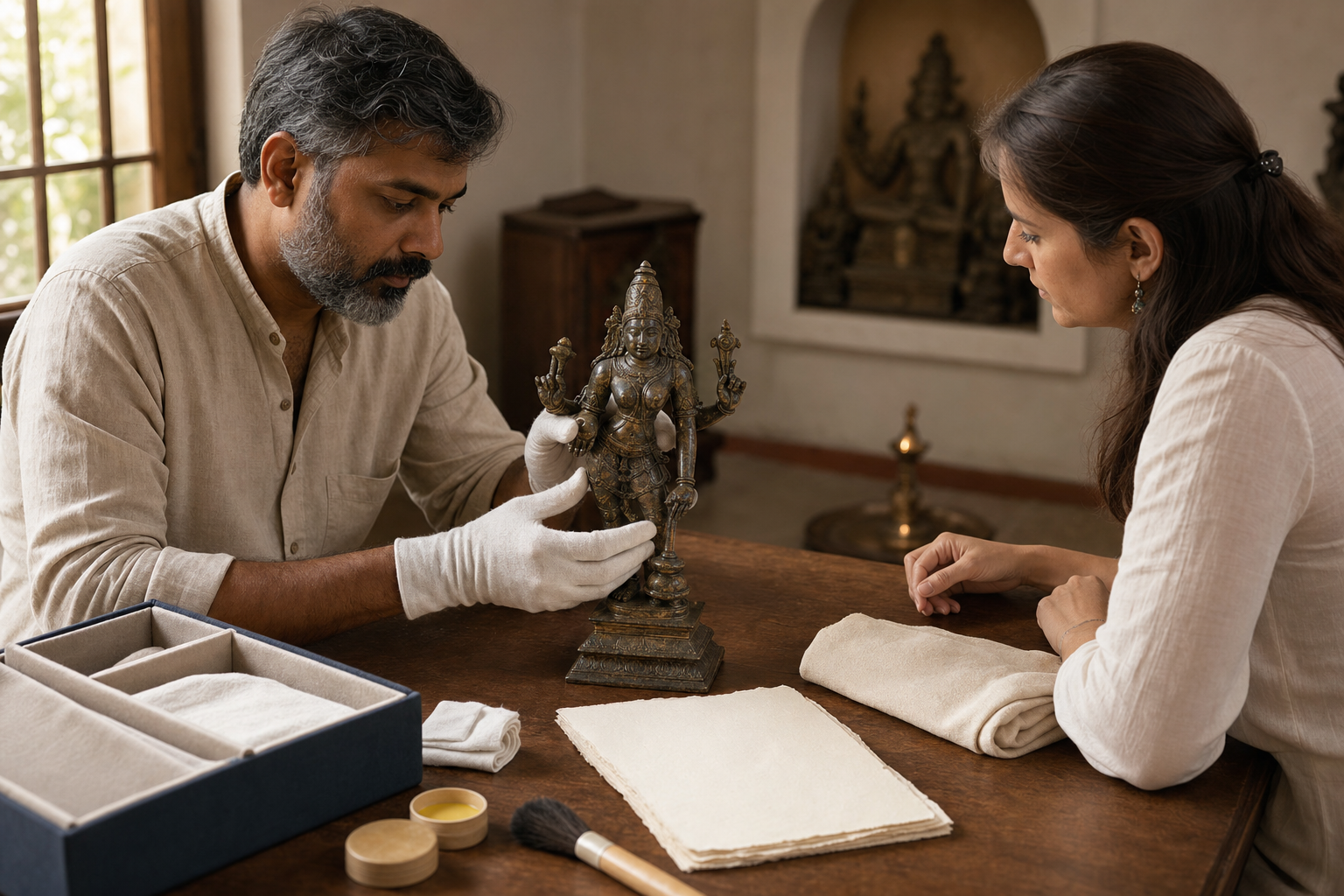
- Lift from the base and main body. Do not use an extended hand, āyudha, aureole, finger, or narrow ankle as a handle. A heavy solid icon and a lighter hollow one can both fail at a projecting joint when lifted badly.
- Dust gently. Use a clean, soft cloth or soft brush. Avoid aggressive rubbing over eyes, jewelry, inscriptions, textile borders, or chased hair.
- Use clean water for abhiṣekam where the ritual tradition permits. Afterward, remove residual moisture carefully from recesses and around detachable attributes. With a hollow icon, verify that access points and joints are properly sealed before establishing a frequent bathing routine.
- Control oil accumulation. Apply ritual oils judiciously and remove sticky accretions periodically by a gentle method compatible with temple custom. Thick residue can trap dust and obscure detail.
- Avoid harsh acids and abrasive polish. Brightness is not the same as cleanliness. Grinding or repeated polishing can erase chasing, soften anatomy, remove a stable patina, and complicate later conservation.
- Treat coatings as interventions. Microcrystalline wax can stabilize a bronze in a museum-like setting, but it should be used minimally and reversibly by someone who understands the alloy, existing patina, and ritual requirements.
- Stop handling when structure changes. A crack at an ankle, a moving aureole, a loose āyudha tenon, or a separation at the base can worsen during carrying. Do not improvise with grinding or aggressive soldering. Ask a conservator familiar with pañcaloha and sacred metalwork to assess it.
Before you choose an icon, write one sentence describing its actual life: where it will stand, how it will be worshipped, whether it will travel, and whether it must contain deposits. Give that sentence to the priest, sthapati, or seller and insist that every technical choice answer it. A well-chosen mūrti is not simply heavy or light; its material form is fitted to the seva it will receive.