
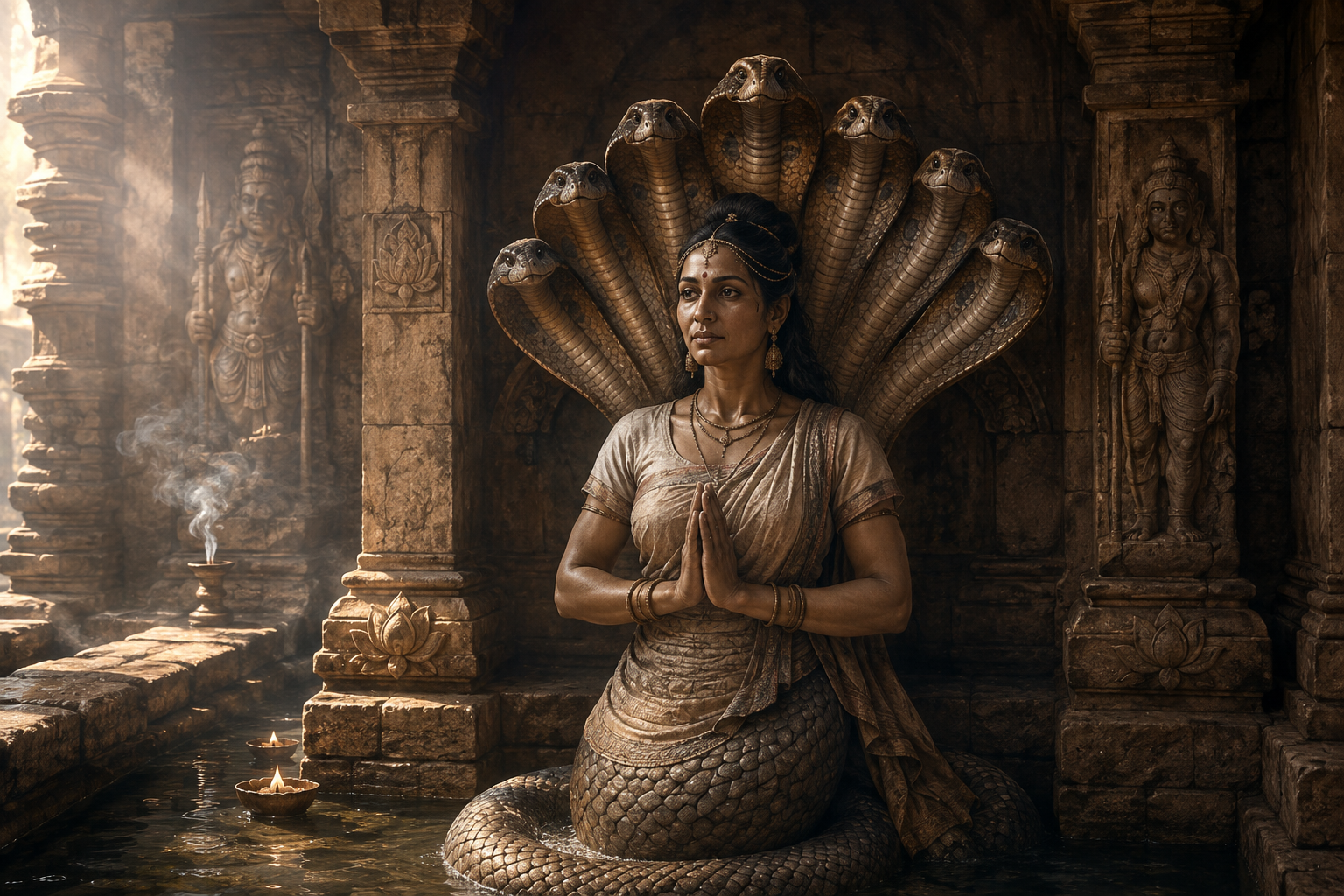
You are looking at a temple carving of a woman beneath a cobra hood. Is she Nagini, a named deity, an attendant, or simply a decorative figure? The reliable answer comes from reading three things together: her form, her relationship to nearby figures, and the sacred setting in which she appears.
That method matters because Nagini is not merely a woman with a snake attached to her image. She belongs to a sacred serpent realm with its own dignity and spiritual meaning. Yet the word does not always identify one universal goddess with one fixed biography. Learning that distinction will help you look closely without forcing every sculpture or scriptural appearance into the same explanation.
Begin with the right question: name or sacred identity?
Nagini, or Nagini, is the feminine counterpart of the Naga: a divine serpent being present in Hindu, Buddhist, and Jain traditions. The term can therefore identify a female member of the Naga realm before it identifies any one individual.
This is the first distinction to carry into a temple, museum, book, or digital archive. “Nagini” may operate as a sacred classification, much as “Naga” can describe a kind of divine being. A particular story or local tradition may then give that being a personal name, relationship, and narrative role.
Do not move directly from “female figure with serpent features” to “this is the goddess Nagini” as though every example represented the same personality. Ask instead:
- Is the figure individually named in the surrounding narrative, inscription, catalogue, or temple tradition?
- Does she appear alone, with a male Naga, or as part of a larger group?
- Is she acting as a guardian, devotee, attendant, sovereign figure, or participant in a particular event?
- Does the local community preserve an identification more precise than the general word “Nagini”?
This approach respects both unity and local particularity. You can recognise the figure as belonging to the Naga world without pretending to know a personal identity that the surviving context does not establish.
How to recognise Nagini imagery without over-reading it
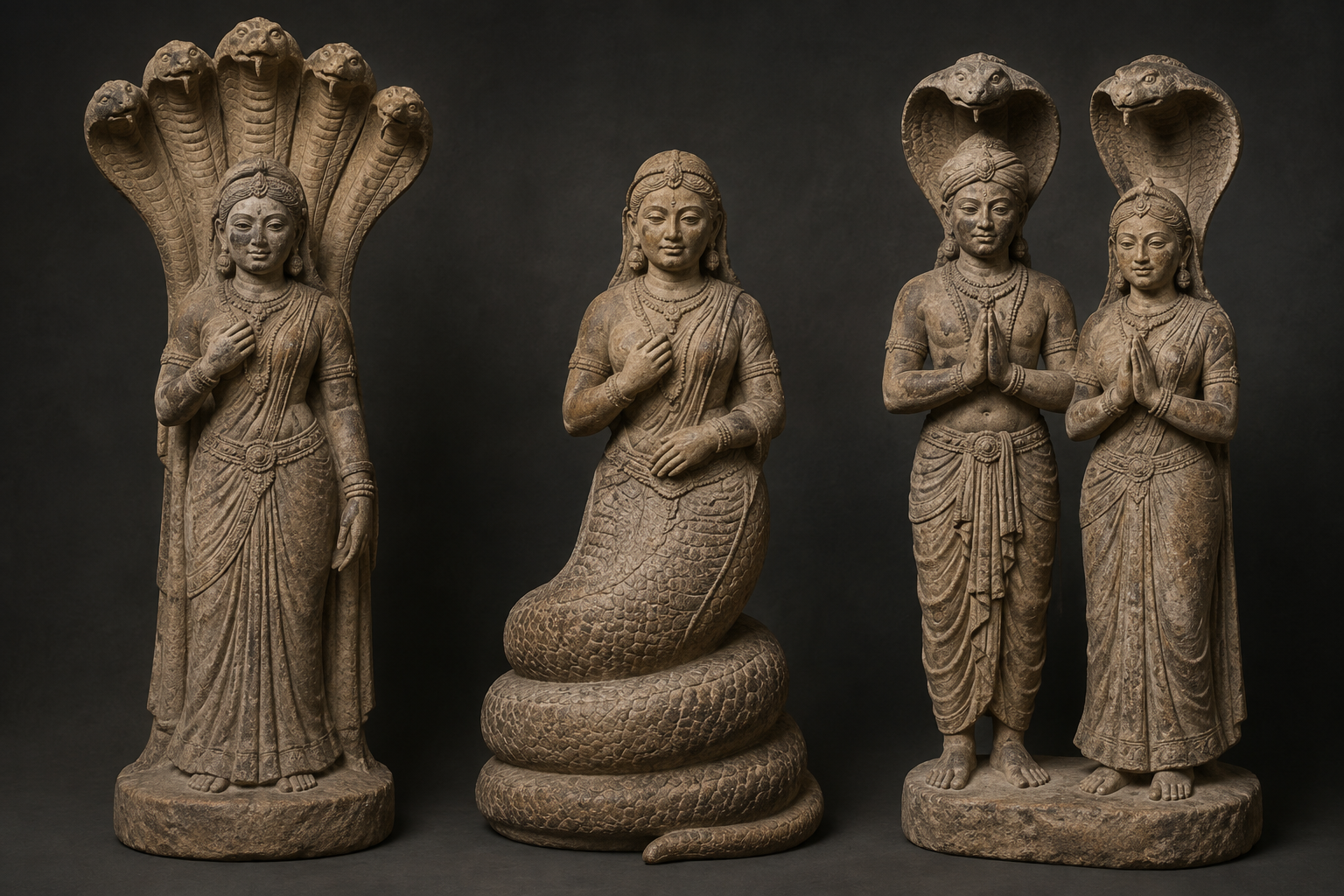
Hindu sacred art communicates identity through a visual grammar. In Nagini imagery, the serpent element is central, but it can be joined to the feminine form in more than one way. A sculptor may present a predominantly human female figure sheltered by a cobra hood, a human-serpent composite, or a more fully serpentine being within a narrative scene.
Use the following clues in order. No single clue should be made to carry the whole identification.
- Look above and behind the head. A clearly articulated cobra hood is a strong sign of Naga identity. One or several hoods may form a canopy, but their number alone does not securely establish a personal name.
- Trace the whole body. Determine whether the form is human, serpentine, or composite. Damage, burial, cropping, and poor photographs can conceal the lower portion that would settle the question.
- Read gestures and ornaments cautiously. Jewellery, graceful posture, and sacred gestures can communicate divine dignity, but many deities and celestial beings share them. They support an identification; they do not prove it.
- Inspect the neighbouring figures. A companion, presiding deity, repeated serpent figure, or unfolding episode may tell you more than the isolated body does.
- Notice architectural placement. A figure at a threshold, within a narrative panel, or beside another sacred being is performing a contextual role. Placement is evidence, not empty background.
The most common mistake is to treat the serpent hood as a complete name label. It is better understood as an identity marker: it tells you that the figure belongs to the Naga domain. The rest of the composition must tell you who she is, if that information is present at all.
The serpent is not a Hindu equivalent of evil

A reader formed by a religious or popular vocabulary in which the serpent is mainly sinister can badly misread Nagini. Hindu sacred imagery does not require the snake to stand for one fixed moral category. Serpent symbolism can hold apparent opposites together: danger and protection, hiddenness and revelation, earthly presence and divine power.
The animal itself helps explain this range. A snake moves close to the earth, disappears into concealed spaces, emerges unexpectedly, and sheds its skin. Sacred imagination can therefore use serpent form to evoke guarded power, mystery, continuity, renewal, and movement between visible and hidden realms. These associations are interpretive possibilities, not a universal code that mechanically deciphers every image.
The feminine form also deserves more than a one-word explanation. Calling every Nagini merely a “fertility symbol” strips away personality, agency, rank, and sacred presence. Conversely, describing her only as dangerous ignores the honour expressed through divine posture, adornment, companionship, or placement. Begin with the role enacted in the scene; use broad symbolism only after that role is clear.
A sound interpretation therefore has two levels. First describe what this Nagini is doing here. Then consider what serpent embodiment contributes to that action. Reversing the order often produces a generic explanation that could have been pasted beneath almost any snake image.
A shared Dharmic presence does not erase differences
The presence of Nagas and Naginis across Hindu, Buddhist, and Jain traditions reveals a shared Dharmic visual and religious vocabulary. That continuity matters. It shows that sacred serpent beings cannot be confined to one narrow modern category or dismissed as marginal curiosities.
Shared vocabulary, however, is not identical theology. A serpent being may occupy a different narrative, devotional, or cosmological role in each tradition and in each local setting. The responsible comparison is therefore neither “these are completely unrelated” nor “they are all the same deity.” Look for family resemblance while preserving the actual distinctions.
If you are comparing images from different Dharmic traditions, keep three columns in your notes: visual form, narrative function, and local identification. Similar cobra hoods belong in the first column. A shared protective or devotional role, where the scene establishes it, belongs in the second. Names and community-specific meanings belong in the third. This simple separation prevents visual similarity from being mistaken for total equivalence.
This is also a more faithful way to understand Bharat’s civilisational inheritance. Traditions can participate in a common symbolic world while developing it through their own scriptures, teachers, artistic conventions, and sacred places. Difference within relationship is not a weakness in the Dharmic family; it is part of its historical texture.
A practical method for reading an unfamiliar Nagini
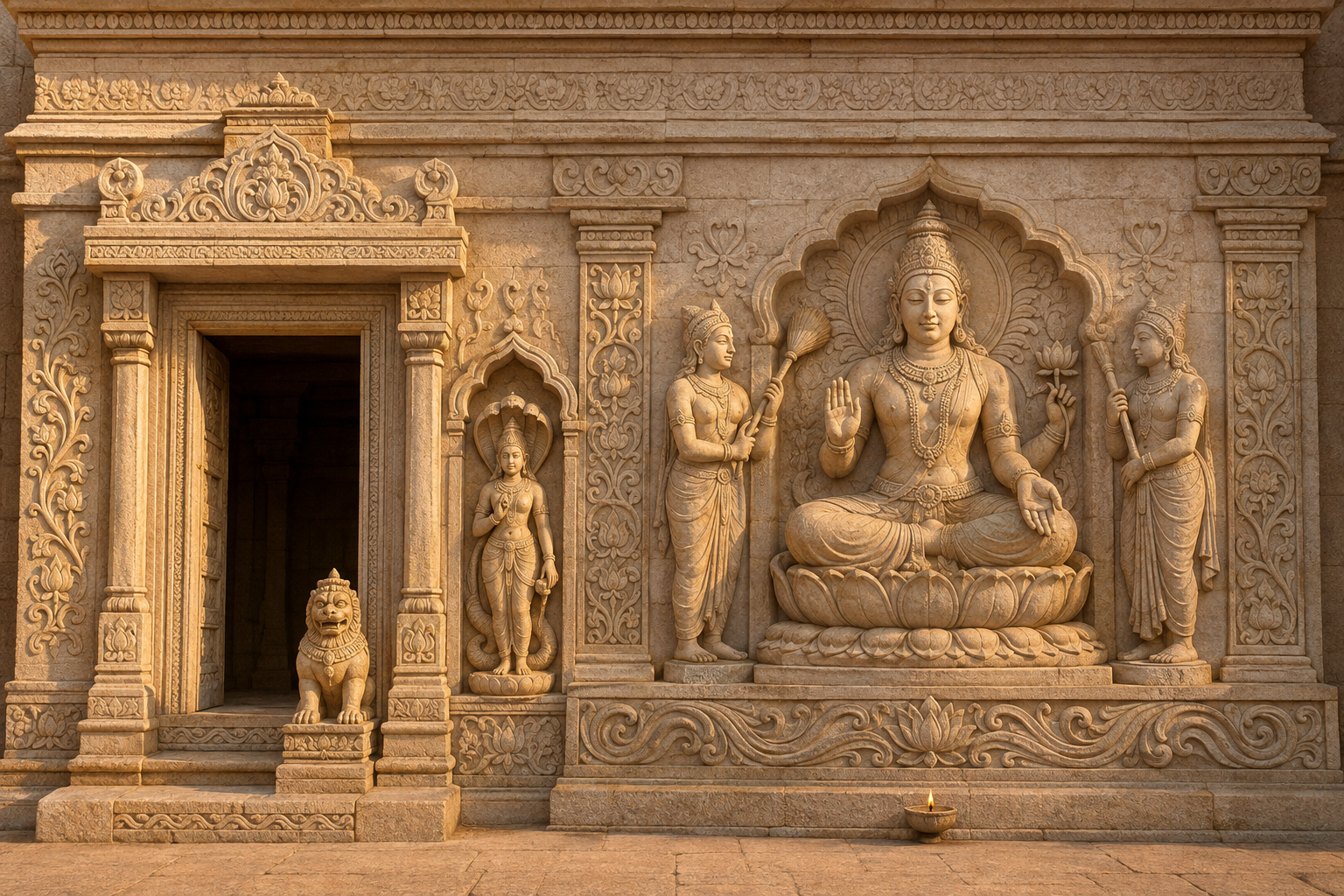
When you encounter an unfamiliar sculpture or scriptural reference, resist the urge to settle its identity from the first resemblance. Work from observation to interpretation.
- Record the setting. Note the temple, shrine, architectural position, manuscript passage, or narrative episode before isolating the figure.
- Describe before naming. Write down only what is visible or stated: female form, serpent hood, composite body, gesture, companion, action, and surrounding figures.
- Assign the broad identity. If the serpent markers are clear, “female Naga” or “Nagini figure” is a defensible starting point.
- Search for the individual identity. Consult the temple’s own account, an inscription, a reliable catalogue, or the immediate scriptural context. Do not let an unrelated image found online supply the name.
- Identify the role. Ask what the figure contributes to this particular scene. Role usually gives symbolism its proper limits.
- State uncertainty honestly. If no personal name survives, keep the broader identification. “Nagini figure, specific identity uncertain” is better scholarship than a confident guess.
The same method improves captions. Instead of writing “Nagini goddess” and ending there, try: “Female Naga figure identified by the cobra hood; her placement beside the central sacred figure indicates a relational role, while her individual name remains uncertain.” Adjust the second clause only to what the actual composition supports.
In scripture, pay particular attention to grammar and relationships. Is one female serpent being speaking as an individual, or are Naginis mentioned collectively? Is she identified through kinship, location, duty, or action? A translation may use “serpent woman,” “serpent maiden,” or “female Naga,” but those English phrases should not tempt you to discard the sacred status carried by the Dharmic category.
Key takeaways
- Nagini first identifies the sacred feminine counterpart of the Naga; it does not automatically name one universal goddess with one biography.
- A cobra hood is a strong identity clue, but body form, neighbouring figures, placement, and narrative context complete the reading.
- Serpent symbolism in Hindu art is multivalent. Do not reduce it to evil, danger, fertility, or any other single idea.
- Hindu, Buddhist, and Jain Nagini traditions share a Dharmic symbolic world without becoming interchangeable.
- When evidence does not preserve an individual name, a precise general identification is more respectful than speculation.
The next time you meet a Nagini in stone or scripture, pause before asking what “the snake” symbolises. First ask who is present, what she is doing, and how the surrounding sacred world recognises her. That shift turns a decorative glance into a genuinely Dharmic reading.
References
