
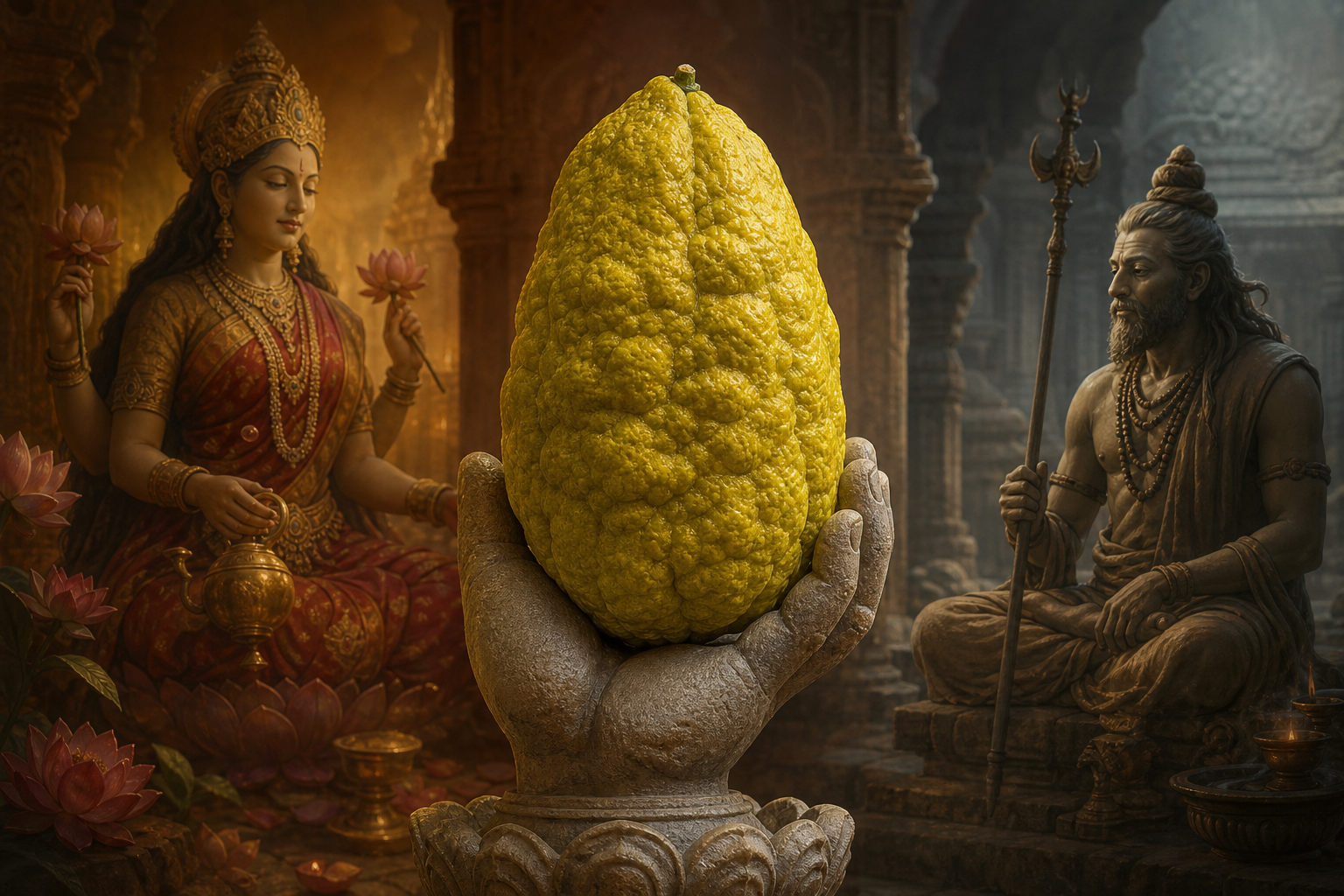
You notice an oversized, knobbled fruit in a deity’s hand. It is too large for an ordinary lemon, too solid for a lotus bud, and too deliberately placed to be a casual decoration. Identifying it correctly changes how you read the entire murti.
In the best-known images of Kolhapur Mahalakshmi and Lakulisha, the object is mātuluṅga: usually the thick-rinded citron, Citrus medica. Once you know its shape, placement, and Sanskrit associations, you can see why the same fruit belongs equally well to a goddess of prosperity and an ascetic Shaiva teacher.
First identify the fruit before interpreting the symbol
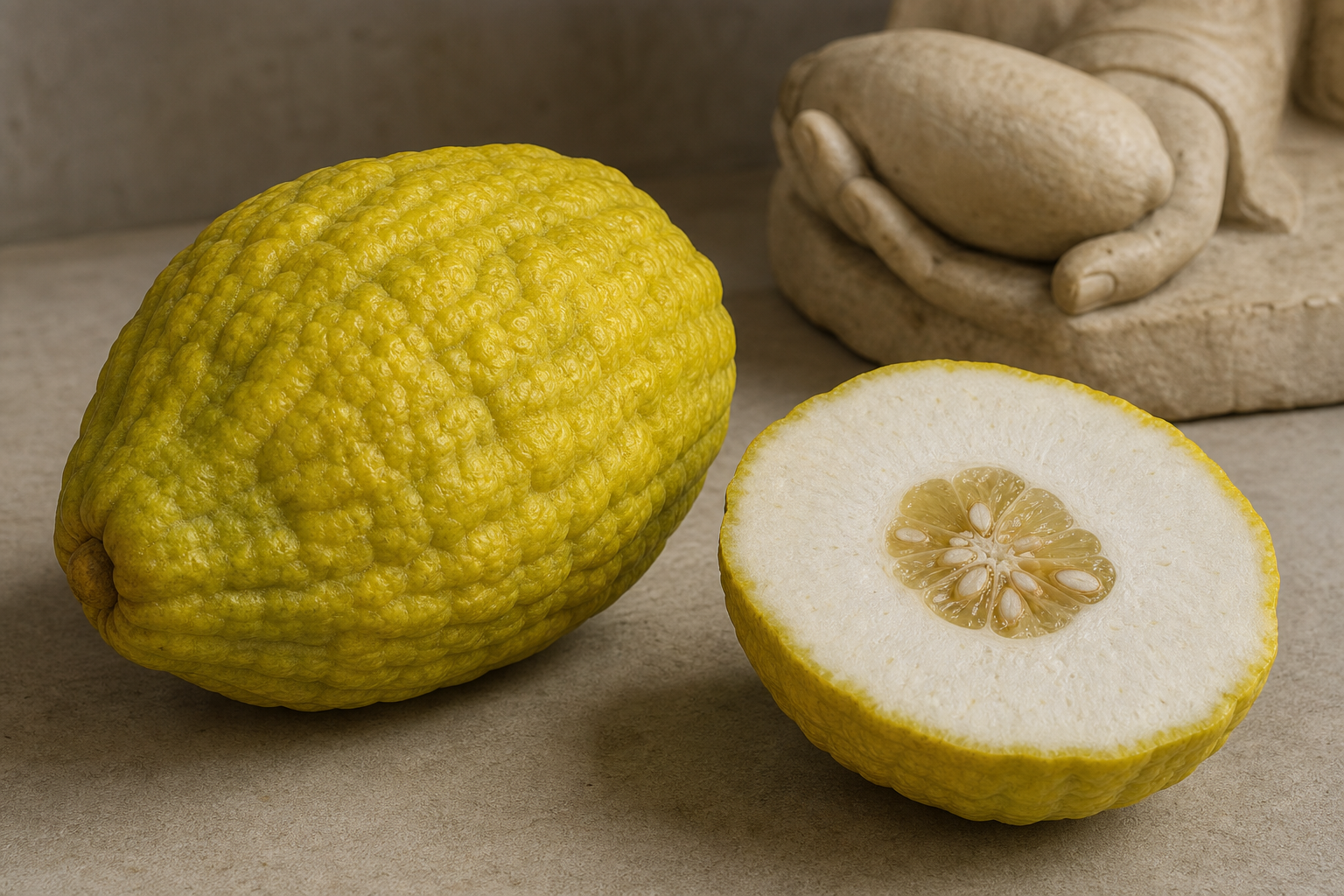
Mātuluṅga is not simply a learned name for any large lemon. The term usually identifies the citron, while regional names include mahalunga and mahalimbu. A citron is large, fragrant, thick-rinded, and commonly oval or oblong. Its corrugated surface and nipple-like apex give sculptors a recognizable form to emphasize.
When you examine a sculpture, look for three features together:
- Scale: the fruit is conspicuously large in relation to the hand, not a small sphere or berry.
- Silhouette: it is usually ovate or oblong, often narrowing toward a protruding apex.
- Surface: surviving details may show a ridged, uneven, or incised rind rather than petals.
Regional observers sometimes identify the object as a rough lemon or pomelo. That caution is reasonable when a sculpture is damaged, heavily restored, or simplified. If the apex and rind are no longer visible, call it a large citrus fruit unless the deity’s established attributes or local temple tradition support the more precise identification. Iconographic confidence should come from several clues, not from resemblance alone.
Colour can reinforce the meaning in a painted or ornamented image, but it should not decide the species. A golden-yellow fruit readily evokes auspicious radiance, yet shape, texture, deity, and hand position provide the stronger identification.
Key takeaways
- Mātuluṅga in these images is usually a citron, not a generic lemon.
- Its large body, uneven rind, oblong outline, and projecting apex are the main visual clues.
- Kolhapur Mahalakshmi holds it in her lower right hand, where it presents prosperity as something ripened and given.
- Lakulisha commonly holds it in his upper left hand, where it points toward the fruit of disciplined practice.
- The Sanskrit word phala means both fruit and result, connecting the object with karmic consequence.
Mahalakshmi and Lakulisha reveal two kinds of fruition

A symbol does not carry exactly the same emphasis in every hand. You must first identify who holds it, then ask how the fruit relates to that figure’s larger iconography.
At Kolhapur, prosperity is cultivated and offered
Shri Mahalakshmi at Kolhapur holds the mātuluṅga in her lower right hand. That placement is striking because a viewer might otherwise expect a conventional gesture of assurance or blessing. Instead, the goddess presents a tangible product of soil, labour, time, and ripening.
This makes the fruit a precise correction to a shallow understanding of Lakshmi as a dispenser of effortless money. The citron points to prosperity that has been cultivated. Its luminous body evokes śrī, the auspicious splendour associated with the goddess, while its seeds support meanings of fertility, continuity, and abundance that can reproduce itself. The lower right hand invites you to see that abundance as something offered rather than grasped.
If you are reading the murti as a householder, the practical question is therefore not merely, “How do I obtain wealth?” It is, “What kind of prosperity am I cultivating, and what will it nourish?” The fruit joins livelihood to dharma. Earnings, harvests, skills, and family continuity become auspicious when their means are ethical and their benefits are shared.
With Lakulisha, discipline has ripened into knowledge
Lakulisha belongs to the Pāśupata Shaiva tradition and is recognized by a cluster of attributes rather than by the fruit alone. His name is linked with the lakuṭa, or club. Images may also include an akṣamālā, a skull bowl or scripture, and the mātuluṅga. In established representations, the fruit commonly occupies the upper left hand.
Beside the club and other signs of ascetic discipline, the citron no longer emphasizes household abundance. It becomes the result of sādhanā: knowledge matured through restraint, attention, and sustained practice. Its fragrance can suggest realization becoming perceptible through conduct, while its contained interior can suggest vital energy conserved and directed toward a higher purpose.
The left-side placement can support a receptive, inward reading, but it should not be turned into a universal rule that every left hand means interiority. The stronger evidence comes from the complete figure: an ascetic teacher, his other attributes, and the fruit’s recognized place in western Indian Lakulisha iconography.
Mahalakshmi and Lakulisha therefore do not give the citron contradictory meanings. They disclose two domains in which action bears fruit. With Mahalakshmi, righteous activity ripens as sustaining prosperity. With Lakulisha, disciplined practice ripens as insight. The householder’s field and the ascetic’s practice remain different, but both are governed by patience, consequence, and responsible use of what has matured.
Why the citron can carry so many layers of meaning
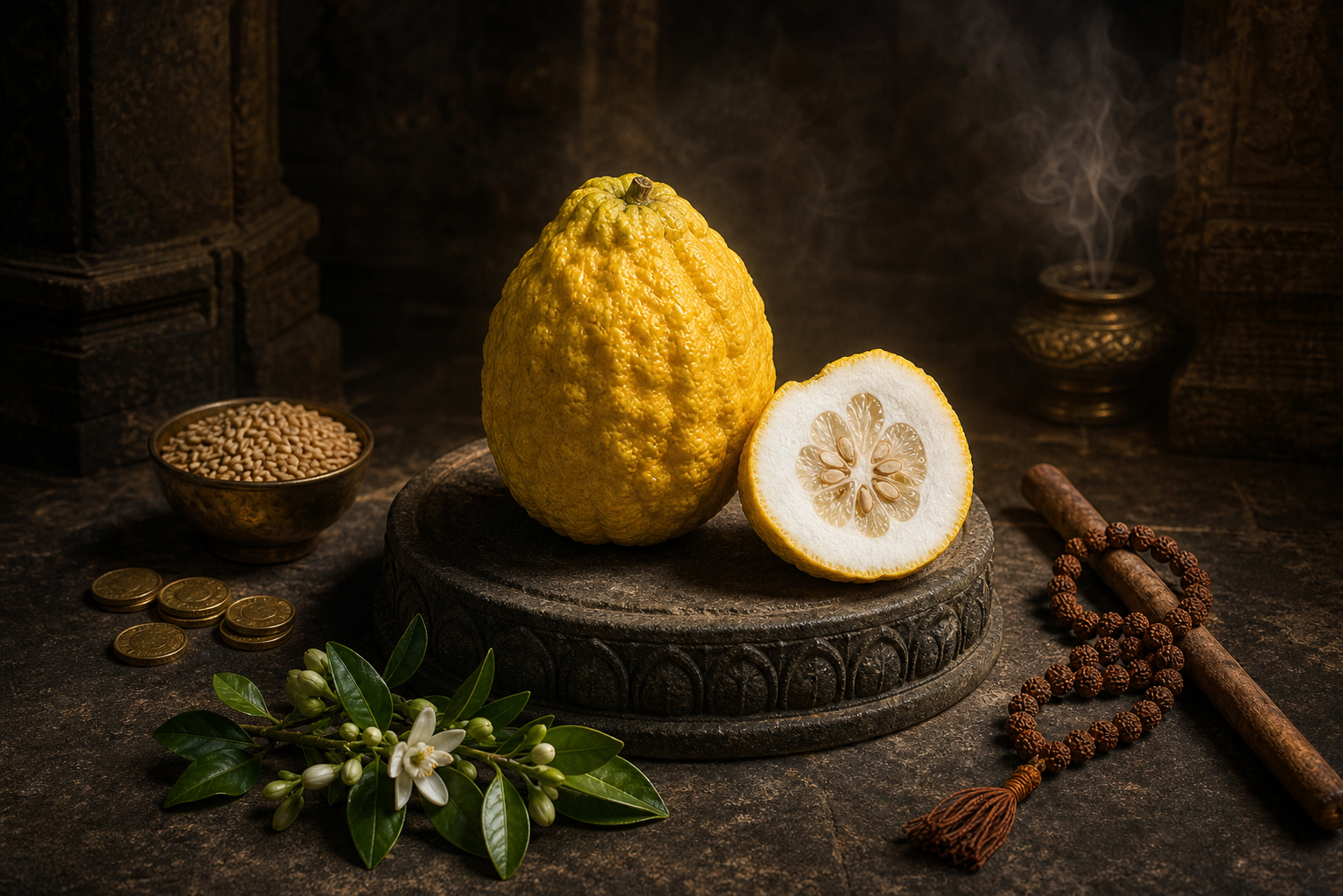
The citron works because its physical qualities already invite symbolic thought. These associations are best treated as connected interpretive paths, not as a rigid code in which every seed, groove, or drop of juice has one compulsory meaning.
| Feature of the citron | Iconographic association | How to read it carefully |
|---|---|---|
| Large golden-yellow body | Abundance and the radiance of śrī | Especially fitting for Mahalakshmi, but colour alone does not identify the fruit. |
| Fragrant, oil-rich rind | Gandha, purity, and subtle presence | Fragrance matters because it is itself an established mode of ritual offering. |
| Thick protective rind | Restraint, preservation, and protective tapas | This is a contemplative analogy rather than a universal iconographic formula. |
| Flavourful interior | Rasa, the savour or essence of realized truth | The contrast between outer austerity and inner essence is particularly apt for Lakulisha. |
| Numerous seeds | Fertility, lineage, and transmission | With Mahalakshmi it can indicate family continuity; with a guru it can evoke teachings multiplying through disciples. |
The most reliable bridge between the physical fruit and its theological meaning is linguistic. In Sanskrit, phala means both “fruit” and “result.” A fruit held by a deity makes consequence visible. Actions, disciplines, and intentions do not disappear when performed; they mature into results.
That double meaning sharpens the difference between the two icons. Mahalakshmi’s fruit can signify the just result of dharmic livelihood rather than prosperity detached from conduct. Lakulisha’s fruit can signify the fruition of yogic knowledge rather than an insight obtained without preparation. In both cases, the object teaches karmaphala without requiring a written explanation.
The citron also belongs to a ritual world in which fragrance is not incidental. Gandha is a formal offering, and the aromatic rind makes the fruit a natural emblem of a presence that spreads beyond its visible boundary. Its associations with freshness and cleansing deepen that suitability. These are ritual and symbolic associations; they should not be converted into personal medical advice merely because citron also appears in Ayurvedic traditions.
Its regional ecology matters as well. Citron and related large citrus fruits were available through agricultural and temple networks associated with western India, including the Konkan and Deccan. That availability offers a plausible context for the symbol’s prominence around Kolhapur and in sculptures from Gujarat and Rajasthan. It does not, by itself, prove a single point of iconographic origin. What it does show is how effectively Hindu sacred art can elevate a familiar product of the local landscape into a theological object.
The choice of citron also distinguishes this image from other fruit symbolism. Mango can emphasize fullness and devotional sweetness. Pomegranate can express fecundity and unity within multiplicity. Āmalakī can evoke purity and restraint. Mātuluṅga brings a more particular combination: aromatic presence, cleansing, gradual ripening, protected energy, and consequence. Treating every fruit as a vague sign of abundance erases this carefully differentiated vocabulary.
Use a five-step method when you encounter the symbol
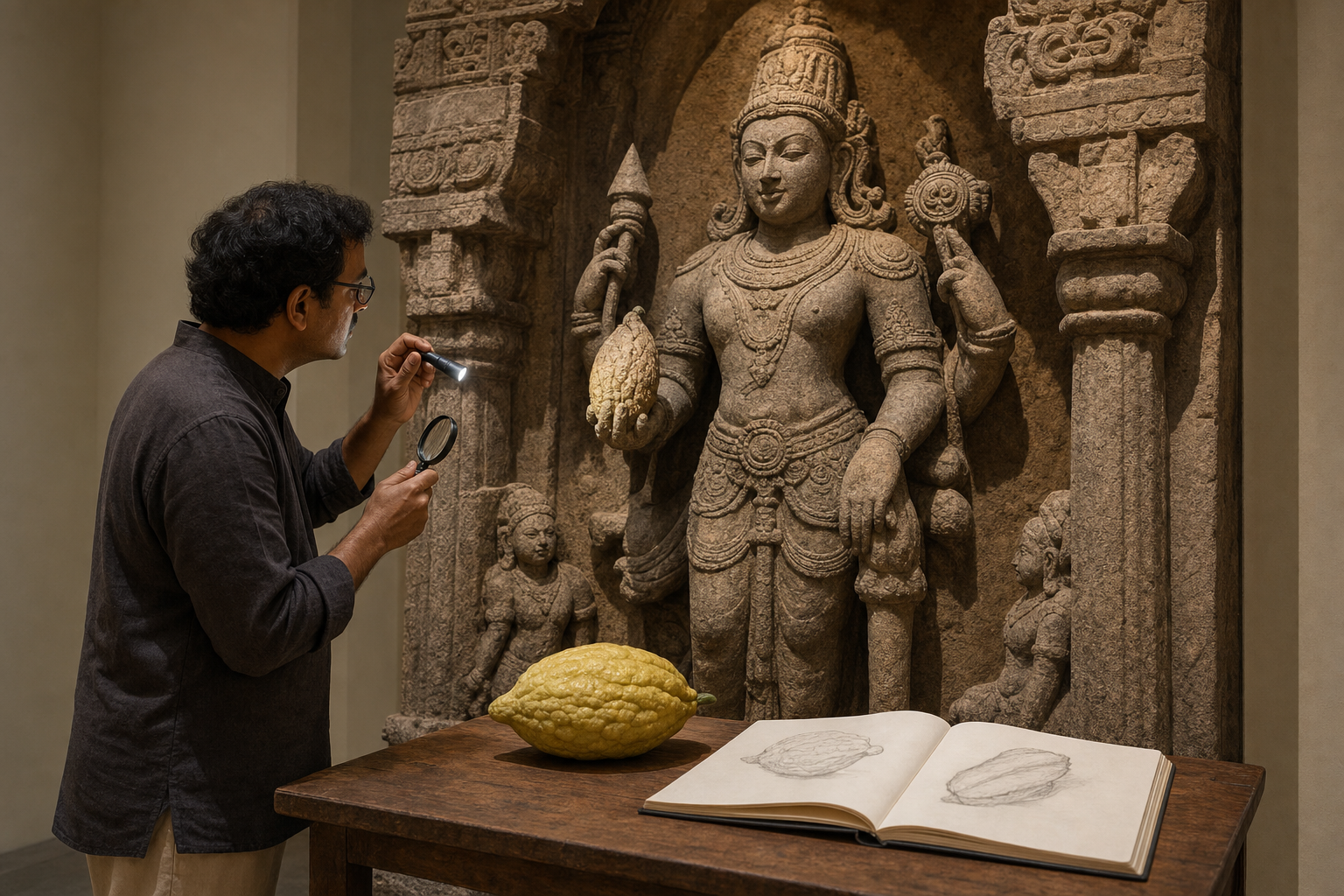
You can read an unfamiliar murti more reliably by moving from visible evidence to contextual meaning. The order matters. Beginning with an attractive interpretation and then forcing the object to fit it is the easiest way to misidentify an attribute.
- Identify the figure before naming the fruit. For Lakulisha, look for the club and the wider ascetic attribute set. For Kolhapur Mahalakshmi, begin with the temple’s established icon and local tradition.
- Inspect the object’s morphology. Note its relative size, oblong outline, projecting apex, and any surviving rind texture. If those features are absent, keep the identification provisional.
- Record the hand and position. Lower right in Kolhapur Mahalakshmi and upper left in common Lakulisha representations are meaningful specifics. Do not reduce them to a generic statement that the deity “holds a fruit.”
- Choose the interpretation that fits the deity. Cultivated and distributed prosperity belongs naturally to Mahalakshmi. The inward fruit of disciplined practice belongs naturally to Lakulisha.
- Separate firm identification from meditation. The named attribute and its placement can be iconographic evidence. Readings involving rind as tapas, pulp as rasa, or seeds as teaching lineages are illuminating extensions, but they should be presented as such.
This method also prevents two common errors. The first is using the fruit alone to identify a deity; attributes work as an ensemble. The second is declaring every large fruit a citron. Hindu sculptors used multiple fruits, and weathering can make their differences harder to see. When certainty is limited, “a fruit, probably mātuluṅga” is a stronger description than a confident but unsupported label.
Local temple tradition deserves attention because iconography is not merely a catalogue assembled at a distance. A sthala may preserve the identity of an attribute even when age, ornamentation, or ritual coverings obscure its physical details. At the same time, a local identification and a botanical identification answer different questions. Devotional continuity may securely preserve the name mahalunga even when no observer can determine the precise citrus species from the visible form.
Shared Dharmic echoes do not erase distinct traditions
The citron’s symbolic reach is not confined to these two Hindu figures, but comparisons require precision. Similarity can reveal a shared ethical grammar without proving that every tradition assigns the fruit an identical doctrinal meaning.
In Jain art, Ambikā Yakṣiṇī is often shown with fruit, and examples in several regions have been identified as mātuluṅga. There the fruit can unite domestic nurture, fecundity, and spiritual guardianship. You should still resist labelling every fruit in every Ambikā image as citron without inspecting its form and regional context.
Large citrus fruits also appear as offerings in Buddhist communities of South and Southeast Asia, where brightness and fragrance suit acts of purity and merit-making. An offering placed before a sacred image, however, is not automatically the same thing as a fixed hand-held attribute in Hindu sculpture. The parallel lies first in ritual value, not necessarily in a shared iconographic prescription.
Sikh practice requires an even clearer distinction. Sikh sacred expression is not based on anthropomorphic deity iconography, so there is no direct equivalent of Mahalakshmi or Lakulisha holding a citron. Fruit enters the ethical sphere through seva, hospitality, and shared nourishment, including the wider discipline represented by langar. The connection is an ethic of receiving and distributing food with gratitude, not a borrowed image.
Across these contexts, the useful common thread is modest but substantial: food is grown through dependence on living systems, received rather than created from nothing, and made sacred through right use. Hindu iconography gives that insight a particularly concentrated form. The mātuluṅga asks whether the fruit of your own action will nourish only your appetite or become an offering.
The next time you stand before a murti with an unfamiliar object, give it one quiet minute. Identify the form, note the hand, examine the other attributes, and only then ask what has ripened. With mātuluṅga, that sequence turns an easily overlooked piece of stone or metal into a practical lesson: cultivate carefully, accept consequences, and share what bears good fruit.