
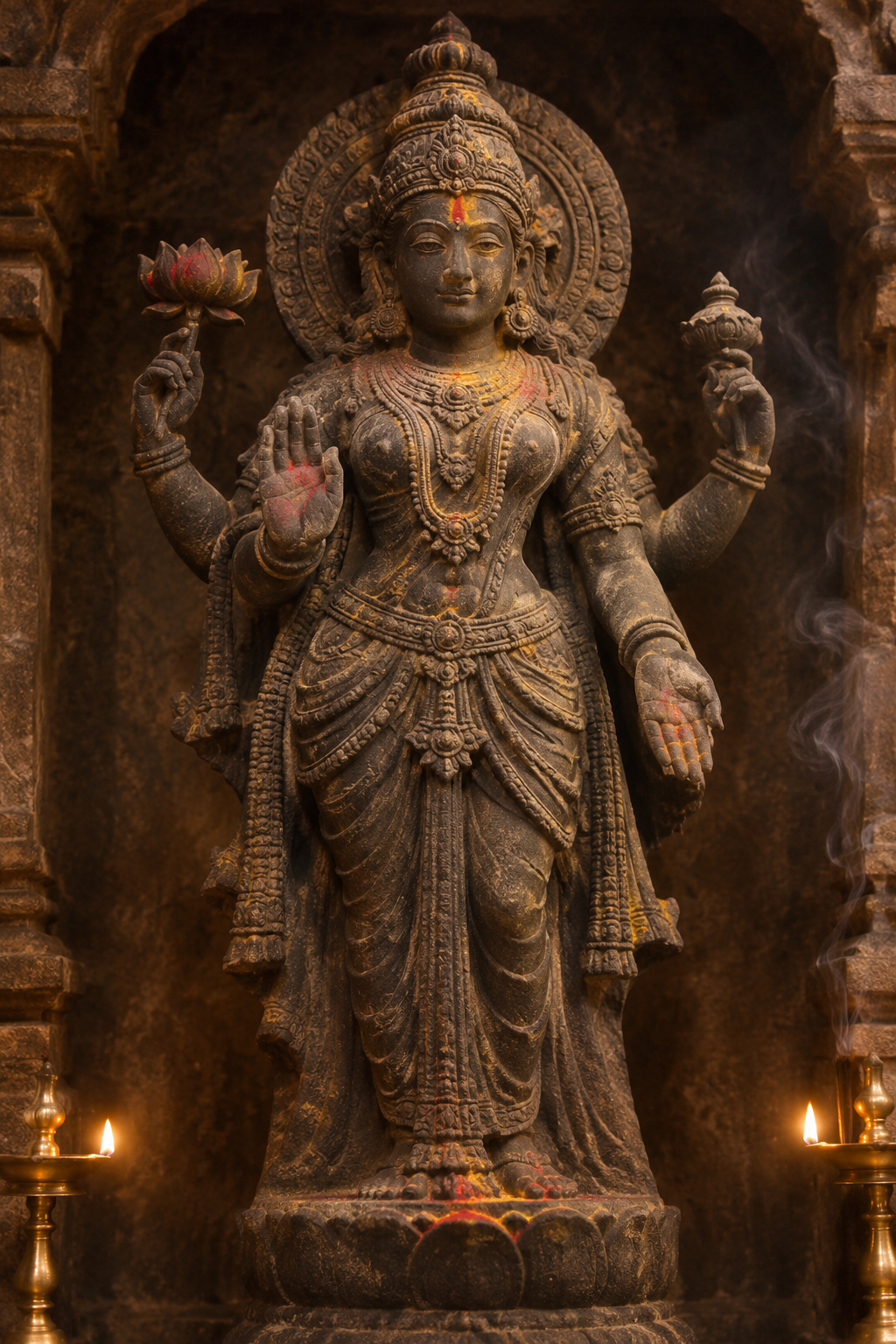
You recognise the deity, but the sculpture still leaves you with questions. Why is one colour dominant? Why does a hand curve gently instead of simply pointing? Does the number of arms indicate rank, action, or something else? A label may supply a name without showing you how to read the form.
Begin by treating the sculpture as a composed act of meaning. The body, hands, posture, attributes, ornaments, and colour belong to one visual statement. Once you learn to examine that statement in the right order, you can interpret more carefully without reducing a sacred image to a dictionary of isolated symbols.
Read a visual sentence, not a collection of symbols
Hindu sacred sculpture is not merely a naturalistic portrait of a divine personality. In a deliberately composed image, gesture, ornament, colour, object, and posture all contribute to meaning. An element may identify the deity, express a divine power, establish the mood of the form, or direct your attention toward a particular spiritual action.
A useful reading therefore has two stages. Recognition asks, “Which form is this?” Contemplation asks, “What is this form showing divine power doing?” If you stop after recognition, you may identify the icon correctly while missing its inner movement. If you skip recognition, you risk attaching a familiar but irrelevant meaning to whatever catches your eye.
You can use grammar as a working analogy. The divine form is the subject. Posture and gesture often carry the action. Attributes help specify identity and power. Colour and ornament establish emphasis. The surrounding figures or setting may supply relationships and context. This is a method of observation, not a universal code: the same colour or object need not carry exactly the same force in every tradition.
That last caution matters. A symbol does not float free of the deity, sect, shrine, or theological setting in which it appears. Do not transfer an interpretation from one form to another merely because both contain a similar hand, weapon, flower, or colour. First determine the form in front of you; then interpret its features as a coordinated whole.
In living worship, a murti is approached as sacred presence rather than as a specimen assembled from artistic clues. The precise theology of that presence varies across Hindu traditions, but the practical lesson for any viewer is the same: iconographic analysis should deepen attention, not replace reverence with puzzle-solving.
Use a disciplined sequence from whole form to fine detail
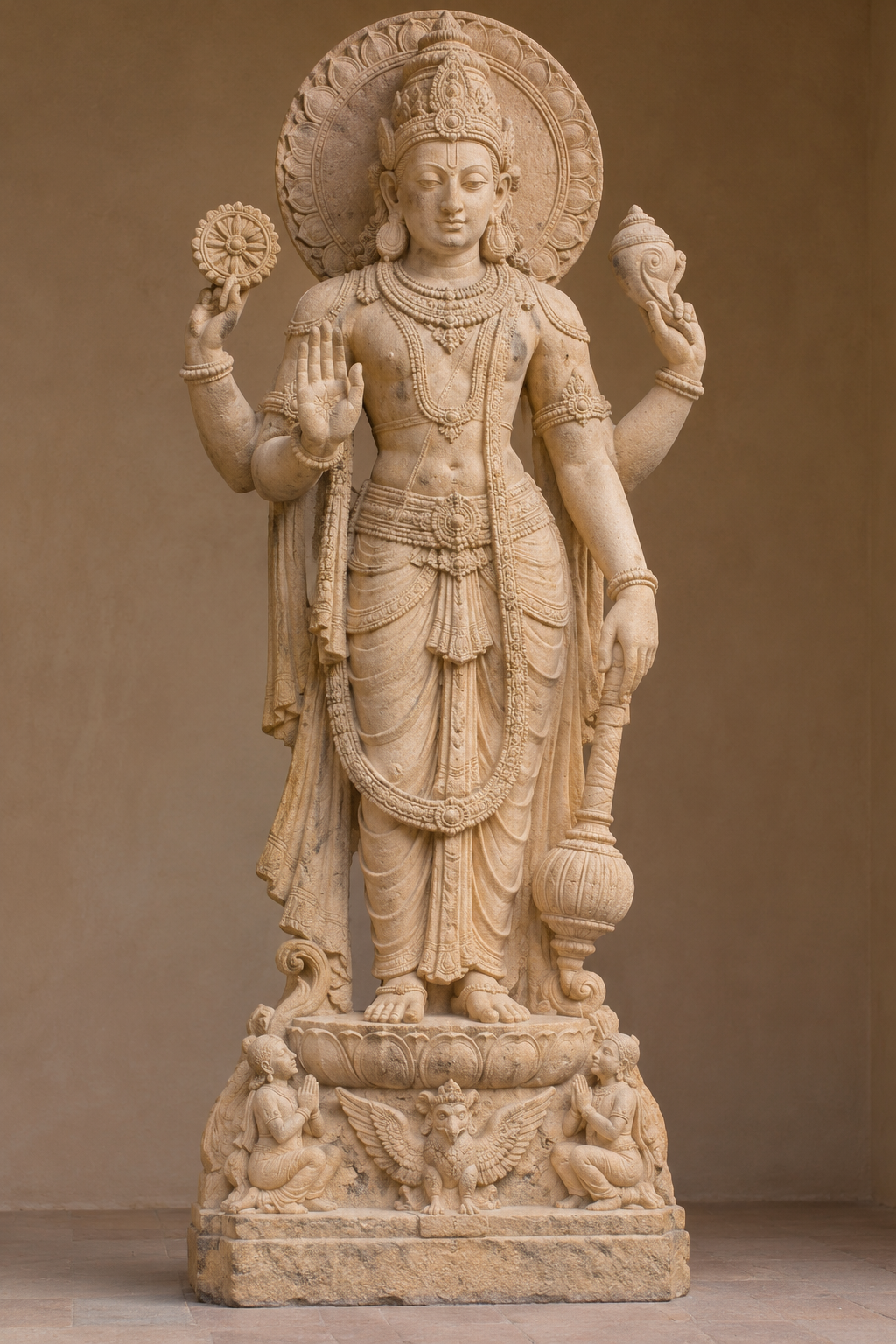
When you face an unfamiliar sculpture, resist the urge to begin with its strangest object. Start with the entire composition and narrow your attention gradually.
- Establish the context. Note the deity’s name if it is known, the shrine or panel in which the form appears, and whether it is the principal image or part of a larger narrative. Context limits the range of plausible readings.
- Take in the silhouette. Observe whether the form is seated, standing, moving, balanced, expansive, compact, gentle, or forceful. Do this before naming individual attributes.
- Describe the body without interpreting it. Record the number of faces and arms, the direction of the gaze, the distribution of weight, and the orientation of the torso. Description gives you evidence that can later correct an attractive but weak interpretation.
- Separate hands from held objects. Ask which hands perform gestures and which hold attributes. A hand has its own line and expressive quality even when it carries nothing.
- Notice repetition and dominance. A colour, posture, directional movement, or type of ornament that governs the whole form deserves more interpretive weight than an incidental detail.
- Group related features. Look for several elements pointing toward the same action or quality. A reading supported by posture, hand, and colour is stronger than one based on a single object.
- State the dominant action in a verb. Is the form protecting, teaching, stilling, unfolding, subduing, blessing, or inviting contemplation? A verb forces you to explain how the image works instead of merely listing what it contains.
Checks that prevent an attractive misreading
- Keep observation separate from interpretation. “The clothing is predominantly yellow” is an observation. “Yellow means this and only this” is an interpretation requiring context.
- Prefer clusters to isolated clues. One detail may be decorative, damaged, restored, or misunderstood. Several converging details provide a firmer basis.
- Do not interpret absence too quickly. A broken hand or missing attribute cannot safely be treated as intentional emptiness. Likewise, if colour is not preserved, do not invent a colour scheme.
- Make your certainty visible. Say “identifies,” “supports,” or “suggests” according to the strength of the evidence. Careful uncertainty is more useful than a confident guess.
This sequence also helps when a museum label offers a finished interpretation. Look first, form your provisional reading, and then use the label to correct or deepen it. You will remember the sculpture more clearly because you have followed its visual logic yourself.
Bagalamukhi shows why simplicity does not mean lesser power
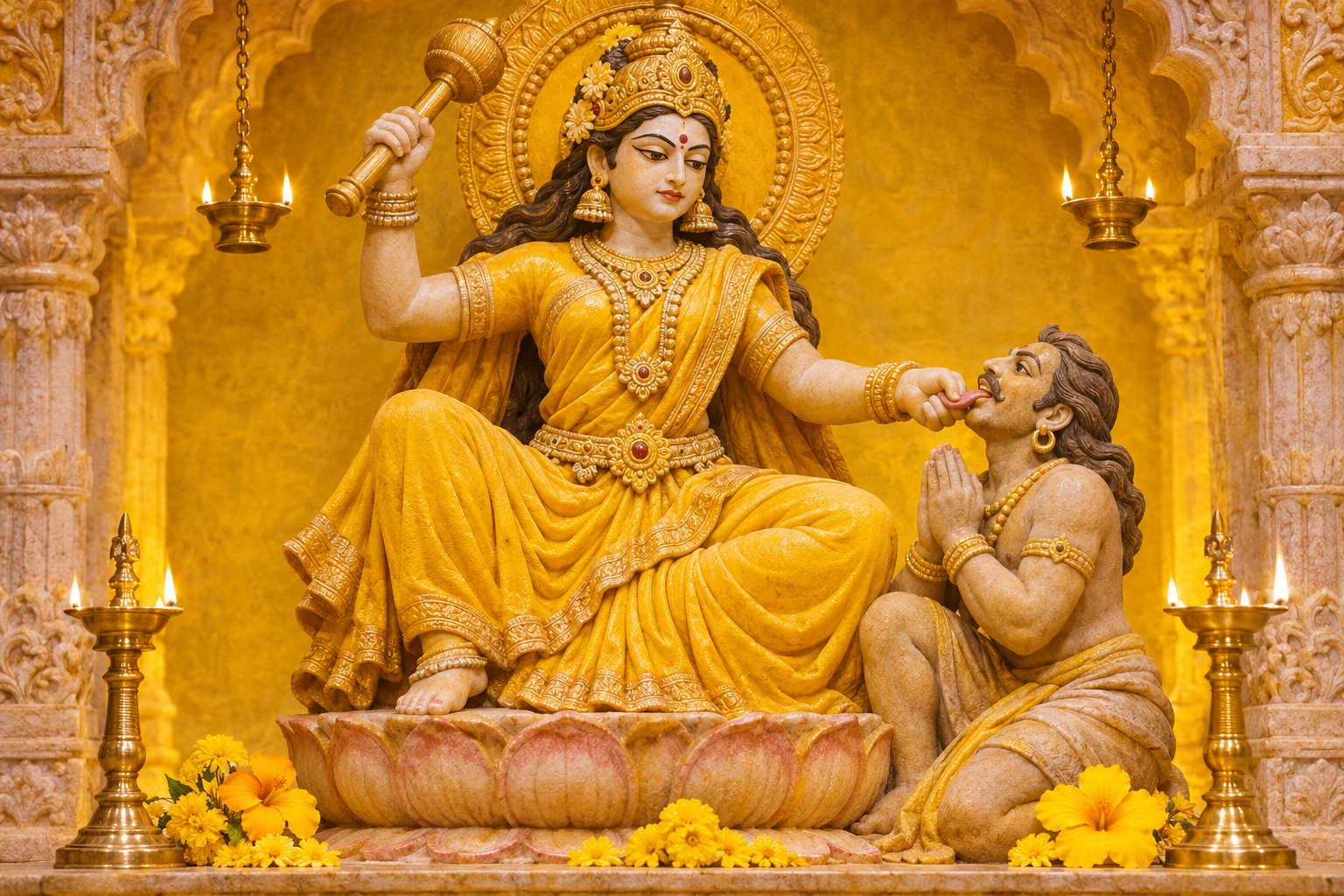
Bagalamukhi provides a focused test of this method. She is one of the ten Mahavidyas and is traditionally visualised as a powerful, two-armed Devi clothed predominantly in yellow. The same iconographic field is oriented toward stambhana, the arresting or stilling of force.
Begin with what those facts allow you to say securely. The Mahavidya identity supplies the theological family. The two-armed form supplies the bodily structure. The dominance of yellow makes colour part of the form’s visual programme rather than a minor embellishment. Stambhana supplies the action around which the features should be read.
Now notice what you should not infer. Two arms do not make the form spiritually minor or iconographically unsophisticated. Bagalamukhi is explicitly presented as powerful, so counting limbs cannot become a crude scale of divine importance. The better question is how completely the available elements concentrate attention on her particular power.
Nor should you assign a universal meaning to yellow and then stop. Its predominance is unquestionably significant to the composition, but a responsible explanation must connect that colour to Bagalamukhi’s own identity and tradition. A colour detached from its deity becomes a generic code; a colour read within the complete form becomes part of a theological statement.
Use three tests when you encounter a Bagalamukhi image:
- Concentration: Which feature first commands your attention, and which other features reinforce it?
- Action: How do posture, hands, and attributes make stambhana visible rather than leaving it as an abstract term?
- Coherence: Does your explanation account for the predominantly yellow, two-armed form together, or does it interpret one detail while ignoring the rest?
This approach does not require you to pretend that every surviving image is identical. It gives you a stable centre from which to notice variation. You can distinguish the defining visual programme from regional style, later restoration, or an artist’s handling of proportion without confusing those differences with a change of divine identity.
Pallava Hasta turns the quality of growth into gesture
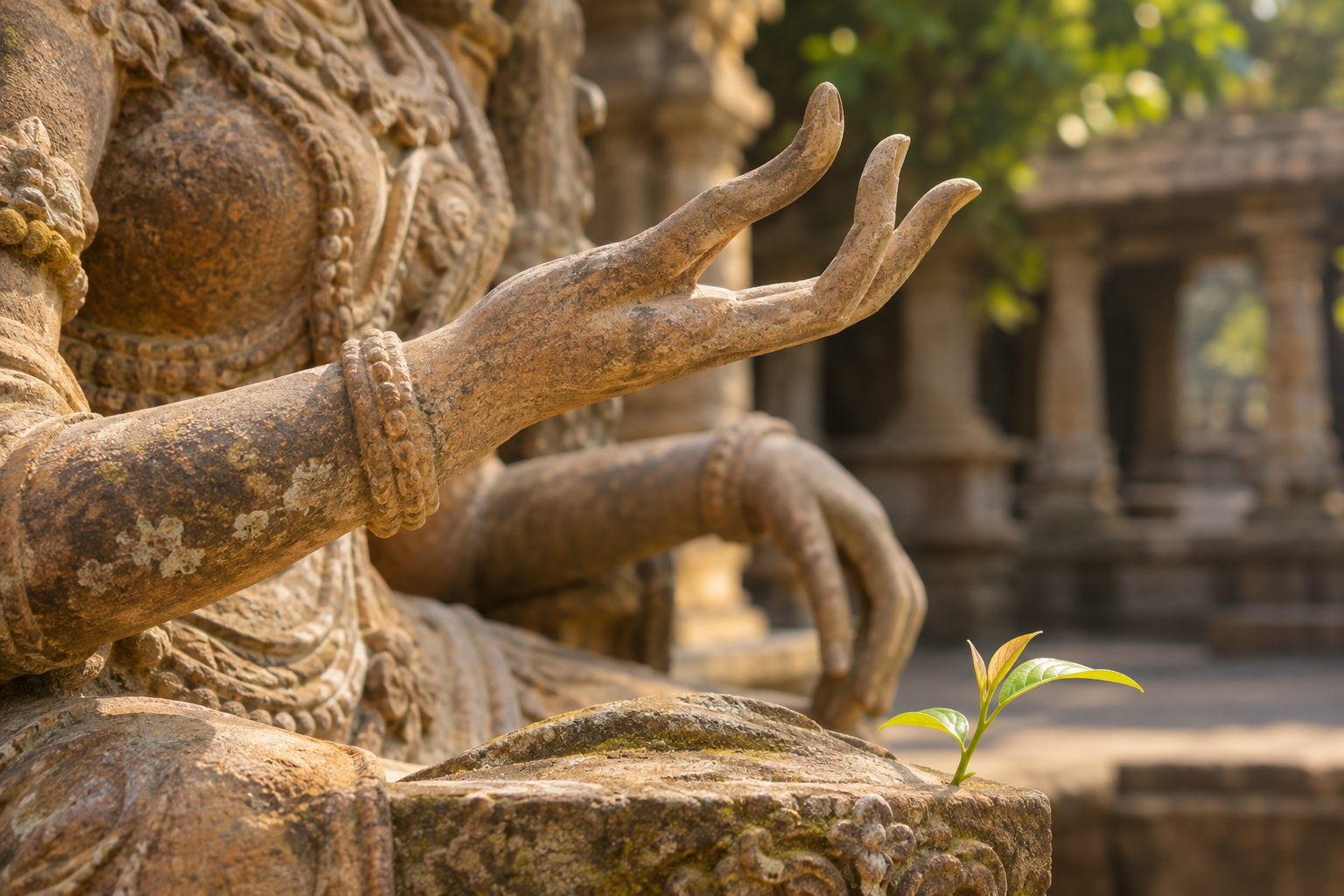
Some symbols work through an identifiable object. Others work through the quality of a line. Pallava Hasta belongs to the latter kind. Pallava refers to a tender leaf, a fresh shoot, or newly emerging growth. Its visual principle carries associations of freshness, delicacy, beauty, youthfulness, and life’s gentle unfolding.
The important lesson is not simply that “pallava means leaf.” That translation gives you a noun but not yet a reading. You must notice how a sculpted hand embodies the character of tender emergence. The hand is meaningful through its contour, direction, softness, and relationship to the rest of the body.
When examining such a hand, trace the movement visually from the wrist toward the fingers. Ask whether the line appears to open, extend, droop, rise, or unfold. Then compare that motion with the torso and surrounding composition. If the hand carries the pallava principle, your description should be able to express more than anatomical position; it should identify the quality made visible.
A weak note would say, “This is a leaf symbol.” A stronger note would say, “The hand’s gentle unfolding gives bodily form to the freshness of a new shoot.” The stronger version remains anchored in what you can see while explaining why the gesture matters.
Do not apply the label Pallava Hasta to every graceful hand. Grace is a broad aesthetic judgement; Pallava is a particular visual and symbolic principle. Confirm the identification through the sculpture’s context or a reliable iconographic description, and then use close observation to explain how the hand realises that principle.
Placed beside Bagalamukhi’s stambhana, Pallava Hasta also sharpens a larger insight. Hindu sacred form can communicate through contrasting dynamics. One image may organise attention around arresting or stilling; another gesture may embody emergence and unfolding. To read either one, ask not only “What is shown?” but “What movement of power or life is being made perceptible?”
Key takeaways for your next encounter with a murti
- Identify the divine form and its setting before assigning meanings to individual details.
- Read posture, hands, attributes, colour, and ornament as a coordinated composition.
- Distinguish what you directly observe from what tradition allows you to interpret.
- Do not treat the number of arms as a simple measure of divine power.
- Give repeated or dominant features more weight than isolated details.
- Describe the image with an active verb: stilling, unfolding, protecting, teaching, or another action supported by the complete form.
- Keep devotional context in view; iconography is a way of attending to sacred form, not a substitute for the form’s living religious meaning.
At the next temple, exhibition, or image archive you visit, pause before reaching for a ready-made explanation. Name the dominant posture, describe what each hand does, identify the repeated colour or motif, and decide which action links them. Then consult the available identification and revise your reading. You will come away with an interpretation you can explain, test, and deepen rather than a symbol list you can only repeat.
References
- Hindu Blog — Dasa Mahavidya Bagalamukhi Idol Form – Iconography
- Hindu Blog — Pallava Hasta Of Hindu Sculptures

Leave a Reply
You must be logged in to post a comment.