
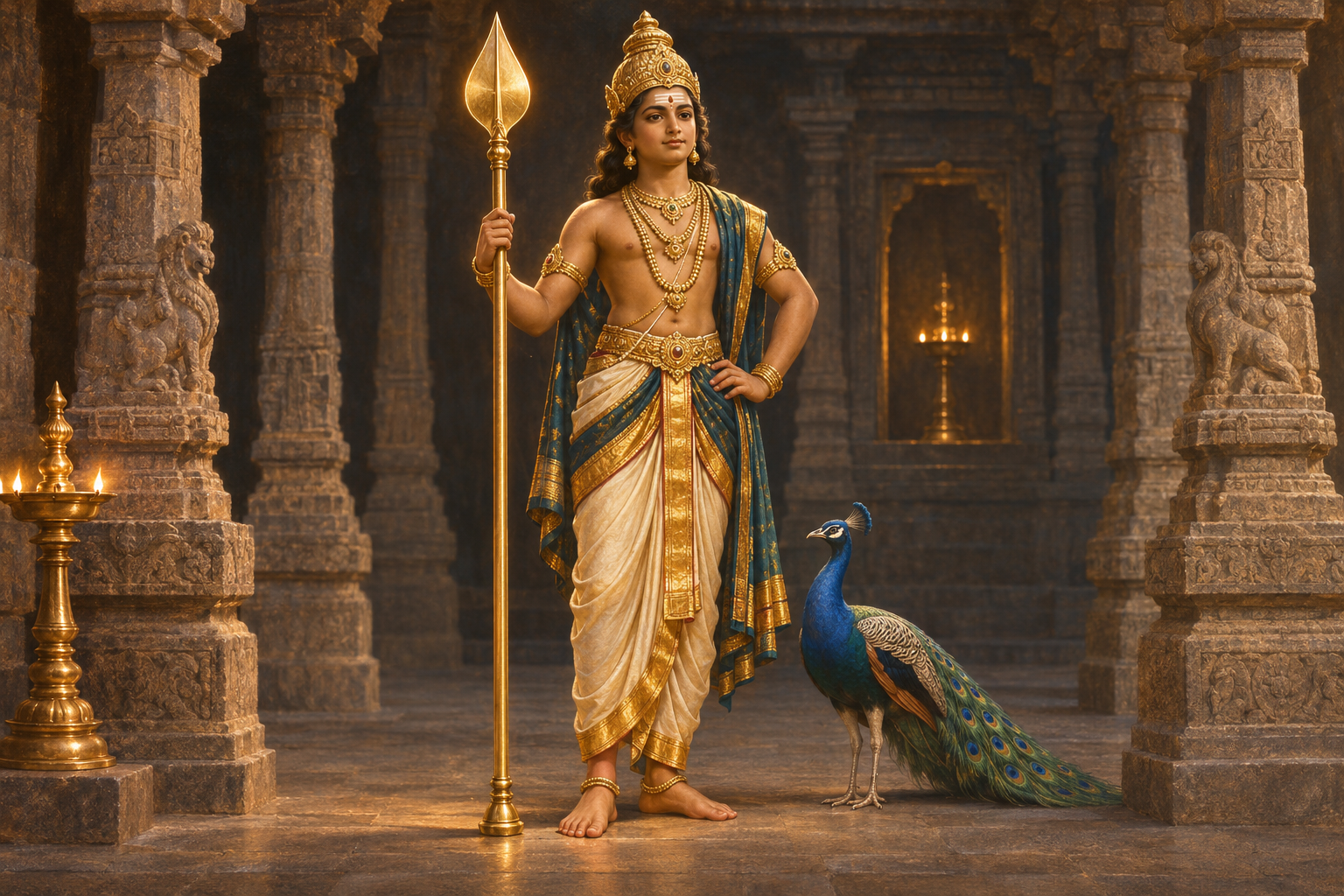
You are looking at an image of Murugan, and the spear immediately commands your attention. Is it simply a weapon, an identifying emblem, or a spiritual teaching rendered in metal or stone? The answer is not one of these but all three, provided you read them in the right order.
Begin with what the sculptor has actually shown you. Then consider how the form works within the image. Only after that should you move to theological interpretation. This approach will help you understand the Vel without reducing it to an instrument of war or turning every decorative detail into an unsupported allegory.
Begin with the Vel as Murugan’s identifying attribute
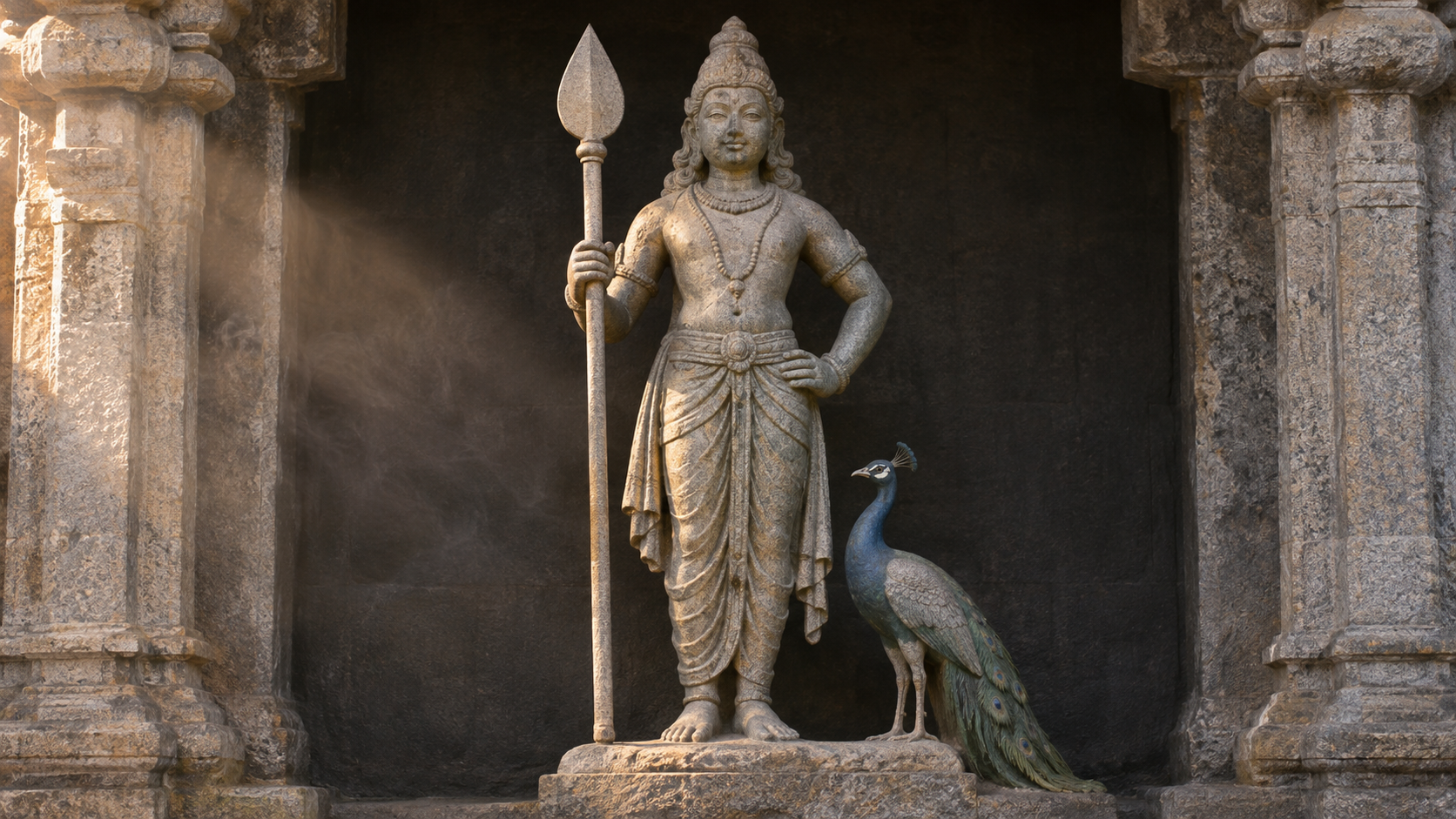
The Vel is the sacred spear most closely associated with Murugan. That association gives it an iconographic function: it helps you recognize whose presence the image represents. It is not merely a piece of military equipment added to make the deity appear formidable.
In the technical language of Hindu sculpture, the Vel is a primary ayudha, or divine weapon. It belongs to the shakti class of weapons and, more precisely, to the piercing type. That classification tells you how the object functions at the level of sculptural form. Its defining action is concentrated penetration rather than cutting, striking, or shielding.
This is the first distinction to keep clear. Classification answers, “What kind of divine attribute is this?” It does not by itself settle every theological question about the Vel. In particular, the term shakti here belongs to the vocabulary used to classify the weapon. You should not assume that every meaning carried by that word in other religious settings has automatically been encoded into every representation of the spear.
If you are trying to identify a worn sculpture, a partial image, or a highly stylized representation, treat the spear as a strong clue rather than isolated proof. Look at the whole composition. Ask whether the object is deliberately connected to the central figure, whether it has been given unusual prominence, and whether its pointed form is still legible despite damage or ornamentation.
Read the shape before assigning a symbolic meaning
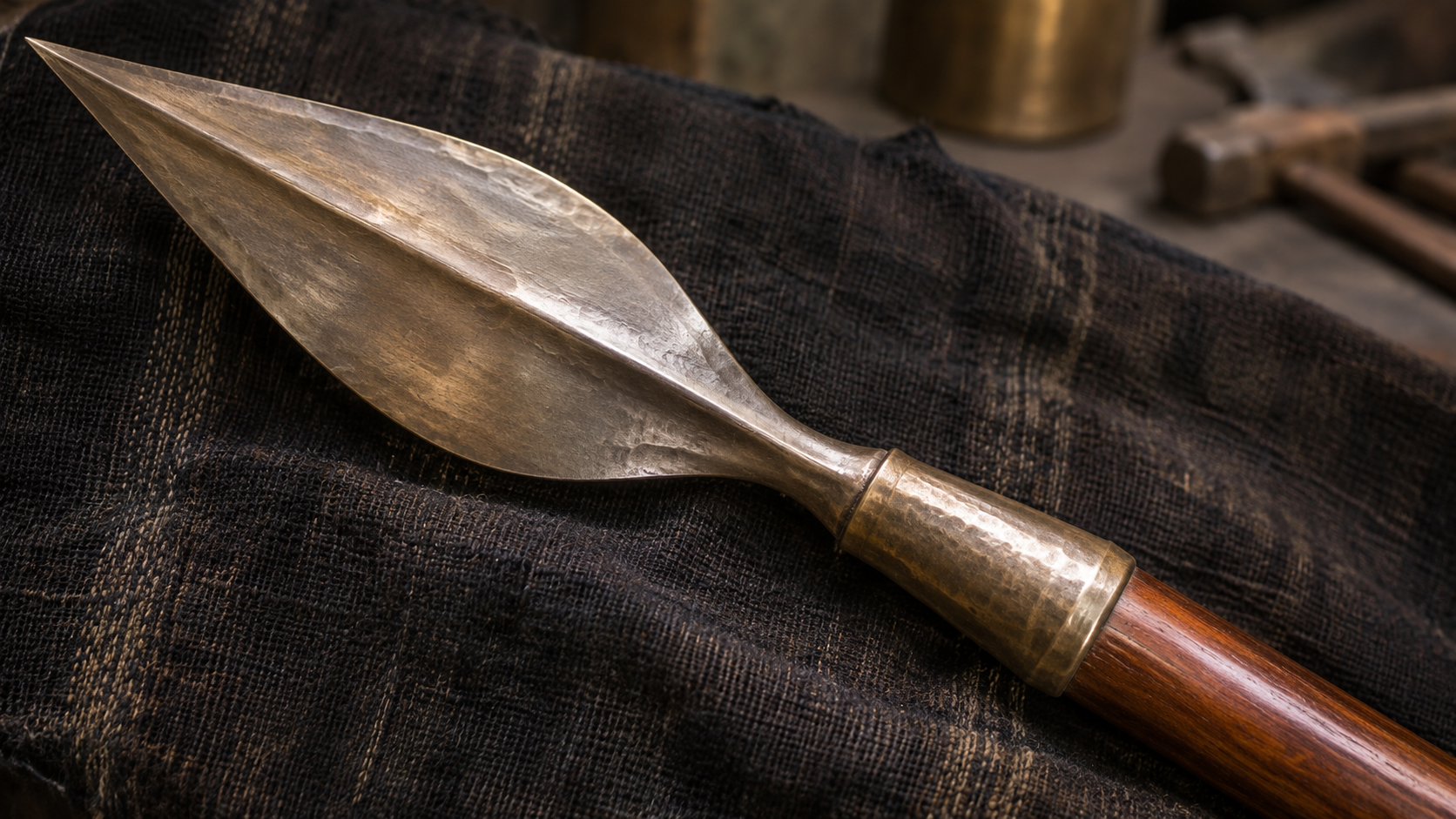
A reliable reading begins with description. Before saying that the Vel “means” something, identify what your eyes can verify: a shaft, a point, an orientation, a position in relation to Murugan, and a degree of visual prominence. This prevents a devotional interpretation from becoming free association.
- Follow the line of the shaft. A long, straight form can establish a firm visual axis. Notice whether it steadies the composition, rises beside the figure, or directs your gaze toward a particular part of the image.
- Look at the point. The tip concentrates the energy of the entire form into one place. That concentration is essential to the visual language of a piercing weapon.
- Notice the relationship to Murugan. Ask whether the Vel appears as something actively held, quietly present, ceremonially emphasized, or visually dominant. The relationship matters more than the object considered in isolation.
- Compare its prominence with other elements. Scale, placement, clarity, and ornament can tell you what the sculptor wanted you to notice first. Do not assume that the largest element is always the most important, but do not ignore deliberate emphasis either.
This sequence separates observation from inference. “The point draws the eye” is an observation about form. “The point represents discernment” is an interpretation. The second may be spiritually illuminating, but it becomes more persuasive when it grows from the first.
The same discipline helps when the image is unfamiliar. You do not need to know every convention in advance. Describe the object accurately, identify its relation to the deity, and then ask what kind of sacred power its shape is capable of expressing.
The martial form carries a teaching about wisdom

The Vel retains the form of a weapon, so its martial character should not be explained away. It communicates force, readiness, protection, and the capacity for decisive action. Yet its religious significance is not exhausted by its use as a martial implement.
The piercing form offers a disciplined way to understand its connection with divine wisdom. A point does not disperse its force in every direction. It gathers force and directs it. In devotional reading, that gives the Vel a natural affinity with concentrated understanding: the intelligence that penetrates confusion, distinguishes what matters from what distracts, and reaches the centre of a problem.
This does not mean that the physical spear is merely a disguise for an abstract idea. Hindu iconography often allows visible power and spiritual meaning to remain together. The weapon is still a weapon, but its power is governed, purposeful, and aligned with divine order. Wisdom is not presented as passive information. It becomes the ability to see clearly and act without diffusion.
You can therefore read the Vel through three connected movements:
- Recognition: the Vel identifies the image with Murugan.
- Form: the shaft and point express direction, concentration, and piercing force.
- Contemplation: those visible qualities can lead you toward discernment, disciplined purpose, and wisdom made effective through action.
Keeping these movements connected protects the image from two opposite errors. It prevents a purely material reading in which the Vel is only a battlefield object, and it prevents an overly abstract reading in which the concrete force of the spear disappears.
Four common mistakes obscure what the Vel is doing
The hardest part of reading sacred art is often not seeing more, but refusing to impose too much. These four mistakes are especially easy to make when encountering the Vel.
- Treating it as a generic spear. Its close association with Murugan makes identity part of its function. Calling it “a weapon” is formally correct but iconographically incomplete.
- Reading divine power as uncontrolled violence. A sacred weapon can signify the capacity to overcome, protect, and act decisively. Its pointed force does not require you to celebrate aggression or anger.
- Assigning a fixed meaning to every detail. A decorative ridge, variation in proportion, or unusual curve may reflect a sculptural convention, material constraint, or artistic choice. Begin with the unmistakable structure of the Vel before interpreting minor features.
- Using one technical term as a complete theology. The classification of the Vel as a shakti-class, piercing weapon is valuable, but classification and spiritual interpretation are not identical tasks. Establish the category first; develop the devotional meaning with care.
There is also a broader habit worth correcting: isolating one attribute from the rest of the image. Iconography works through relationships. The direction of the body, the handling of the attribute, the overall stillness or movement, and the prominence of the spear all affect how you experience the Vel. Read the object closely, but return to the whole figure before reaching a conclusion.
Key takeaways for your next encounter with the Vel
- The Vel is Murugan’s sacred spear and a primary identifying attribute, not incidental decoration.
- Its sculptural category is a divine weapon of the shakti class, specifically the piercing type.
- Begin with visible form: shaft, point, orientation, placement, and prominence.
- Keep observation distinct from interpretation. First describe what the image shows; then ask what that form makes spiritually intelligible.
- Its martial force and its association with divine wisdom belong together. The point gives a visual language to concentrated insight and purposeful action.
- Do not force every stylistic detail into a universal code. Read the Vel in relation to Murugan and to the composition as a whole.
The next time you stand before Murugan, resist the urge to translate the Vel into a single slogan. Follow its line, notice where its point leads your attention, and observe how it changes the presence of the figure. Then ask a practical question of yourself: where does your own attention need to become less scattered, more discerning, and more decisively aligned with dharma? At that moment, the Vel has ceased to be an object you merely recognize. You have begun to read it.
References

Leave a Reply
You must be logged in to post a comment.