
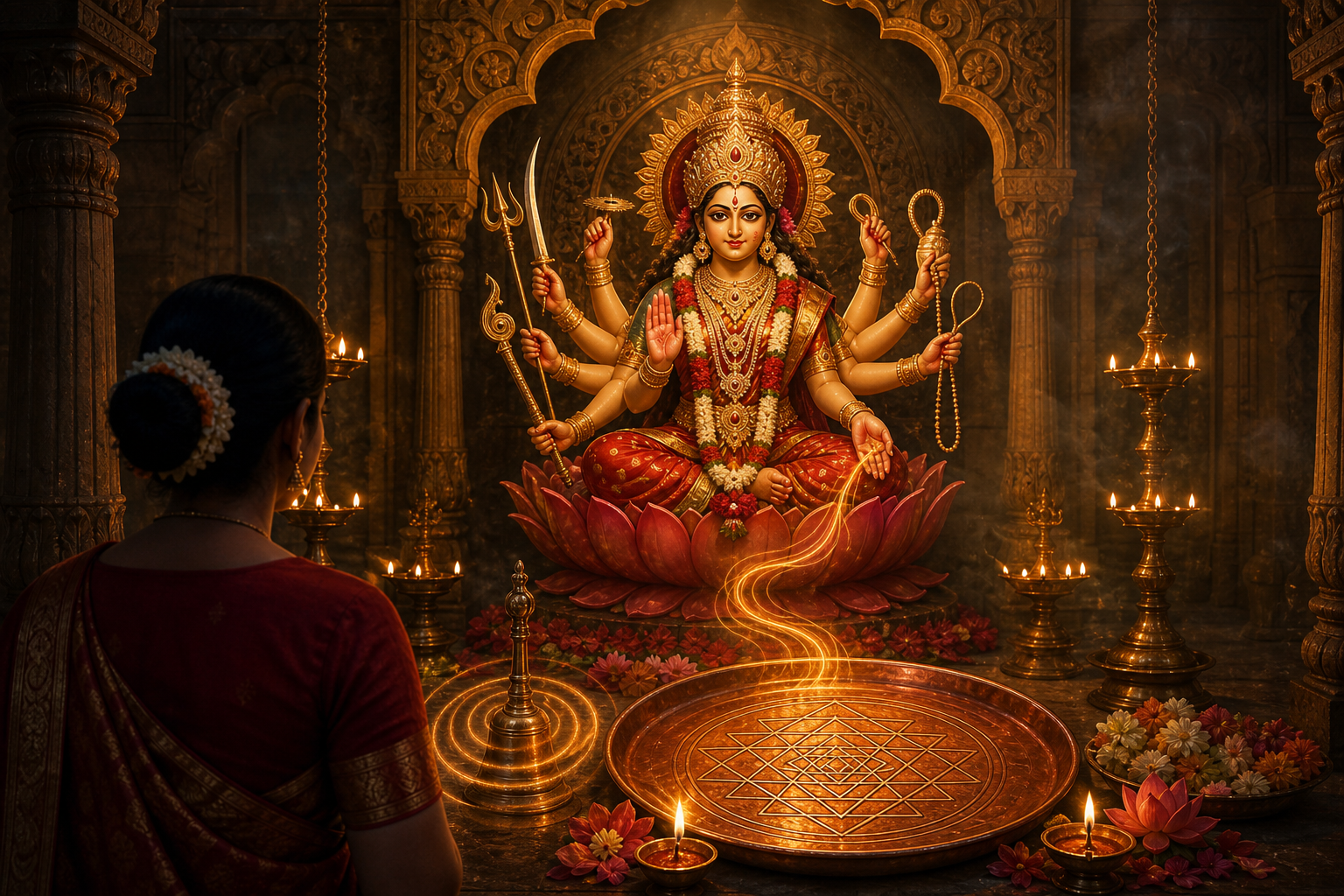
You stand before a Devi murti. You recognize the lotus, the raised hand, the crown, and perhaps the noose or rosary. A bell sounds and a mantra follows. Yet the shrine’s meaning can remain elusive because its parts are often treated as separate symbols instead of one coordinated act of teaching.
You can read that teaching without pretending every motif has one universal definition. Begin with context, move from the base of the image toward its center, and then follow the sound from audible speech into silence. This gives you a disciplined way to encounter Shakta-Tantric art as darśana rather than as a catalogue of exotic objects.
Begin with relationship, not a symbol dictionary
In Shakta-Tantric worship, a murti is neither a decorative statue nor merely an illustration of a story. Its posture, proportions, hands, implements, ornaments, pedestal, and surrounding arch form a visual theology shaped for ritual presence. Mantra performs a related work through sound, breath, attention, and meaning. Yantra gives that same sacred field a geometric organization.
This does not make image, sound, and geometry interchangeable. Murti presents divine power through an embodied form with which the devotee can enter a devotional relationship. Yantra orders attention spatially, often through successive enclosures and a central bindu. Mantra unfolds through time as phoneme, rhythm, breath, mental recollection, and silence. Each mode reveals something the others cannot express in quite the same way.
The first mistake to avoid is assigning a fixed definition to an isolated feature. A lotus generally carries associations of purity, but its precise role depends on the deity, the objects around it, the local lineage, and the ritual being performed. A red garment can suggest active Shakti in a Śrīvidyā setting, yet it may also belong to a temporary festival alankāra. A third eye can mark insight in one atelier, while another lineage may omit it to emphasize serene vidyā-śakti.
Lopamudra Devi shows why context matters. Her iconography is not governed by one standardized pan-Indian prescription. A vidyā-oriented form may draw upon Sarasvati-like signs such as a book, rosary, water vessel, or vīṇā. A Rājarājeśvarī-oriented form may instead carry the noose, goad, sugarcane bow, and five flower-arrows associated with Śrīvidyā sovereignty. Neither cluster should be declared false merely because it differs from the other. Local paramparā, temple liturgy, and sthala tradition determine how the form is completed.
Ask three questions before interpreting any detail:
- What is the context? Identify the deity if possible, then note the temple, region, sampradāya, ritual occasion, and whether you are seeing permanent sculpture or temporary decoration.
- Which layer am I reading? Distinguish the theological ground beneath the deity, the body’s posture and gestures, the held implements, and the wider field formed by the aureole, yantra, mantra, and ritual action.
- What is attention being asked to do? A useful interpretation should disclose a movement such as becoming fearless, gathering the senses, directing the mind, receiving knowledge, or resting at the center.
If the context is unknown, use words such as likely, may, and in this combination. That is not evasiveness. It is the honest language required by a living tradition whose regional forms share a grammar without becoming identical.
Read a Devi image from the pedestal upward
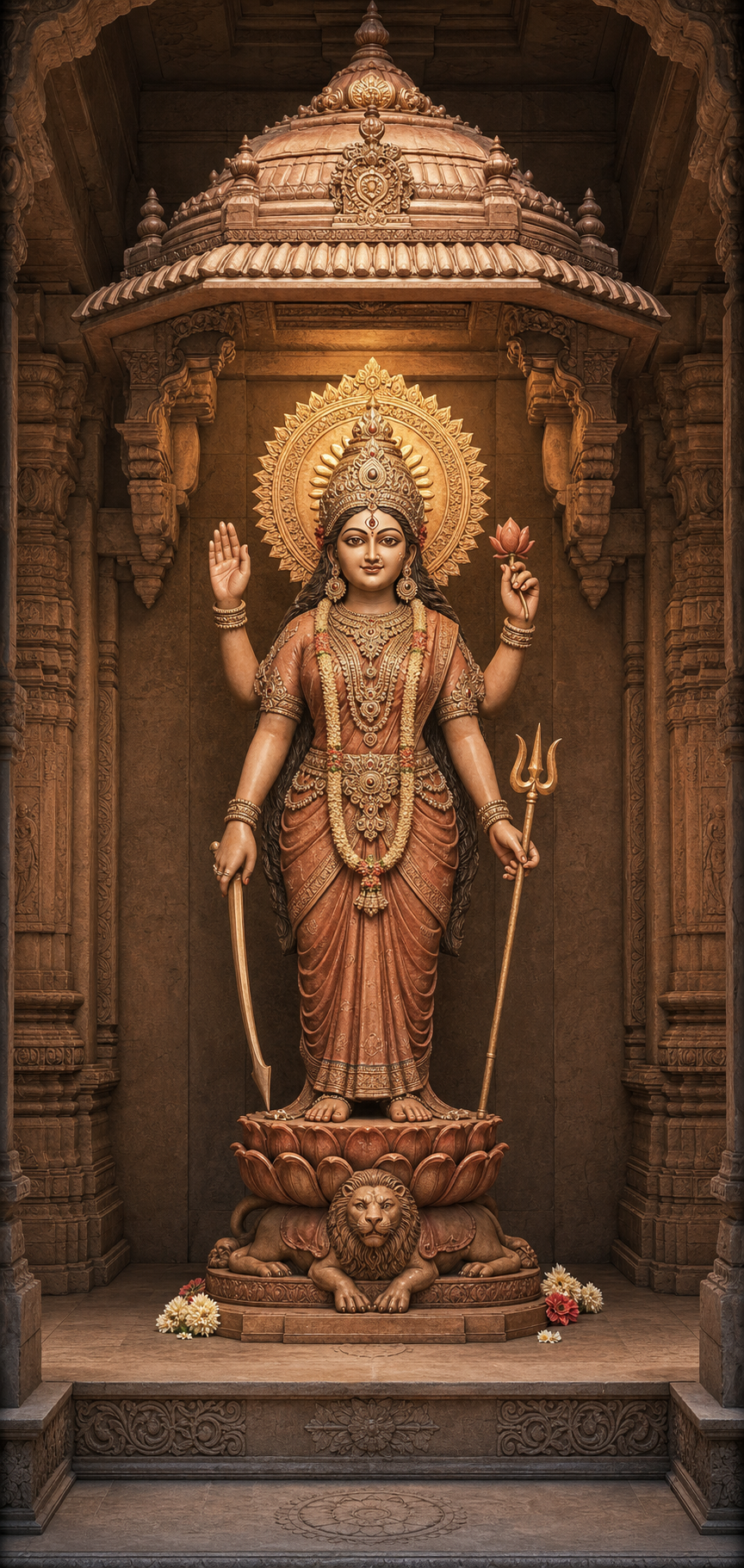
The most conspicuous object is not always the best place to begin. Reading from the base upward prevents a dramatic weapon, crown, or facial feature from overwhelming the theological structure supporting it.
- Begin with the pīṭha and vāhana. A lotus pedestal presents purity and transcendence: the sacred can arise within the world without being stained by it. A yoni-pīṭha places the form upon the sign of cosmic source, making the generative dimension of Shakti explicit. A tortoise base signifies stability and cosmic support. When a lion appears, heroic and sovereign Shakti comes forward. The absence of a vāhana can also be meaningful, especially in a Sarasvati-adjacent or strongly contemplative form.
- Read the posture before the hands. Padmāsana establishes contemplative balance and often suits a form centered on knowledge. Lalitāsana, the posture of royal ease with one leg pendant, combines accessibility with sovereignty. Tribhaṅga gives the body lyrical movement through three bends. Do not reduce these to mood: posture tells you how divine power is being held, whether as still knowledge, gracious rule, or graceful dynamism.
- Separate mudrā from implement. An empty open hand can carry as much meaning as a weapon or book. Abhaya mudrā offers fearlessness; varada mudrā expresses giving and compassionate grace. Read them as ethical instructions as well as divine assurances. Abhaya does not only say that the Goddess protects you. It asks what truthful or dharmic action becomes possible when fear no longer governs the hand.
- Read held objects as a sentence. A book points toward scriptural learning; an akṣamālā joins knowledge to disciplined repetition; a kamaṇḍalu evokes purity and rishi-like restraint; a vīṇā unites learning, speech, meter, and musical order. In another cluster, the pāśa gathers and disciplines the senses, while the aṅkuśa directs consciousness. The sugarcane bow and five flower-arrows place the faculties of mind and perception under the refining disciplines of beauty and restraint. The combination matters more than any object viewed alone.
- Finish with face, crown, ornament, and surrounding arch. A regal crown declares sovereignty, while the eyes and brows shape the compassionate gaze required for darśana. A forehead bindu centers attention; an optional third eye intensifies the sign of insight beyond ordinary conception. Jewelry communicates auspicious plenitude rather than mere luxury. In the prabhāvali, makaras releasing foliage and pearls suggest abundant emanation, while the kīrtimukha protects the sacred field and consumes egoic excess.
Proportion belongs to this language too. Many Devi images are organized through eight- or nine-tāla systems in which the face supplies a module for the whole body. You do not need to calculate every aṅgula while standing in a temple. Notice instead how calibrated proportion produces poise, clarity, and śrī. Iconometry is one reason a disciplined sacred image feels integrated before you have consciously decoded any attribute.
Regional style modifies the reading without destroying its grammar. Odisha may emphasize lyrical tribhaṅga and intricate ornament. Bengal and Assam can foreground vigorous Shakta presence, while southern bronzes inherit the fluid silhouettes associated with lost-wax casting. Material, workshop practice, and lamplight affect what you see. Treat them as part of the encounter, but do not confuse a regional sculptural idiom with the complete identity of the Goddess.
Follow sacred sound from utterance back toward awareness
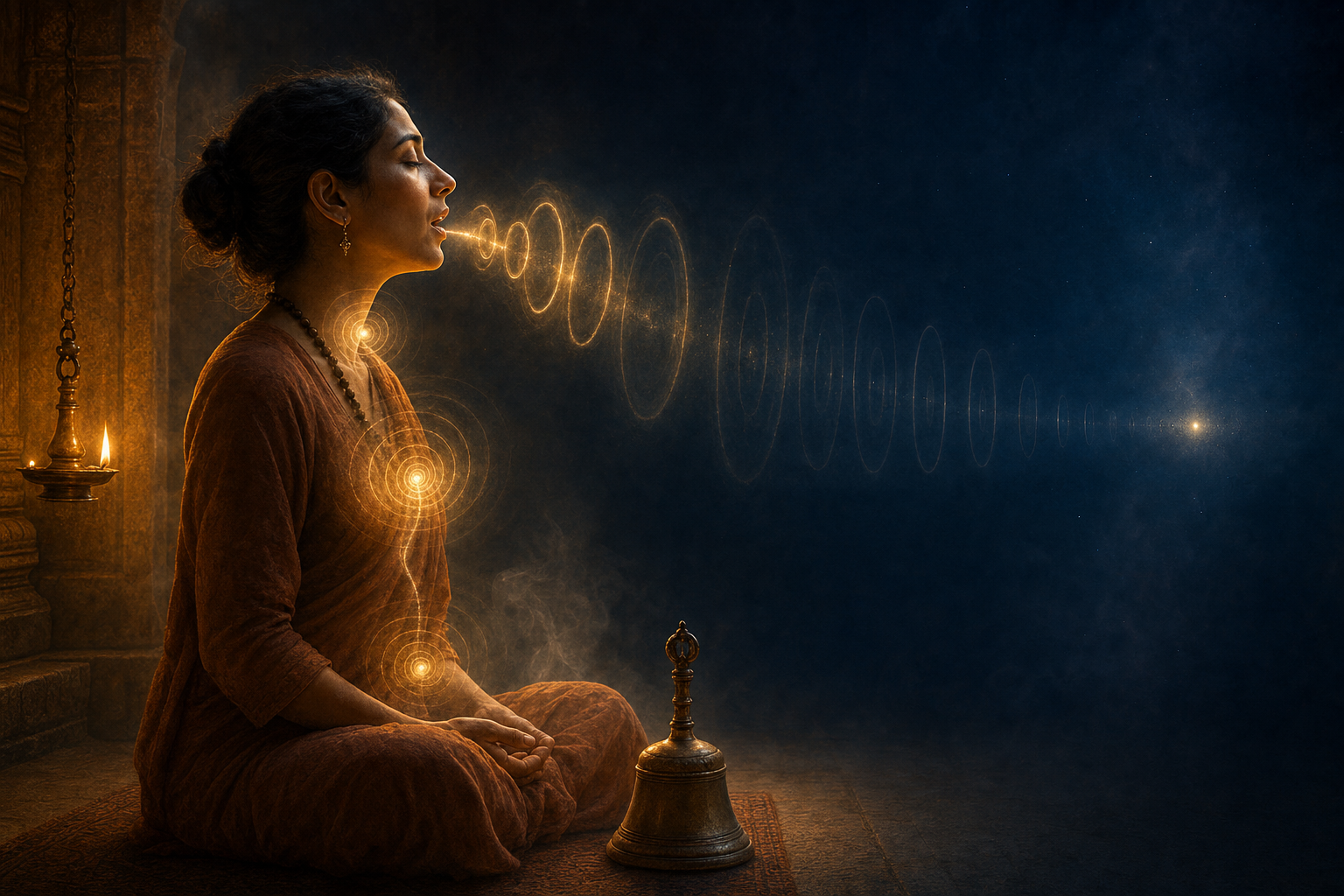
A mantra cannot be understood by translating its words and stopping there. Its sound, meter, deity principle, mode of repetition, breath pattern, and silence all participate in its function. Shakta and Shaiva traditions go further by treating the Sanskrit phonemes as mātrikās, the subtle mothers or powers through which differentiated expression appears.
The traditional account of speech identifies four stages between undifferentiated awareness and audible utterance:
- Parā is speech at its undivided source, before sound and meaning appear as separate objects.
- Paśyantī is the intuitive or visionary level at which meaning and sound remain unified.
- Madhyamā is mental speech, where an intention begins taking a differentiated verbal form.
- Vaikharī is articulated, audible speech produced through breath and the organs of pronunciation.
Ordinary communication moves outward until it becomes vaikharī. Mantra practice can train attention in the other direction. You begin with a clearly formed sound, become aware of its mental continuity, notice the intention and meaning preceding the utterance, and finally attend to the silence from which it arose. Silence is therefore not dead space after the mantra. It is part of the practice.
The three common modes of japa help you notice that inward movement. Vācika japa is audible and makes pronunciation, breath, and rhythm plainly available to attention. Upāṃśu japa uses a whisper or barely audible murmur, reducing outward projection. Mānasika japa repeats the mantra mentally and requires enough stability to prevent the sequence from dissolving into unrelated thought. These can represent progressive refinement, but that does not mean every practitioner should abandon audible repetition as quickly as possible. Use the mode given by your lineage and suited to your actual steadiness.
Seed syllables such as OM, HRĪM, ŚRĪM, and KLĪM should not be treated as interchangeable labels for desired effects. A mantra traditionally includes relationships among seed, power, meter, deity principle, and guarded or sealed knowledge. Pronunciation alone is not the whole practice, and an attractive sound is not sufficient reason to detach a bīja from its ritual setting. Where a mantra belongs to an initiated discipline, guidance from the relevant paramparā matters.
For a simple, publicly familiar exercise, you can listen closely to one unforced OM. Let A resonate through the lower vocal tract and chest, allow U to travel through the throat and palate, and close with M as a gentle nasal resonance. Then do nothing for a moment. Attend to the silence rather than rushing to produce the next sound. Keep the breath comfortable; the purpose is attentive continuity, not volume or duration.
Tantric yogic anatomy supplies another interpretive layer. Viśuddha at the throat is associated with expression and the refinement of vibration. Anāhata at the heart is linked with the unstruck sound, a resonance not caused by two external objects colliding. Ājñā at the brow integrates sound, light, and meaning. These are contemplative correspondences within a yogic map, not substitutes for clinical anatomy or medical treatment.
Acoustic resonance, rhythmic entrainment, humming, and slow breathing can help explain changes in attention or arousal during vocal practice. They do not prove the metaphysical claim of Śabda Brahman. That claim concerns consciousness and reality as primordial sound or vibration, not merely the measurable behavior of air and tissue. Keeping the levels distinct protects both contemplative philosophy and empirical inquiry from careless exaggeration.
See murti, yantra, mantra, and ritual sound as one field
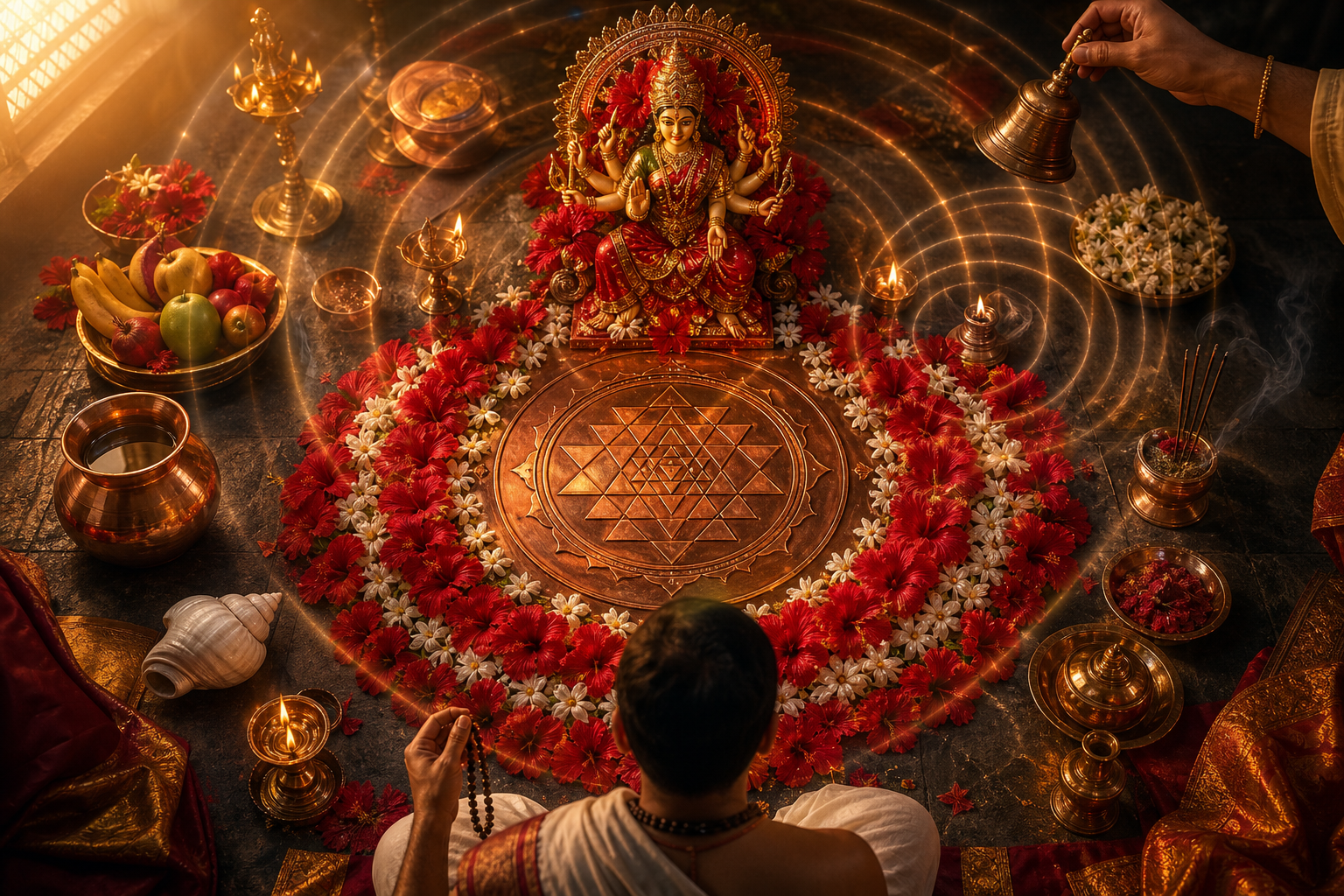
Image and sound become clearer when you ask what each medium contributes to the whole encounter. The following distinctions prevent four common reductions.
| Mode | What it organizes | What to notice | Common misreading |
|---|---|---|---|
| Murti | Embodied form and devotional relationship | Pedestal, posture, gaze, mudrā, implements, proportion | Treating the form as an inventory of decorative attributes |
| Yantra | Sacred space and inward orientation | Successive enclosures, movement toward the bindu, placement in relation to the murti | Treating geometry as an ornamental pattern |
| Mantra | Sound, breath, recollection, and attention through time | Phoneme, rhythm, mode of japa, mental continuity, ensuing silence | Reducing mantra to a translation or promised effect |
| Ritual sound | The shared temporal field of worship | Thresholds, sequence, resonance, recitational precision | Hearing bells, conches, and chants as background music |
The Śrī Yantra makes the spatial dimension especially clear. When installed behind or beneath a murti according to a sampradāya, it is not a hidden duplicate of the Goddess. Its concentric organization provides a path. Navāvaraṇa worship moves inward through successive enclosures and culminates at the bindu, the ultimate point where multiplicity is gathered into unity. The murti presents divine presence in form; the yantra orders the approach to that presence.
Mantra gives the approach duration and pulse. Mātrikā nyāsa can consecrate the practitioner’s body as a field of letters, relating individual embodiment to the garland of phonemic powers. Because nyāsa depends on precise placement and lineage, its existence is useful for understanding Tantric symbolism but not an invitation to invent a sequence from visual clues. Learn the actual practice from the tradition that transmits it.
Temple sounds also mark changes in ritual attention. The bell gathers and clarifies awareness within the worship space. The conch announces or seals a threshold through its broad resonance. The ḍamaru signifies rhythm, polarity, and emergence. Carefully preserved Vedic accents show that sacred recitation depends not only on retaining words but also on transmitting tonal form. When you hear these sounds, ask what transition is occurring: entry, invocation, offering, culmination, or return.
This integrated field also clarifies what Shakta symbolism shares with other Dharmic paths. Abhaya and varada gestures recur in Hindu, Buddhist, and Jain images, and the lotus carries the theme of unstained purity across these traditions. Mantra has a central role in Hindu and Vajrayāna disciplines; the Jain Namokar Mantra venerates spiritual purity and liberation; Sikh practice gives primacy to Shabad and Naam Simran while remaining fundamentally aniconic in worship. Shared forms reveal a civilizational conversation, not a license to erase distinct theologies or ritual boundaries.
The responsible comparison is functional and ethical. You can recognize fearlessness, compassion, disciplined attention, and liberation as resonant values while still asking how each tradition understands the authority, object, and goal of its practice. Similarity becomes more illuminating when difference is allowed to remain visible.
Use a repeatable method at your next darśana
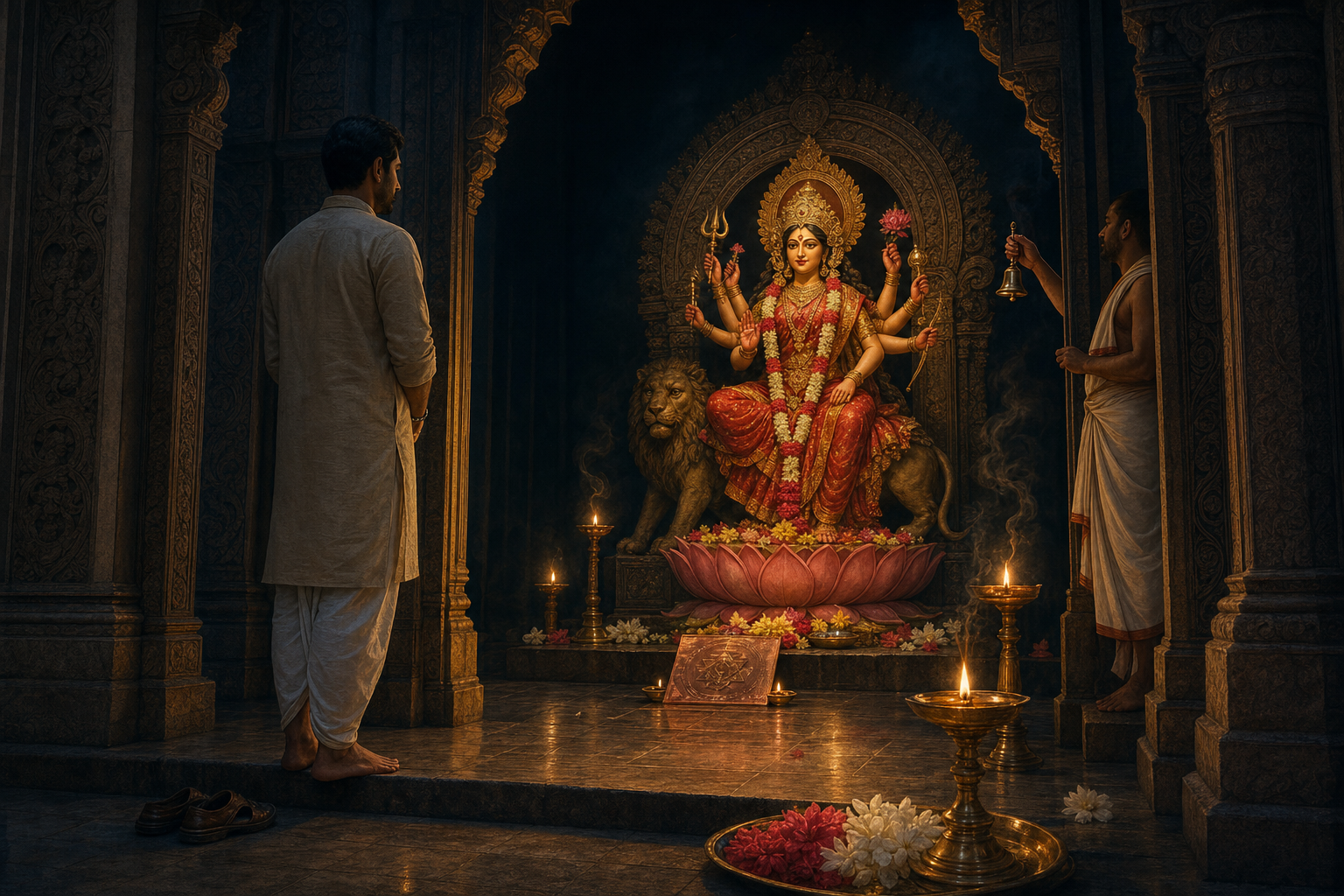
You do not need to decode an entire shrine in one visit. Choose a limited sequence and let observation precede interpretation.
- Pause before naming. Describe what is actually present: the base, number and position of hands, posture, objects, facial expression, surrounding arch, yantra, and sounds. This keeps recognition from turning into projection.
- Establish the local setting. Look for the deity’s name, temple tradition, ritual occasion, and regional idiom. Notice whether flowers, garments, colors, and ornaments are permanent iconography or that day’s alankāra.
- Read from ground to center. Move from pīṭha and vāhana to posture, hands, implements, face, crown, and prabhāvali. Interpret combinations rather than isolated objects.
- Follow one sound completely. Hear its audible beginning, feel how breath sustains it, notice its mental continuation, and attend to the silence after it ends. Do not chase unusual sensations.
- Turn the symbol into an ethical verb. Abhaya becomes relinquish fear; pāśa becomes gather; aṅkuśa becomes direct; varada becomes give; the book becomes study; the bindu becomes center. If your interpretation produces only a label and no transformation of attention or conduct, it is probably incomplete.
- Verify before declaring. Compare your reading with temple liturgy, a knowledgeable practitioner, or the relevant paramparā. If local teaching differs from your first impression, revise the impression rather than forcing the shrine into a universal chart.
Key takeaways
- Shakta-Tantric symbols work through relationships among form, sound, geometry, ritual, and lineage.
- Read a murti from its theological ground upward: pedestal, posture, mudrā, implements, gaze, crown, ornament, and surrounding field.
- Treat a cluster of attributes as a sentence. One object rarely identifies a deity or settles its meaning by itself.
- Hear mantra on more than the audible level. Breath, mental continuity, intention, and silence belong to the practice.
- Keep metaphysical, contemplative, acoustic, and physiological explanations distinct; they can meet without becoming identical.
- Shared Dharmic motifs indicate civilizational resonance, but they do not make Hindu, Buddhist, Jain, and Sikh practices interchangeable.
At your next encounter with a Shakta shrine, select one gesture, one implement, and one sonic event. Trace how each directs attention, then ask what faculty in you is being steadied, gathered, refined, or released. That question turns symbolism from something you merely recognize into a discipline you can inhabit.
References
- DharmaRenaissance Blog — Lopamudra Devi Iconography Unveiled: A Scholarly Guide to Shakta-Tantric Symbols and Mudras
- DharmaRenaissance Blog — Awaken the Primordial Pulse: Tantric Science of Sabda Brahman, Mantra, and Living Sound