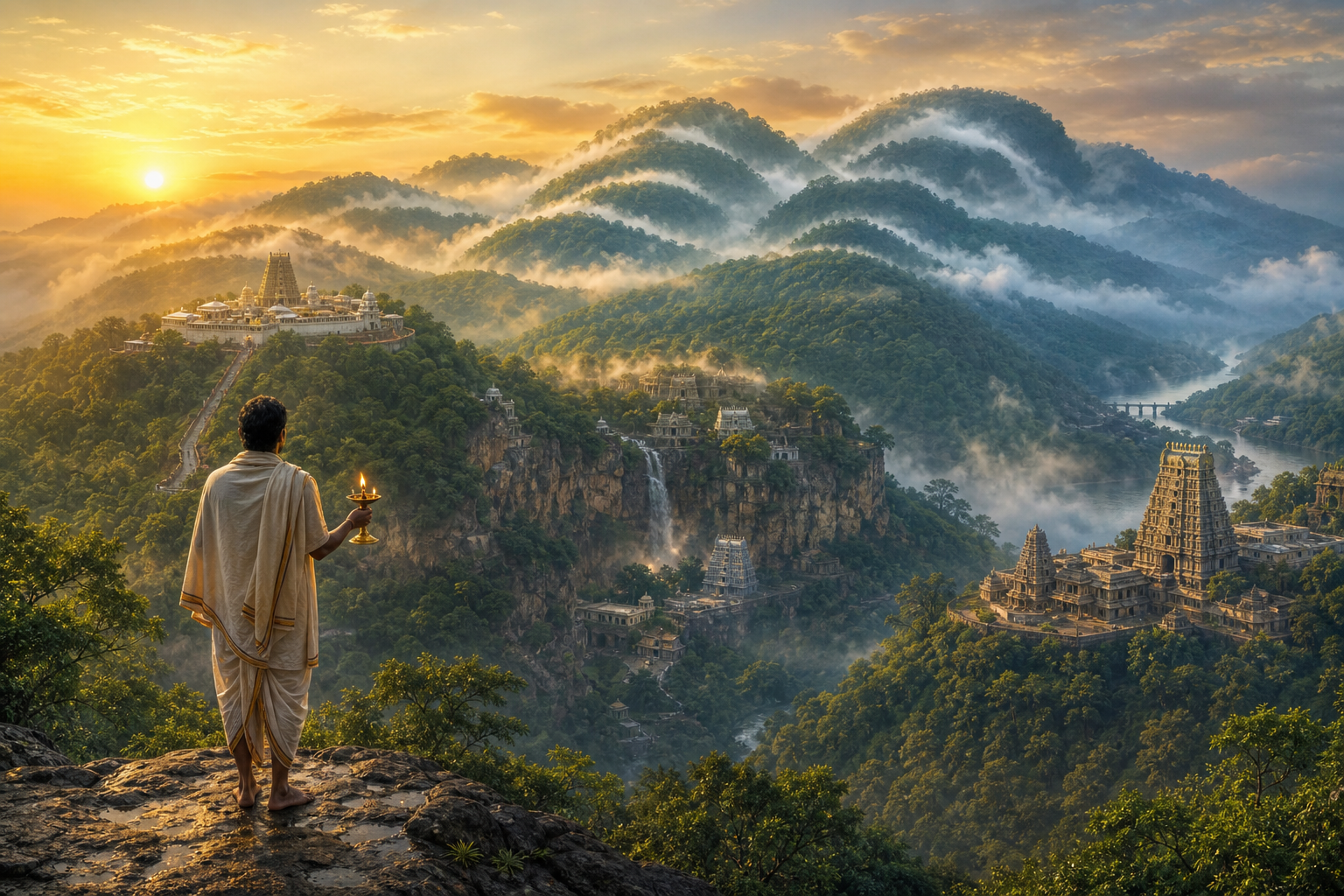
If you’re trying to understand why Tirumala, Ahobilam and Srisailam belong in one pilgrimage, don’t begin with road distances. Begin with the hills. A long-standing devotional vision reads these three kshetras as points along the body of Adi Sesha, the cosmic serpent who serves Vishnu and sustains creation.
That vision can change how you travel. Tirumala becomes more than a crowded darshan, Ahobilam more than a demanding temple circuit, and Srisailam more than a separate Shaiva destination. Each place reveals a different movement of the same sacred landscape: surrender, protection, integration and clarity.
The sacred map is a way of seeing, not a road diagram
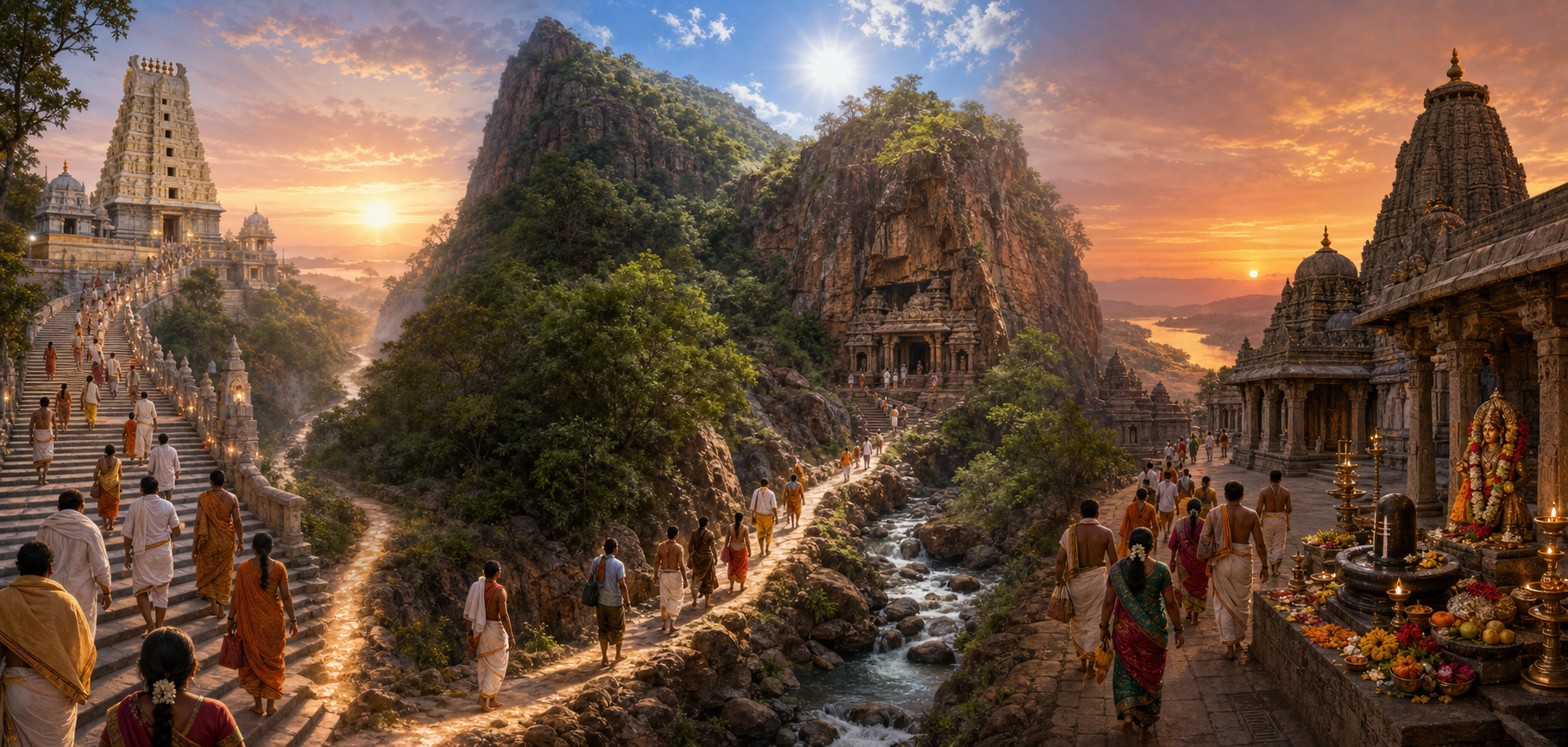
In this devotional geography, Tirumala, Ahobilam and Srisailam are understood as points along Adi Sesha’s sacred body. Tirumala occupies the Seshachalam Hills, while Ahobilam and Srisailam lie within the Nallamala landscape of the Eastern Ghats. The three places form a meaningful triangle, but not a perfectly equilateral one by road. Its unity is theological rather than mathematical.
The names help you understand the idea. “Sesha” carries the sense of what remains after cosmic dissolution. “Ananta” means the limitless or endless one. Adi Sesha is therefore not merely a serpent-shaped divine being. He represents continuity beneath change: the support that remains when visible forms pass away. Puranic memory presents him as Vishnu’s couch in the cosmic ocean and as a sustaining principle of terrestrial stability.
The Venkatachala Mahatmya associated with the Skanda Purana sacralizes the Tirumala massif through Vishnu’s presence. Local sthala-puranas and oral traditions extend the same mode of seeing across Ahobilam and Srisailam. They teach the pilgrim to interpret terrain as part of worship rather than as empty space between temples.
There is no universally fixed anatomical chart. One tradition may identify Srisailam with the hood or head, Ahobilam with the heart or navel, and Tirumala with the tail or feet. Another may reverse some of those correspondences. You don’t need to resolve the disagreement before undertaking the yatra. The variation is itself instructive: no single shrine owns the whole sacred body, and every shrine claims intimate participation in its life.
Use the map as a contemplative framework, not as a literal claim that the mountain ranges reproduce an anatomically exact serpent. That distinction lets you respect the tradition without forcing sacred geography to answer a question it was never intended to answer.
Read each kshetra through its own terrain and deity
Tirumala: surrender across the seven hills
Tirumala’s relationship with Adi Sesha is visible in its traditional identity as a seven-hilled massif. The hills are Seshadri, Neeladri, Garudadri, Anjanadri, Vrishabhadri, Narayanadri and Venkatadri, with Sri Venkateswara’s main temple on Venkatadri. They are remembered as the coils or hoods of the divine serpent.
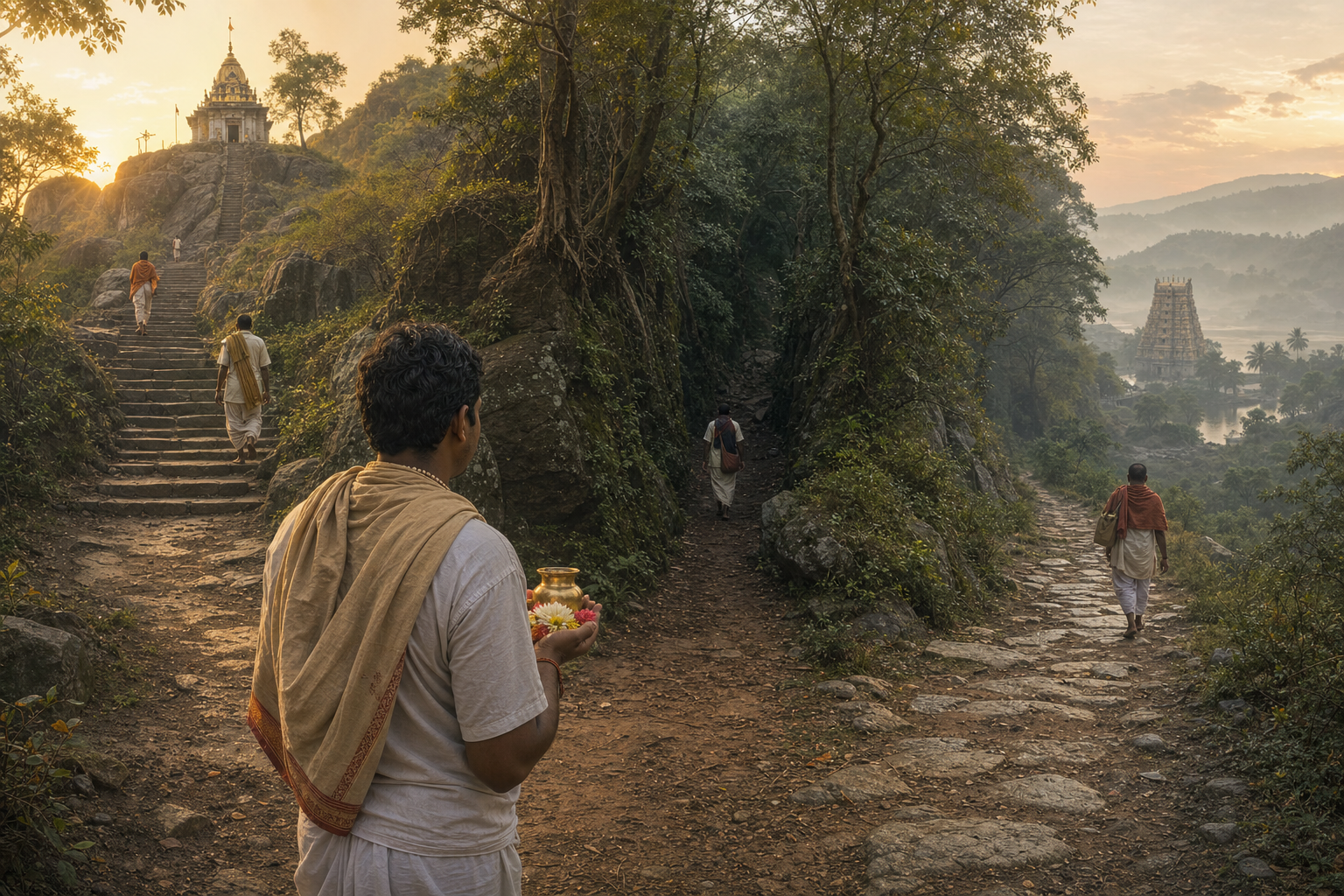
This gives the ascent a meaning that a temple-only visit can miss. The hills prepare you before you reach the sanctum. The scale of the landscape, the disciplined movement of pilgrims and the brevity of darshan all press the same question: what are you willing to place at the Lord’s feet?
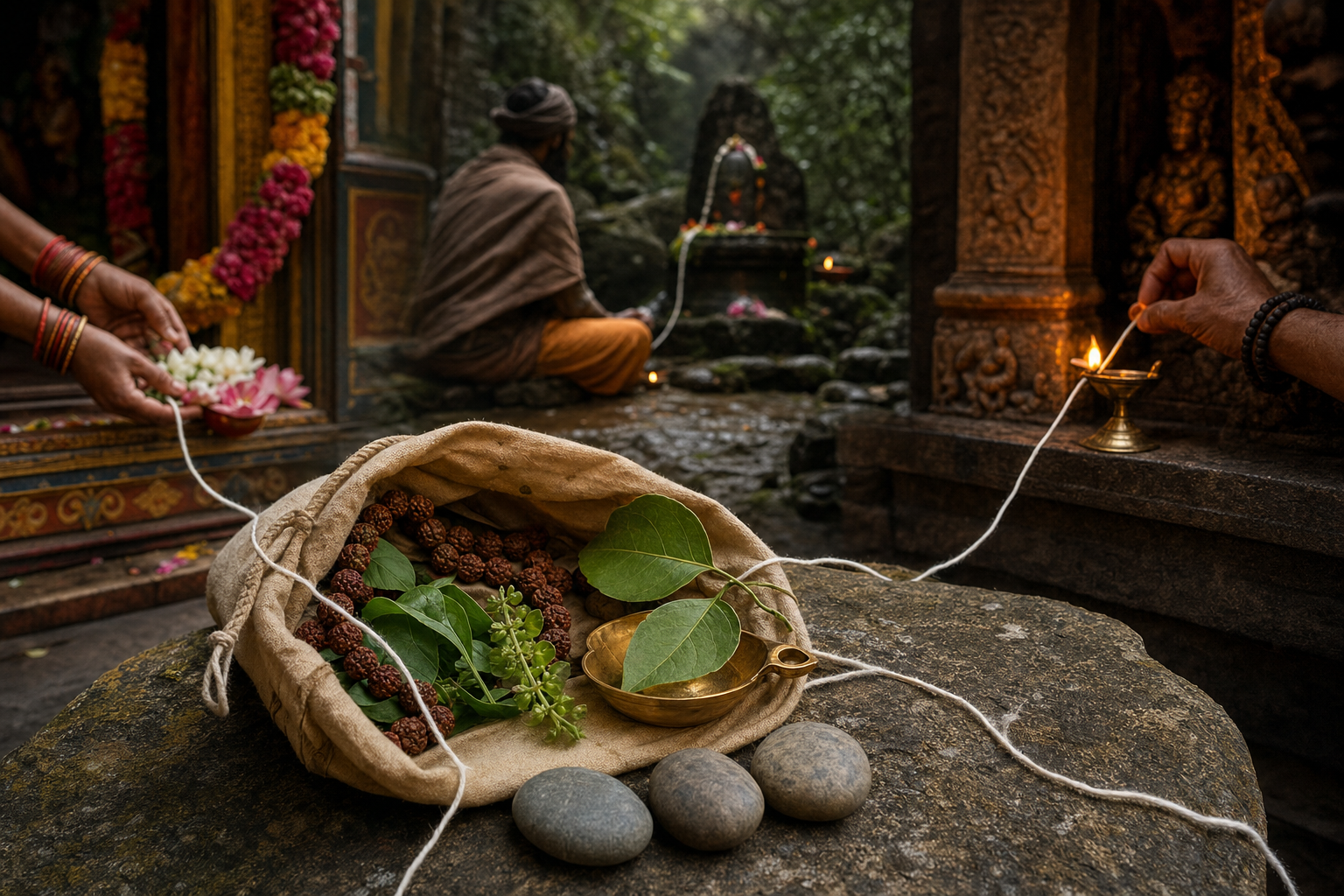
When you arrive, don’t measure the visit only by how many seconds you stood before the murti. Notice the larger ritual world around the encounter: Suprabhatam, archana, naivedya, harati, Vedic recitation and the Divya Prabandham. Chola, Pandya and Vijayanagara layers in the complex also show that Tirumala is not the product of one moment or dynasty. Its continuity has been carried by generations of worship, patronage and service.
Ahobilam: protection encountered in nine forms
Ahobilam, in the Nallamala terrain of present-day Nandyal district, asks more of your body and attention. Its sacred world is distributed across lower and upper Ahobilam rather than concentrated in one enclosure. The Nava-Narasimha circuit comprises Ahobila, Jwala, Malola, Kroda, Karanja, Bhargava, Yogananda, Chatravata and Pavana Narasimha.
The multiplicity matters. Narasimha cannot be reduced here to a single image of rage. Jwala confronts you with a fiery, uncompromising aspect; Malola reveals tenderness; Yogananda turns attention toward disciplined stillness; Chatravata’s grove-like setting invites quiet. The circuit allows fierceness, protection, affection and contemplation to remain parts of one divine response.
Ahobilam’s ravines, sandstone ridges and seasonal cascades aren’t scenery added to the theology. They carry it. The Ugra Stambha, a vertical outcrop revered as the memory of the pillar from which Narasimha emerged for Prahlada, makes this relationship especially clear. Rock becomes testimony, and movement through the forest becomes part of the encounter.
Don’t approach Ahobilam as a box-ticking exercise in which nine names must be collected as quickly as possible. Let the differing forms question you. Where does courage need to become fierce? Where has fierceness forgotten compassion? Which form of protection are you actually seeking? Those questions make the circuit coherent even if practical constraints require you to complete it over more than one visit.
Srisailam: Shaiva and Shakta worship in one kshetra
Srisailam completes the triad on the Nallamala plateau above the Krishna River. Its distinctive force comes from a sacred conjunction: Sri Mallikarjuna is revered as a Jyotirlinga and Sri Bhramaramba as a Shakti Peetha. Shaiva and Shakta devotion are therefore woven into the identity of the same kshetra.
If you visit Srisailam as part of the Adi Sesha route, give both presences their proper weight. Don’t treat Bhramaramba as an optional appendix to Mallikarjuna, or Mallikarjuna as merely a stop beside the Goddess. Their conjunction is the teaching: consciousness and power, stillness and activity, aren’t rivals.
The temple’s gateways, pillared mandapas and broad prakaras carry Kakatiya and Vijayanagara layers, while the Krishna’s vast sweep below the plateau places the built complex within a much larger natural setting. Pause long enough to register both. The stone temple concentrates worship; the river and escarpment enlarge it.
The three kshetras preserve unity without erasing difference. Tirumala and Ahobilam are Vaishnava centers, while Srisailam joins Shaiva and Shakta worship. Adi Sesha’s sacred geography doesn’t require one tradition to absorb the others. It shows distinct forms of devotion participating in one civilizational landscape.
Serpent imagery also resonates elsewhere in the Dharmic world: Mucalinda shelters the meditating Buddha, and Parshvanatha appears beneath a serpent canopy in Jain iconography. These parallels can deepen your appreciation of guardianship and spiritual protection, but they shouldn’t be used to declare every tradition identical. Shared symbols become more meaningful when their particular settings are respected.
Choose a pilgrimage direction that serves your sankalpa
Because the anatomical correspondences vary, there is no need to pretend that only one sequence is spiritually valid. You can begin at Srisailam and move through Ahobilam to Tirumala, or travel in the opposite direction. What matters is that you choose the sequence deliberately.
| Direction | Contemplative movement | Question to carry |
|---|---|---|
| Srisailam to Ahobilam to Tirumala | From clarity and integration, through the heart of protection, toward surrender at the feet | Can understanding become courage, and can courage become an offering? |
| Tirumala to Ahobilam to Srisailam | From surrender, through Narasimha’s fierce and gentle protection, toward clarity | What becomes visible after control has been surrendered and fear has been faced? |
These aren’t fixed anatomical doctrines. They are two ways to turn travel into inner movement. Choose the first if your starting concern is how to translate conviction into surrender. Choose the second if you need to begin by laying down a burden before examining what courage and clarity require.
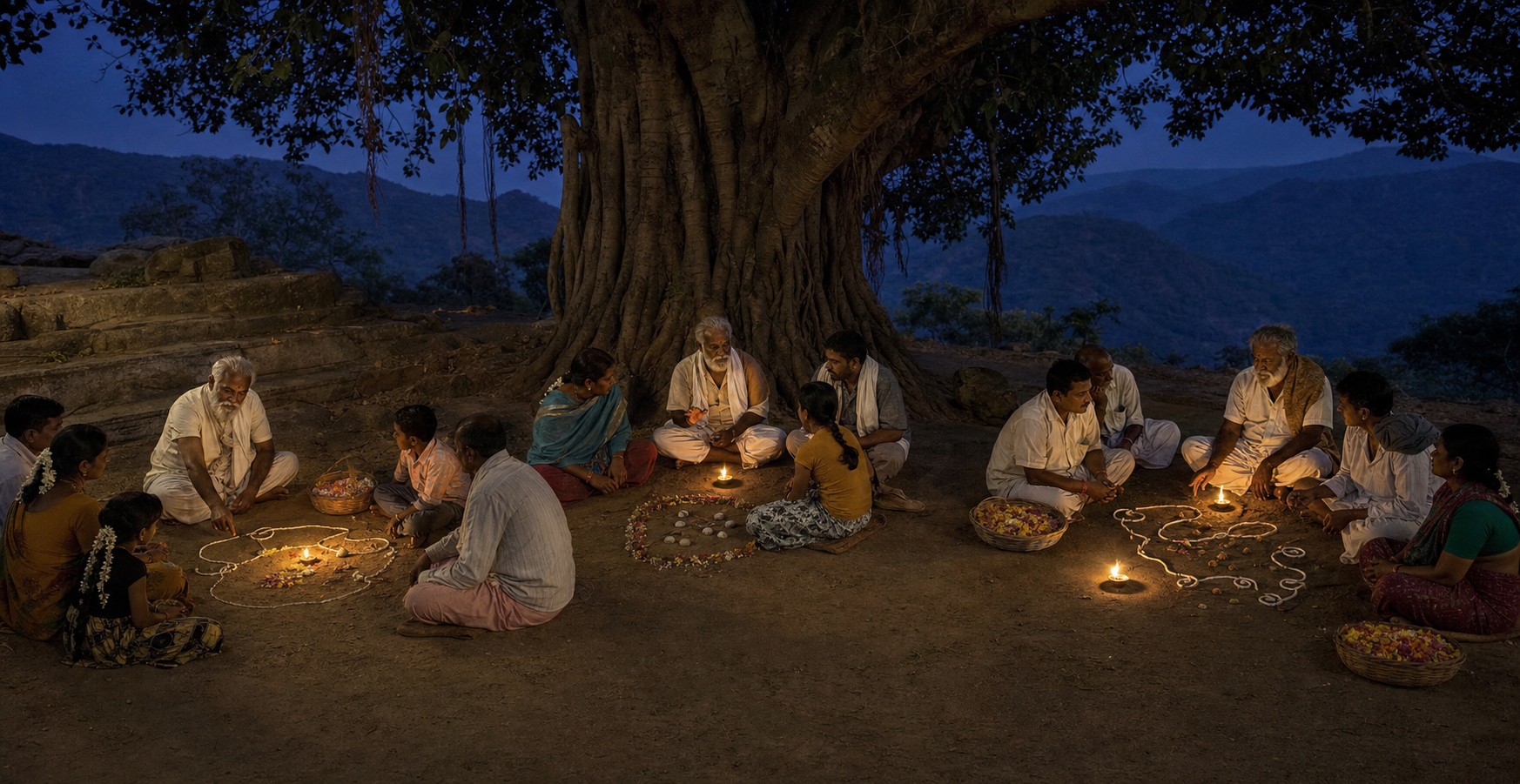
A simple practice will keep the three visits connected:
- Write one sankalpa in a single sentence before the journey. Keep it short enough to remember without consulting your phone.
- Choose your direction from that sankalpa, not from a claim that one itinerary is universally superior.
- Before entering each principal shrine, identify the terrain that holds it: seven hills at Tirumala, forest and ravine at Ahobilam, plateau and river at Srisailam.
- After darshan, record one sentence about what changed in your understanding. Don’t compose a travelogue; preserve the one insight you don’t want the next stop to erase.
- At the final kshetra, read all three sentences together and decide on one concrete act of seva, restraint or daily practice that will carry the yatra home.
If you can’t visit all three in one journey, don’t turn an incomplete itinerary into a spiritual failure. Hold the larger map in mind and complete the axis over time. Sacred continuity is more important than hurried completion.
The forest is part of the shrine, not space between shrines
Calling these ranges Adi Sesha’s body carries an ecological consequence. The Seshachalam Hills were designated a Biosphere Reserve in 2010, and the Seshachalam-Nallamala landscape includes important forest habitat, distinctive quartzite and sandstone formations, and endemic flora such as red sanders. A pilgrim who reveres the cosmic serpent’s body cannot reasonably treat the physical hills as disposable.
Make that principle visible in ordinary conduct:
- Stay on established routes and follow local access restrictions, especially in forested or steep areas.
- Don’t remove plants, wood, stones or other natural objects as personal souvenirs.
- Carry your waste until you reach a proper collection point rather than assuming the forest will absorb it.
- Keep music and amplified audio off while walking through quiet natural stretches. Let the terrain’s own sound enter the pilgrimage.
- Don’t feed or disturb wildlife. Darshan doesn’t grant ownership over the beings living within a sacred landscape.
This isn’t an environmental add-on imposed upon an older tradition. It follows directly from the sacred-geography claim. If hill, forest and river participate in divine embodiment, care for them becomes a form of reverence.
Key takeaways
- Tirumala, Ahobilam and Srisailam can be approached as one sacred axis across the Seshachalam and Nallamala hills, not merely as three famous temples.
- Regional traditions differ over which shrine corresponds to Adi Sesha’s head, heart, navel, tail or feet. The shared relationship matters more than enforcing one diagram.
- Tirumala teaches surrender through the seven hills, Ahobilam reveals Narasimha’s protection through nine forms, and Srisailam joins Shaiva and Shakta worship.
- Either pilgrimage direction can be meaningful when it is chosen around one clear sankalpa.
- Respect for paths, forests, wildlife and water is part of honoring a landscape understood as the body of Adi Sesha.
Before you plan the route, write the single question you want this yatra to answer. Then choose your direction and give the hill, forest and river as much attention as the sanctum. That is how Adi Sesha’s sacred geography becomes a lived discipline rather than a decorative legend.