
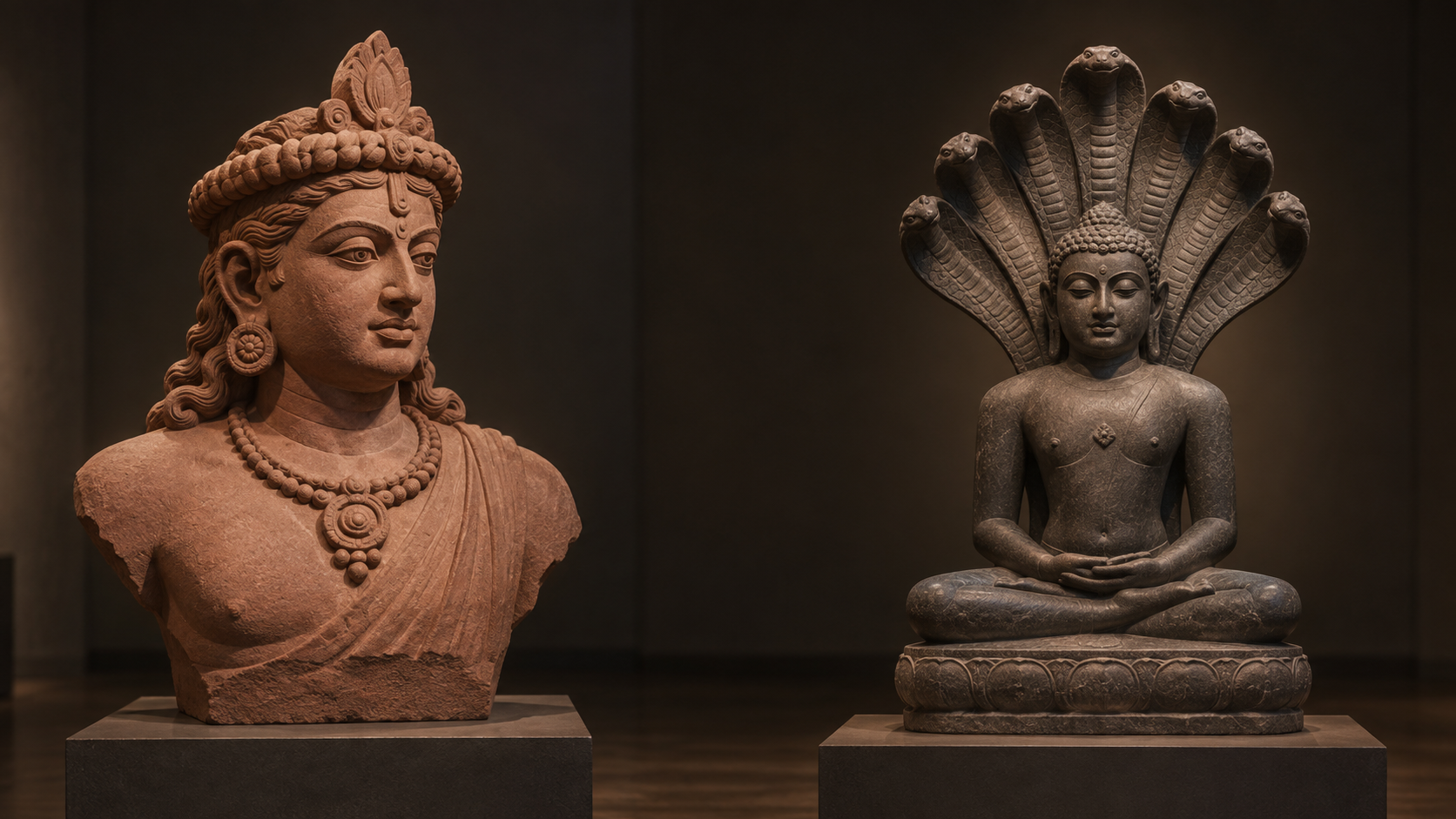
You recognize the sacred figure, but the detail above the head still looks like decoration. Is it a crown, a topknot, a protective canopy, an emblem of identity, or several of these at once? That uncertainty is often where serious looking begins.
You can read such details more confidently by asking three separate questions: What do you physically see? What job does the feature perform in the composition? What can you responsibly infer within that religious tradition? The Akhanda Mauli in Hindu sculpture and the serpent canopy of the Jain Tirthankara Parshvanatha show why this order matters.
Every sacred detail has a job in the image
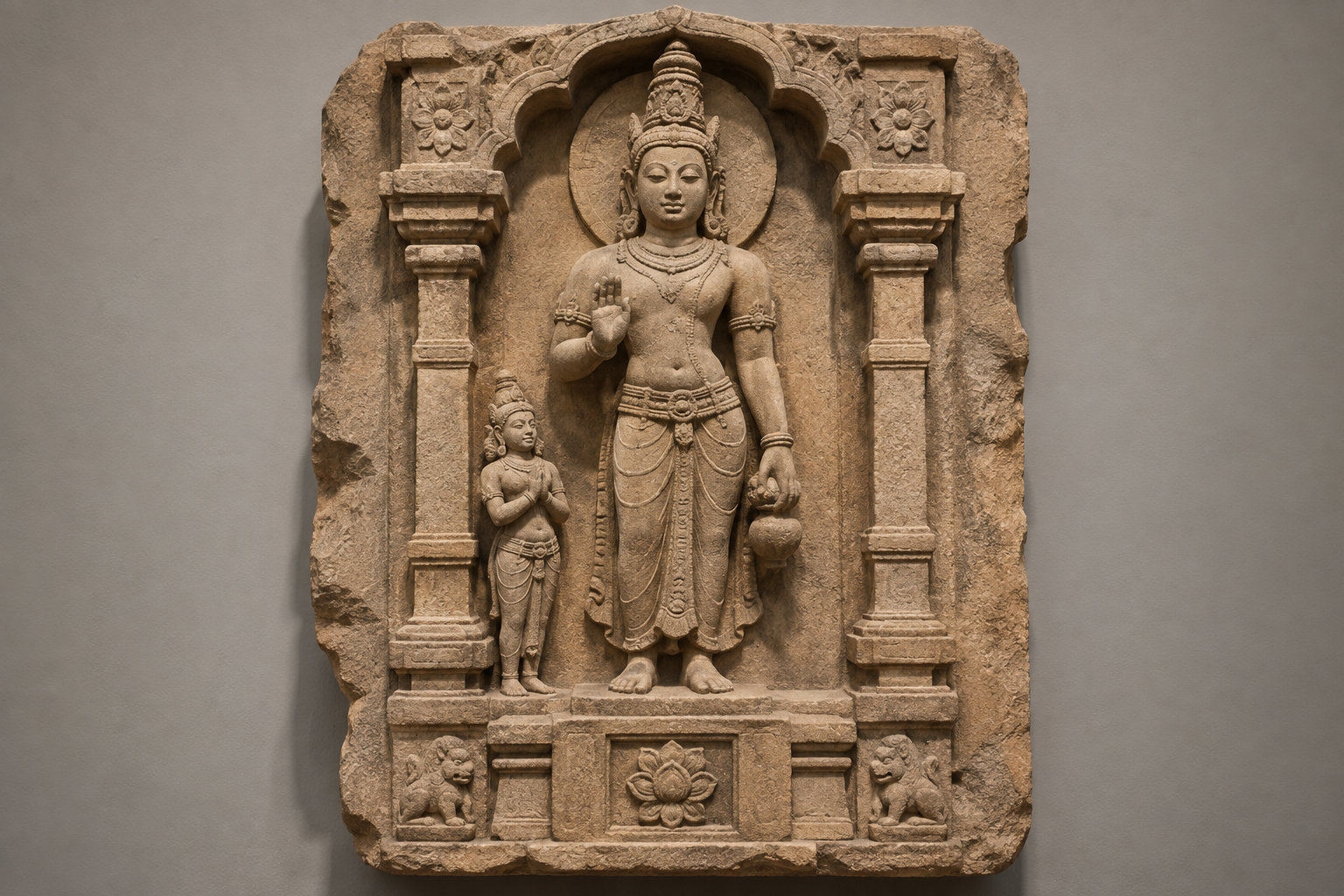
A sacred sculpture is an ordered form, not a human figure to which an artist casually added accessories. Posture, gesture, headdress, canopy, implements, attendants, and base can all contribute to its meaning. In Hindu iconographic tradition, even a subtle element of a deity’s form can carry several layers of significance.
That does not mean every feature has one fixed translation. A detail may do more than one kind of work:
- Identify the figure: a distinctive attribute can separate one sacred personage from another.
- Express a quality: the form may direct attention to sovereignty, wholeness, composure, protection, renunciation, or another spiritual idea.
- Recall a narrative: a visible object can carry the memory of an episode without depicting the entire event.
- Organize the composition: a crown or canopy can mark the vertical summit, frame the head, establish a centre, or distinguish the principal figure from surrounding forms.
Begin by deciding which of these functions is plausible. Do not begin with a universal symbol dictionary. A serpent above a meditating figure does not necessarily mean what a serpent underfoot, around an ornament, or at the edge of a scene would mean. Placement changes the relationship, and the religious setting changes the interpretation.
Read the Akhanda Mauli through both form and name
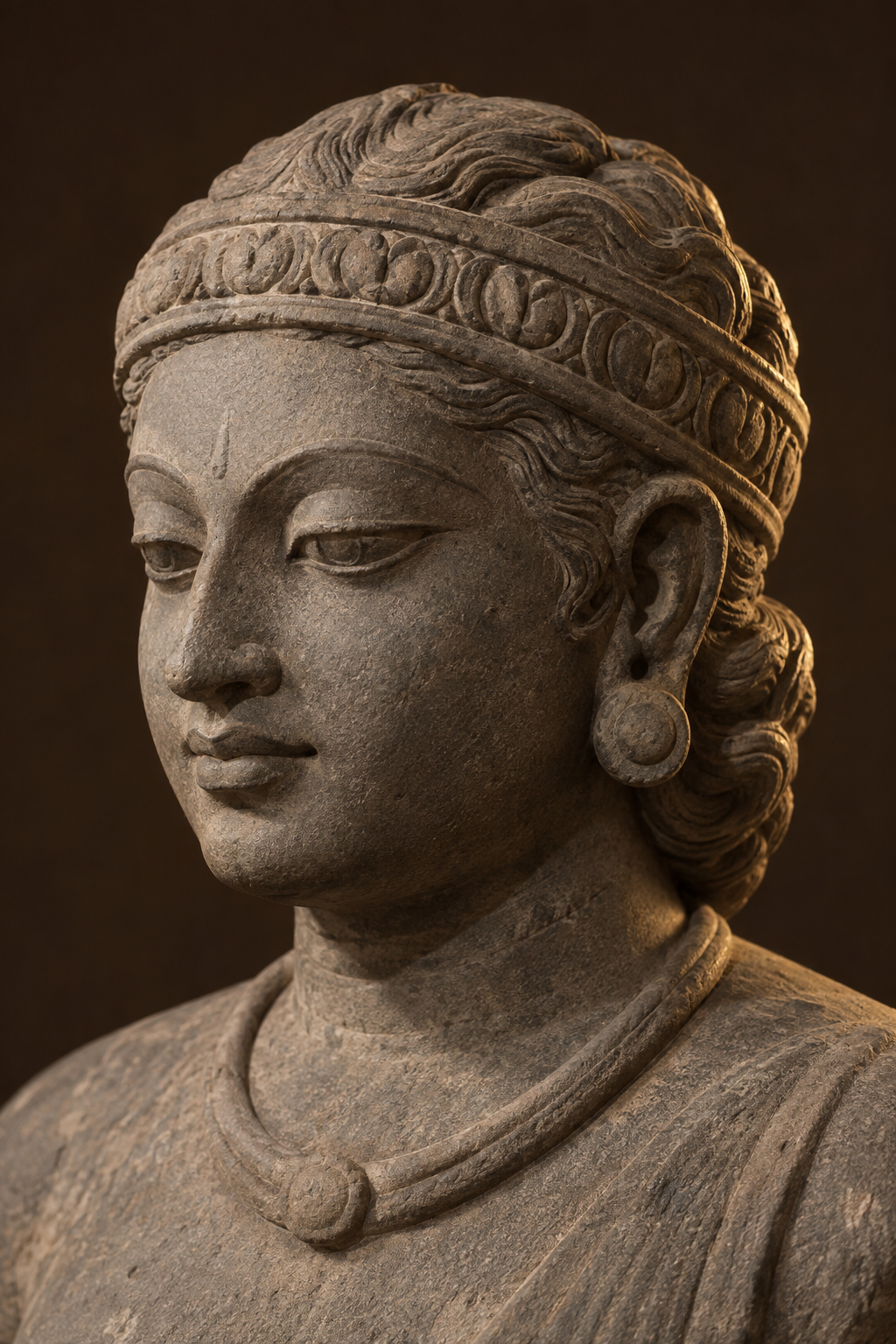
The term Akhanda Mauli already supplies an interpretive discipline. Akhanda means unbroken, whole, or indivisible, while mauli can mean a crown, crest, or topknot. The element belongs to the summit of the deity’s form, but its significance cannot be reduced to expensive headgear or worldly status.
The useful question is not simply, “What is the deity wearing?” Ask, “Why is an image of indivisible wholeness placed here?” The name directs your attention from the object to the condition it communicates. The mauli crowns the figure visually; akhanda gives that crowning form a philosophical force centred on completeness and continuity.
When you examine a sculpture that may contain an Akhanda Mauli, work from observation before interpretation:
- Look at how the uppermost form relates to the head, hair, crown, and central axis.
- Notice whether it appears visually continuous or divided into clearly separate elements.
- Compare its prominence with the figure’s other attributes rather than studying it in isolation.
- Check whether damage, erosion, restoration, or a cropped photograph has obscured its structure.
- Use the specific name only when the object’s documentation or iconographic context supports it. Not every crown or topknot should automatically be called an Akhanda Mauli.
This last distinction protects you from a common error: learning one meaningful term and applying it to every vaguely similar form. A sacred vocabulary is useful because it is precise. If the identification is secure, the Akhanda Mauli helps you read the upper part of the sculpture as a statement about indivisible sacred wholeness. If the identification is uncertain, describe what is visible and leave the specialized label open.
Let Parshvanatha’s serpent canopy identify and interpret
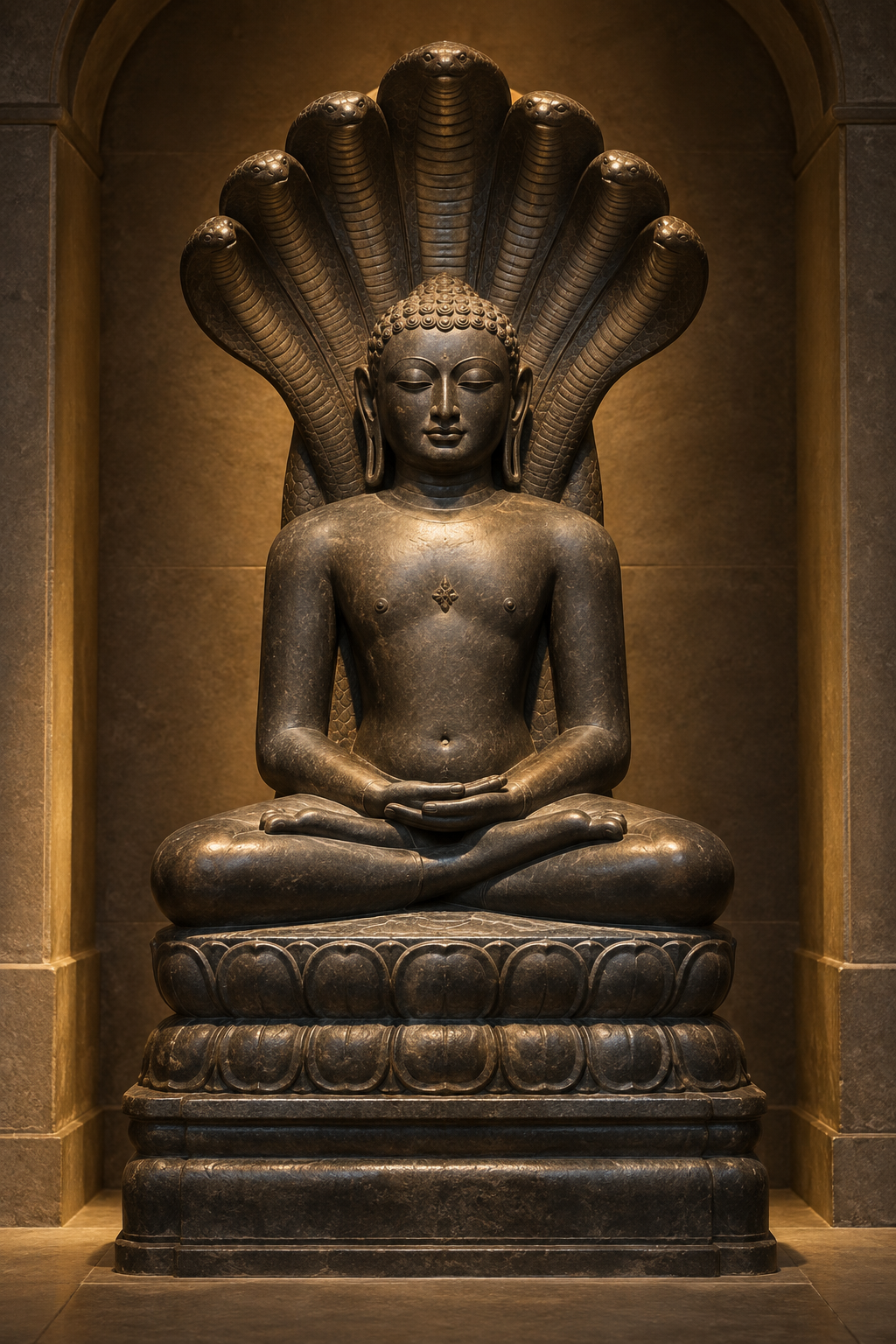
In Jain sculpture, a serpent canopy can perform two tasks at once. Parshvanatha is the twenty-third Tirthankara and is distinctively represented with a serpent canopy. The feature therefore helps identify the figure, but its work does not end with identification. It also carries spiritual and narrative significance.
Read the spatial relationship first. The serpent is not merely present beside Parshvanatha. The canopy rises over and frames the sacred figure. That arrangement changes the visual idea from threat to sheltering presence. It also concentrates attention on the composed central figure: the dramatic canopy does not displace spiritual steadiness at the centre.
If you encounter a Jain sculpture with a calm central figure beneath a serpent canopy, Parshvanatha should become your leading identification. Treat it as a strong clue, not permission to stop looking. Confirm the religious setting, inspect any label, and examine the surviving composition. On a damaged fragment, the canopy may be especially valuable, but a fragment also gives you less context and therefore calls for more careful wording.
Do not translate the serpent into a generic meaning such as danger, fertility, cosmic energy, or evil before establishing its role in this particular image. Those broad associations may come from other traditions or settings. Here, the canopy belongs to Parshvanatha’s Jain iconography. Nor does its presence turn the Tirthankara into a Hindu deity or make the sculpture a hybrid. Similar visual materials can serve distinct religious teachings.
A five-pass method for reading an unfamiliar sculpture
You do not need to recognize every Sanskrit or Prakrit term before you can look well. Use the following sequence in a temple, museum, catalogue, classroom, or photograph.
Make five passes through the image
- Establish the setting. Identify whether the sculpture is Hindu, Jain, or still uncertain. Use the label, temple context, associated figures, and overall iconographic setting. Do not decide from one familiar-looking object alone.
- Describe without interpreting. Record what you can actually see: a continuous form above the head, a crown-like crest, a many-curved canopy, a seated central figure, or a damaged upper register. This creates a boundary between evidence and inference.
- Map the relationship. Ask whether the feature is worn, held, stood upon, placed behind, or extended above the figure. Then ask what that placement does: identify, frame, shelter, elevate, or distinguish.
- Classify its likely function. Decide whether the feature is mainly an identity marker, a spiritual qualifier, a narrative reminder, a compositional device, or a combination. Parshvanatha’s canopy combines identification with spiritual and narrative meaning. The Akhanda Mauli connects a crowning form with the idea of indivisible wholeness.
- State only the smallest secure conclusion. Say, “The serpent canopy strongly supports an identification as Parshvanatha,” or, “If this upper form is documented as an Akhanda Mauli, its name directs the reading toward wholeness.” Separate certainty from possibility.
Reject four tempting shortcuts
- Do not dismiss sacred attributes as ornament. Decoration and meaning can coexist; visual beauty does not make an element semantically empty.
- Do not force Hindu and Jain images into one code. Shared artistic environments do not erase different identities, narratives, or spiritual aims.
- Do not begin with an elaborate story. First establish what survives in the sculpture. A narrative may explain the symbol, but an unsupported retelling can make you see details that are not there.
- Do not let a label replace observation. A museum caption may give you the correct name, but you should still be able to point to the feature that supports it and explain what that feature contributes.
A reliable interpretation can usually be expressed in three sentences. The first describes the visible feature. The second explains its relationship to the figure. The third gives the tradition-specific meaning at an appropriate level of certainty. If the third sentence claims much more than the first two can support, revise it.
Key takeaways
- Sacred attributes may identify a figure, express a spiritual quality, preserve narrative memory, and organize the image simultaneously.
- The Akhanda Mauli joins a crown, crest, or topknot with the idea of the unbroken and indivisible; it should not be treated as mere status decoration.
- The serpent canopy is a distinctive marker of Parshvanatha, the twenty-third Jain Tirthankara, while also carrying spiritual and narrative meaning.
- Position matters: a canopy above a figure creates a different relationship from a serpent placed beneath, beside, or around one.
- Similar forms do not make Hindu and Jain theology interchangeable. Interpret each symbol within its own iconographic setting.
- When evidence is incomplete, precise description is better than an impressive but unsupported identification.
On your next encounter with a sacred sculpture, choose one feature and write those three sentences: what you see, what it does in the composition, and what the tradition allows you to infer. That small practice will teach you more than memorizing a long list of symbols without their contexts.
References
- Hindu Blog – Akhanda Mauli Of Hindu Sculptures
- Hindu Blog – Symbolism and Story in the Jain Sculpture: Parshvanatha with a Snake Canopy

Leave a Reply
You must be logged in to post a comment.