
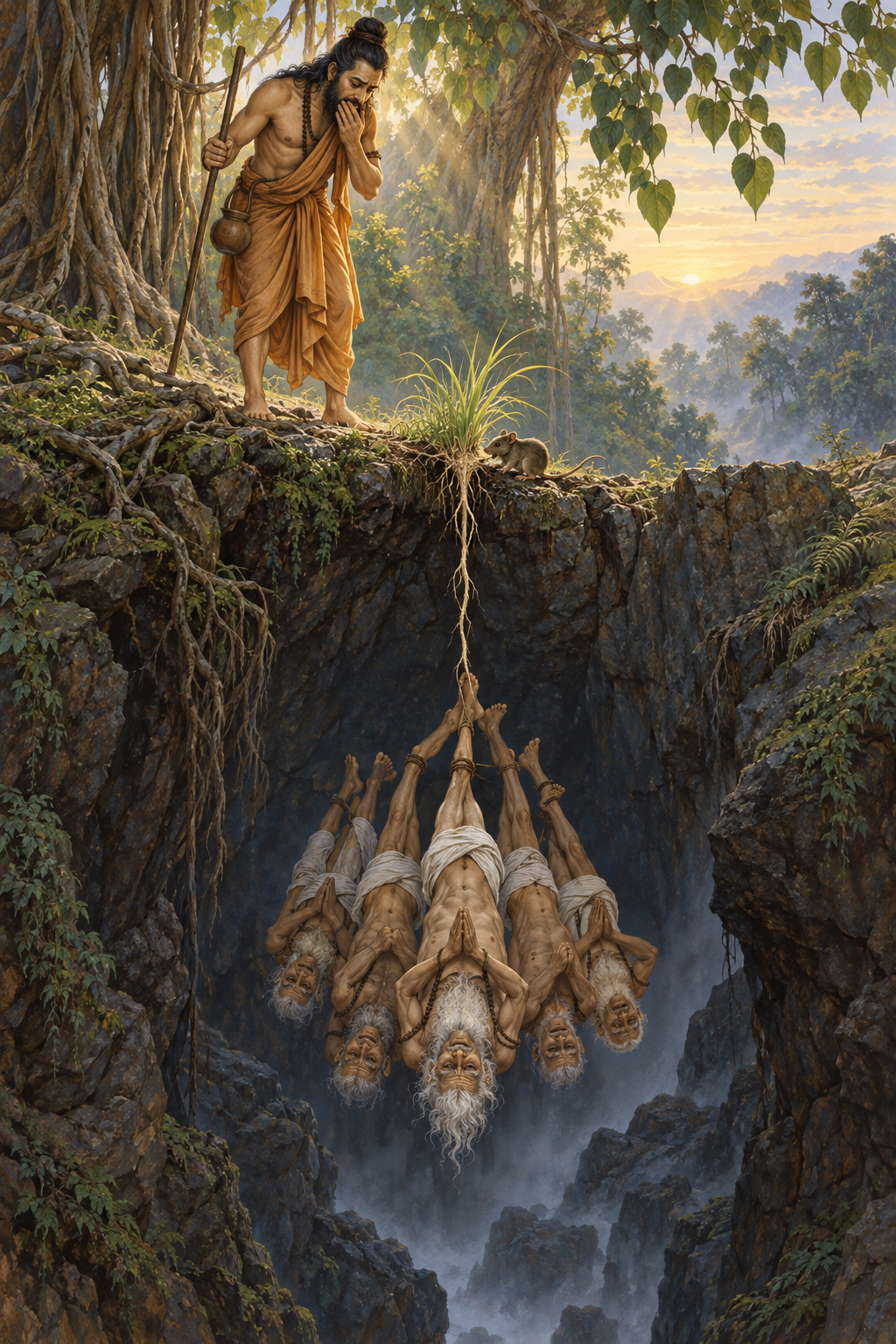
Perhaps your family expects you to marry, continue a lineage, preserve a tradition, or care for an elder. You may feel the moral weight of that request without knowing where duty ends and pressure begins. Jaratkaru’s encounter with his ancestors gives you a demanding but humane way to make that distinction.
The lesson is not that every inherited expectation must be obeyed. It is that a spiritual life cannot be built as though you arrived in the world alone. You received a body, a name, relationships, memories, and forms of knowledge from people before you. Your task is to decide consciously what you will repay, repair, preserve, and pass forward.
The crisis Jaratkaru could no longer treat as someone else’s
In the Astika Parva of the Adi Parva, the rishi Jaratkaru encounters his forefathers, the Yayavaras, in a state of grave peril. Their future has become precarious because the family line depends upon a descendant who has not continued it. Jaratkaru then discovers that he is the person on whom that continuity rests. The ascetic’s private decision has consequences beyond his private life.
This meeting between Jaratkaru and the Yayavaras changes the direction of his life. He accepts the responsibility of becoming a householder and later becomes the father of Astika, the sage known for halting the great serpent sacrifice. A threatened line does more than survive: it produces a person capable of intervening in a much larger disaster.
The narrative does not make renunciation contemptible. Jaratkaru is a great rishi, not a selfish caricature. That is precisely why the conflict matters. A worthy personal discipline can still become incomplete when it excludes every claim made by relationship, inheritance, and consequence.
You need not share Jaratkaru’s exact circumstances to recognize the problem. A decision may look purely personal when viewed from the present moment, yet alter what your family or community can carry into the future. The first practical lesson is therefore simple: before calling a choice private, identify who will bear its effects after you.
Ancestral duty is more than obedience to the past

Duty to ancestors is easily misunderstood in two opposite ways. One reduces it to ceremonial observance while leaving living responsibilities neglected. The other dismisses it as inherited social pressure. Jaratkaru’s predicament points toward a more serious middle path: receive your inheritance honestly, discern what deserves continuity, and accept responsibility for what will disappear if you do nothing.
That duty has four practical movements:
- Remember: Learn the names, places, decisions, sacrifices, and disruptions that shaped your family. An unnamed inheritance is difficult to examine and easy to lose.
- Repay: Meet concrete obligations to living parents, grandparents, teachers, and dependants where you genuinely have responsibility and capacity.
- Repair: Do not transmit cruelty, prejudice, addiction, secrecy, or destructive conflict merely because it came through the lineage.
- Continue: Preserve the knowledge, virtues, relationships, and sacred practices that should remain available to another generation.
These movements require discernment because a lineage can transmit courage and fear, wisdom and error, devotion and vanity. Honoring your ancestors does not mean pretending that every ancestral choice was correct. Honest remembrance is more respectful than convenient mythology.
Nor does preservation mean keeping every custom unchanged. Ask what a practice protects. Does it sustain worship, family memory, mutual care, language, knowledge, or moral discipline? Or does it now survive mainly as a method of controlling someone with less power? The first deserves serious effort. The second deserves examination, and sometimes a firm boundary.
How to read the demand for descendants without weaponizing it

The literal problem in Jaratkaru’s life concerns marriage, descendants, and the continuation of his ancestral line. A faithful reading should not conceal that fact. For someone freely discerning marriage and parenthood, the episode asks a necessary question: are you considering only present freedom, or also the future relationships and responsibilities your decision will create or foreclose?
But the narrative should not be turned into a weapon against someone who is unmarried, involuntarily childless, infertile, widowed, committed to a genuine renunciant path, or otherwise unable to reproduce. Biological continuity is central to Jaratkaru’s particular crisis; it does not follow that every person’s contribution to continuity must take the same form.
You can transmit an inheritance by raising children, but also by teaching younger relatives, caring for elders, supporting a student, preserving a family archive, serving a temple or community, recording a threatened language, or handing down a discipline that would otherwise end with you. These forms are not identical to biological descent. They are nevertheless real answers to the question, “What will remain available because you accepted responsibility?”
If your family is invoking ancestry to press you into a major life decision, test the request with four questions:
- What specific person, relationship, body of knowledge, or sacred practice would this decision protect?
- Is the requested duty proportionate to your actual ability, or does it require deception, resentment, or foreseeable harm?
- Are you being asked to preserve something valuable, or merely to protect family status and appearances?
- Can the underlying obligation be fulfilled in another honest form?
A demand becomes morally suspect when it treats you as an instrument while refusing to consider your consent, capacity, or safety. Creating a household under coercion does not honor a lineage; it transfers unresolved suffering into another generation. Ancestral duty is strongest when it produces responsible continuity, not compliance without conscience.
A seven-day audit of what depends on you

You do not need to settle every question about ancestry at once. Use the next seven days to find one responsibility that is both real and actionable.
- Map three generations. Write the names of your parents, grandparents, and great-grandparents where known. Add places of origin, languages, occupations, teachers, family deities, and important migrations. Leave unknowns blank rather than guessing.
- Record one living memory. Ask an elder about one decision that changed the family’s direction. Record the date and the speaker’s name. With permission, preserve the conversation as audio or a written account.
- Name one present obligation. Choose something concrete: a regular call, transport to an appointment, help organizing records, participation in worship, or time given to a dependant. Do not write “be more available.” Put the action on your calendar.
- Identify the fragile inheritance. Find the prayer, language, recipe, song, manuscript, photograph, ritual procedure, craft, or family history that may disappear because only one person still knows it.
- Create a transmission route. Decide who will learn it, where it will be stored, and when the transfer will happen. A box of unnamed photographs is not an archive; add names, dates, locations, and relationships while someone can still identify them.
- Separate duty from inherited harm. Write down one pattern you do not intend to pass forward. State the replacement behavior precisely. “We will not shout” is weaker than “We will pause the discussion when voices rise and return to it at an agreed time.”
- Make one kept promise. Complete a small obligation before taking on a grand project. Ancestral duty becomes credible through repeated acts, not through an impressive declaration.
This audit will usually reveal an important difference. Some inherited burdens are vague because no one has defined them. Others become manageable as soon as you turn them into a named task, a date, and a responsible person. Do that conversion before you either accept or reject the burden.
Key takeaways
- Jaratkaru’s spiritual discipline did not erase the consequences of his choices for his ancestors and descendants.
- Ancestral duty includes remembrance, care, repair, and transmission; it is not exhausted by ritual or obedience.
- The narrative takes biological continuity seriously, but it should not be used to shame people whose circumstances or vocations differ from Jaratkaru’s.
- A valid family obligation should protect something identifiable and should be proportionate to your consent, safety, and capacity.
- The most useful first step is to preserve one endangered memory or practice and meet one concrete living responsibility.
Before this week ends, ask one elder a question whose answer would otherwise vanish with them. Label one photograph, learn one family prayer, schedule one act of care, or teach one younger person something worth carrying. You do not honor the past by living inside it. You honor it by ensuring that what was worthy does not end through your inattention.
References

Leave a Reply
You must be logged in to post a comment.