
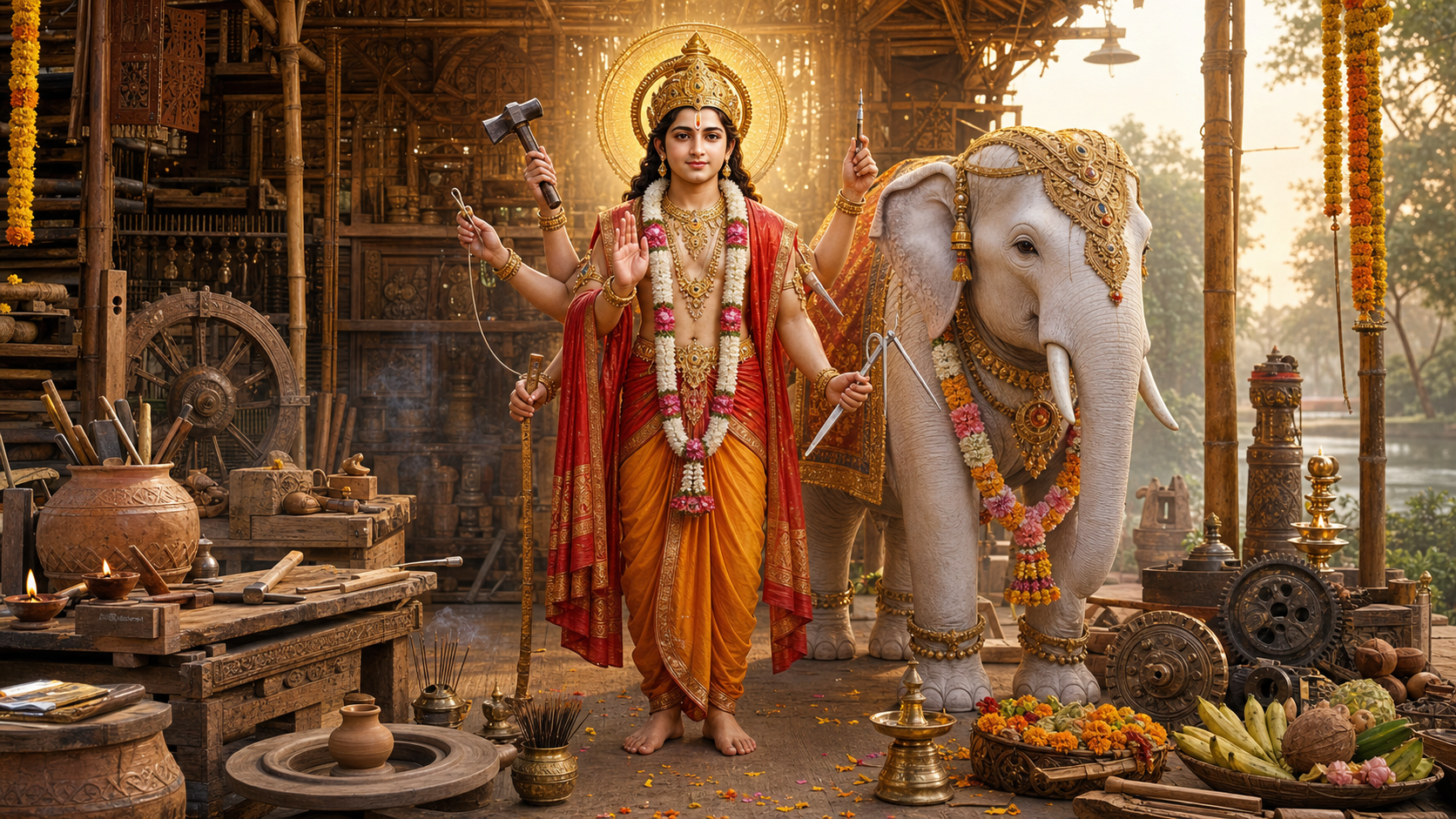
You are looking at a Vishwakarma image from Bengal, but the deity does not resemble the elderly artisan-sage you expected. The face is young, the gaze is bright, and the bearing suggests someone ready to build. Is this a different Vishwakarma, a modern invention, or simply a regional style?
The clearest answer lies in what the image asks you to notice. Bengal’s youthful Vishwakarma does not discard experience. He brings inherited mastery into the moment of action. Once you read the face, posture, tools, workplace, and ritual setting together, the apparent contradiction between youth and wisdom disappears.
The younger face changes the emphasis, not the deity
Age functions as a visual language in sacred art. An elderly Vishwakarma makes experience immediately visible: long practice, accumulated knowledge, and the settled authority of a master. Bengal’s youthful rendering places greater emphasis on vigor, aspiration, and creative momentum.
The important distinction is that youthful does not mean inexperienced. Vishwakarma remains the eternal architect and the embodiment of disciplined making. His tools, composure, and association with measurement continue to express mastery. Youthfulness tells you that this mastery is active rather than merely remembered.
That makes the form especially intelligible to a student learning a craft, a technician taking responsibility for a machine, or a designer confronting an empty page. The image joins two moments that are often separated: receiving a tradition and using it to make something new. Wisdom supplies the method; youthful energy supplies the willingness to begin.
If you are describing such an image in a caption, lesson, or exhibition, avoid calling it merely a modernized or younger god. A more accurate description is: a Bengali emphasis that presents Vishwakarma’s timeless mastery through the visual qualities of readiness, confidence, and renewal. That wording explains the symbolism without pretending that every workshop or artist follows one fixed design.
Read the whole visual sentence, not just the face
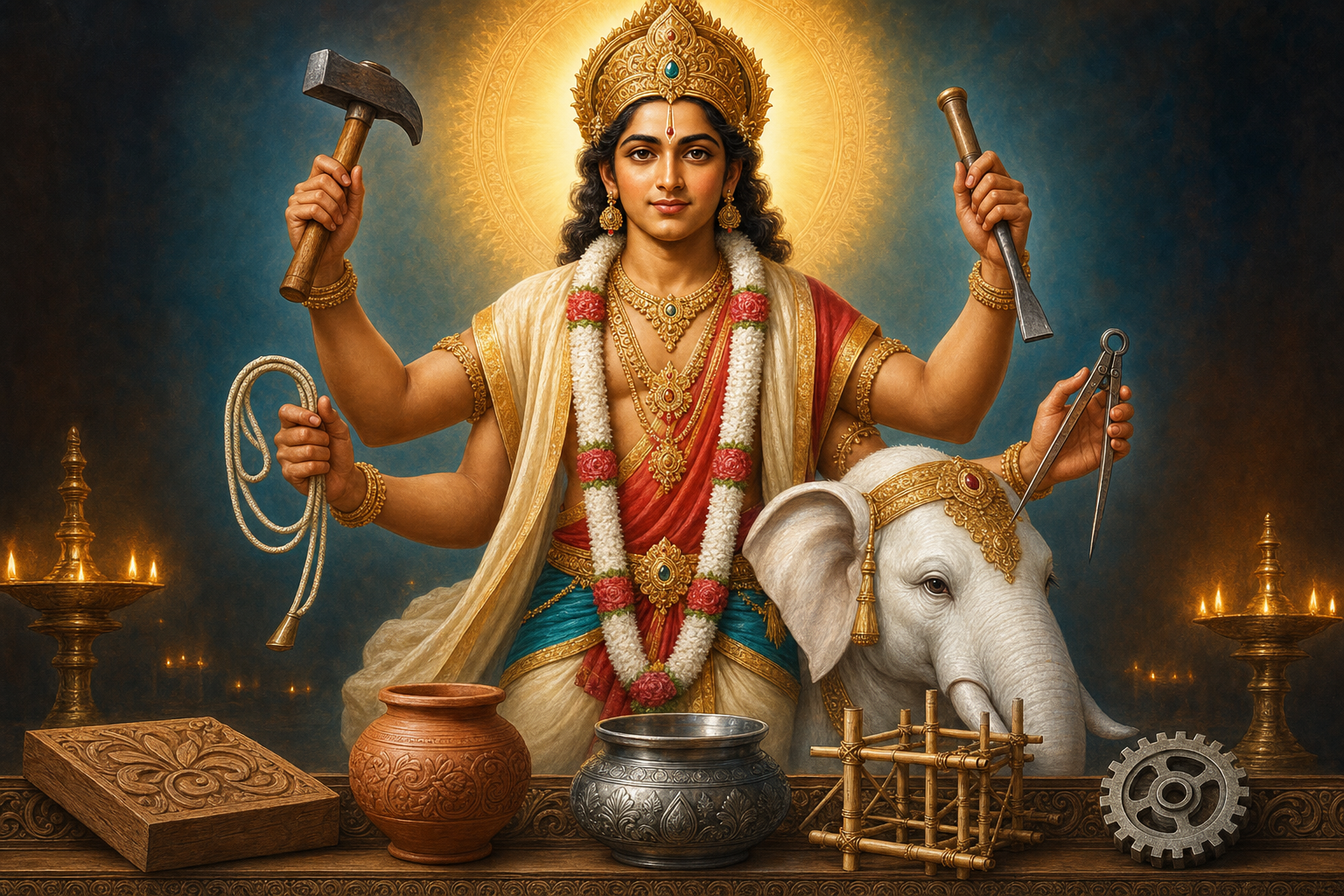
A youthful face by itself is not enough to explain the iconography. Sacred images communicate through a cluster of features. When you examine a Bengali Vishwakarma murti, print, or pandal image, look for four connected signals:
- The eyes: A luminous, attentive gaze conveys intelligence that is awake and ready to respond. It directs attention toward alertness rather than age alone.
- The posture: The body may appear composed but not passive. Poise indicates control; a sense of movement or readiness indicates creative force held under discipline.
- The tools: Measuring scales, carpentry implements, and instruments associated with design identify mastery through work. They point toward proportion, planning, and competent execution rather than vague inspiration.
- The setting: A loom, press, crane, lathe, workbench, drafting kit, or toolbox places the deity within the world of actual making. The surrounding equipment can carry as much interpretive weight as the face.
These signs should be read together. Bright eyes without tools might communicate youth but not Vishwakarma’s particular vocation. Tools without a poised bearer might identify an occupation without conveying the moral command of mastery. A workshop shrine brings the two together: trained intelligence is being asked to guide material action.
The measuring instrument deserves special attention. Measurement is not a decorative reference to engineering. It expresses the principle that good creation accepts standards. A builder must respect proportion, a weaver must maintain a pattern, and a designer must test whether an idea works outside the imagination. In this visual grammar, creativity is not permission to be careless.
Do not insist that every image must display every implement. Local artists and workplaces adapt the presentation to their circumstances. Identify the form by the convergence of youthful vitality, composed mastery, instruments of making, and the devotional world of work.
The workplace shrine explains why the form feels Bengali
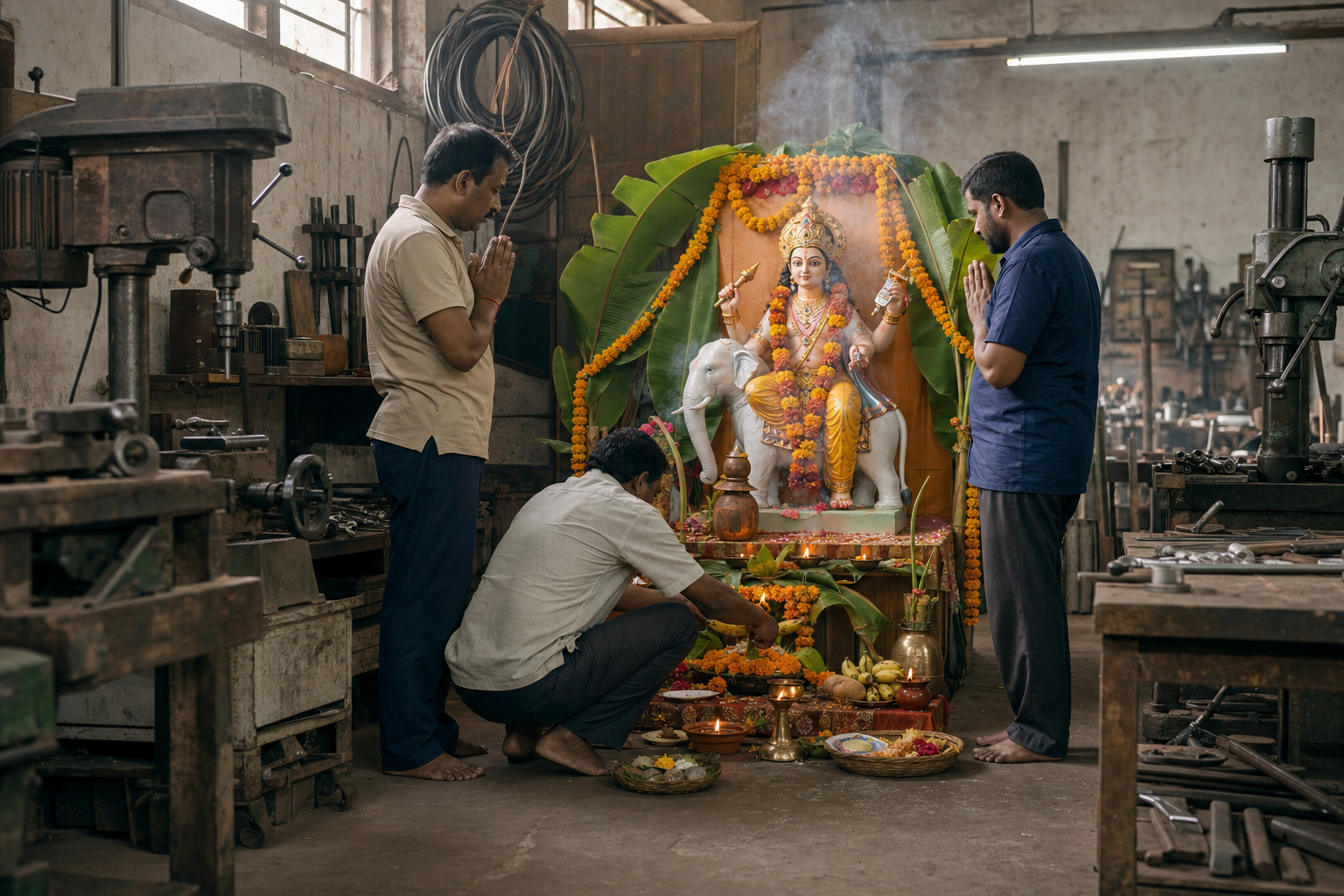
Vishwakarma Puja makes this iconography easier to understand because the ritual is not confined to a distant sacred setting. Across Kolkata and Bengal’s industrial towns, tools, looms, printing presses, and cranes are cleaned, decorated, and blessed. Flowers appear beside machines. A small shrine may stand above a lathe or workbench. Notebooks, drafting kits, and toolboxes can enter the space of worship.
Cleaning the implement before decorating it matters. It turns reverence into attention. The worker must stop, notice the instrument on which the work depends, and acknowledge that maintenance and skill are part of the offering. The youthful deity fits this moment of renewal: the tool returns to view, the standard of workmanship is recalled, and another cycle of making can begin with greater care.
Kite-flying adds another register to the observance. The shrine belongs to the workshop, while kites place celebration in the autumn sky. Industry, neighborhood life, devotion, and play are not treated as sealed worlds. Together they make Vishwakarma Puja a public affirmation that skilled labor has cultural dignity.
Bengal’s craft inheritance gives this visual language a deep cultural fit. The terracotta temples of Bishnupur unite structural purpose with intricate beauty. Riverine boat-building turns knowledge of material and water into a usable form. Textile traditions depend upon pattern, proportion, repetition, and practiced hands. These examples do not prove that one historical craft produced the youthful image. They show why an image joining beauty, utility, precision, and renewal is readily understood in Bengal.
The same relationship appears in Shilpa Shastra values of correct proportion, careful measurement, and ethical intention. Beauty is not an ornament added after usefulness; usefulness is not an excuse for ugliness or poor execution. A worthy object asks the maker to hold form, function, and intention together.
If you are preparing a school display, community explanation, or puja caption, make that relationship concrete. Pair one local inheritance, such as Bishnupur terracotta, boat-building, or textiles, with one object from the present workplace. Then identify the shared discipline: proportion, material knowledge, pattern, or careful execution. That teaches continuity more effectively than a general claim that tradition and technology are connected.
The image carries a dharmic ethic, not a productivity slogan
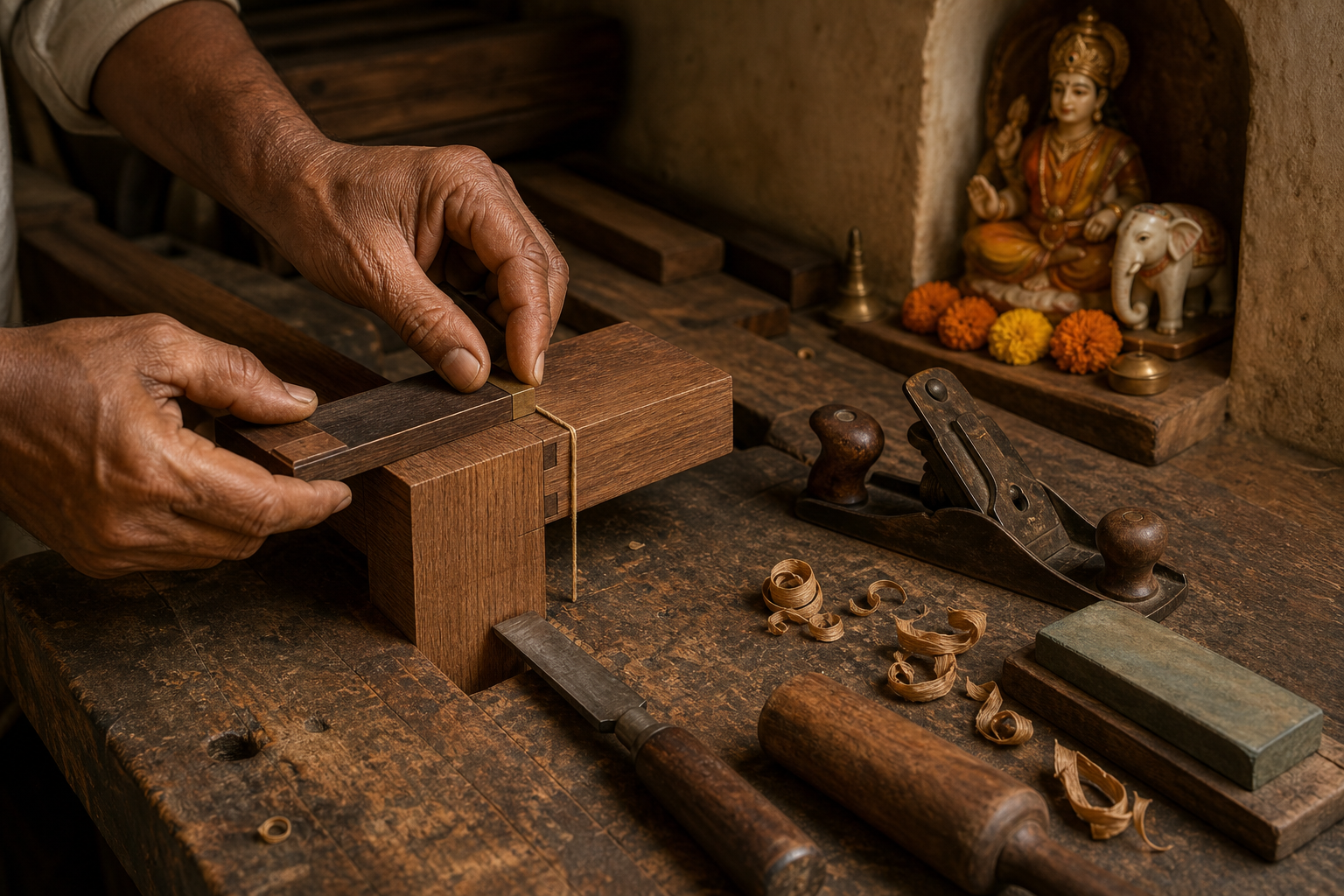
Work as worship is easy to repeat and easy to misunderstand. It does not mean that every task, product, or commercial demand becomes sacred simply because someone worked hard on it. The qualifying word is dharma. Skill must be directed by responsibility.
The youthful Vishwakarma therefore presents three practical tests for anyone who makes, repairs, designs, codes, manages, or teaches:
- Is the work accurate? Check the measure, proportion, pattern, specification, or logic that determines whether the result is sound.
- Is the work responsible? Consider how the design affects the people who use it, the community around it, and the natural world from which its materials and energy come.
- Does the work preserve dignity? Treat the craftsperson as a bearer of knowledge, not merely as a unit of output. Let quality, honest labor, and service matter alongside speed.
This ethic has recognizable parallels across the dharmic family. Hindu karma-yoga joins duty to disciplined action. Buddhist sammā-ājīva, or Right Livelihood, asks that earning remain aligned with compassion and clarity. Jain ahiṃsā and aparigraha place restraint, non-harm, and freedom from excess around material activity. Sikh kirt karo affirms honest labor, while seva directs effort toward service.
These parallels should not be used to flatten distinct traditions into a single doctrine. Their vocabularies and spiritual frameworks remain their own. The useful point of convergence is narrower and stronger: work acquires moral meaning through the way it is performed and the good it serves.
That distinction also protects Vishwakarma from being reduced to a mascot for relentless productivity. His implements represent trained capability, but capability alone is morally incomplete. The scale must measure more than output; it must also ask whether the result is careful, sustainable, and of genuine use.
Key takeaways: turn the icon into a discipline of making
- Identify the youthful Vishwakarma through a cluster of signs: radiant attention, poised energy, instruments of design or craft, and a working-world setting.
- Explain youthfulness as active mastery and creative renewal, not as a rejection of age, experience, or inherited knowledge.
- Include the surrounding workplace when interpreting the image. A blessed loom, press, crane, toolbox, or drafting kit helps disclose what the icon means.
- Connect heritage to the present through a specific discipline such as proportion, measurement, pattern, maintenance, or material knowledge.
- Apply the phrase work as worship conditionally: the work should be accurate, responsible, dignifying, and directed toward service.
- When discussing other dharmic paths, name each principle precisely and preserve the distinctions among karma-yoga, Right Livelihood, ahiṃsā, aparigraha, kirt karo, and seva.
You can make this teaching practical at the next puja or before your next serious project. Clean and inspect the tool you depend on. Name the quality standard the work must meet. Consider who will live with the result. Then begin with full attention. The tool might be a carpenter’s implement, a loom, a notebook, a drafting kit, a press, a crane, or a computer; the discipline is the same even when the crafts are not.
Bengal’s youthful Vishwakarma makes inheritance actionable. Let the youthful form remind you that renewal remains possible, and let the tools prevent inspiration from becoming careless. Carry the image into your work through one well-measured, ethically considered act of creation.
References
