
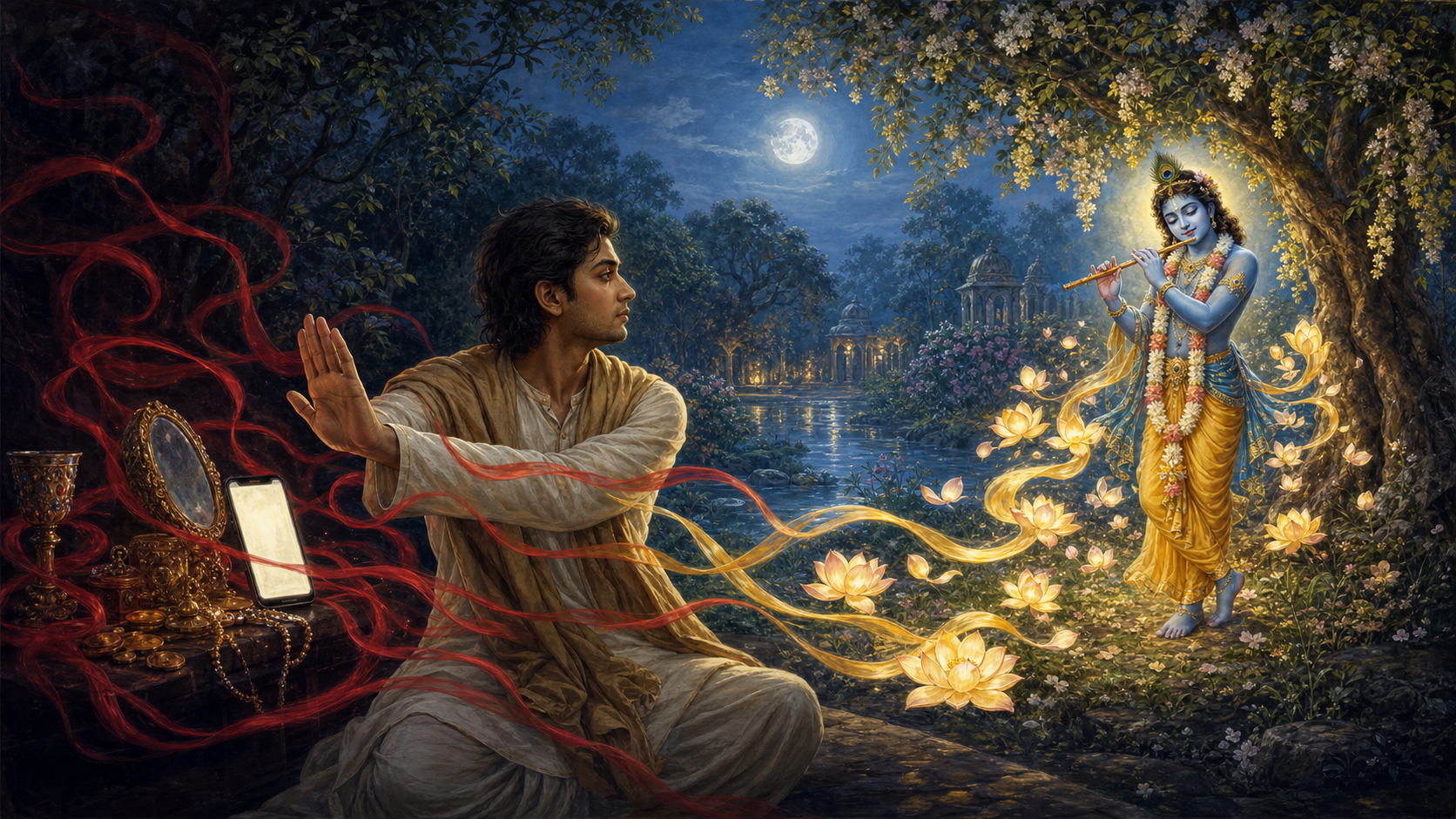
You may understand that a desire is unhelpful and still feel it return with full force. Reason can expose the consequences, restraint can prevent an impulsive act, and yet the mind continues circling the person, possession, experience or recognition it wants.
Madana Mohana offers a more demanding answer than either indulgence or suppression. You learn to uncover what the desire is really promising, redirect its energy toward Sri Krishna, and judge the change by your conduct. The aim is not to become incapable of attraction. It is to become free enough that attraction no longer dictates what you see, value or do.
First identify the promise hidden inside the desire

Desire rarely presents itself as a considered argument. It arrives as urgency: obtain this, prolong this, win this person, protect this image, repeat this pleasure. If you obey the urgency immediately, you never discover the belief beneath it.
Begin by separating attraction, intention and action. Attraction is something you notice. Intention is the direction you give it. Action is the choice for which you become responsible. Treating all three as identical produces either shame or rationalisation: you condemn yourself merely for feeling something, or you excuse an action because the feeling seemed involuntary.
When a desire becomes insistent, write or mentally answer these questions:
- What exactly has captured my attention: a person, an image, a sensation, approval, novelty, control or escape?
- What am I expecting it to give me that I believe I lack?
- Do I want to honour what is beautiful, or do I want to possess, consume or control it?
- Which duty, promise or relationship becomes less visible when this desire dominates me?
- What would a truthful and non-exploitative response look like if the feeling did not disappear?
This inquiry matters because the object and the promise are not the same. You may fixate on another person’s attention while actually seeking reassurance about your own worth. You may crave a purchase while seeking relief from restlessness. You may pursue status while hoping to become immune to rejection. Satisfying the immediate demand does not necessarily answer the deeper longing.
Do not turn self-examination into an excuse for delay. If acting on the desire would violate a vow, deceive someone, neglect a duty or treat another person as an instrument, establish the boundary first. Reflection can then reveal how the energy should be redirected. The relevant question is not whether attraction appeared. It is whether attraction has been granted authority.
Madana Mohana redirects attraction toward its highest object
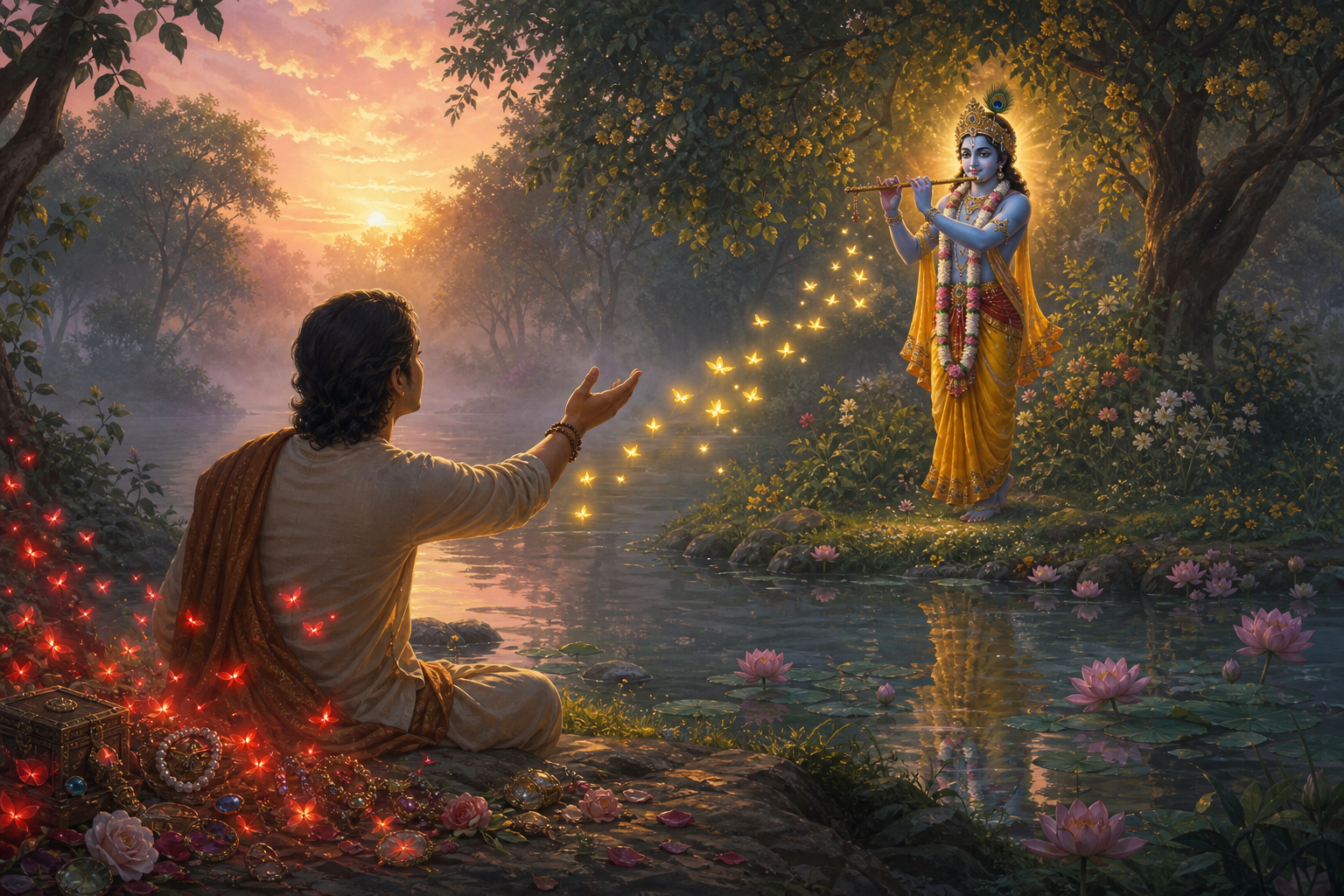
Madana Mohana names Sri Krishna as the one whose beauty enchants even Kamadeva, the power of worldly attraction. The image is not a declaration that beauty is spiritually suspect. Krishna does not overcome attraction by making the heart numb. Divine beauty reveals that no finite object can rightfully bear the full weight of your longing.
This is a hierarchy of love, not a hatred of embodied life. A beautiful face, melody, landscape or gesture may genuinely move you. The error begins when the experience becomes a claim of ownership: because something delights me, it must belong to me; because someone awakens longing, that person must satisfy it; because a feeling is intense, it must be obeyed.
Kama, in this spiritual diagnosis, is broader than sexual desire. It is longing organised around the self’s demand to acquire, enjoy or control. Prema is not merely a stronger or more refined pleasure. It is love reorganised around the beloved, expressed through remembrance, reverence, service and willingness to accept rightful limits. Kama asks what the object can do for the self. Prema asks how the self may respond truthfully to what is sacred.
The language of rasa helps explain why aesthetic experience can participate in this change. Beauty, poetry, music and sacred drama are not merely decorations added to doctrine. They educate responsiveness. The Vraja narratives of the Srimad-Bhagavatam present Krishna’s flute, pastoral grace and compassionate play as ways the Supreme becomes intimate and lovable. Within Gaudiya Vaishnavism, contemplating this form disciplines feeling by giving it a sacred centre.
This does not mean every intense mood is devotion. Rasa is not permission to chase spiritual sensation. If music, darshan or a lila narrative only gives you another experience to consume, the direction of desire has not yet changed. Sacred aesthetics do their work when delight becomes remembrance, remembrance becomes steadiness, and steadiness changes how you treat others.
From attraction to absorption
The movement begins with recognition. You admit that the mind has been seized without pretending that the object is either worthless or absolute. Next comes recollection: the attractive quality is placed within remembrance of Sri Krishna rather than allowed to close the mind around itself.
Repeated remembrance can stabilise attention through nama-japa, kirtan, darshan and contemplation of lila. The mind still wanders, but it now has somewhere sacred to return. Absorption becomes meaningful when it produces an ethical expression: gratitude instead of entitlement, restraint instead of compulsion, service instead of acquisition, and respect instead of objectification.
The transformation is therefore not a single emotional event. It is a direction practised repeatedly. A desire may return after sincere prayer without proving that the prayer failed. The next return is another occasion to decide which centre the longing will serve.
Use this sequence when desire begins to govern you

A practice has to work before the mind has constructed a complete justification for what it wants. Use the following sequence as soon as you notice fixation, bargaining or repeated mental rehearsal.
- Interrupt the automatic action. Put down the device, leave the purchase unconfirmed, postpone the message or step away from the setting long enough to regain choice. This is a boundary, not the whole transformation.
- Name the desire and its promise. Complete the sentence: I want this because I expect it to give me something. Then name that expected gift as precisely as you can: pleasure, recognition, security, intimacy, revenge, relief or control.
- Place the longing before Sri Krishna. Repeat a chosen name, remember the form of Madana Mohana, or sit before the murti. A plain prayer is sufficient: Krishna, receive this longing and teach me how it can serve love rather than possession.
- Ask what dharma requires while the feeling remains. Which action preserves truth, consent, dignity, fidelity and responsibility? Which option can be explained openly rather than hidden behind spiritual language?
- Convert the available energy into a fitting act. Return to a neglected duty, offer practical seva, sing kirtan, continue nama-japa or make a needed repair in a relationship. Afterwards, notice whether the action brought greater clarity and non-attachment or merely distracted you until the urge returned.
The sequence does not require you to call every desired object impure. Its purpose is to break the false equivalence between seeing value and claiming possession. You can recognise beauty without consuming it, appreciate another person without demanding reciprocity, and enjoy a legitimate pleasure without making it the organiser of your life.
If another person is involved, their dignity and consent are not secondary details. Devotional vocabulary cannot turn pressure, secrecy or manipulation into sacred romance. Sometimes transforming desire begins with a firm distance because continued exposure predictably weakens a vow or feeds an exploitative pattern. Redirecting the heart and limiting the occasion can be parts of the same discipline.
Seva must also be chosen honestly. It should not become a respectable way to avoid an apology, a difficult conversation or an existing obligation. The best act of service is often the duty already in front of you, performed without using spiritual practice to escape its discomfort.
Build a devotional ecology before the difficult moment
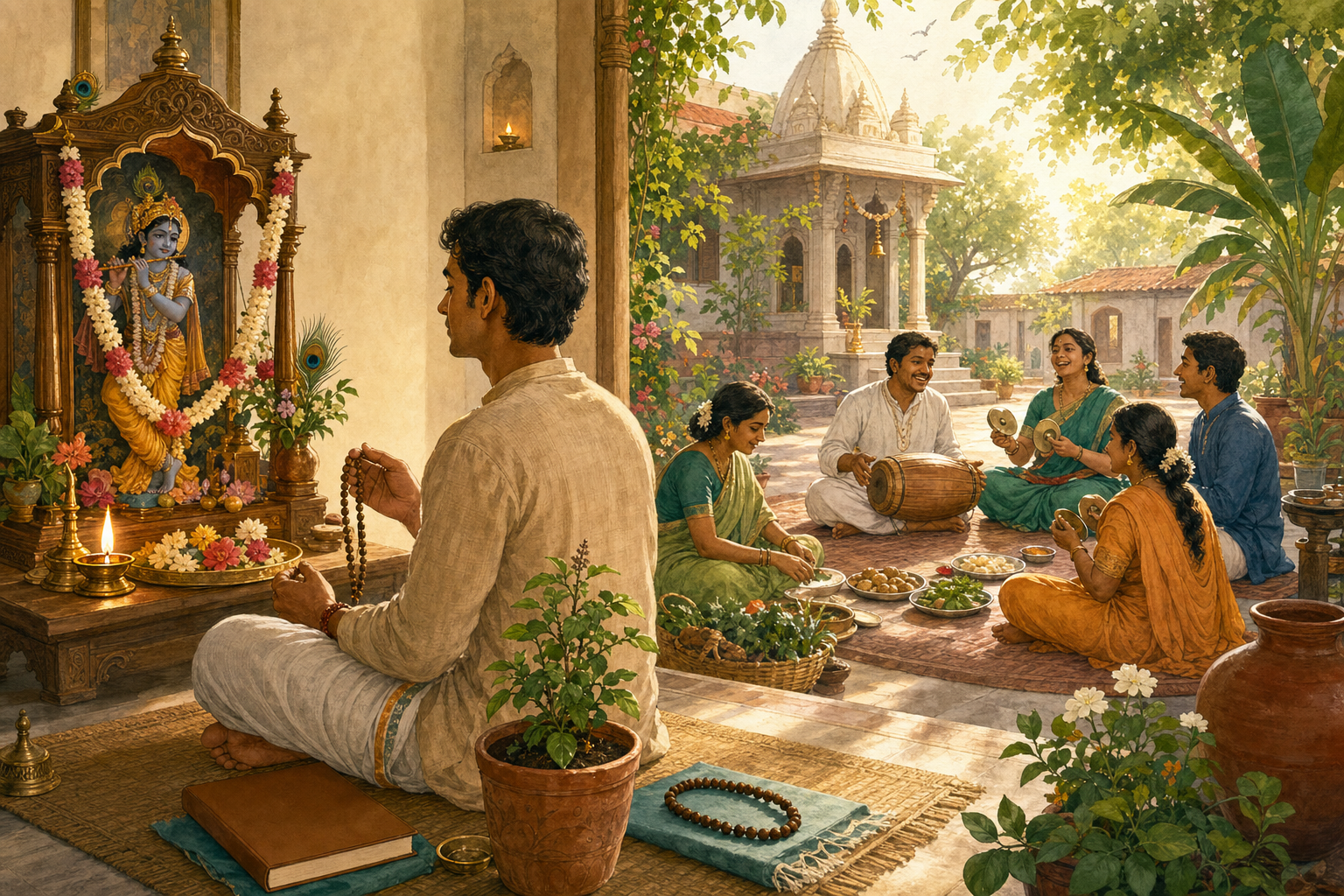
A mind trained only during temptation has little support. Madana Mohana belongs to an embodied devotional ecology in which seeing, hearing, remembering, studying and serving reinforce one another. The Madan Mohan Temple in Vrindavan, kirtan, iconography and sacred drama express the same practical insight: attention is shaped by what you repeatedly place before the senses.
You do not need to reproduce Vrindavan’s atmosphere at home. Reproduce its organising principle by giving sacred remembrance a stable place in ordinary life:
- Make darshan your first deliberate act of seeing at the beginning of the day. Behold the murti or an image of Sri Krishna without simultaneously checking messages, consuming media or planning tasks.
- Carry a chosen name of Krishna into the transitions of the day. Nama becomes especially useful at the moment attention starts attaching itself to an object.
- Participate in kirtan as remembrance rather than performance. Let voice, hearing and meaning gather around the same sacred focus instead of evaluating the experience from outside.
- Read lila slowly enough to contemplate Krishna’s character, relationships and grace. Study should deepen the object of remembrance, not merely increase the amount of information collected.
- Attach seva to a recurring responsibility. Service becomes formative when it remains reliable after the devotional mood fades.
- At the end of the day, review where desire narrowed your vision and where remembrance reopened it. Add gratitude for beauty received without possession.
Use beauty deliberately. A raga, poem, murti or sacred narrative should turn attention toward Krishna and then return you to life with clearer obligations. If you become dependent on a particular atmosphere before you can practise kindness or restraint, the aesthetic experience has become another demand for consumption.
The wider dharmic family offers related disciplines without teaching an identical theology. Buddhism turns careful attention toward freedom from craving and the cultivation of compassion and clarity. Jainism joins inner purification to aparigraha, weakening possessiveness through restraint. Sikh practice directs longing through Naam and Shabad-kirtan toward remembrance of the One. The shared civilisational insight is worth preserving without erasing differences: longing must be educated if human beings are to become inwardly free.
Measure transformation by freedom, duty and conduct
Powerful devotional feeling can accompany transformation, but intensity is an unreliable measure. The more useful test is what happens to attention, relationships and action when you do not immediately receive what you want.
| Area | When kama is directing you | When prema is beginning to direct you | Question to ask |
|---|---|---|---|
| Attention | The mind repeatedly rehearses acquisition or gratification. | Attention can return to Krishna, duty and the whole person before you. | Can I redirect my attention without resentment? |
| Relationship | Another person is valued mainly for the response or experience they provide. | Their dignity, freedom and good remain important even when they set a limit. | Can I honour a boundary that frustrates me? |
| Action | You hide, rationalise or neglect obligations to protect the desire. | You become more truthful, restrained and dependable. | What did this longing actually make me do? |
| After-effect | Satisfaction quickly becomes renewed agitation, dependency or entitlement. | Remembrance leaves greater gratitude, steadiness and non-attachment. | Am I becoming freer or merely better at naming my attachment? |
| Devotion | Krishna is invoked to bless a result already demanded by the ego. | The desired result itself can be surrendered while practice continues. | Would I still remember and serve if the outcome were denied? |
Watch for counterfeits. Suppression may produce outward control while inwardly feeding shame, hostility or fantasy. Aesthetic consumption may collect moving experiences without changing a neglected duty. Spiritualised entitlement may call possessiveness love and resistance surrender. Emotional dependency may abandon practice whenever darshan or kirtan does not produce the expected mood.
None of these errors is corrected by condemning beauty. They are corrected by restoring its proper direction. In the Madana Mohana vision, beauty awakens the heart, but dharma tests the awakening. If devotion is maturing, another being becomes harder to exploit, a promise becomes harder to betray, service becomes easier to sustain, and an unwanted outcome becomes more possible to accept.
Key takeaways
- Attraction is something to recognise and educate; it is neither a command nor proof of spiritual failure.
- Kama seeks to organise the beloved around the self, while prema reorganises the self around remembrance, reverence and service.
- Nama, darshan, kirtan, lila contemplation and seva give restless attention a sacred direction.
- Firm boundaries may be necessary when a desire threatens truth, consent, fidelity or duty.
- The clearest evidence of transformation is not emotional intensity but greater honesty, gratitude, restraint, compassion and non-attachment.
Choose the desire that most often narrows your attention. Name its hidden promise, decide the boundary that protects dharma, and select the form of remembrance you will use when it returns. At that next moment, do not demand immediate numbness. Turn toward Madana Mohana and give the longing a higher work: let it become attention, offering and love.
References
