
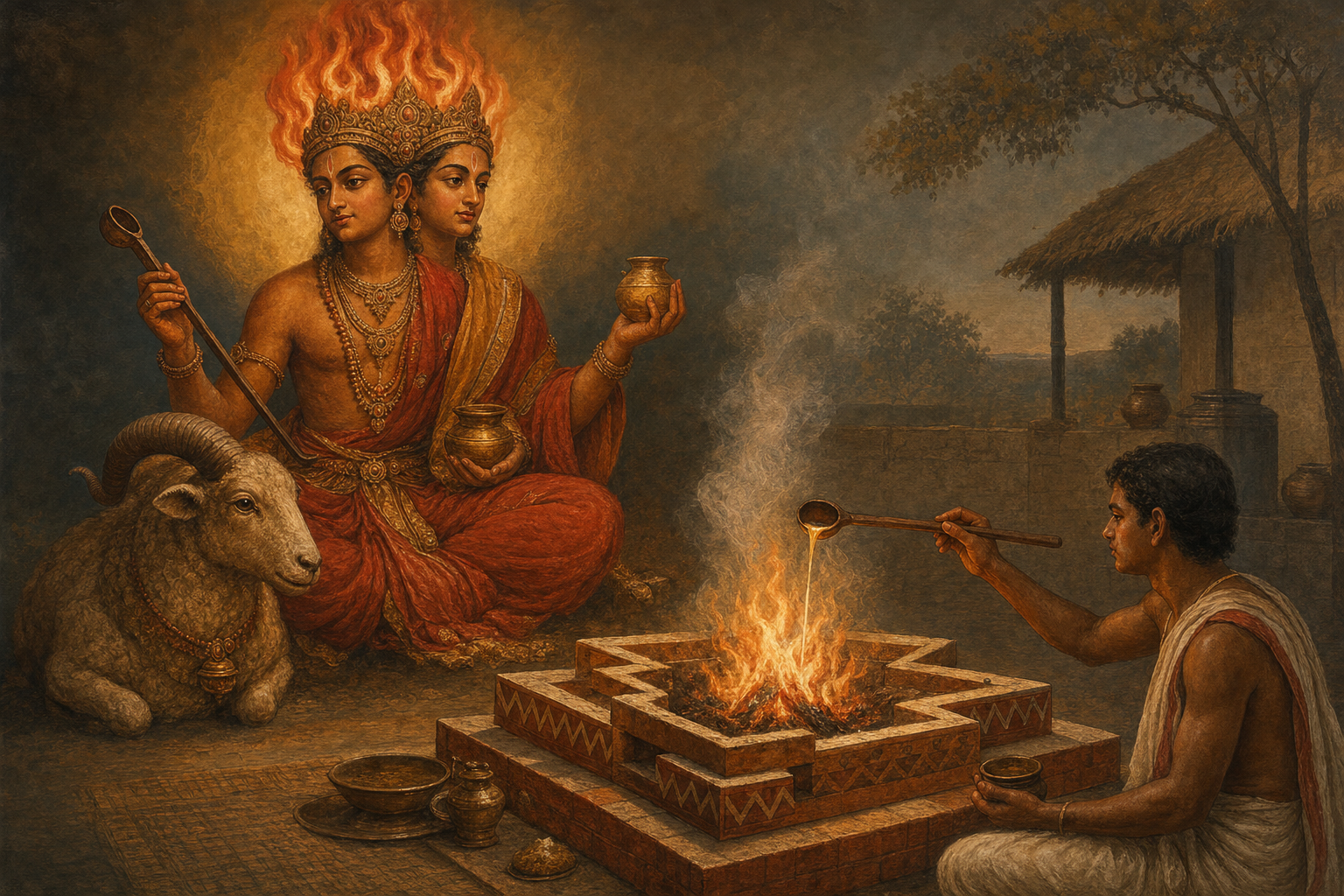
You may recognize the flames and still be unsure what you are looking at. Is the figure Agni, another radiant deity, or simply a personification of fire? And if the image belongs to a ritual setting, which details describe an actual practice rather than a general spiritual idea?
The reliable way to read Agni is to connect image, ritual action, and location. A ram, a flame-crowned pair of heads, a sacrificial ladle, and a southeastern niche become meaningful as a cluster. The same discipline matters when you move from viewing sacred fire to participating in a homa: an image can teach the logic of yajna, but it cannot replace instruction in a particular rite.
Read the ritual relationship before counting attributes
Agni receives the opening invocation of the Rig Veda because fire stands at the point where worship becomes offering. Agni is addressed as the household priest, the divine officiant, and the power through which yajna reaches its intended recipients. This is the basis of the description of Agni as the mouth of the gods and carrier of havis.
That relationship gives you the first rule of interpretation: do not treat the objects in Agni’s hands as royal accessories. The sruk and sruva are long-handled ladles for offering. A flaming vessel or brazier refers to the sacrificial fire itself. A kumbha belongs to purification, while an akshamala points toward the ordered use of mantra. Together, the objects present Agni as an active ritual mediator, not merely as a symbol of heat.
- Ask what is being offered. The ladles direct your attention to havis and the human act of giving.
- Ask what transforms the offering. The flames represent a controlled sacred process, not uncontrolled destruction.
- Ask where the offering is understood to go. Agni joins the visible action at the altar to an unseen divine relationship.
This three-part reading also prevents a common mistake. Fire can represent energy, knowledge, purification, ascetic heat, or destruction in Indian art, but Agni’s ritual implements narrow the meaning. When you see a ladle held beside a fire vessel, read the action before reaching for a broad metaphor.
Identify Agni by a cluster of visual evidence
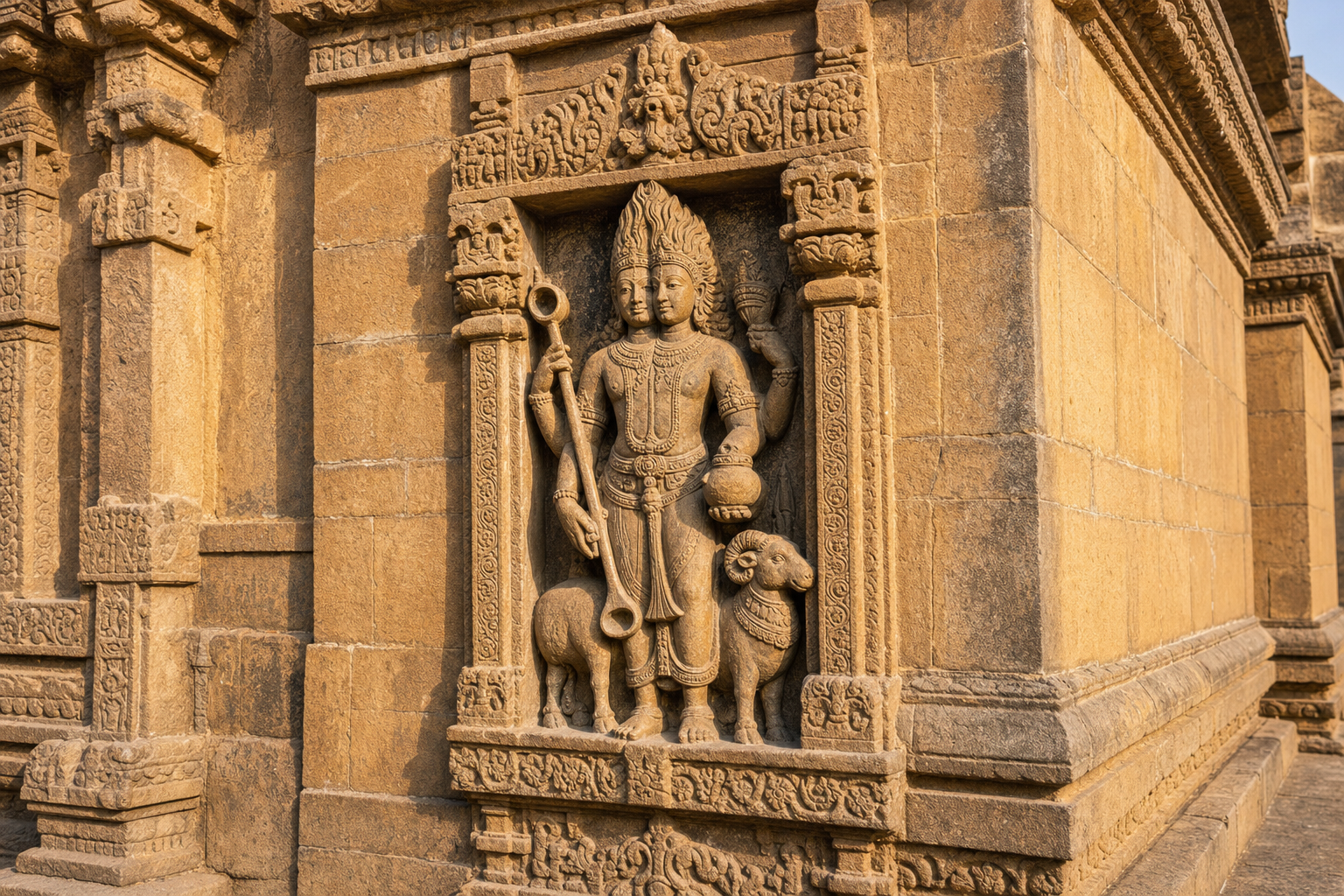
No single feature is decisive in every period or region. Hands break off, mounts disappear, pigments fade, and local artists adapt inherited forms. A dependable identification therefore combines the mount, heads, flames, implements, and directional setting.
| Visual cue | What it communicates | How much weight to give it |
|---|---|---|
| Ram, or occasionally a goat-like mount | Agni’s customary vehicle, associated with strength, momentum, and vital force | A strong identifier, especially when ritual implements are also present |
| Two heads | Complementary dimensions such as beneficent and fierce, terrestrial and celestial, together with vigilant attention | Strong supporting evidence, but regional forms can vary |
| Red or orange body, flame crown, or fiery aureole | Heat, energy, radiance, and sacred knowledge | Useful in a complete image, but too general to establish identity alone |
| Two or four arms carrying ladles, a fire vessel, kumbha, or rosary | Command of offering, purification, mantra, and ritual procedure | Particularly valuable because the objects reveal function |
| Seven flames or a multi-flamed crown | The seven tongues through which fire consumes, purifies, conveys, and illuminates | Important when preserved, although the seven may be implied rather than separately carved |
| Southeastern position in a directional program | Agni’s place among the guardians of the directions | Excellent contextual confirmation in an intact temple layout |
Use a four-pass method when you encounter an uncertain sculpture:
- Find the mount. A ram beneath the figure is more diagnostic than flames by themselves.
- Inspect the surviving hands. Look for the narrow shafts and bowl-like ends of sacrificial ladles, then check for a firepot, water vessel, or rosary.
- Examine the head and halo. Two heads and a flame crown strengthen the attribution, but damage may have removed one face or part of the aureole.
- Recover the original setting. In a temple, determine whether the niche belongs to a dikpala sequence and occupies the southeast. In a museum, present display direction is usually not evidence because the sculpture has been moved.
This method works across stylistic variation because it asks several independent details to support the same identification. A South Indian temple image and an adapted Angkorian form need not look identical to remain intelligible within a shared Vedic iconographic system.
Altar shape tells you which ritual world you have entered
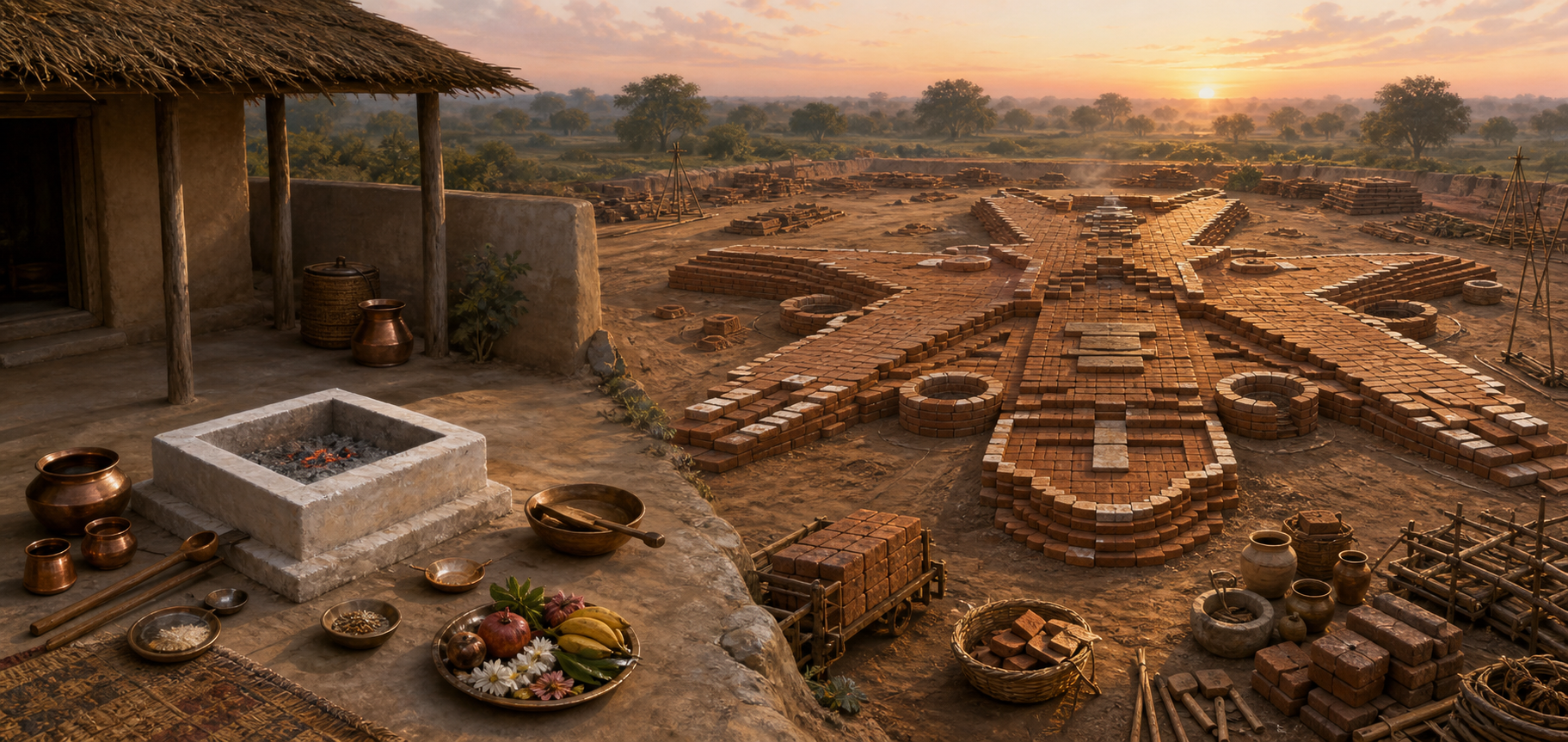
Agni’s iconography becomes clearer when you understand that Vedic ritual fire is differentiated by purpose. The traditional triad does not describe three artistic versions of one generic hearth. Each fire has a place and function within a particular ritual arrangement.
| Sacred fire | Characteristic form | Primary ritual association |
|---|---|---|
| Garhapatya | Circular | The household fire, maintained with continuity |
| Ahavaniya | Square | The fire into which offerings for deities are made |
| Dakshinagni or Anvaharyapacana | Semicircular or rectangular | Ancillary functions within the larger sacrificial system |
These forms help you classify a ritual space, but shape alone is not enough. A modern square homa-kunda should not automatically be identified as an Ahavaniya fire in the full Vedic three-fire system. First establish the rite, the officiants, the other fires present, and the tradition governing the altar.
Large srauta constructions carry the principle much further. The falcon-shaped syena-citi of Agnicayana turns brick, direction, number, and time into one design. Its canonical 10,800 lokamprina bricks correspond to the muhurtas of a Vedic year. The geometry is therefore not decoration surrounding the rite; it is one of the means by which the rite represents an ordered cosmos.
If you are studying a plan or reconstruction, separate three levels before interpreting it: the domestic hearth, the formal offering altar, and the large srauta complex. Then ask which measurements, materials, sequences, and textual rules belong to that level. The Satapatha Brahmana and Sulbasutras preserve the kind of ritual and geometric codification required for elaborate constructions. A photograph of an altar does not supply those instructions, and its outline should not be reverse-engineered into a home rite.
Archaeological claims require the same restraint. Fire-altars at Kalibangan and related settlements have been interpreted in relation to practices later articulated in Vedic traditions, but their precise cultural affiliation remains debated. When an excavated structure resembles an altar, describe the physical evidence first. Resemblance can justify a comparison; it does not by itself establish the identity of a rite or community.
Do not confuse symbolic literacy with ritual authority
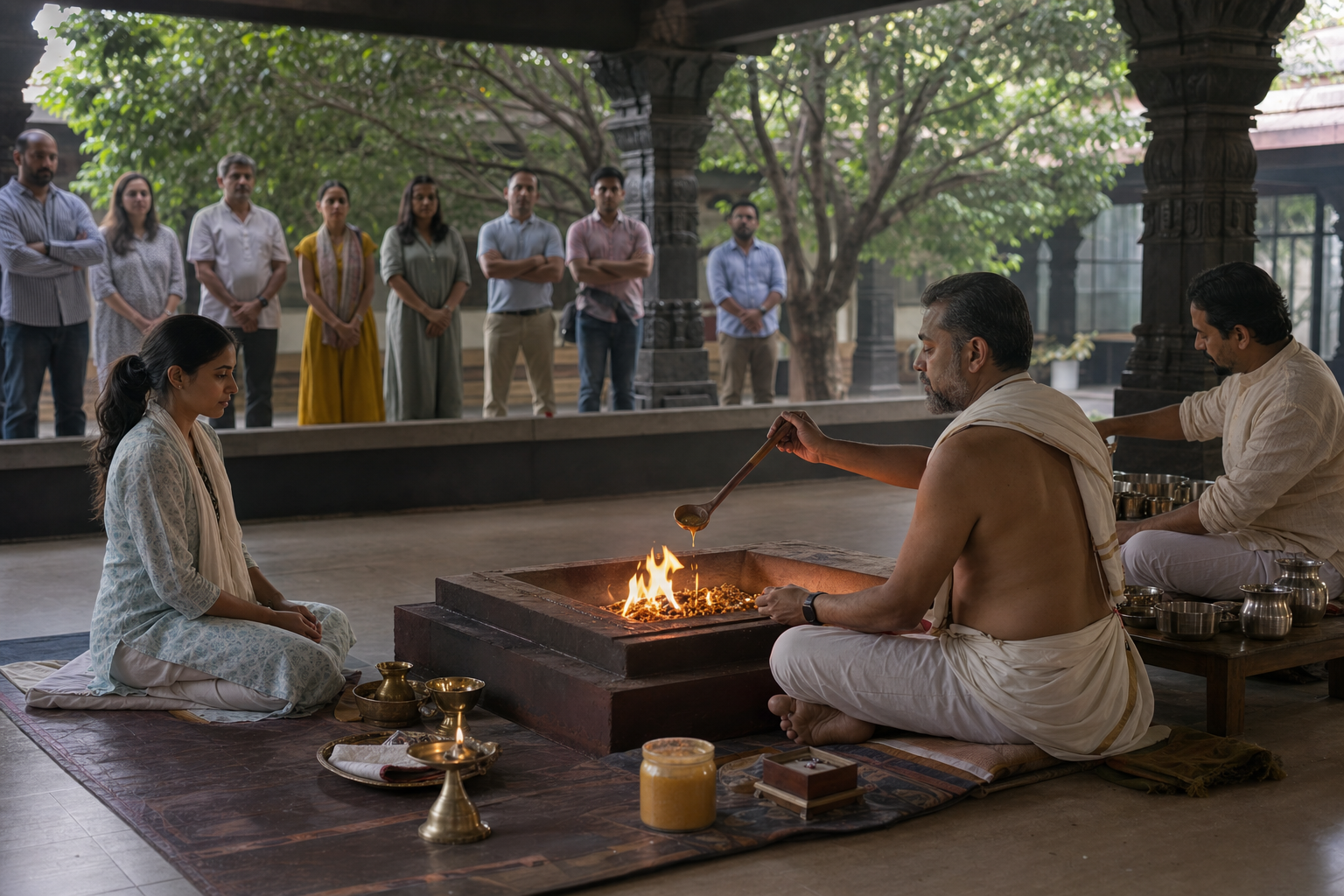
Recognizing Agni does not qualify you to improvise an Agnihotra, homa, or srauta sacrifice. These terms do not name interchangeable versions of one ceremony. A particular rite has its own officiants, mantras, offerings, sequence, altar requirements, and rules for tending the flame.
- Name the rite before gathering materials. Ask whether you are preparing for a domestic observance, a temple homa, or a formally constituted Vedic sacrifice. If no one can identify the procedure precisely, pause before lighting anything.
- Learn within a living tradition. A qualified acharya or trained officiant should explain the mantras, permitted offerings, order of actions, and method of completion used by that lineage. An Agni image reveals the theology of offering; it is not a procedural manual.
- Prepare for an actual fire, not an abstract element. Use a stable fire-resistant setting with adequate ventilation, keep combustible objects and loose clothing away, and have fire-extinguishing equipment appropriate to the fuel and venue. Follow local building, fire, and site rules, and never leave the flame unattended.
- Use direction intelligently. The southeast, or Agneya, is traditionally associated with Agni, kitchens, hearths, and homa spaces. That association does not make an unsafe corner suitable. Ventilation, clearance, structural safety, and the officiant’s requirements must all be satisfied.
- Close the rite as carefully as you begin it. Tending and extinguishing sacred fire belong to the discipline of the practice. Follow the prescribed conclusion and the officiant’s safety instructions rather than walking away when the visible offering ends.
Notice one practical distinction: a kumbha shown with Agni signifies ritual purification, not emergency fire control. Keep ceremonial vessels and safety equipment conceptually separate. If your home cannot support live fire safely, study the rite, attend a properly supervised homa, or seek guidance on an appropriate non-fire observance. Do not declare an improvised substitute ritually equivalent.
Questions that prevent the most common misreadings
Are Agni’s seven tongues always carved as seven separate flames?
No. They may appear explicitly or be condensed into a multi-flamed crown or aureole. Their traditional names are Kali, Karali, Manojava, Sulohita, Sudhumravarna, Sphulingini, and Visvaruci. They express differentiated capacities of sacred fire: consuming, purifying, conveying offerings, and revealing knowledge. If damage or regional stylization prevents you from counting exactly seven flames, use the mount, heads, implements, and setting instead of forcing the identification from an uncertain number.
Does sacred fire mean the same thing in every Dharmic tradition?
No. The traditions share a language of transformation, discipline, purity, and illumination, but they do not turn that shared language into one uniform ceremony. Hindu yajna and homa place offering and divine reciprocity at the center. Vajrayana and East Asian esoteric lineages preserve homa or goma forms, while the Buddhist Fire Sermon also uses burning as a metaphor for insight. Jain reflection treats the fire or tejas principle within the demands of ahimsa, with lamps and arati expressing reverence and illumination. Sikh scripture’s language of jot centers divine light and inner clarity. Use these parallels to begin a comparison, not to erase each tradition’s theology, ethics, and ritual authority.
Does a southeastern niche prove that the figure is Agni?
It is strong supporting evidence only when the building’s original orientation and directional program are known. Agni guards the southeast among the Ashtadikpalas, so a ram-mounted, flame-crowned figure with sacrificial ladles in that position is a persuasive identification. Direction alone is insufficient: a kitchen, later installation, moved sculpture, or incorrectly reconstructed display can produce a misleading association.
On your next temple or museum visit, make three passes: identify the figure, reconstruct the ritual action encoded by the attributes, and test the reading against the surrounding space. If you intend to move from observation to live fire, take that same precision to a trained officiant before lighting the flame. That is how Agni’s image becomes a lesson in disciplined transformation rather than an invitation to improvise.
References
