
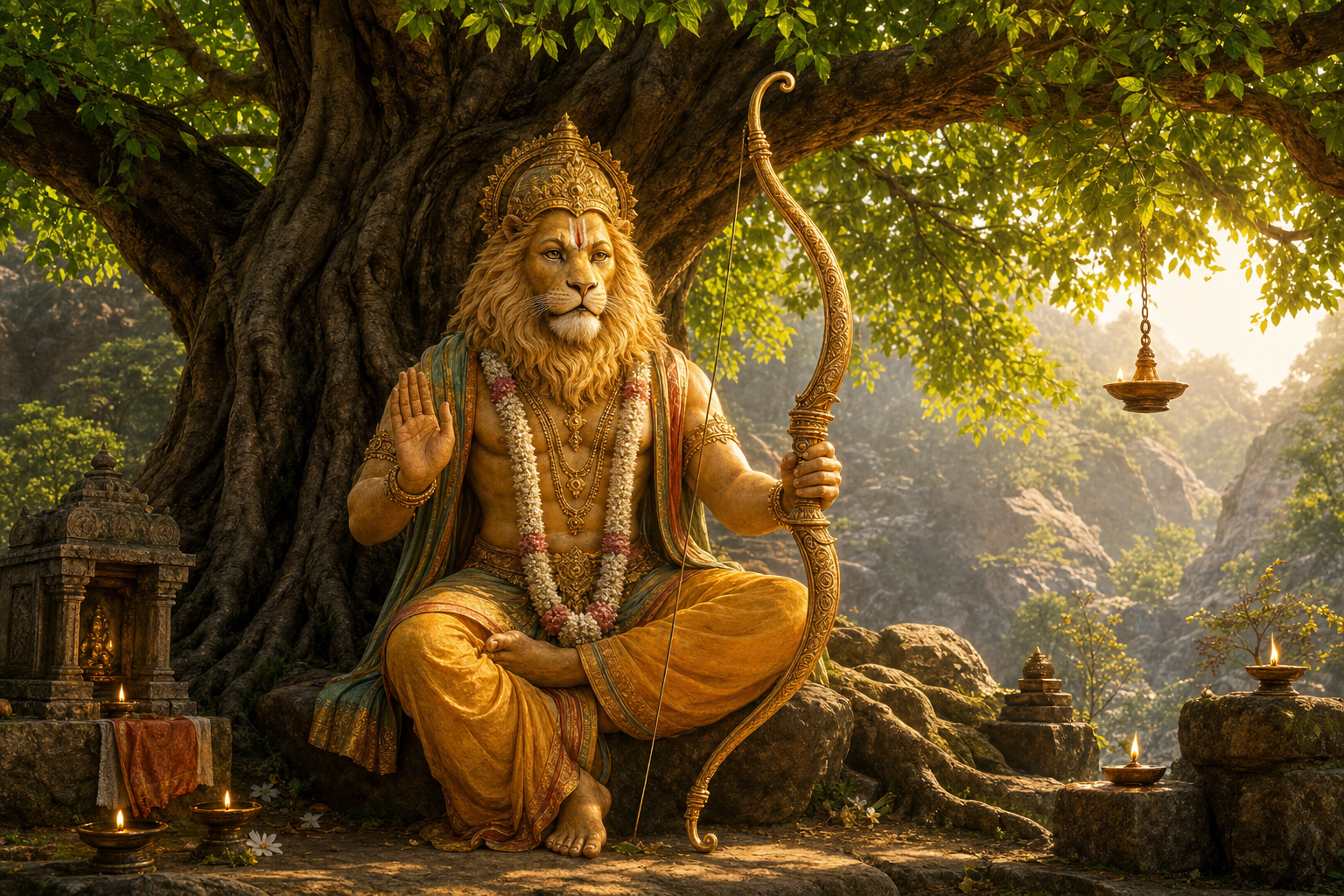
If you are planning a pilgrimage to Ahobilam, Karanja Narasimha can easily become one more name on a nine-shrine checklist. Pause here. This shrine addresses a question that many devotees eventually face: does loyalty to one form of Bhagavan require distance from another?
The bow held by Karanja Narasimha gives a precise answer. Once you understand why it is there, you will know what to notice during darshan, how Karanja belongs within the Nava Narasimha pilgrimage, and how to keep one-pointed devotion from hardening into sectarian rivalry.
Why the bow appears beneath the karanja tree
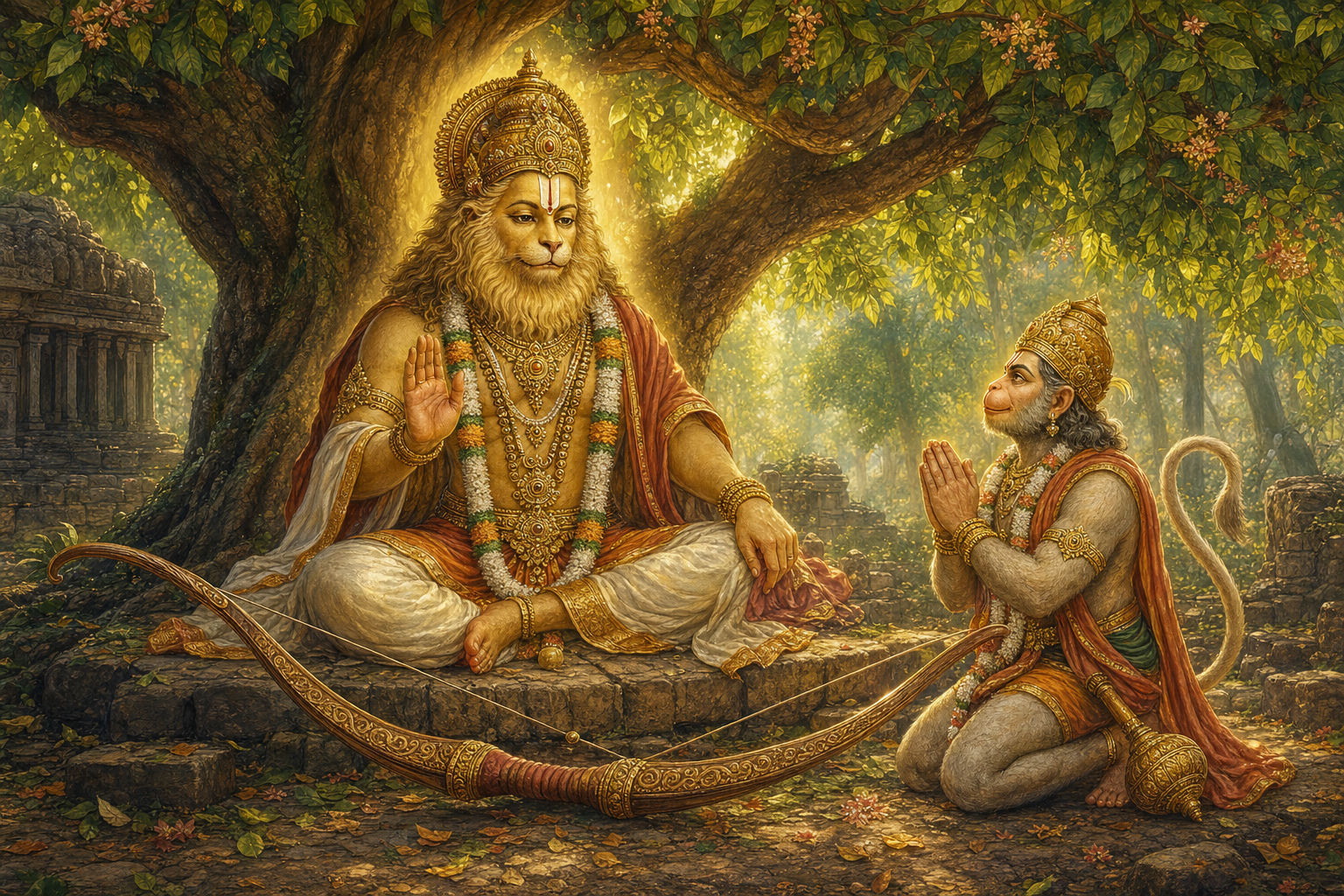
The Karanja tradition begins with Hanuman performing Rama-nama japa beneath a karanja tree. When Narasimha appeared, Hanuman remained unwavering in his devotion to Sri Rama. Narasimha responded to that fidelity by revealing divine unity in a form Hanuman could receive: the leonine Lord appeared with a bow associated with Rama. The encounter is remembered as an instance in which Bhagavan honours the devotee’s established relationship with the Divine rather than demanding that it be discarded.
Local tellings preserve more than one version. Some say Narasimha briefly manifested as Sri Rama. Others retain the leonine form but add a bow, interpreted either as Kodanda, the bow of Rama, or as Sharnga, the bow of Vishnu. The theological point is clearer than the narrative mechanics: Rama and Narasimha are not competing powers, and Hanuman’s devotion does not become defective merely because it is focused.
You therefore do not need to settle every iconographic variation before entering the shrine. In fact, forcing a single reconstruction onto a living sthala-purana can make you miss what the murti communicates. Look first at the leonine presence and then at the bow. Two apparently different avatara identities are held together without either being erased.
The tree matters just as much as the attribute. Karanja is the common name associated here with Pongamia pinnata, and the shrine takes its identity from the tree beneath which Hanuman’s japa is remembered. The canopy is not incidental landscaping. Tree, icon, path, and narrative form one sacred setting. Before you hurry toward the sanctum, allow the filtered light and quieter atmosphere beneath the canopy to mark the transition from travel to darshan.
The present temple also carries a later-medieval Vijayanagara architectural imprint, including a compact sanctum-and-mandapa arrangement suited to rugged terrain. Its construction history is layered, so it is wiser to notice the relationship between stone shrine and living tree than to assign every visible element to one period. At Karanja, the natural canopy remains part of the temple’s theological language.
Hanuman’s one-pointed devotion is not sectarian rivalry
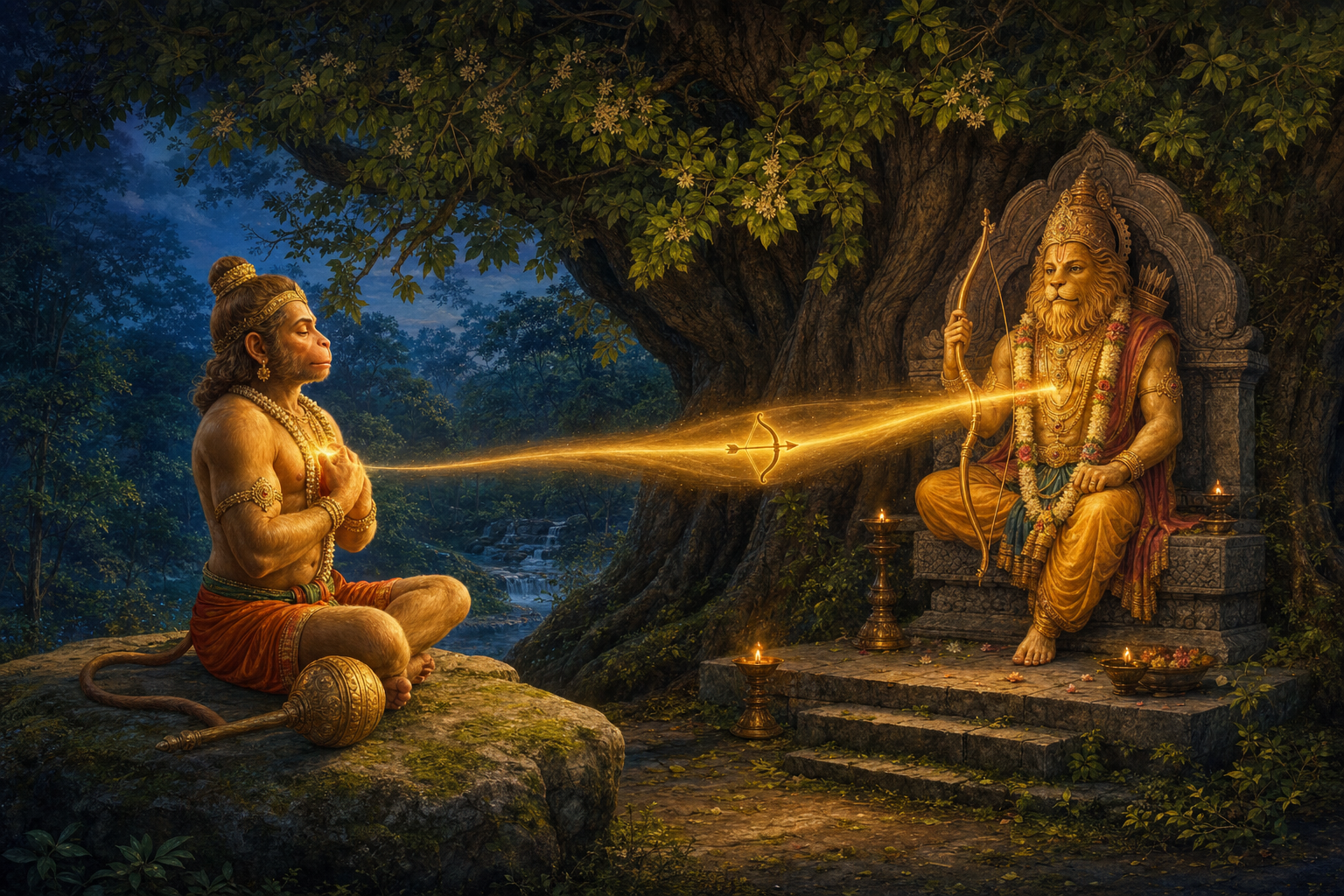
Hanuman’s response can be misunderstood in two opposite ways. One reading turns it into a claim that only his chosen form is worthy of worship. Another dilutes it into the idea that all forms are interchangeable, so commitment and discipline do not matter. Karanja Narasimha supports neither conclusion.
Hanuman practises ekanishtha, one-pointed fidelity. He does not move from deity to deity in search of novelty. Narasimha does not punish that constancy or demand a new spiritual identity. Instead, the Lord makes the unity of Vishnu’s avataras intelligible through the form Hanuman already loves. Difference remains visible, but opposition falls away.
This gives you a practical test for understanding an Ishta-Devata. Your chosen form is not merely the deity you happen to prefer at the moment. An Ishta-Devata becomes the centre of a sustained discipline: a name you repeat, a form you contemplate, virtues you try to embody, and a relationship you do not abandon whenever another practice appears more exciting.
- If Sri Rama is your Ishta-Devata, you can enter a Narasimha shrine without treating the visit as disloyalty to Rama.
- If Narasimha is your Ishta-Devata, the bow teaches you to honour Rama-bhakti without weakening your own practice.
- If you are teaching a child, begin with the visible attribute: the bow allows Narasimha to meet Hanuman through the form Hanuman trusts.
- If your devotion is producing contempt for other sincere devotees, it is no longer resembling Hanuman’s bhakti. His firmness summons recognition, not hostility.
The last distinction is especially important. Unity does not require uniformity, but plurality does not mean that every discipline is identical. Jain anekantavada, Buddhist upaya, Sikh Ik Onkar, and the Vaishnava theology of Ishta-Devata arise from different doctrinal settings and should not be collapsed into one formula. They nevertheless help a Dharmic reader notice a shared civilizational resistance to the demand that spiritual truth must always appear in one uniform expression. Karanja adds a distinctly Vaishnava insight: the one Supreme Reality can become approachable through the devotee’s established language of love.
Use that insight as a self-examination rather than a slogan. Ask whether your chosen practice is making you steadier, more courageous, more compassionate, and more capable of service. Those are harder measures than declaring allegiance to a name, and they are closer to the conduct represented by Hanuman.
Where Karanja belongs in the Nava Narasimha experience
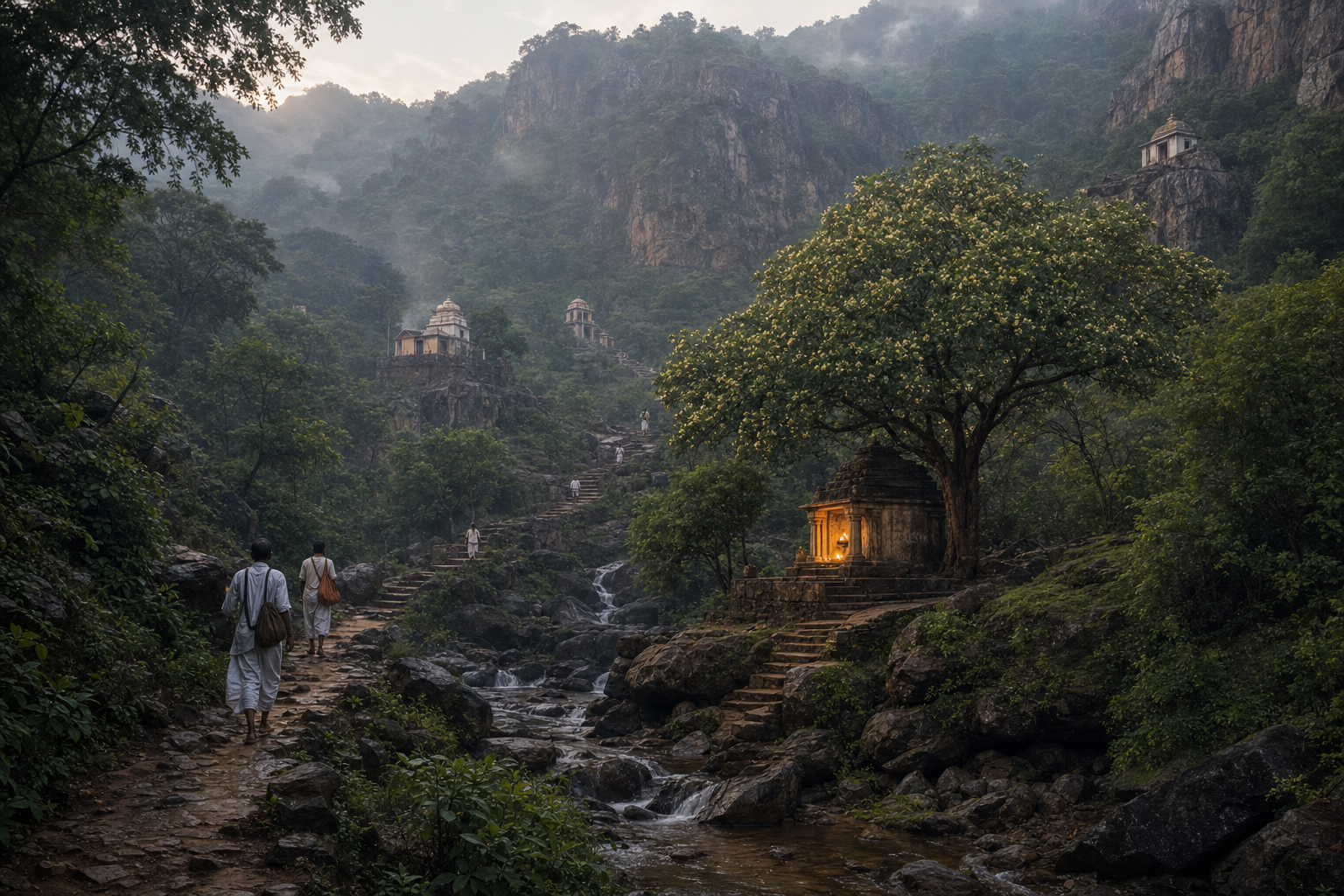
Ahobilam is not a collection of nine unrelated temples. Its Nava Narasimha landscape presents distinct theological and emotional registers of the same protective Lord. Mountain paths, caves, groves, streams, and shrines make those registers tangible. You move through them bodily rather than encountering them only as abstract ideas.
- Ahobila or Ugra Narasimha directs attention to protective ferocity: divine force exercised for Prahlada and against tyranny.
- Jwala Narasimha is associated with the climactic destruction of Hiranyakashipu and carries the intensity suggested by the name Jwala, or flame.
- Malola Narasimha, with Mahalakshmi, reveals tenderness and the inseparability of justice from compassionate grace.
- Krodha or Varaha Narasimha brings Varaha-inflected imagery into the Narasimha form and points toward power placed under dharmic discipline.
- Karanja Narasimha shows divine responsiveness to one-pointed bhakti through the bow connected with Hanuman’s love of Rama.
- Bhargava Narasimha is associated with Parashurama’s tapas and invites a more contemplative mood.
- Yogananda Narasimha turns from the violence of the avatara’s appearance toward meditative steadiness and the instruction of Prahlada.
- Chatravata Narasimha belongs to a tree-sheltered setting associated with musical worship.
- Pavana Narasimha is approached as a purifying, secluded culmination to the circuit.
This list is an interpretive map, not a guaranteed walking order. Routes have to answer to terrain and present access conditions. The useful question at each shrine is not simply whether you have collected another darshan. Ask what has changed in the way Narasimha is being revealed and what response that form asks from you.
Karanja has a distinctive place in that progression. Ahobila and Jwala bring you close to the fierce defence of Prahlada. Malola tempers fierceness with Lakshmi’s presence. Karanja adds reconciliation: the Lord who breaks tyranny does not break a devotee’s sincere fidelity. The murti is consequently often read as gentler in expression than the more explicitly ugra forms.
The shrine’s location along the forested connection between the lower and upper areas reinforces this role. Karanja is a place of passage and encounter. Treat it as a contemplative interval between ascents, not merely as a checkpoint between larger temples.
Turn your Karanja visit into a deliberate practice
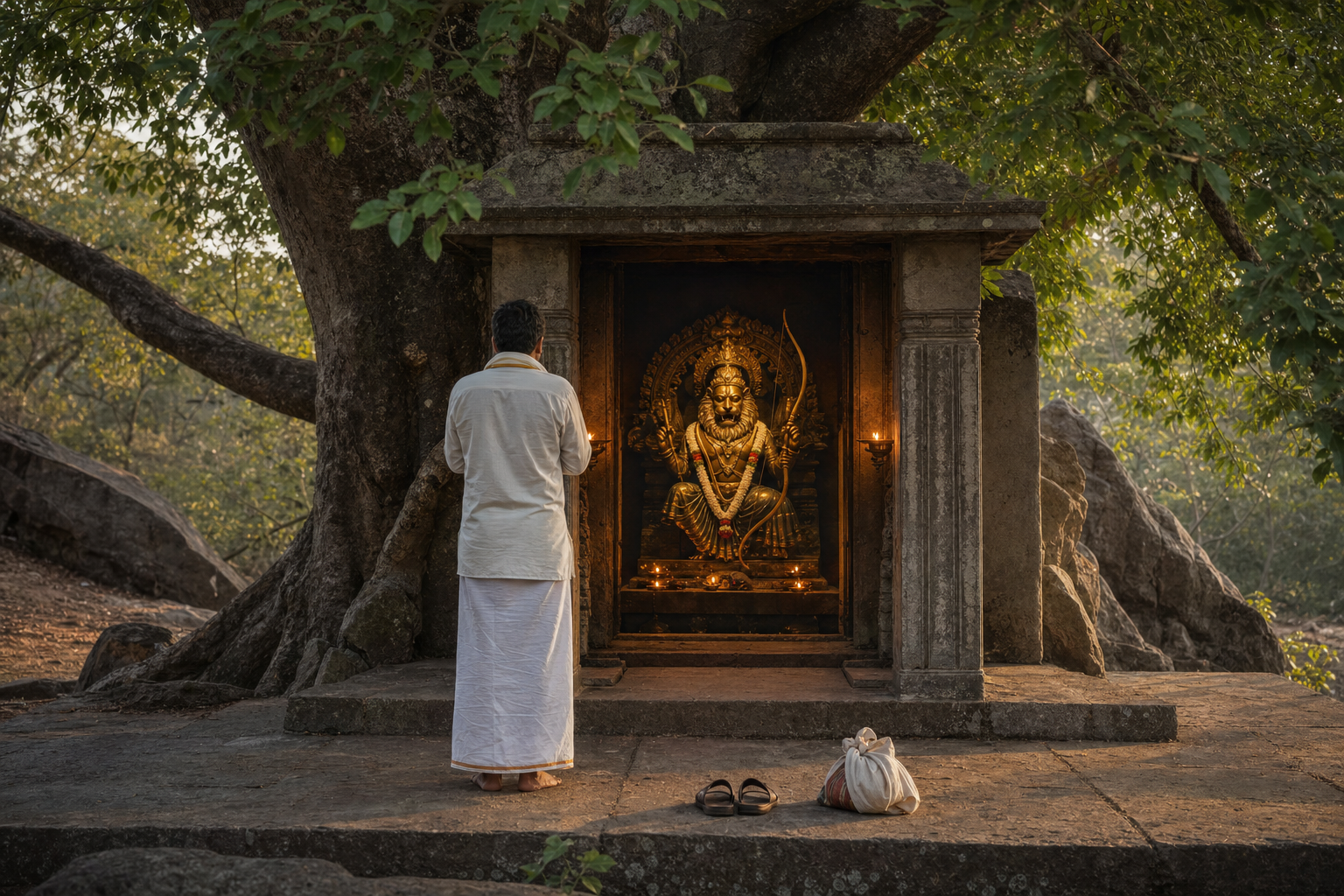
At the shrine
The following is a personal contemplative framework, not a substitute for the temple’s ritual procedure. Follow the archaka’s directions and allow the established worship to take priority.
- Become quiet before you reach the murti. Use the approach beneath the karanja canopy to slow your breathing and finish ordinary conversation. The transition is part of the pilgrimage.
- Carry one name into the shrine. If you already practise Rama-nama or a Narasimha mantra, remain with it. Karanja’s lesson is depth of attention, not the anxious accumulation of many formulas.
- Look deliberately at the bow. Notice how one attribute evokes Rama while the leonine form remains Narasimha. Let the icon resolve the apparent contradiction before you try to explain it in words.
- Examine your own fidelity. Ask one concrete question: has devotion made you more disciplined and useful to others, or merely more defensive about religious identity?
- Leave without damaging the setting. Do not cut leaves, carve the tree, or place objects against it unless temple authorities explicitly permit the act. Preserving the living canopy preserves part of the shrine, not just its surroundings.
If the space is crowded, shorten the exercise rather than obstructing the movement of other pilgrims. The point is concentrated attention, not occupying the sanctum for a fixed amount of time.
Across Ahobilam
The most common planning mistake is to treat all nine shrines as though they were rooms in one level temple complex. Lower Ahobilam is the more accessible settlement and provides the main concentration of pilgrim facilities. Upper Ahobilam involves hill paths, steps, streambeds, and forest terrain. The full Nava Narasimha circuit is therefore commonly undertaken as a whole-day pilgrimage combining worship with moderate trekking.
- Choose your scope before setting out. A focused Karanja darshan and a full Nava Narasimha circuit are different undertakings. Do not promise yourself nine shrines and then rush every darshan to protect the count.
- Use early morning for a quieter Karanja approach. The softer light beneath the canopy and reduced bustle are better suited to japa and close attention to the murti.
- Treat monsoon terrain seriously. Verdure becomes more intense, but rock and forest paths can be slick. Use footwear suitable for the approach, removing it wherever temple rules require, and do not assume that a route described as moderate will be easy for every pilgrim.
- Separate accessibility from aspiration. If anyone in your group has limited balance or mobility, plan the more accessible lower-temple visit independently from the forest trek. Confirm current route conditions locally before committing the group.
- Do not depend on an unverified timetable. Darshan hours, ritual access, weather, and trail conditions can change. Confirm them locally rather than building the day around an old schedule.
- Protect the full sacred landscape. Carry waste out, avoid damaging vegetation, and respect water structures and paths. At Ahobilam, conserving the route and canopy is inseparable from conserving the temples.
Karanja’s regular worship belongs to the Pancharatra rhythm of abhisheka, alankara, and archana. Narasimha Jayanti in Vaishakha brings collective recitation and special observance, while Hanuman Jayanti has particular resonance because of the shrine’s foundational encounter. If you visit for either occasion, enter the shared liturgical rhythm instead of expecting the quiet atmosphere of an ordinary early morning.
Key takeaways for your pilgrimage
- Karanja Narasimha’s bow expresses the unity of Rama and Narasimha while honouring Hanuman’s exclusive fidelity to Rama.
- Local versions differ over whether Narasimha appeared as Rama or retained the leonine form with Kodanda or Sharnga. Do not turn that variation into false certainty.
- Ishta-Devata means disciplined relationship, not casual preference and not hostility toward other forms of Bhagavan.
- The karanja tree, forest approach, murti, and story belong to one sacred ecology. Notice and protect all four.
- Karanja is one member of the Nava Narasimha landscape, but its purpose is not exhausted by completing a nine-shrine count.
- A full circuit requires time and comfort with varied terrain. A focused visit can be more spiritually coherent than a rushed claim to completeness.
Before you travel, decide which pilgrimage you are actually making. If Karanja is your focus, give the shrine one unhurried interval. Carry the name you already trust, look closely at the bow, and leave with one practical commitment through which your devotion can become courage, compassion, restraint, or service.
References
- DharmaRenaissance Blog — Aho Balam, Aho Bilam: Ahobilam Narasimha’s Origin, Nine Shrines, and Trek in Nallamala Hills
- DharmaRenaissance Blog — When Hanuman’s Bhakti Moved Narasimha: Karanja Ahobilam’s Miracle, Iconography, Legacy
