
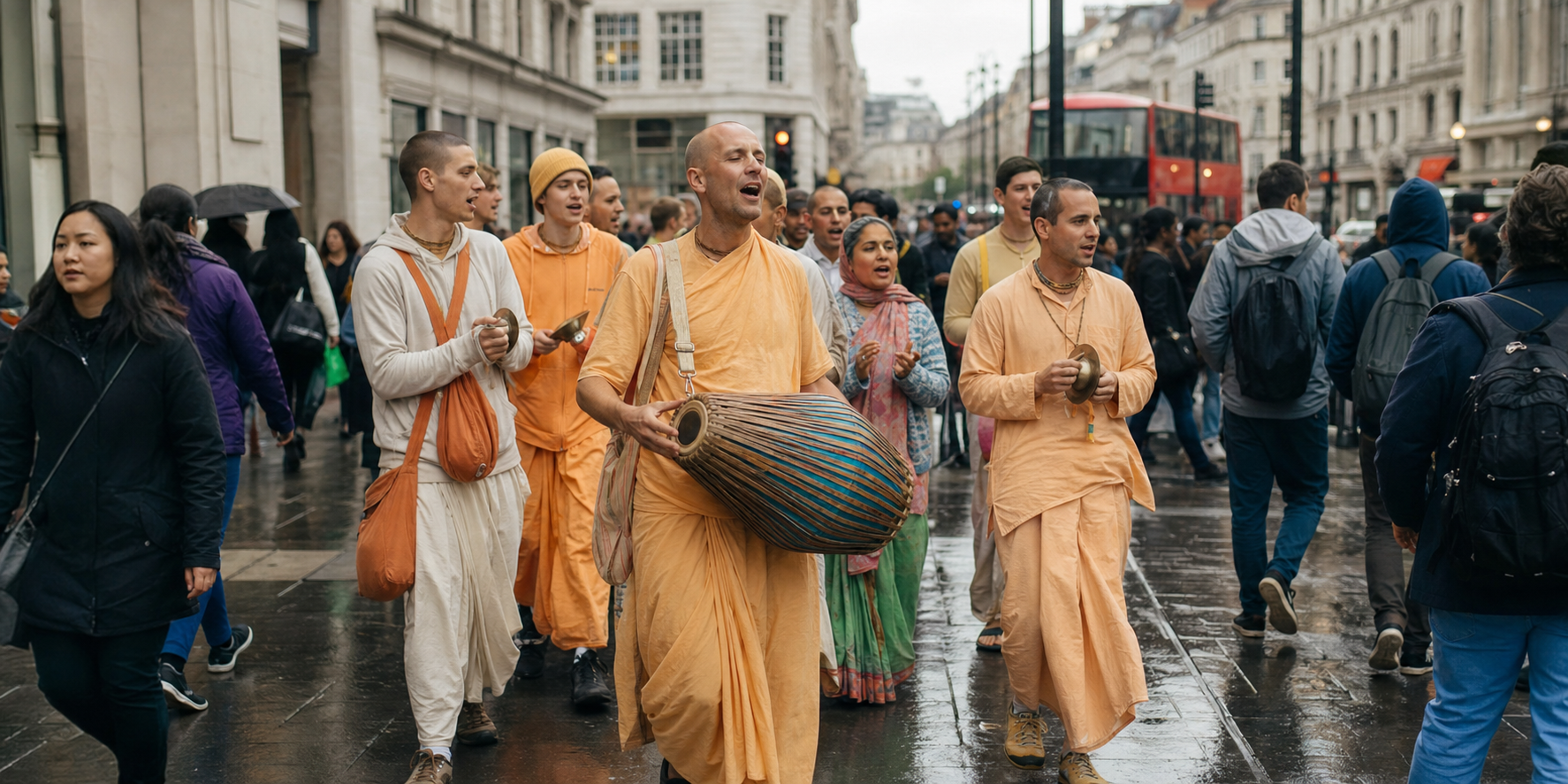
Public Hare Krishna chanting changes a London street in a small but revealing way. A space governed by traffic, commerce and hurried movement briefly becomes a place of shared rhythm, sacred address and voluntary participation.
Understanding that encounter requires more than describing robes, drums or dancing. The devotional meaning of the mantra, the effects of musical repetition and the chant’s place in London’s cultural history illuminate different dimensions of the practice, but they should not be collapsed into a single claim about what chanting does.
What the chant asks of a passer-by
The supplied DharmaRenaissance article identifies the mantra as sixteen invocations conventionally counted as thirty-two syllables: Hare Krishna, Hare Krishna, Krishna Krishna, Hare Hare; Hare Rama, Hare Rama, Rama Rama, Hare Hare. Because its three sacred names are voiced as forms of address, the mantra is not primarily a proposition to be debated. It is an appeal directed toward the divine.
In the Gaudiya Vaishnava interpretation presented by the article, Hare invokes divine devotional energy, especially Radha, while Krishna and Rama address the all-attractive and joy-giving Supreme. The source also cautions that Vaishnava lineages can emphasize these names differently, so no brief English translation exhausts their meaning.
The public setting matters. Japa generally means individual mantra repetition, often using a mala of 108 beads. Bhajan is a wider category of devotional song. Kirtan commonly employs a leader-and-response form, while sankirtana emphasizes collective glorification and can occur in homes, temples, festivals or streets. London street chanting is therefore not simply private meditation made louder; its communal structure is part of the practice.
Why repetition works on several levels
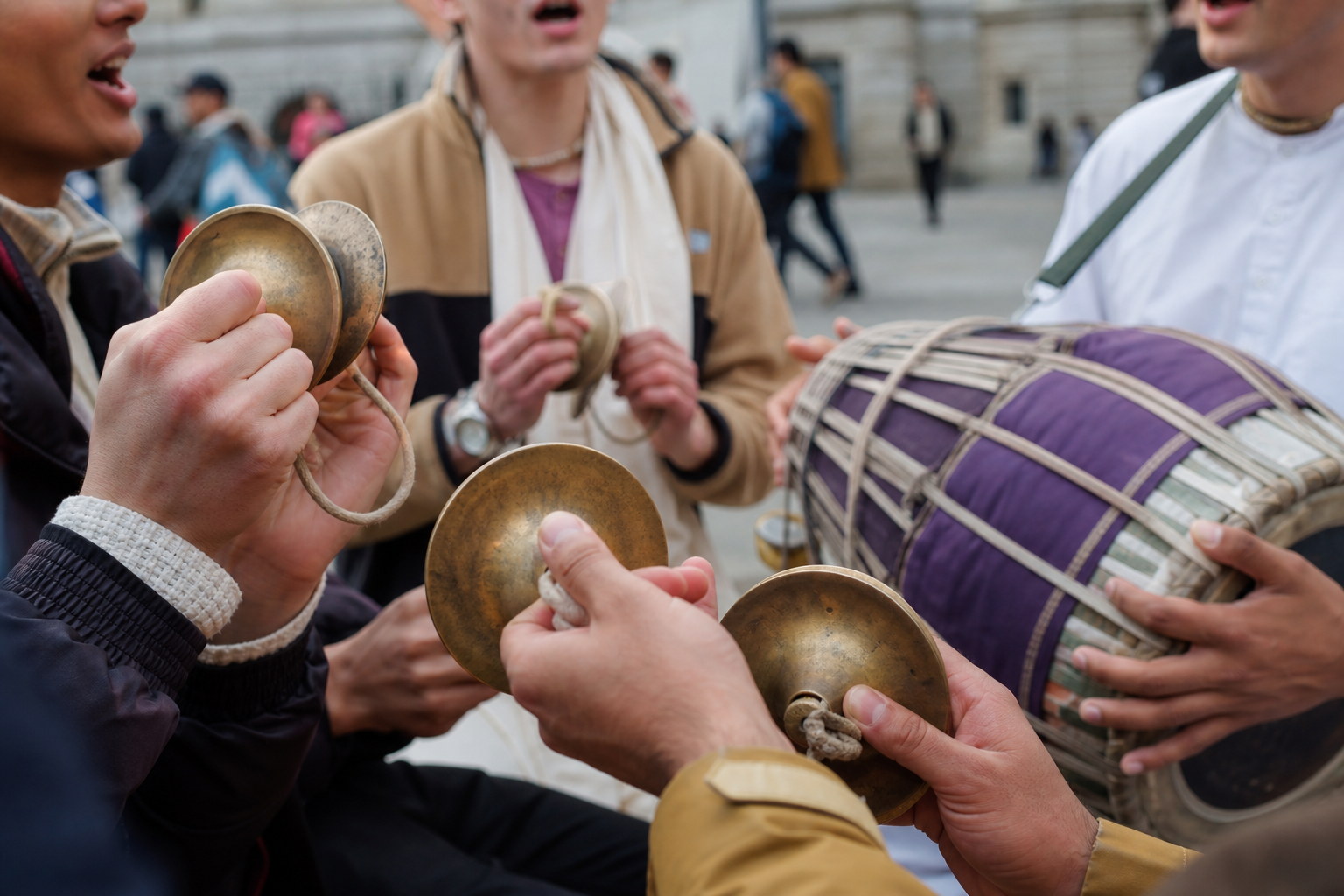
Within Gaudiya Vaishnava theology, divine sound has a status far beyond that of a memory aid. The name is understood as intimately related to Krishna’s presence, making chanting an encounter, an act of service and a way of redirecting desire toward devotion. The source connects this understanding with Bhagavad Gita 9.14, Srimad-Bhagavatam 12.3.51 and a version of the mantra in the Kali-Santarana Upanishad. These texts provide theological authority for practitioners; they are not experimental proof of a psychological outcome.
The music also has an accessible cognitive design. A leader supplies the words, pitch and timing, and the gathering answers. Repeated language reduces uncertainty, a steady beat organizes attention, and alternating phrases create recurring periods of singing and listening. Drums may establish the rhythmic cycle, hand cymbals may mark the beat, and clapping or dancing can involve the body as well as the voice. Instrumentation varies, but the response pattern enables newcomers to join without first learning a long composition.
These features may temporarily reduce scattered attention or rumination, but energetic kirtan is not necessarily quiet or sedating. Its tempo and physicality can produce organized excitement rather than stillness. At the social level, singing the same refrain may also soften urban anonymity by giving strangers a brief shared activity. Such possibilities remain different from the tradition’s claim of liberation from material bondage; temporary regulation, momentary belonging and spiritual liberation are related interpretations, not interchangeable findings.
Key takeaways
- Public Hare Krishna chanting is a communal devotional practice, not merely individual meditation performed in public.
- The mantra’s repetitive, call-and-response form lowers the practical threshold for participation.
- Theological liberation, psychological relief and social connection describe different kinds of claims and require different standards of evidence.
- London’s familiarity with the chant grew through street practice, recorded music, a permanent temple and public processions.
- A thumbnail without a transcript or scene details cannot establish the location, route, crowd size or experiences of particular participants.
How the mantra entered London’s cultural memory
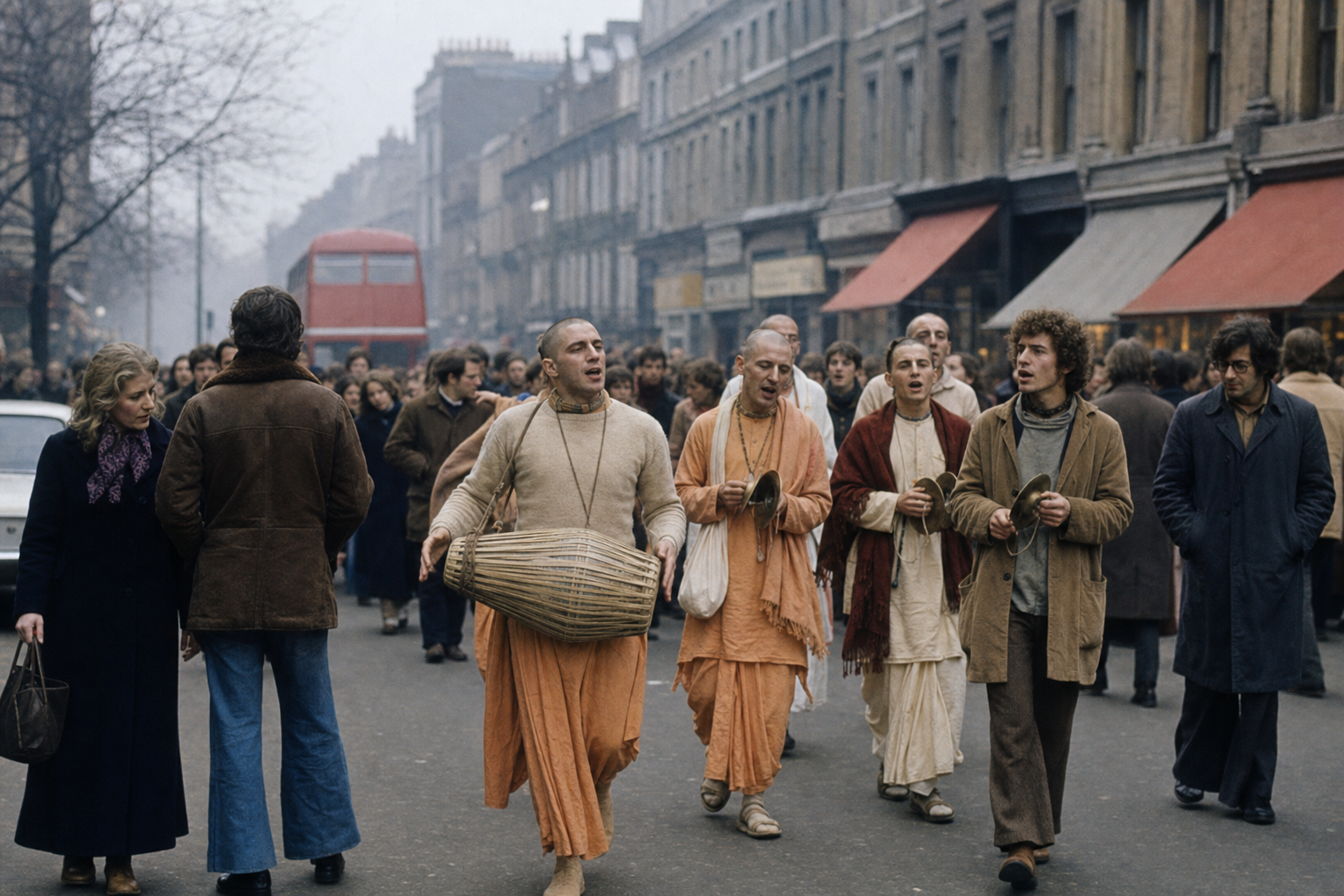
The London story described by the source extends beyond isolated pavement performances. Drawing on an official ISKCON London timeline, the article reports that three devotee couples arrived in September 1968 and made contact with George Harrison later that year. A recording for Apple Records followed in July 1969. The resulting Hare Krishna Mantra single entered the UK chart that September and, according to chart information cited by the article, reached number 12 during a nine-week run.
That recording carried the mantra through radio, television and popular music as well as public chanting. The source further reports that a Radha-Krishna temple opened at 7 Bury Place in December 1969 and that the community relocated to Soho Street in 1978. The first London Ratha Yatra also took place in 1969, following a route between Hyde Park and Trafalgar Square. Together, these channels helped turn the chant into a recognizable part of the capital’s religious and cultural landscape rather than a passing countercultural novelty.
The article also places the practice within a highly diverse city, citing the 2021 Census finding that 25.3 percent of London residents reported a religion other than Christianity. This context does not tell how any particular pedestrian interprets kirtan, but it helps explain why a visible devotional tradition can be simultaneously distinctive and part of London’s ordinary plurality.
Care is needed when connecting this history to a particular recording. The supplied source dates its subject record to 11 July 2026, while the 2026 London Ratha Yatra occurred separately on 24 May. It reports an ISKCON News account estimating more than 10,000 participants and over 16,000 plates of prasadam distributed at that event, but identifies those as organizer-reported figures. Nothing in the supplied thumbnail establishes that the July material depicts Ratha Yatra, so the two should not be treated as the same occasion.
Reading a street scene without overclaiming
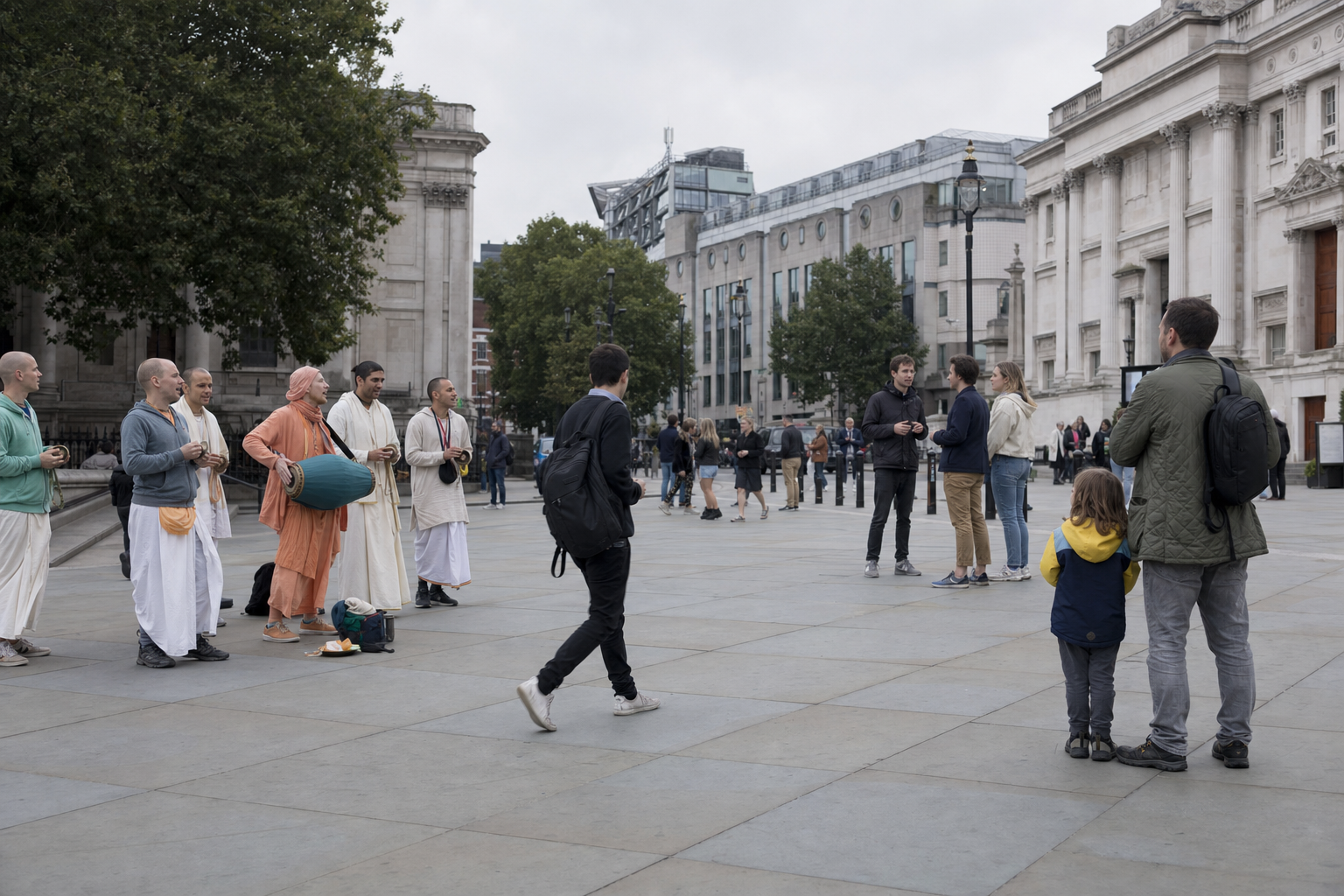
The source contains no transcript, precise location, named participants, route, crowd estimate or account of events before and after the recorded moment. Those omissions sharply limit what can be concluded about the scene itself. A person answering the refrain can demonstrate audible participation; it cannot by itself reveal that person’s beliefs, emotional state or enduring spiritual transformation. Likewise, a passer-by who keeps walking may still have listened, but the image supplies no basis for asserting that.
The most responsible interpretation therefore distinguishes observation from meaning. Sound, movement and public interaction can be documented. Psychological effects require appropriate evidence, while claims concerning grace, divine presence and liberation belong to the tradition’s theological account. Respecting those boundaries does not diminish kirtan. It shows more clearly how one repeated mantra can function at once as devotional discipline, participatory music and a durable feature of London street culture.
Future accounts of London kirtan can add depth by documenting the setting, event context and words of participants while preserving this distinction between visible response and inward experience. That would make the city’s encounter with sacred sound easier to understand without reducing it either to spectacle or to an untestable claim presented as fact.