
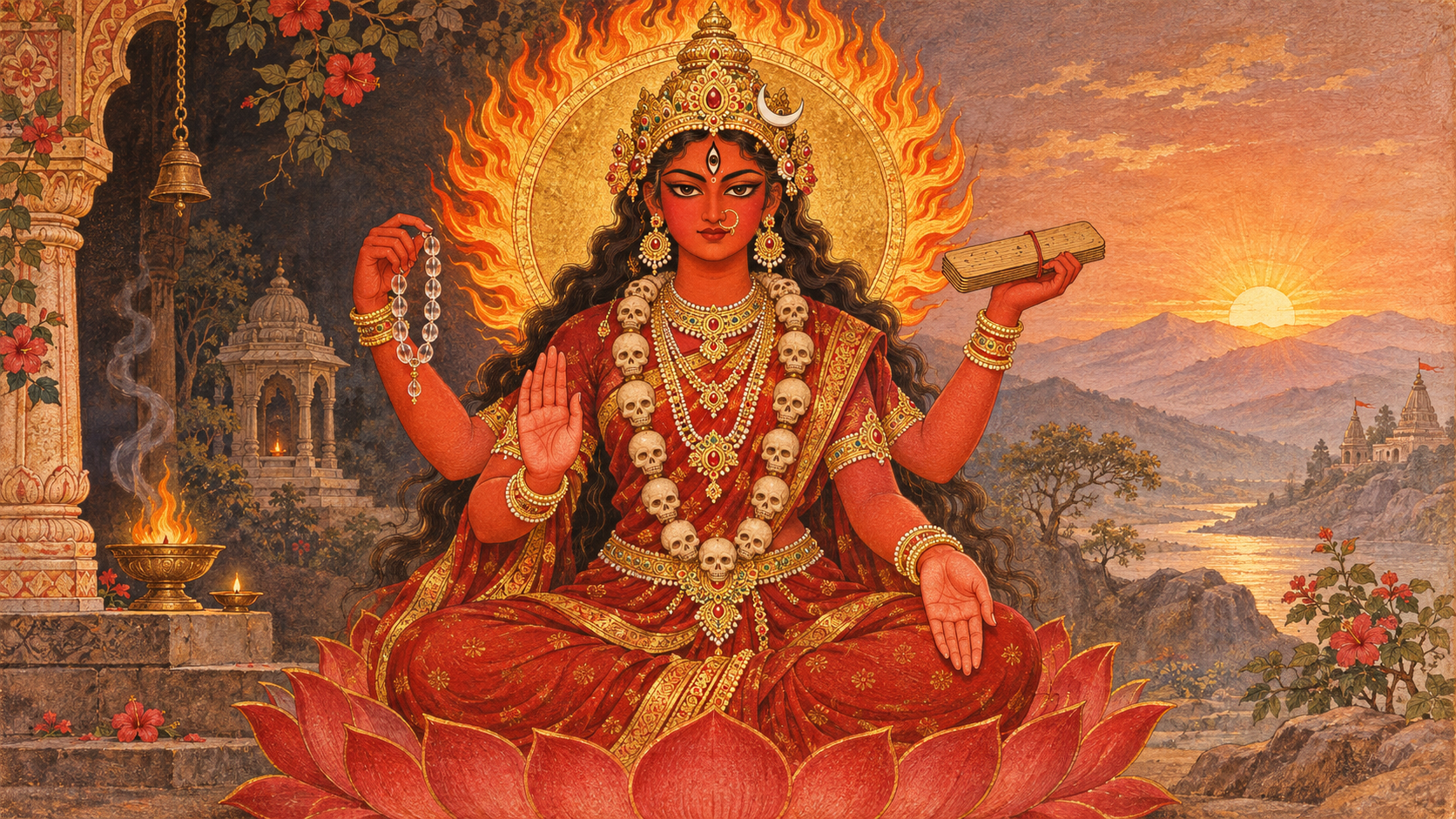
You may be looking at an image labelled Bhairavi or Tripura-bhairavi and wondering whether its ferocity signals anger, danger, or something deeper. Do not begin by cataloguing whatever appears frightening. Begin with her place among the Mahavidyas and ask what her fierceness is understood to accomplish.
That change of approach makes the image more intelligible. Bhairavi’s radiance is transformative: destruction is not the final meaning but the passage through which renewal becomes possible. Her iconography should therefore be read as visual theology, not as a collection of ominous decorations.
Begin with identity, not visual guesswork

Bhairavi belongs among the ten Mahavidyas, the great wisdom forms of Devi. She is also known as Tripura-bhairavi. Those facts provide the minimum frame for interpreting an identified image.
| Question | Reliable starting point |
|---|---|
| Who is represented? | Bhairavi, also called Tripura-bhairavi |
| Where does she belong? | Among the ten Mahavidyas |
| What quality does the form express? | Fierce, radiant and transformative divine power |
| What movement does it embody? | Destruction as a necessary passage toward renewal |
Treat this as an interpretive profile, not an exhaustive visual inventory. A fierce expression by itself does not prove that an otherwise unidentified figure is Bhairavi. Iconographic identification normally depends on a cluster of evidence: the name supplied by the worshipping tradition, the setting, the accompanying inscription or explanation, and the features of that particular representation.
This distinction matters because Bhairavi is worshipped through related manifestations. You should expect meaningful variation rather than force every image into one rigid template. If the representation has not been identified, do not invent certainty from its mood alone.
Fierce does not mean evil
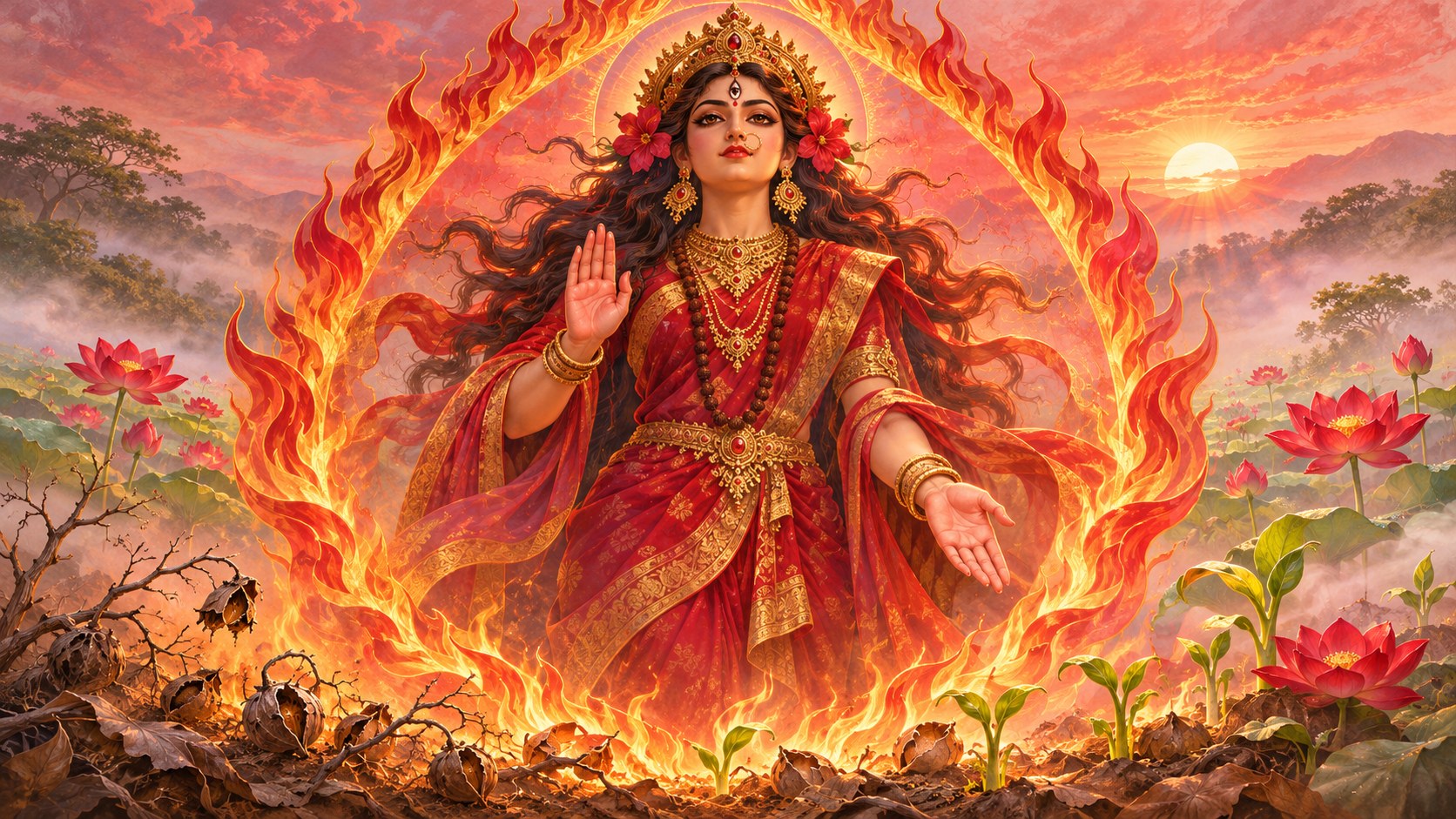
The easiest mistake is to carry a simple moral equation into the image: gentle must mean good, while fierce must mean bad. Bhairavi’s form refuses that equation. Her fierceness belongs to the transformative aspect of the Divine Feminine.
Within this framework, destruction is not presented as an isolated appetite. It is connected to renewal. The image directs attention to a difficult but recognisable spiritual movement: what has become exhausted, obstructive or untenable must give way before something new can emerge.
When you encounter Bhairavi’s fierce radiance, ask a more precise question than “Why is this goddess frightening?” Ask, “What kind of transformation requires such uncompromising force?” That question keeps the icon’s intensity intact without turning the Devi into a figure of mere hostility.
Do not over-personalise this symbolism. An image does not prove that a particular loss, conflict or crisis in your life was caused by the goddess. Iconography offers a theological way to contemplate transformation; it is not a prediction about individual events.
Three misreadings that distort the image
- “Every fierce goddess is Bhairavi.” Fierceness is a quality, not a unique name tag. Confirm the identification through the tradition or context attached to the image.
- “Destruction is the whole message.” In Bhairavi’s iconographic logic, destruction prepares the way for renewal. Stopping at terror removes the direction of the transformation.
- “One depiction fixes every detail.” Related manifestations can vary. Do not assume that one image establishes a universal arm count, posture, colour, implement, seat or surrounding figure for every representation bearing Bhairavi’s name.
The third error is especially important when you are comparing temple images, printed devotional art and modern digital illustrations. Differences do not automatically make one representation false. But variation is not permission to call any fierce female figure Bhairavi. The name and its traditional context still matter.
If you are documenting an image, separate observation from identification. Record what is visibly present first. Then record the name, location or tradition that identifies the deity. Finally, interpret those details through Bhairavi’s Mahavidya setting. This order prevents an assumption from quietly becoming a supposed fact.
A disciplined way to read Bhairavi iconography
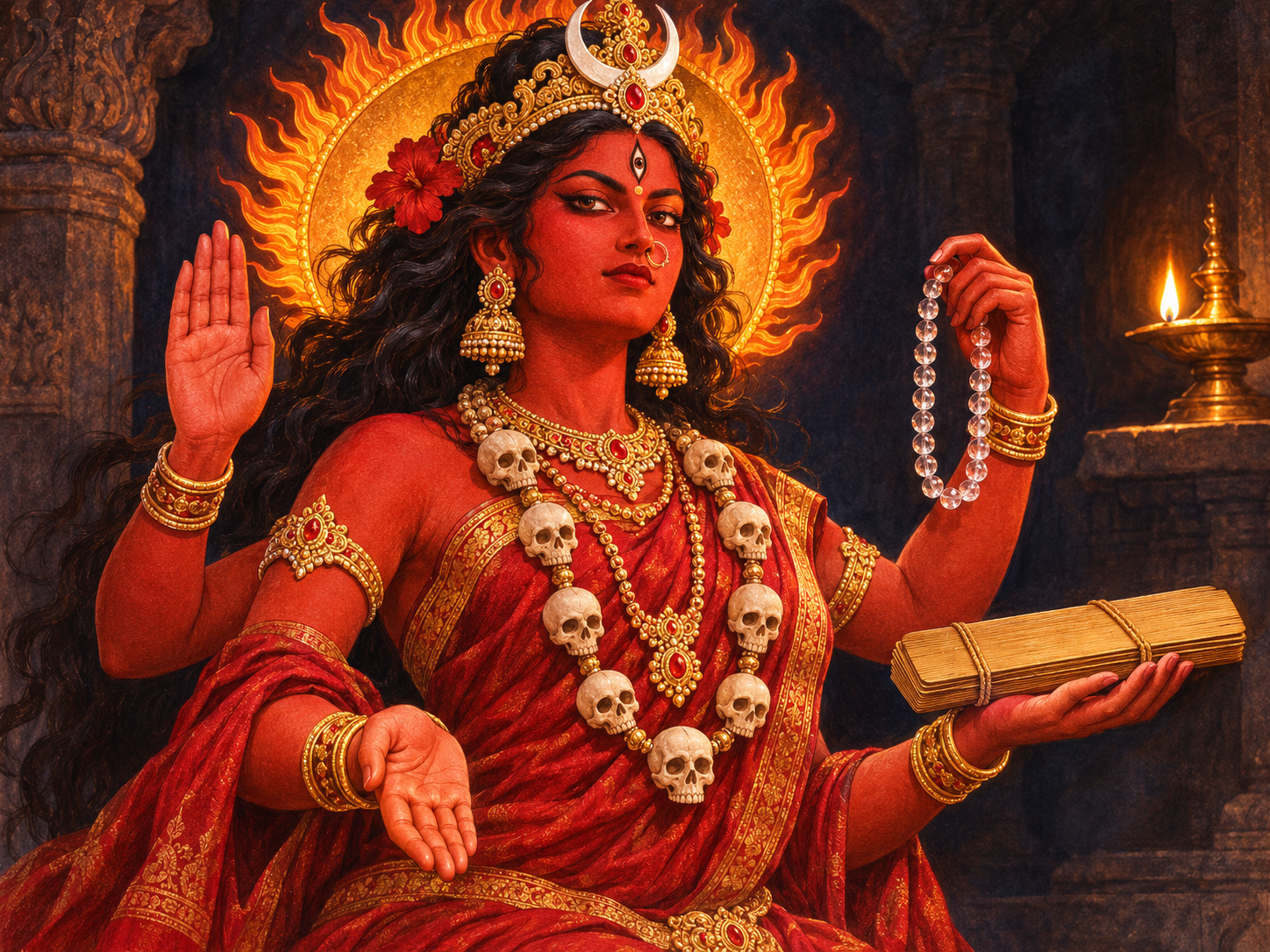
- Establish the supplied name. Look for Bhairavi or Tripura-bhairavi in the caption, inscription, temple explanation or established worship context. If no name is supplied, keep the identification provisional.
- Place the form within the Mahavidya framework. Remember that you are not reading an isolated frightening figure but one of the ten great wisdom forms of Devi.
- Separate identity from interpretation. The name establishes who is represented; the fierce quality helps you understand how divine power is being expressed. One should not be substituted for the other.
- Follow the complete theological movement. Read destruction together with renewal. Ask what must be removed or brought to an end for transformation to occur, while avoiding claims the image itself cannot establish.
- Mark what remains unknown. If the particular manifestation, ritual setting or significance of an attribute has not been explained, say so. Honest uncertainty is more respectful than a confident invention.
Your purpose should also shape the next step. A visitor can use this framework to look beyond surface ferocity. A student should document the image’s context and distinguish visible features from later interpretation. A devotee seeking instructions for worship should follow the relevant lineage, teacher or temple practice rather than reverse-engineer ritual from a photograph.
This method preserves two things at once: the specificity of Bhairavi’s identity and the depth of her symbolism. It also prevents iconographic study from becoming either vague mysticism or a mechanical hunt for visual objects.
Key takeaways
- Bhairavi, also called Tripura-bhairavi, is one of the ten Mahavidyas.
- Her fierceness expresses transformative divine power, not simple malevolence.
- Destruction and renewal form one movement in her iconographic meaning.
- A fierce appearance alone is not enough to identify an unlabelled goddess as Bhairavi.
- Related manifestations allow variation, so one depiction should not be treated as the universal template.
- For ritual practice, use tradition-specific guidance rather than deducing procedures from an image.
The next time you stand before a Bhairavi image, pause in this order: confirm the name, remember her place among the ten Mahavidyas, recognise the fierce transformative quality, and then ask how destruction opens toward renewal. If the image does not disclose more, let the remaining uncertainty stand. Careful seeing is itself a form of respect.
References

Leave a Reply
You must be logged in to post a comment.