

You may be trying to decide whether a serious spiritual life requires you to step back from work, family and public responsibility. One side of you wants time for study and inward clarity. Another knows that unfinished duties will not disappear merely because you call them distractions.
You do not need to choose between insight and responsible action as though they led in opposite directions. The practical task is to let jñāna transform the person who acts, while karma yoga turns each necessary action into a test of that understanding. The result is neither withdrawal nor compulsive busyness, but freedom in the middle of a life that still has work to do.
The apparent choice between knowledge and action
Arjuna’s question in Bhagavad Gītā 5.1 is recognisable because it arises under pressure. He has heard of sannyāsa, the renunciation of action, and he has heard karma yoga praised. He does not ask for an elegant theory. He asks which path he should actually follow. The question becomes urgent because a divided mind wants one clear shape for its life.
The preceding movement of the Gītā explains why he is confused. Action can be performed as yajña, an offering rather than a private project of the ego. Knowledge can burn the binding force of karma, as Bhagavad Gītā 4.37 declares. Yet the chapter does not end by telling Arjuna to disappear from his field of responsibility. In 4.42, Kṛṣṇa tells him to cut doubt with knowledge, take his stand in yoga, rise and act.
The contradiction begins to dissolve once you distinguish the outward form of a life from the inward cause of bondage. Work does not bind merely because the body and mind are active. What binds is the claim woven through the action: “I am the independent doer; this result must validate me; its success is mine; its failure diminishes me.” Giving up a task does not automatically remove that claim. It may only move the same ego into a quieter room.
This does not reduce formal sannyāsa to an attitude or deny the integrity of a genuine renunciant vocation. It prevents a householder, professional, parent or public servant from romanticising the external form of renunciation as an escape from unresolved attachment. Outer withdrawal and inner freedom are not interchangeable.
Before making a major change in the name of spirituality, ask three questions:
- Is the duty itself dharmic? A proper attitude cannot purify deceit, cruelty or knowingly harmful conduct. Correct the action before trying to become detached from its result.
- Am I leaving from clarity or from aversion? Exhaustion, wounded pride and fear of failure can imitate renunciation. If the strongest thought is “I should not have to face this,” look more closely.
- What attachment would remain if I walked away? If you would continue rehearsing the conflict, craving recognition or blaming others, the field has changed but the knot has not.
These questions redirect you from “Which identity should I adopt?” to “What is actually becoming free?” That is the more demanding question, but it is also the one you can test in daily life.
How jñāna and karma yoga correct one another
Jñāna is not the accumulation of spiritual vocabulary. It is discriminating knowledge: the inquiry that exposes mistaken identification with the changing body, mind, role, possession and result. It asks what is real, what is transient and who the supposed owner of action actually is. Without that inquiry, even generous service can strengthen the private story of being indispensable, virtuous or spiritually advanced.
Karma yoga is not simply working hard or being helpful. It is disciplined action performed as duty and offering, without treating the expected fruit as the foundation of one’s identity. Bhagavad Gītā 4.24 presents the act of offering, the offering itself, the sacred fire and the one who offers within a single Brahman-consciousness. This vision of yajña transforms the structure of action: the act is no longer imagined as an isolated ego sending its property into an alien world.
The two disciplines therefore address different sides of the same bondage. Jñāna reveals the error in “I am this separate doer and possessor.” Karma yoga prevents that insight from remaining merely verbal by placing it inside deadlines, criticism, uncertainty, service and loss of control.
Knowledge without disciplined action can become a protected self-image. You may speak fluently about the Self while becoming defensive when corrected or resentful when unnoticed. Action without knowledge can become moral strain. You may serve constantly while secretly keeping an account of who thanked you, who failed you and what reward should now arrive.
The integrated movement is practical:
- Discern. Identify the rightful action and the attachment trying to possess it.
- Offer. Place the action in a larger order than personal gain, whether you understand that as service to Īśvara, dharma or the welfare entrusted to you.
- Act fully. Use the skill, attention and care the duty genuinely requires.
- Observe. Notice when fear, vanity, resentment or the demand for control enters the work.
- Release and learn. Accept the result that has arrived, correct what can be corrected and refuse to turn either success or failure into a final definition of yourself.
This is a cycle, not a one-time achievement. Action exposes attachment. Knowledge helps you see it accurately. The next action gives you another opportunity to act without feeding it. In this way, daily life becomes a place of verification rather than an interruption to spiritual practice.
Inner renunciation does not mean indifference
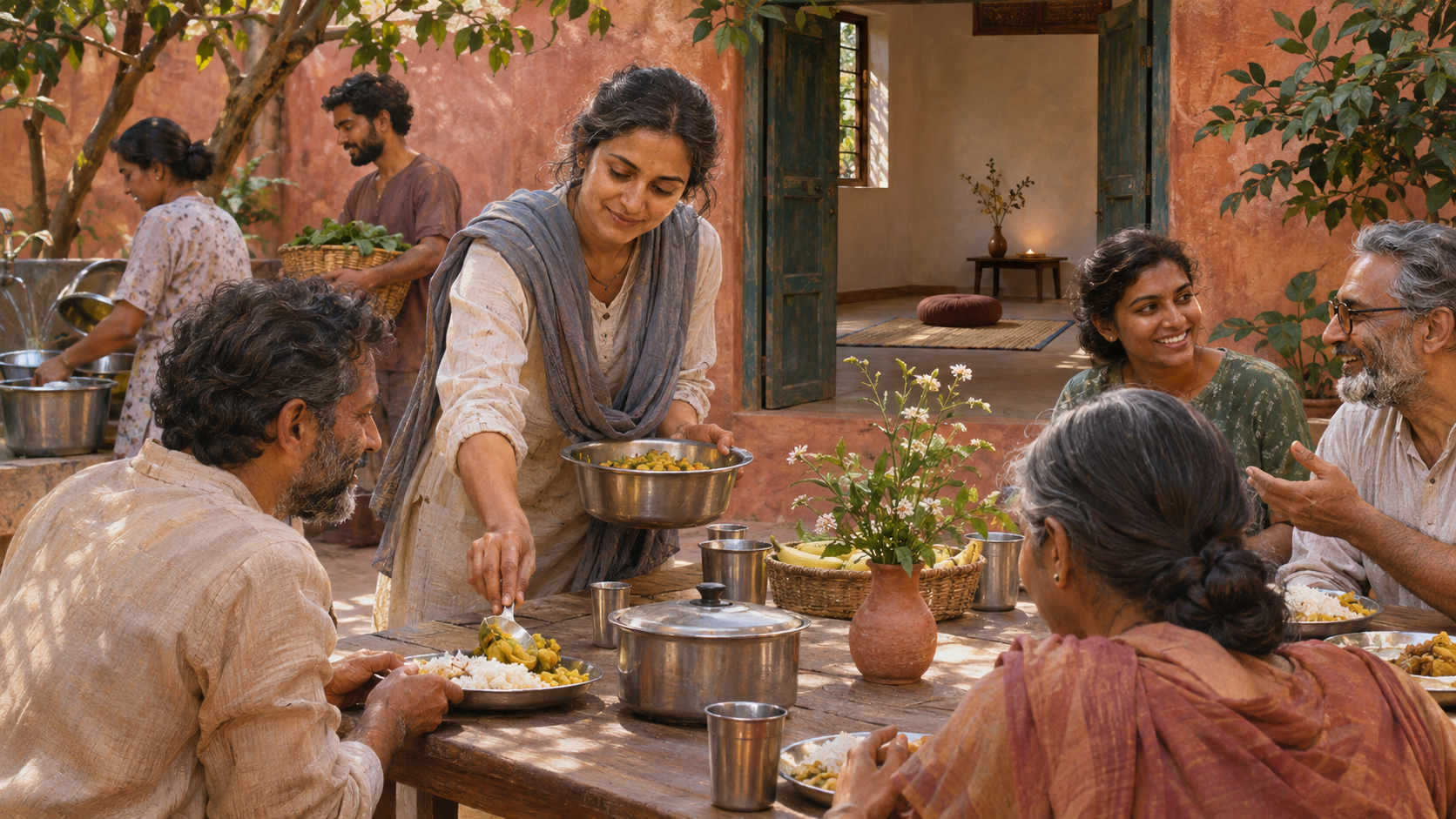
The instruction to relinquish attachment is easy to misuse. A careless worker can call negligence “detachment.” A person avoiding a difficult apology can call silence “peace.” Someone who refuses to plan can claim to have surrendered the future. None of these follows from karma yoga.
You remain responsible for the quality of your means, the care reasonably within your control and an honest response to consequences. What you renounce is the fantasy that careful action gives you absolute command over the fruit, or that the fruit establishes your worth.
- Responsibility is not ownership. You can be answerable for preparing accurate work without imagining that praise, promotion or agreement is owed to you.
- Desire is not dependence. You can prefer a beneficial outcome and work toward it without making inner stability conditional upon obtaining it.
- Care is not control. You can care intensely about a family, community or national concern while recognising that many causes and many people shape the result.
- Renunciation is not escape. You may need to leave an adharmic situation, but the decision should arise from discernment rather than a wish to avoid discomfort, criticism or responsibility.
Suppose you are preparing an important report. Karma yoga does not tell you to be unconcerned about accuracy. You check the facts, meet the rightful deadline and correct an error if one is found. The renunciation concerns the extra mental demand: “Everyone must admire this; no one may question me; the result must secure my position.” Releasing that demand generally makes careful work more possible, not less.
The same distinction matters in seva. If you organise a community event, the event’s welfare deserves planning and accountability. But service becomes binding when recognition is silently made part of the transaction. Irritation at unseen work can reveal that the action was offered only conditionally. That discovery is not a reason to condemn yourself. It is the exact attachment your practice has brought into view.
Detachment also does not require emotional numbness. Disappointment may arise when a worthy effort fails. Relief may arise when it succeeds. Notice both without building an identity around either. Suppressing an emotion to look spiritually composed only drives the attachment out of sight; seeing it clearly gives jñāna something real to illuminate.
A daily discipline that joins insight with duty

An integrated practice works best when it is attached to a real obligation rather than reserved for an ideal spiritual mood. Choose one recurring duty that reliably produces anxiety, pride, resistance or a need for approval. Use that duty as your field of practice until the method becomes concrete.
- Name the dharma before beginning. State the action in plain terms: “My responsibility is to give an accurate answer,” “to listen without manipulating the response,” or “to complete this service carefully.” Do not include the result you hope other people will produce.
- Name the private claim. Complete the sentence, “I am insisting that this action must give me…” The answer may be approval, victory, security, control, gratitude or proof of spiritual worth. Precision matters because a vague attachment is difficult to examine.
- Set an offering intention. Use a short sentence you can remember while acting: “This work is mine to perform, but its fruit is not mine to command.” The sentence is not a charm. It is a reminder of the boundary between responsible effort and ownership.
- Return attention to the action. When the mind begins rehearsing praise, humiliation or imagined outcomes, come back to the next rightful part of the task. Full attention is more consistent with offering than anxious speculation.
- Receive the result without falsifying it. Acceptance does not mean pretending that a poor result is good. Record what happened, repair what is repairable and learn what the action revealed. Then stop using the result as evidence for a permanent story about yourself.
At the end of the day, review the chosen duty with two separate questions. First: “What should I improve in the action?” Second: “What claim of ownership or identity became visible?” Keeping these questions separate prevents two common errors. You will not excuse bad work by appealing to detachment, and you will not mistake practical correction for spiritual failure.
Study should then return you to life. A passage such as Bhagavad Gītā 4.42 does not end with the removal of doubt in abstraction. Its direction is to stand in yoga and act with clarity. After contemplation, decide where the teaching will be tested: in the message you have avoided sending, the promise you need to keep, the correction you need to accept or the service you need to perform without display.
If you notice that study repeatedly produces more concepts but no change in conduct, reduce the distance between learning and application. Take one distinction into one duty. If ceaseless work has crowded out all inquiry, create a regular pause before action so that habit does not masquerade as karma yoga. The disciplines must remain in conversation.
Key takeaways: test the path by what it loosens
- If study makes you avoid rightful duties, bring the insight into one duty before seeking another teaching. Knowledge should cut confusion, not provide a refined excuse for inaction.
- If service makes you resent the people you serve, examine the unspoken reward you expected. Continue, change or leave the task according to dharma, but do not hide the bargain from yourself.
- If “detachment” reduces the quality of your work, you have detached from responsibility rather than ownership. Restore care, preparation and accountability.
- If failure still becomes “I am a failure,” return to jñāna. Learn from the event without turning a changing result into your identity.
- If success immediately becomes “This is mine,” return to yajña. Recognise the conditions, contributions and larger order that made the result possible.
- If criticism can be examined without instant self-defence, integration is beginning to show. Keep what is true, correct what is wrong and release the remainder.
- If you can act firmly without hatred and care deeply without demanding control, inner renunciation is becoming practical. That is a better measure than adopting a spiritual label.
Choose one duty you already have today. Determine whether it is rightful, name the result you are trying to possess, offer the action and perform it carefully. When the outcome arrives, let it teach you without letting it define you. That single completed cycle will tell you more about the integration of jñāna and karma yoga than another round of debating which path sounds higher.

References

Leave a Reply
You must be logged in to post a comment.