
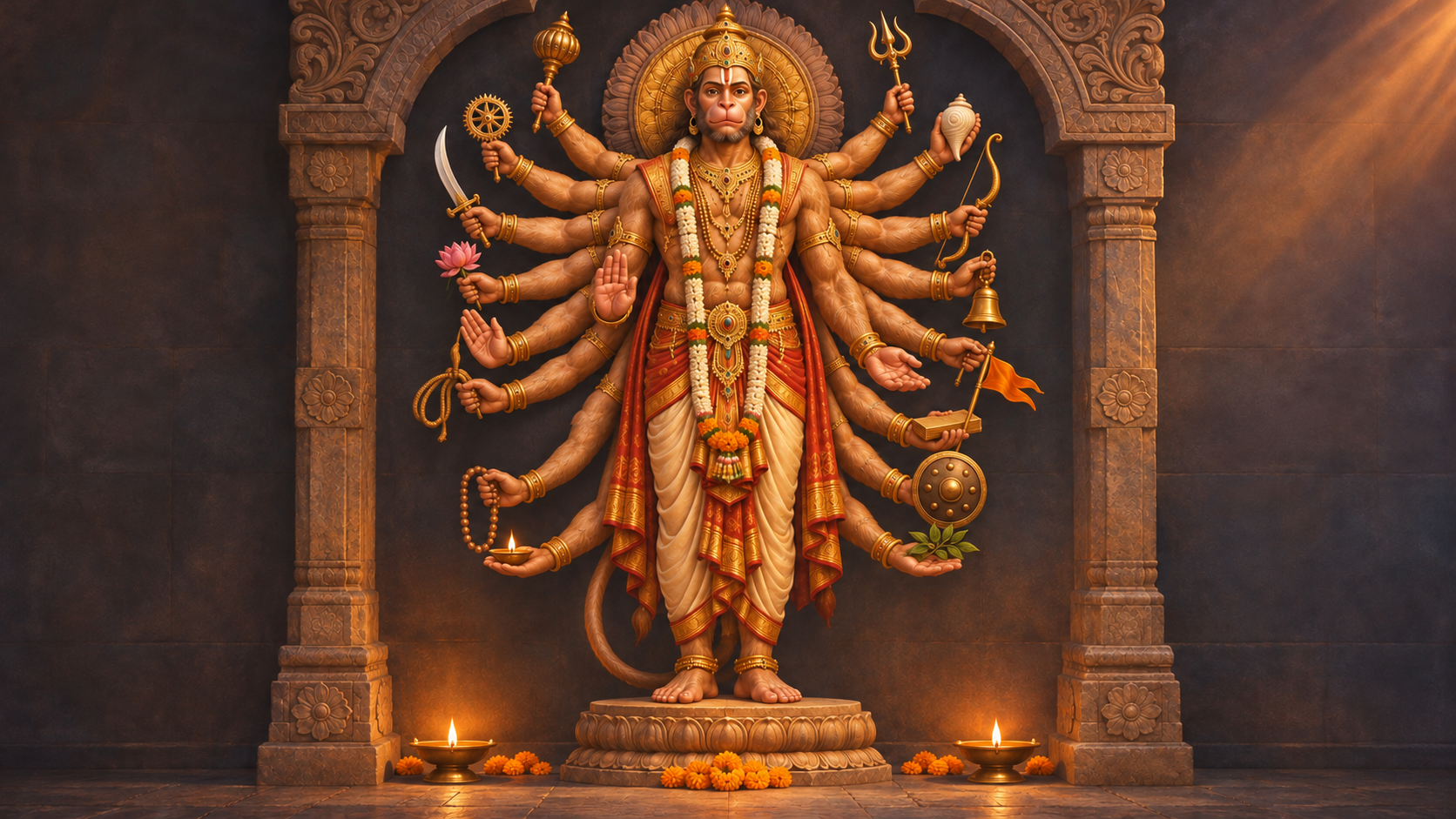
You may have encountered a temple murti or photograph of Hanuman with one face surrounded by an extraordinary array of arms. Your immediate questions are likely simple: Is this Panchamukha Hanuman, what do the eighteen arms signify, and how can you identify the objects without inventing meanings?
Begin with structure before symbolism. Count the faces, count the arms, and only then examine the individual hands. That order lets you recognize Ashtadashabhuja Hanuman accurately while respecting the difference between what the image shows, what a shrine preserves, and what a viewer interprets.
Start with the identifying feature most people miss
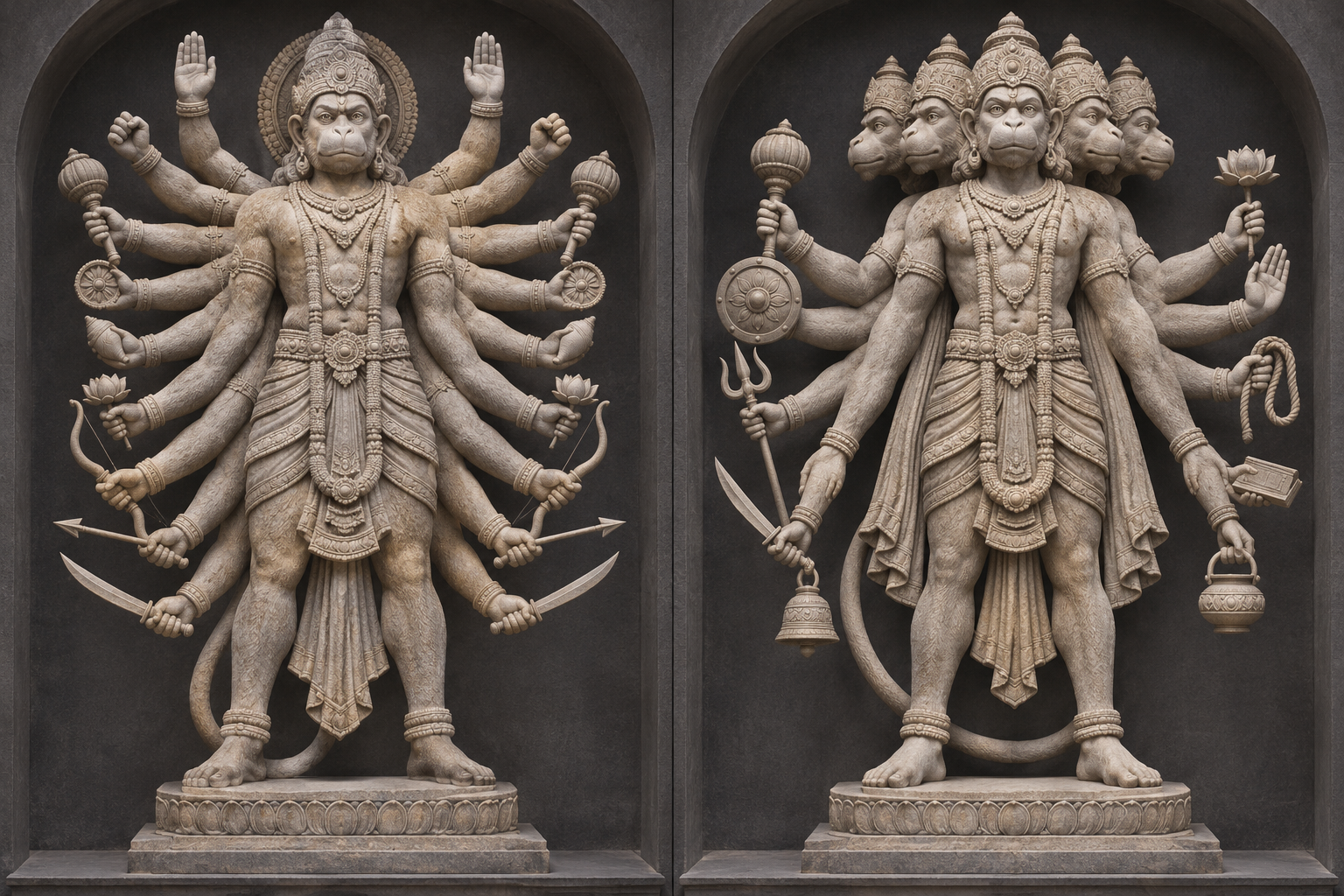
Ashtadashabhuja means eighteen-armed. The decisive feature is not merely the number of hands: this rare and sparsely documented form keeps a single face while presenting eighteen arms. Panchamukha Hanuman, by contrast, is identified through five faces. Count faces first and you avoid collapsing two distinct iconographic ideas into one.
Do not begin by guessing the weapons. Many sacred figures have multiple arms, while photographs can conceal hands through overlap, damage, ornament or foreshortening. Use this identification sequence:
- Confirm that the central figure is Hanuman through the shrine name, inscription, established local tradition and recognizable features. Arm count alone does not identify a deity.
- Count actual faces rather than crowns, aureoles or smaller figures carved beside the main head.
- Trace every arm from the torso or shoulder toward its hand. This prevents one implement from being mistaken for an additional limb.
- Count visible hands and note any places where an arm may be hidden, broken or restored. Do not round an uncertain count up to eighteen merely because the label seems plausible.
- Compare your count with the name used by the temple or community. If the visual evidence and local identification differ, record both instead of silently choosing one.
A single frontal photograph is often insufficient. An arm may pass behind another, a long implement may cross the torso, and a damaged hand may disappear into an ornamental background. When accuracy matters, inspect oblique views or the murti itself. Uncertainty is better than a confident misidentification.
Read the murti from its centre outward
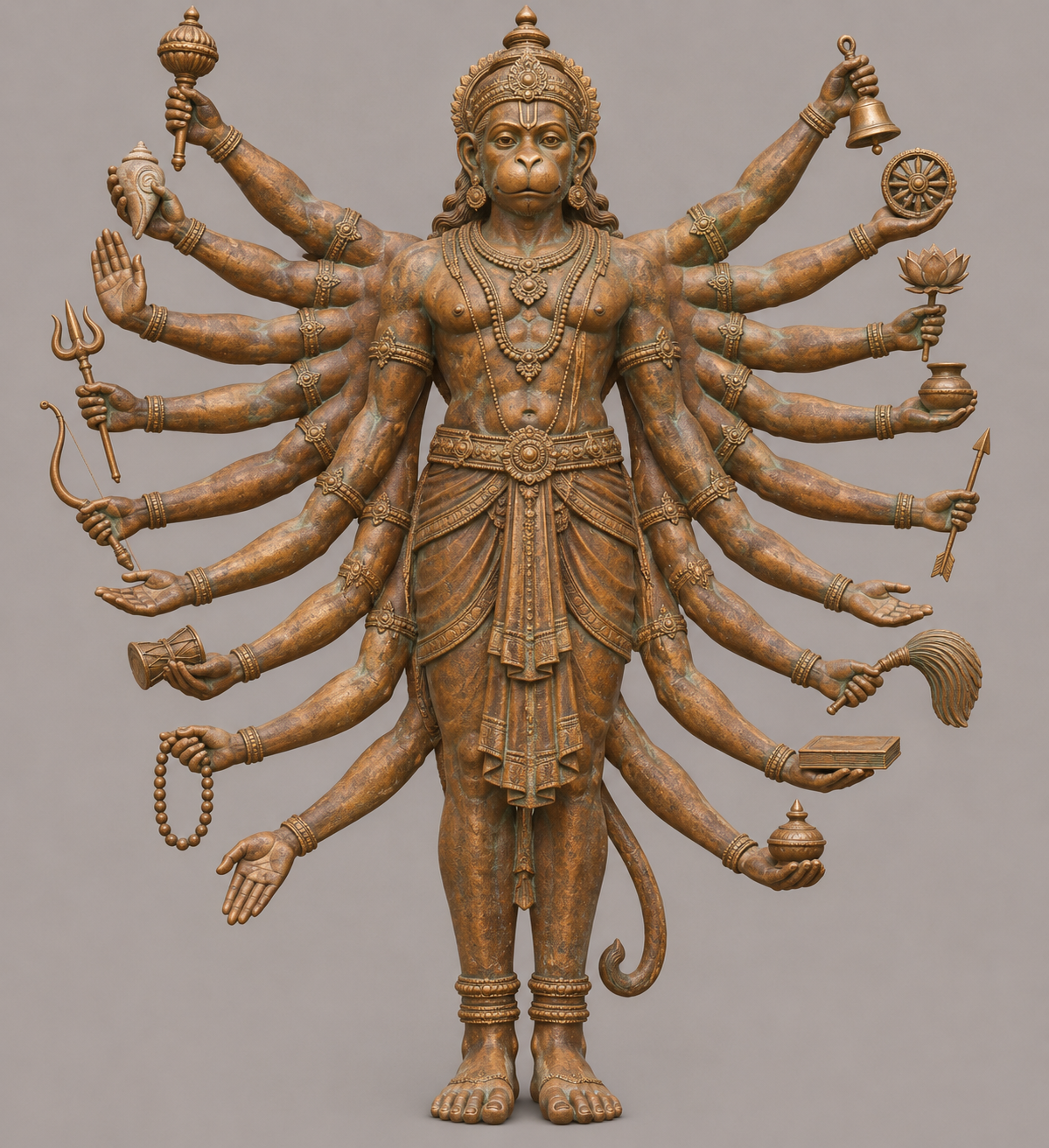
A productive reading begins with Hanuman’s central identity and then moves into the expanding field of action formed by the arms. The single face holds the personality together; the many arms display a capacity to act in numerous ways without fragmenting that identity. This visual grammar matters more than finding an ingenious explanation for every object at first glance.
Face, expression and bodily posture
Notice whether the composition presents stillness, forward movement, readiness or repose. Then ask what is actually carved and what may have been introduced by later paint, ornament or restoration. A bright colour, enlarged eye or recently added decoration can change the emotional impression without belonging to the original sculptural design.
Do not treat a calm face as evidence that the form lacks power, or a forceful posture as evidence of uncontrolled anger. Hanuman’s sacred character joins strength to devotion and service. The useful question is how the composition disciplines its visual power: through symmetry, balance, a stable stance or a face that remains focused amid the movement of eighteen arms.
Hands, gestures and held attributes
Make an inventory before assigning meanings. Number the hands from 1 to 18 using a stated convention, such as moving clockwise from the uppermost hand on the deity’s right. Always say whether right and left refer to the deity or the viewer; otherwise another reader cannot reconstruct your observations.
For each hand, record one of four initial descriptions: recognizable gesture, recognizable object, damaged or obscured object, or uncertain. A worn blade, staff, flower or ritual implement can look like something else when seen from only one angle. If identification depends on a tiny detail that the image does not preserve, label it tentative.
After the inventory is secure, ask how the attributes work together. Some may communicate protection or combat readiness; others may point toward worship, discipline, knowledge or service. Meaning emerges from the ensemble, not from treating every implement as an isolated emblem.
Pedestal, inscription and shrine setting
The setting can settle questions that the figure alone cannot. Record the exact shrine name, any inscription, accompanying deities, subsidiary figures and the language used on nearby labels. A local name, festival practice or sthala-purana may preserve an interpretation unavailable from visual inspection.
Keep local testimony attached to its location. If one temple identifies a particular object or gives the eighteen arms a specific theological correspondence, present that as the temple’s tradition unless you can establish that the interpretation is more widely shared. Locality does not make a tradition less sacred; it tells you the proper scope of the claim.
What the eighteen arms mean, and what they do not prove
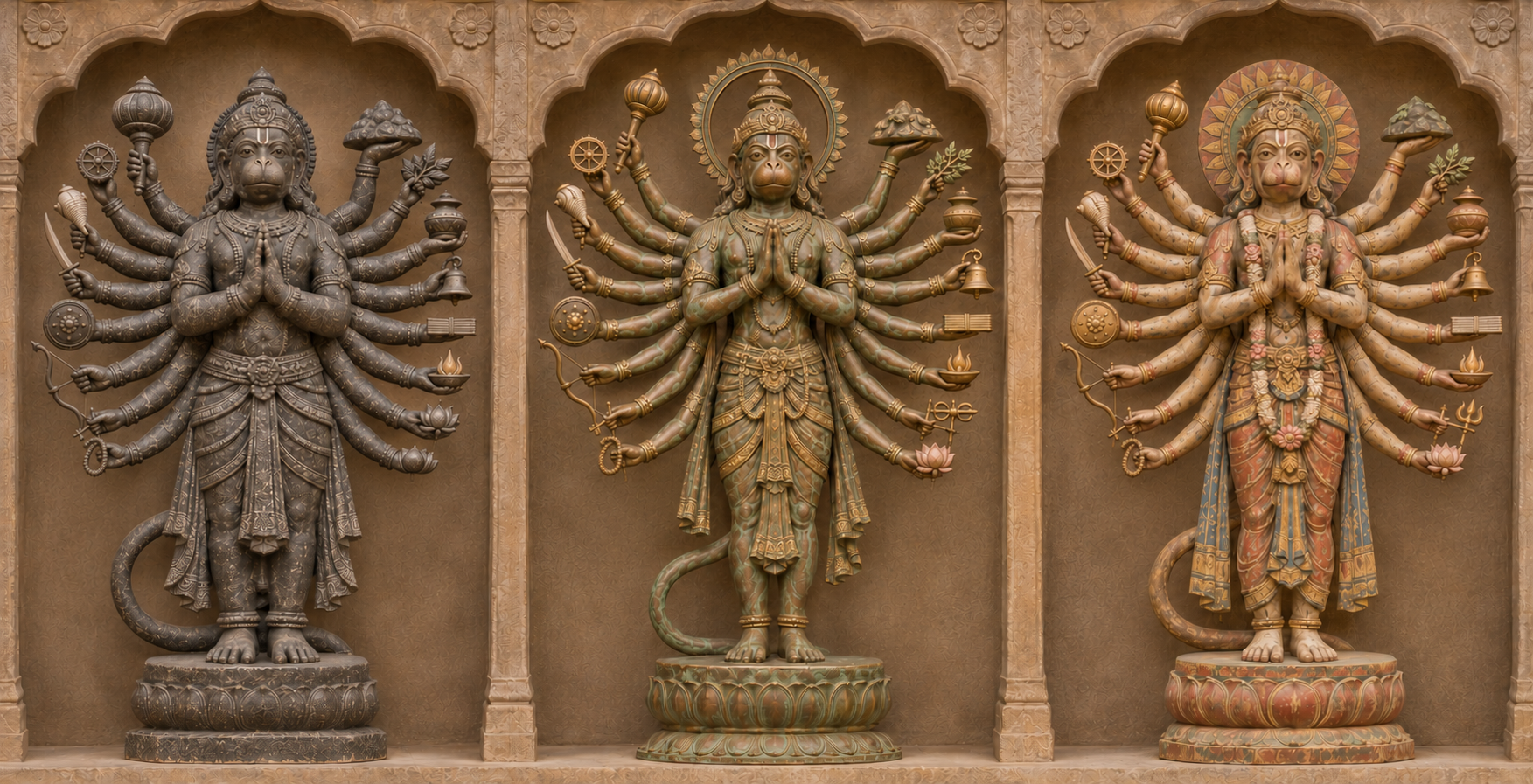
Multiple arms are a visual language for capacities exceeding ordinary human limitation. A person usually performs a small number of physical actions at once; a many-armed sacred form can present protection, strength, readiness, discipline and service simultaneously. In Ashtadashabhuja Hanuman, multiplicity should therefore be read as concentrated agency rather than anatomical excess.
The single face is crucial to that reading. Eighteen arms do not divide Hanuman into eighteen personalities. They radiate from one centre. Devotion, courage, intelligence, strength and service are not competing virtues here; they are coordinated expressions of one dharmic purpose. The sculptural challenge is to make great complexity appear ordered, and the spiritual challenge offered to the devotee is similar: many abilities must answer to one righteous commitment.
The number eighteen can tempt a viewer to search immediately for another sacred set of eighteen and declare a one-to-one correspondence. Resemblance is a reason to investigate, not proof of a connection. The number and arm count alone do not establish any of the following claims:
- That every Ashtadashabhuja image carries the same eighteen objects in the same order.
- That each arm necessarily represents a separately named power, episode, scripture or deity.
- That any familiar religious group of eighteen automatically explains this iconography.
- That an eighteen-armed form is spiritually higher than a two-armed or five-faced representation of Hanuman.
- That an attribute list associated with Panchamukha Hanuman can be transferred unchanged to the single-faced form.
A fixed correspondence may belong to a particular text or temple tradition, but it must be demonstrated rather than assumed. When no inscription, textual reference or reliable local explanation is available, the responsible interpretation stays at the level the image supports: one Hanuman, eighteen arms, many coordinated capacities.
This restraint is not a refusal to interpret. It preserves a meaningful distinction between symbolism and speculation. Symbolism begins with visible form and inherited practice. Speculation begins when an attractive theory is presented as though the sculptor or worshipping community had explicitly taught it.
Document or worship the form without inventing a story
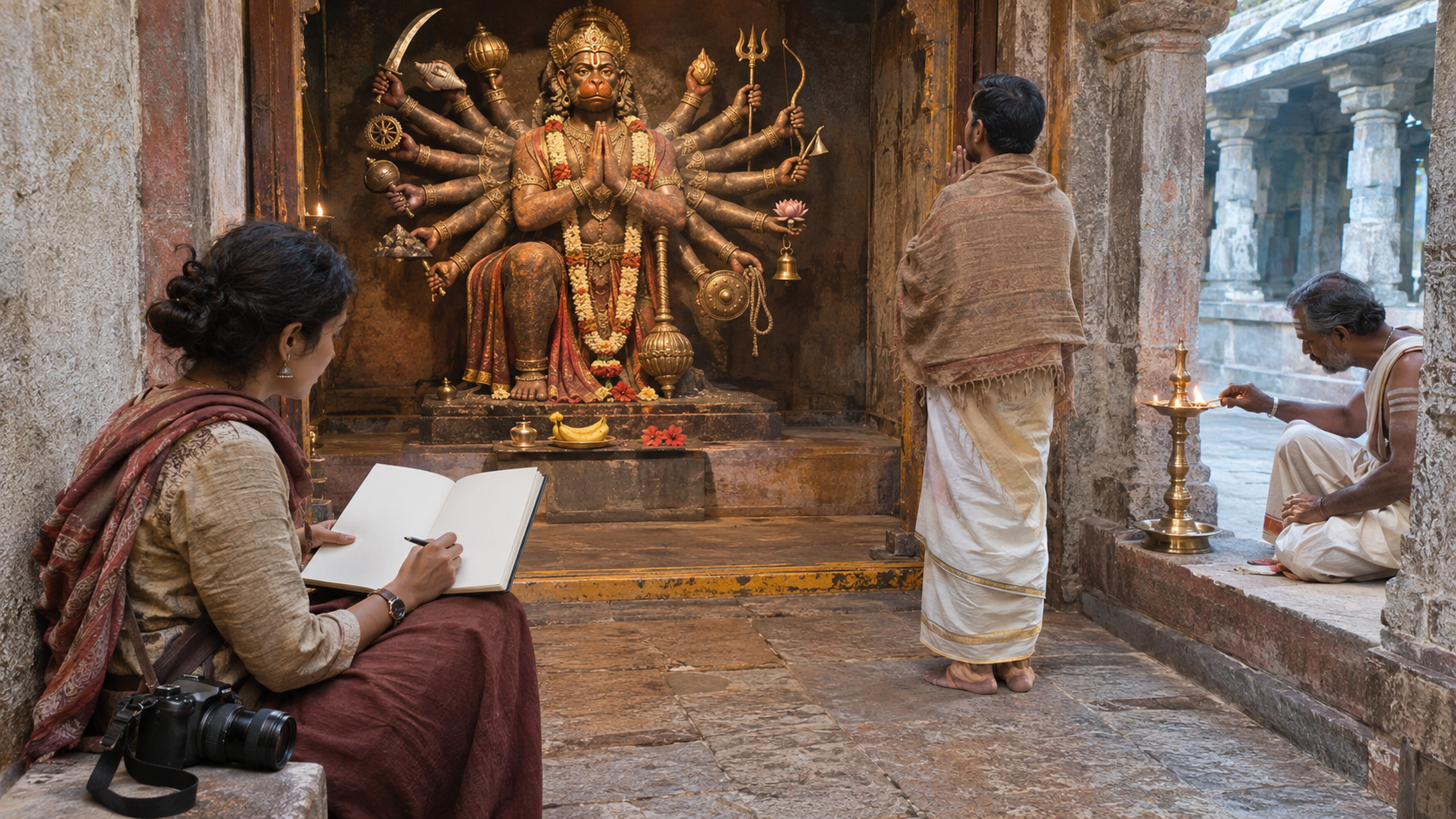
If you are recording an Ashtadashabhuja Hanuman for study, a temple archive, social media or a publication, use a method that someone else can check:
- Ask permission before photographing, especially inside an active sanctum. Temple practice takes precedence over the convenience of documentation.
- Capture a direct frontal view and, where permitted, both oblique sides. The side views help separate overlapping arms and implements.
- Record the temple, locality, shrine name, date of observation and exact local spelling of the form’s name.
- Transcribe inscriptions exactly before translating or correcting them. Preserve uncertain letters as uncertain.
- Create a hand map numbered 1 through 18. Attach a brief visual description to every hand before supplying an iconographic name.
- Ask whether all arms and attributes are original, whether the murti has been restored, and whether a temple booklet, inscription or oral account explains them.
- Publish observation, local tradition and interpretation as three distinct layers.
That final distinction can be stated plainly. An observation says, “The upper hand holds a long, curved object.” A local identification says, “The shrine caretaker names it as a particular weapon.” An interpretation says, “The object may signify disciplined protective power.” Each statement has a different kind of authority, and the reader should be able to see which is which.
A careful caption might read: “Single-faced, eighteen-armed Hanuman, identified locally as Ashtadashabhuja Hanuman; several attributes remain uncertain because of overlap and surface wear.” Add the temple, location and date where appropriate. This is more useful than an impressive but unverifiable list of eighteen weapon names.
If your purpose is devotional rather than documentary, incomplete iconographic knowledge need not obstruct worship. You are approaching Hanuman, and the form’s complexity directs attention toward the breadth of divine service and protection. Follow the name, mantra and ritual practice maintained by the temple. Do not manufacture a special mantra, vow or ritual sequence merely by converting the arm count into a formula.
A murti is not only a visual puzzle; it is encountered through darshana and worship. Precision is therefore a form of respect. It prevents a local sacred form from being overwritten by whatever list happens to circulate most widely online.
Key takeaways
- Ashtadashabhuja Hanuman is identified by one face and eighteen arms; Panchamukha Hanuman is organized around five faces.
- Count faces and arms before attempting to identify weapons, gestures or symbolic correspondences.
- The many arms communicate coordinated divine capacity, while the single face preserves unity of identity and purpose.
- The number eighteen does not, by itself, prove a fixed set of eighteen objects or a correspondence with another sacred group of eighteen.
- Use multiple viewing angles, inscriptions and local temple knowledge when an attribute is ambiguous.
- Keep direct observation, inherited local explanation and your own interpretation visibly separate.
The next time you encounter this form, resist the urge to solve all eighteen hands at once. Establish the single face, build an exact arm map, and ask what the shrine itself preserves. You will leave with fewer dramatic guesses, but with a clearer and more respectful understanding of Ashtadashabhuja Hanuman.
References

Leave a Reply
You must be logged in to post a comment.