
If you have ever completed a puja yet felt irritated when someone interrupted it, the Yajnapatnis lila places a difficult question before you: did the worship make you more available to Krishna, or did finishing the procedure become more important than recognizing whom the procedure serves?
The answer is not that ritual is empty and emotion is sufficient. The lila makes a finer distinction. Sacred discipline reaches its purpose when hearing, remembrance and worship produce a person who can recognize Krishna’s claim and respond. The Yajnapatnis do exactly that. Their example gives you a practical way to examine your own puja, study, seva and household duties.
Read the movement of the lila, not just its moral
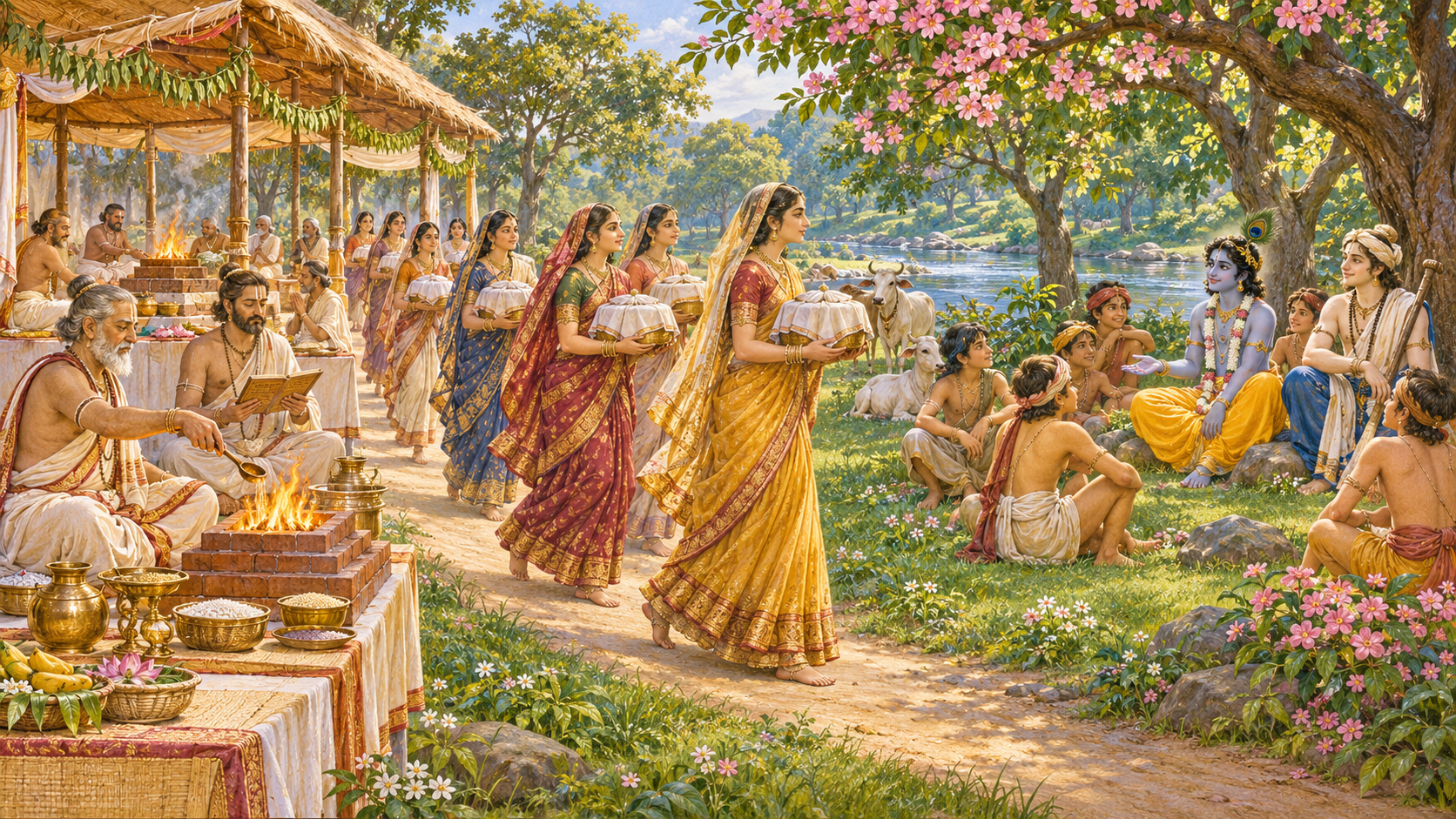
When the cowherd boys become hungry while tending the cattle, Krishna directs them to Brahmanas engaged in a yajna. The boys ask for food in the names of Krishna and Balarama. The ritualists, absorbed in the sacrificial procedure, do not respond to the request.
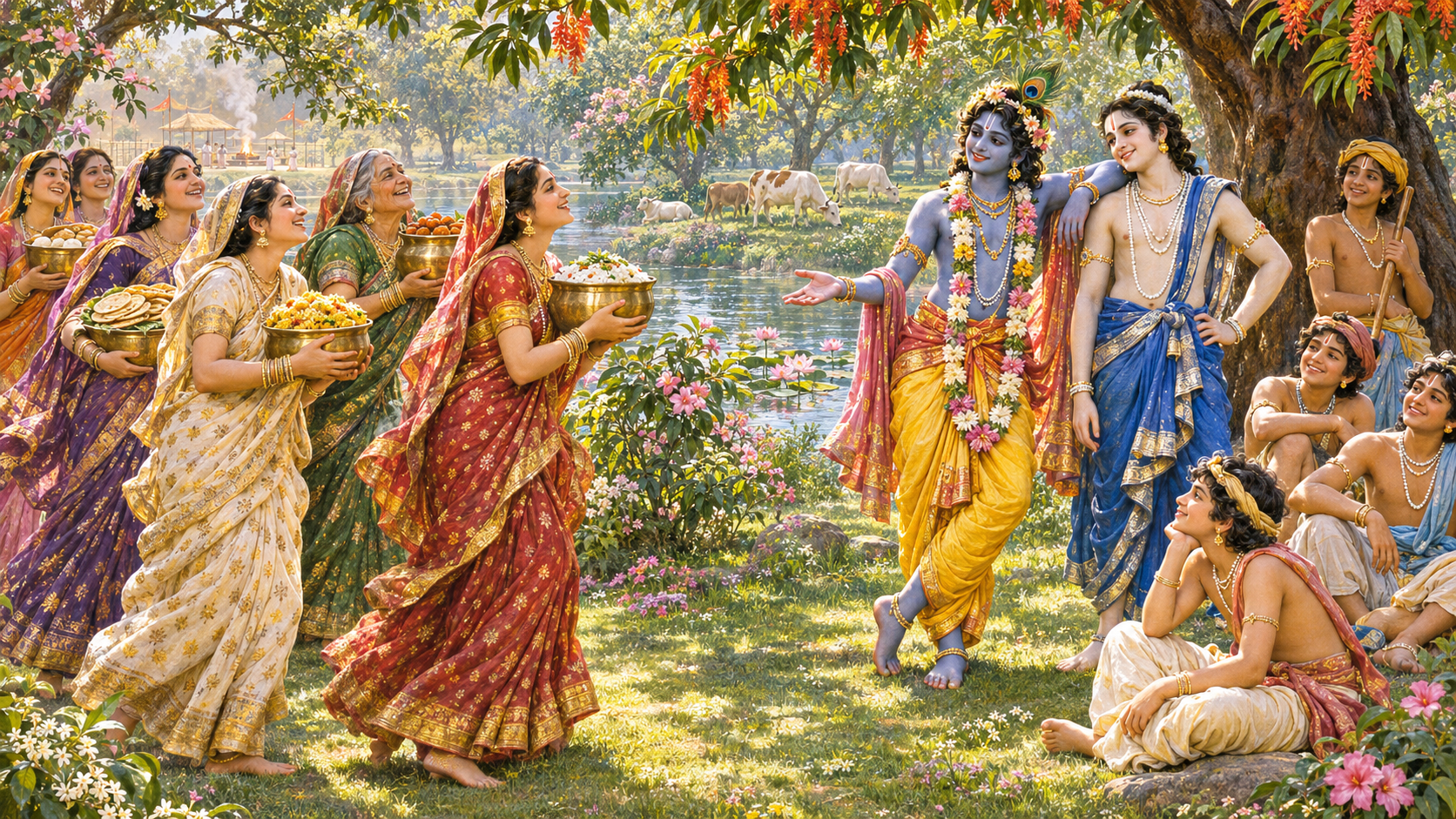
The boys then approach the Brahmanas’ wives. These women have heard about Krishna, and that hearing has already awakened devotion. When they learn that He is nearby and wants food, they gather what has been prepared and go to Him. Social objections do not extinguish their resolve.
The encounter with the Yajnapatnis does not end with their arrival. Krishna receives their devotion and then directs them to return to their households. Their husbands subsequently recognize their own failure to respond and the spiritual discernment shown by their wives.
Notice the full movement: Krishna’s request, the ritualists’ refusal, the wives’ immediate service, their meeting with Krishna, His instruction to return, and the husbands’ recognition of their mistake. If you stop at the refusal, the story becomes a slogan against priests. If you stop at the women’s departure, it becomes a celebration of religious impulse without responsibility. The complete lila supports neither reading.
The real contrast is responsiveness, not ritual versus devotion

Yajna is not the target of the correction. A yajna disciplines attention, offering and responsibility. Its failure here is more precise: the means has displaced the end. The Brahmanas know how an offering should be made, yet they do not recognize the Lord for whom sacrifice ultimately exists when His request reaches them.
That distinction matters whenever you read this lila. Bhakti does not authorize contempt for mantra, purity, sacred learning or careful worship. Nor does technical correctness guarantee spiritual perception. Procedure is meant to train attention toward Bhagavan. When it becomes a shield against His claim, something has gone wrong inside the practitioner, not inside the sacred form.
You can test that distinction with ordinary situations. A child who needs care, an elder waiting for food, a guest asking for water or a genuine request for seva may arrive at an inconvenient moment. The interruption is not automatically a divine command, but irritation should not be your only response. Pause long enough to discern what dharma requires.
- Is the request genuine, ethical and within your ability to meet?
- Are you protecting a necessary discipline, or merely defending your preferred schedule?
- Can you acknowledge the person now, even if the task itself must wait?
- Has your worship made you more attentive to need, or less willing to be disturbed?
This is not a call to abandon every observance whenever someone asks for something. The Yajnapatnis display discernment directed toward Krishna, not indiscriminate compliance. The practical correction is to stop treating inconvenience as proof that a request is spiritually unimportant.
Why the Yajnapatnis recognized what the ritualists missed
The wives do not manufacture devotion after the cowherd boys arrive. They have heard about Krishna. That hearing has already reordered their desires, so His name is not an unfamiliar sound when the request comes. Hearing becomes remembrance; remembrance creates eagerness; eagerness becomes service.
This gives you a sharper standard for listening to katha. The first question is not how much information you retained. Ask what became easier to recognize after hearing. If you hear about Krishna’s compassion but become no more patient with a dependent person, the teaching has remained at the level of description. If you hear about His acceptance of service but continually postpone an offering you can make, remembrance has not yet matured into response.
The social contrast also deserves care. The men possess formal authority within the yajna, while the women stand outside that ritual control. Yet, within this lila, formal position does not monopolize spiritual discernment. The women recognize Krishna’s claim first. Their example prevents us from equating institutional role, learning or public visibility with the fullness of bhakti.
That is not a verdict that women are inherently devotional and men inherently unresponsive. Turning the lila into a contest between the sexes would repeat the very mistake it exposes: judging spiritual capacity by external category. The meaningful difference is what each person has allowed hearing to do within the heart.
The return to their households is equally important. The Yajnapatnis show courage by going to Krishna despite opposition, and devotion by accepting His direction after reaching Him. Their departure and return belong to the same surrender. Taking only the departure can romanticize impulse; taking only the return can turn duty into an excuse for never moving toward Bhagavan.
The husbands’ later recognition adds another necessary lesson. Failure in a spiritual test need not end in permanent condemnation. It can become humility. When another person sees what you missed, the dharmic response is not to defend your title or learning. Name the failure, honor the clearer devotion and let the correction change how you respond next time.
Bring the Yajnapatnis test into your next worship
You do not need to imitate the external circumstances of the lila. Apply its inner sequence at the next puja, recitation, vrata or period of scriptural study.
- Begin with the recipient. Before attending to materials and sequence, remember in your own words whom the worship is for. This keeps correctness connected to relationship.
- Watch your first reaction to interruption. If someone needs you, notice whether concern or annoyance arises first. You may still need to complete a safe stopping point, but acknowledge the person instead of treating them as an obstacle.
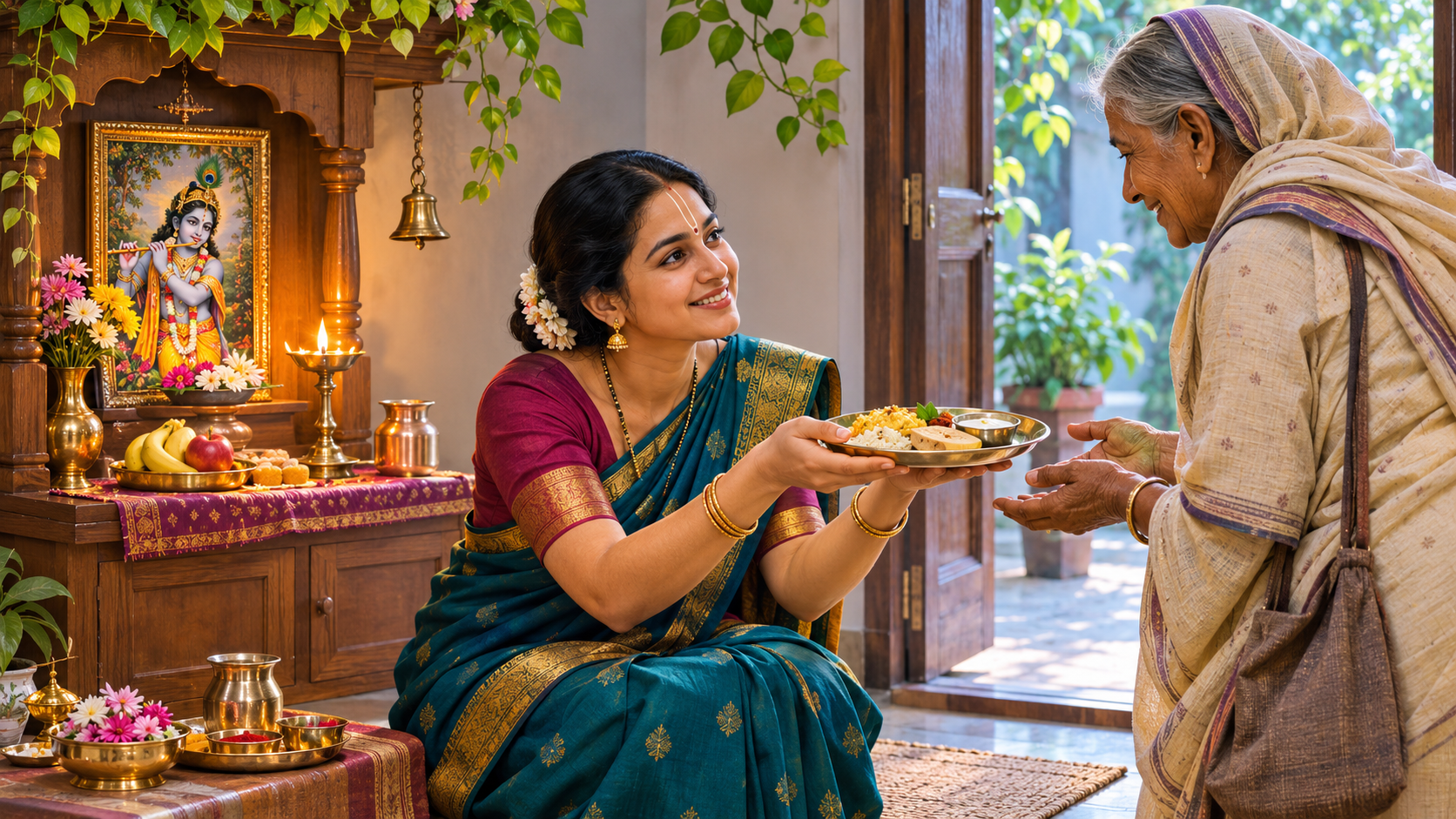
- Let offered food become service. After making your offering according to your tradition, share the prasada where appropriate. The food request in this lila makes it difficult to separate devotion to Krishna from the willingness to give.
- Carry hearing into a visible act. After katha, identify a neglected duty that the teaching has illuminated: an apology, promised help, hospitality, a contribution or care for someone dependent on you. Do it before the insight fades into admiration.
- Return without becoming spiritually absent. A powerful period of worship should sharpen your attention to household and community obligations. Returning to ordinary work is not necessarily a descent from devotion; it can be the place where devotion becomes truthful.
These steps are not a technique for earning Krishna’s grace. They are a way to notice whether worship is forming the disposition commended by the lila. The priests’ difficulty was not a shortage of religious activity. It was the gap between sacred action and recognition. Your practice should steadily narrow that gap.
Key takeaways
- The Yajnapatnis lila corrects ritual pride; it does not dismiss yajna or sacred discipline.
- Hearing becomes spiritually fruitful when it produces remembrance, discernment and timely service.
- The women’s lack of formal control over the sacrifice does not prevent them from recognizing Krishna’s claim.
- Their journey to Krishna and their return at His direction are both expressions of surrender.
- When someone else perceives what you missed, humility is more dharmic than defending status or expertise.
- You can examine worship by asking whether it makes you more attentive to Bhagavan, people and duties.
At your next act of worship, keep one question close: if Krishna’s claim arrived in an inconvenient form, would your practice help you recognize it? Then let the answer shape one concrete act of service. That is where the Yajnapatnis cease to be distant figures in Krishna-lila and become teachers of your own devotional life.
References

Leave a Reply
You must be logged in to post a comment.