

You can visit Kashi, stand beside the sea at Somnath, or enter the sacred atmosphere of Haridwar and still return with little more than photographs. A sacred journey does not automatically loosen pride, clarify purpose, or change conduct. The decisive distance is not the distance you travel across Bharat. It is the distance between what you revere and how you live.
If you are trying to remain rooted in dharma without withdrawing from modern life, antaryatra offers a workable path. It turns civilizational memory into self-examination, and self-examination into disciplined action. Bharat’s spiritual awakening begins at precisely that junction: when inherited wisdom stops being an identity badge and becomes a way of seeing, choosing, working, and serving.
Antaryatra begins where sightseeing ends
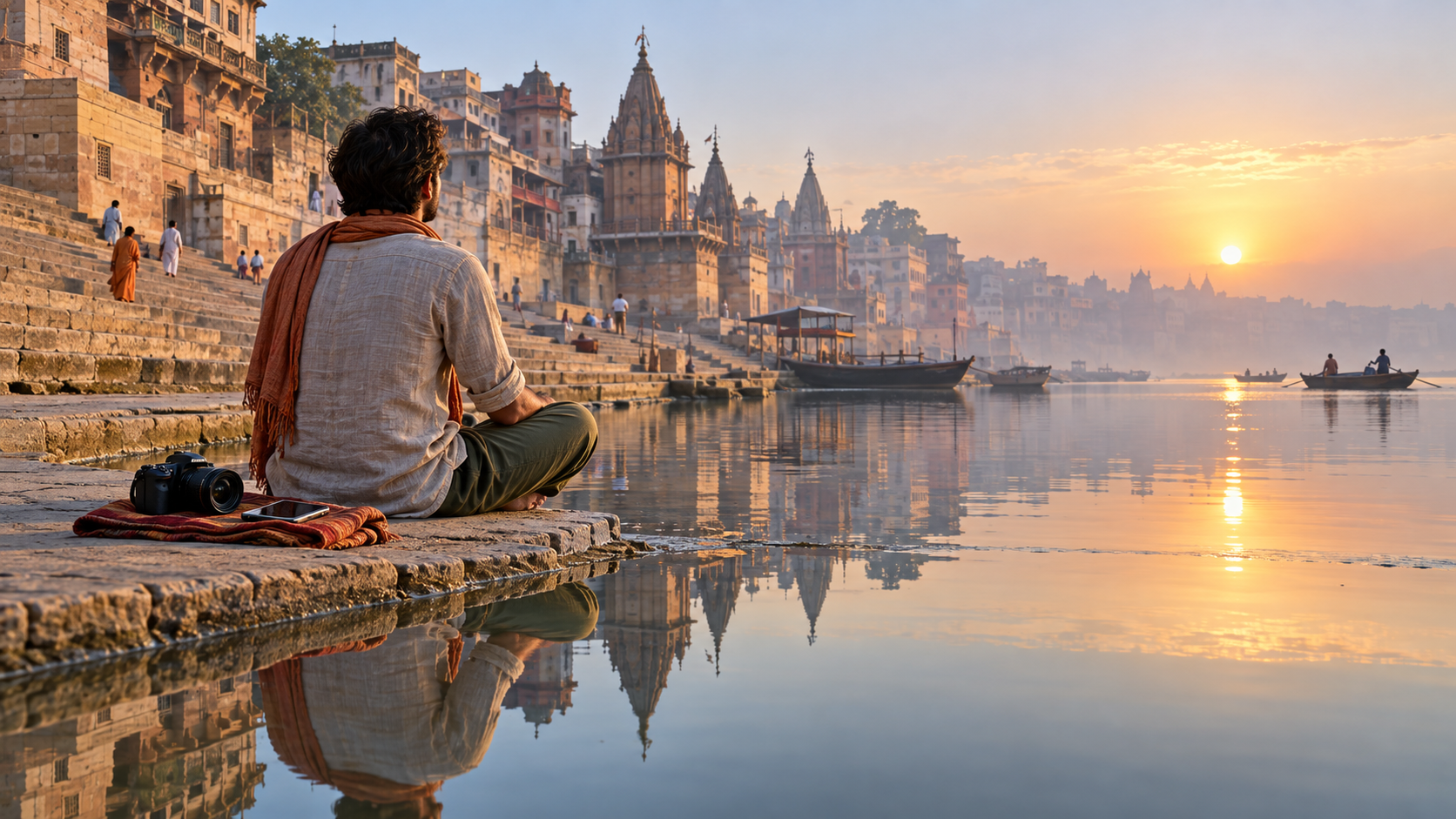
Antaryatra means an inward journey, but it should not be confused with retreat into a private spiritual world. The inward turn asks you to see the forces directing your outer life: appetite, fear, imitation, resentment, duty, aspiration, and the need for approval. It is an encounter with the person who is doing the travelling.
A tourist asks, “What can I see here?” A pilgrim asks, “What is sacred here?” A person undertaking antaryatra adds a more demanding question: “What must change in me because I encountered this?” The third question prevents pilgrimage from becoming spiritual consumption.
- The outer encounter gives you a place, tradition, symbol, teacher, or historical memory to contemplate.
- Inner inquiry reveals your reaction to it, including resistance, impatience, attraction, pride, and genuine reverence.
- Integration converts the insight into a practice, restraint, duty, or act of service that continues after the journey.
If integration is missing, you may accumulate sacred experiences while remaining governed by the same habits. The test is not whether a place made you emotional. The test is whether it made you more truthful about yourself.
Before seeking an unusual experience, work with a precise question. What desire repeatedly overrides your judgement? Which duty have you renamed as an inconvenience? Where do you use tradition to judge others while excusing yourself? What would you pursue if status were removed from the calculation? A question with consequences is more useful than a vague wish to “feel spiritual.”
Bharat’s sacred geography is a network, not a backdrop

Within the Dharmic imagination, Bharat is more than territory. It is Punya Bhoomi: a land made sacred by generations of realization, teaching, worship, philosophical inquiry, artistic expression, and sacrifice. This does not make every place identical. It means that geography carries memory and that movement through the land can become participation in a civilizational inheritance.
The unity becomes visible in the old movement of pilgrims across regions. People from Kerala travelled to Kashi, pilgrims from Kashmir sought Rameswaram, Gujaratis revered Jagannath at Puri, and Bengalis journeyed to Badrinath and Kedarnath. These routes carried practices, stories, philosophical ideas, languages, and relationships across the subcontinent.
That history should be read carefully. It does not prove that every region was politically uniform or that local traditions were interchangeable. It reveals something more durable: people separated by great distances recognized sacred centres beyond their home regions as part of a shared world. Civilizational coherence did not require cultural sameness.
Adi Shankaracharya’s journeys and the monasteries associated with the cardinal directions strengthened this interconnectedness. Swami Vivekananda’s later travels likewise allowed him to encounter Bharat’s diversity while discerning a deeper spiritual bond. In both cases, movement through the country was also a way of understanding the country.
You can use the same principle without pretending to reproduce those journeys. When you approach a sacred place, examine it through three connected lenses:
- Place: What happened here, and why has this location remained meaningful?
- Tradition: Which lineage, deity, teacher, community, or body of teaching preserves that meaning?
- Practice: What do people actually do here, and what quality is that practice intended to cultivate?
This keeps sacred geography from becoming scenery. If you know only a site’s opening hours, you have planned a visit. If you also understand its living practice and allow that practice to question you, you have begun a pilgrimage.
Do not flatten Bharat’s traditions in the name of unity. Hindu, Buddhist, Jain, and Sikh paths have distinct doctrines, disciplines, histories, and sacred vocabularies. A genuine Dharmic awakening meets those differences honestly. It looks for kinship without erasing boundaries and seeks dialogue without forcing every teaching into a single formula.
Turn reverence into a discipline you can practise

The most useful pilgrimage plan is not the one with the greatest number of destinations. It is the one that makes attention possible. A crowded itinerary can protect you from reflection because every encounter is immediately displaced by the next one.
Before you go
- Choose a governing inquiry. Write it in plain language, such as, “Why has achievement become the measure of my worth?” or, “Which responsibility am I postponing?”
- Learn the site’s central tradition before arriving. Know whom or what it honours, the basic meaning of its principal practices, and the conduct expected from a visitor.
- Choose a restraint that protects attention. This might mean limiting photography, reducing unnecessary phone use, avoiding argumentative conversation, or declining to turn every moment into public content.
- Define your offering as a disposition rather than a transaction. You are not purchasing an outcome. You are bringing humility, patience, gratitude, or willingness to serve.
While you are there
- Observe before recording. Notice the rhythm of worship, the behaviour of devotees, the sounds, the physical setting, and your own mental restlessness.
- Keep two kinds of notes: what you encountered and what it exposed in you. The second is usually more important for antaryatra.
- Treat discomfort as information, not automatically as revelation. Crowds may expose impatience; unfamiliar customs may expose regional prejudice; simplicity may expose your dependence on convenience.
- Follow local norms respectfully. A sacred place is not required to reorganize itself around your preferences.
- Allow silence after a significant encounter. Immediate commentary can turn an unfinished insight into a fixed opinion.
After you return
- Complete this sentence: “Because I encountered this place or teaching, I will now change…” If you cannot name a change, continue reflecting before claiming transformation.
- Choose a practice small enough to sustain and serious enough to matter. Japa, svadhyaya, meditation, dana, seva, disciplined work, care for elders, and responsible participation in community life are different possibilities, not interchangeable decorations.
- Connect insight to duty. If the journey deepened gratitude for a tradition, identify how you will help transmit, support, study, or serve it.
- Do not collect advanced techniques from unrelated lineages as spiritual souvenirs. When a practice depends on initiation or specialized guidance, learn from a qualified teacher within that tradition.
Travel is helpful, but it is not a prerequisite. If you cannot journey to a distant tirtha, begin with a nearby temple, gurudwara, monastery, Jain derasar, study circle, or place of service. You can also choose a teaching, learn its context, practise it consistently, and observe what it reveals. Antaryatra is measured by depth of engagement, not kilometres covered.
Judge spiritual awakening by what it changes
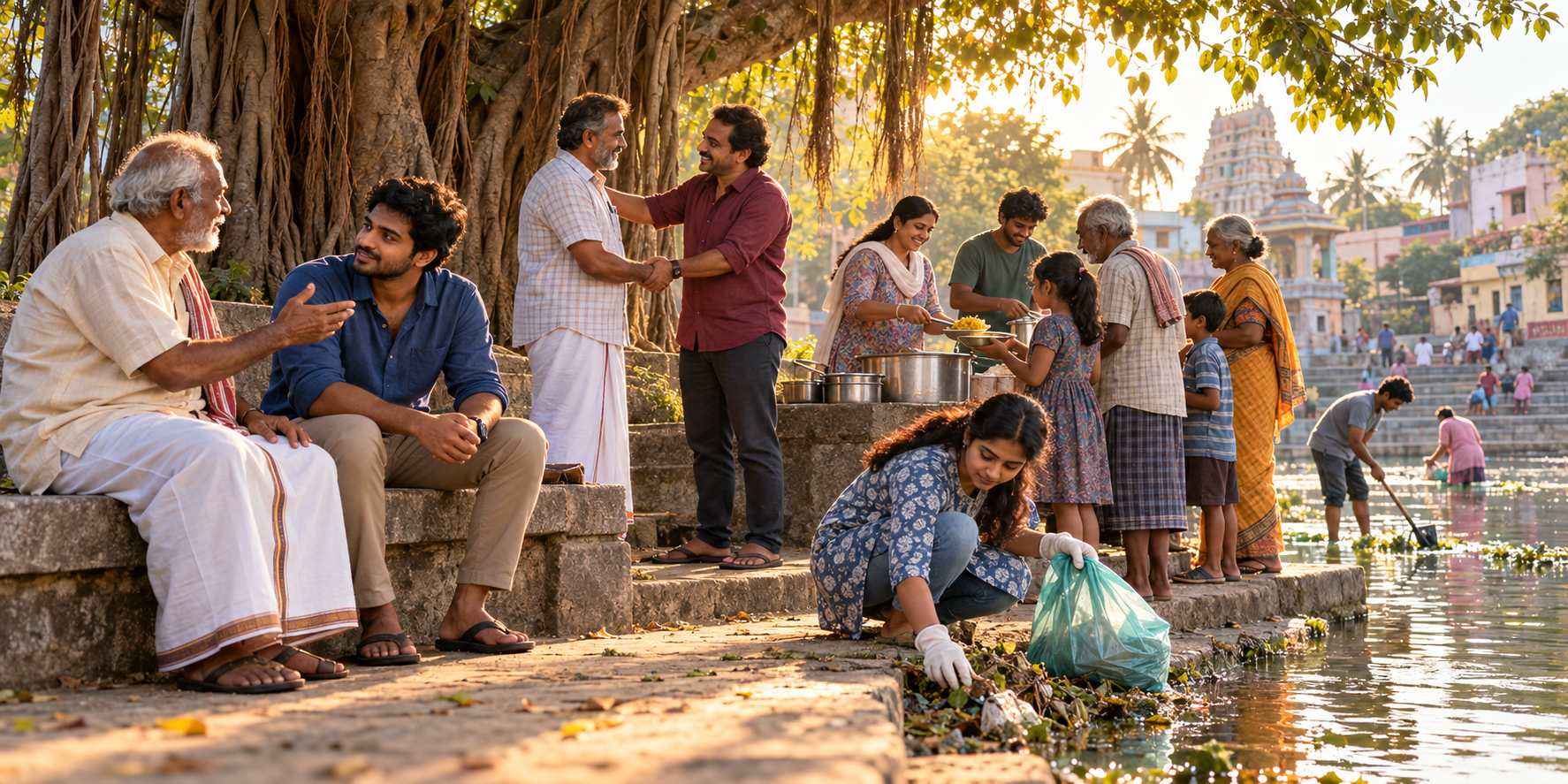
Calls for Bharat’s awakening can become vague very quickly. They may evoke pride without specifying responsibility. A useful definition is more demanding: spiritual awakening is the movement from unconsciously inherited identity to consciously lived dharma.
Sri Aurobindo understood India’s political freedom as a means toward a larger spiritual purpose, not as the completion of that purpose. His vision joined Sanatana Dharma, national renewal, the integral development of the person, and a harmony between material progress and spiritual evolution. Read in that frame, patriotism becomes gratitude expressed through responsibility. It is not permission to cultivate hostility toward other peoples.
This distinction matters. Civilizational confidence that depends on contempt is still psychologically dependent on an opponent. Dharmic confidence should make you more capable of self-command, inquiry, service, and respect for truth. Ideals such as Vasudhaiva Kutumbakam, the world as one family, and Sarve Bhavantu Sukhinah, the wish that all may be happy, set a universal horizon for rootedness.
You can test claims of awakening at several levels:
- Personal conduct: Are you less ruled by instant gratification, social approval, and compulsive consumption?
- Intellectual life: Can you study inherited wisdom seriously without treating every inherited claim as beyond examination?
- Plurality: Can you honour civilizational kinship while representing different sampradayas and Dharmic religions accurately?
- Service: Does love of Bharat produce honest work, care for people, protection of institutions, and responsibility for shared spaces?
- Education: Are younger people receiving only slogans, or are they learning texts, histories, practices, languages, arts, and habits of inquiry?
- Modernity: Can you welcome scientific and material advancement without accepting consumerism as the definition of a successful life?
The last test corrects a false choice. You do not have to abandon modern knowledge to remain rooted, and you do not have to mock spiritual inheritance to appear modern. The harder task is integration: deciding which forms of progress serve human development and which merely multiply appetite.
Apply that test to your own ambitions. Ask what your education and work are training you to become, not only what they may enable you to acquire. Ask whether your success strengthens your capacity for duty or gives you more sophisticated ways to avoid it. This is where a national spiritual awakening becomes personal enough to be real.
Key takeaways
- An outward pilgrimage becomes antaryatra when an encounter with the sacred exposes an inner habit and leads to a durable change in conduct.
- Bharat’s sacred geography reveals a cross-regional civilizational network; its unity is meaningful precisely because it does not erase local and doctrinal differences.
- Prepare for a sacred journey with a clear question, protect your attention while travelling, and convert what you learn into practice after returning.
- Spiritual patriotism should widen responsibility and service. If it produces only pride or hostility, it has missed the Dharmic standard it claims to defend.
- Material advancement and spiritual rootedness need not be enemies. The practical question is whether progress develops the person or merely enlarges consumption.
- Bharat’s awakening becomes credible when civilizational memory changes how you study, work, worship, serve, and transmit dharma.
Begin with the sacred place, teaching, or neglected duty nearest to you. Approach it with one honest question and enough silence to hear an unwelcome answer. Then return to ordinary life with one visible responsibility. That movement – from remembrance to inquiry, and from inquiry to action – is how antaryatra becomes part of Bharat’s renewal.
References

Leave a Reply
You must be logged in to post a comment.