

If you are considering ghar wapsi, the hardest question may not be whether your family once followed a Dharmic tradition. It may be how to explore that inheritance without surrendering your judgement to relatives, activists, religious authorities or public expectations.
The safest way forward is to separate heritage, belief, practice, community membership and formal status. A credible path to ghar wapsi must remain voluntary, lawful, dignified and grounded in mutual respect. That standard protects both the person returning and the Dharma with which they hope to reconnect.
Separate the five decisions hidden inside ghar wapsi

Ghar wapsi is sometimes presented as one decisive moment: a ceremony, declaration or change of affiliation. In practice, you may be facing five different decisions. They do not have to happen together.
- Heritage: Do you want to learn about the Dharmic traditions, places, memories and customs associated with your family or community?
- Belief: Do the teachings of a particular tradition make sense to you as truth, not merely as inherited culture?
- Practice: Are you willing to adopt its disciplines in ordinary life, after the emotion of a homecoming event has passed?
- Belonging: Do you want to identify publicly with a Hindu, Buddhist, Jain or Sikh community, recognising that each has its own teachings and internal diversity?
- Formal status: Do you want a ceremony, a written declaration or any change carrying administrative or legal consequences?
You can say yes to one and not yet to the others. Consent to a heritage class is not consent to a ceremony. Attendance at a place of worship is not permission to publish your name or photograph. A spiritual commitment does not automatically authorise someone to file documents on your behalf.
Ancestry is context, not command. It can give you a reason to investigate, but it cannot make the decision for you. Whether you describe the eventual choice as homecoming, reconnection or conversion, the ethical requirement is the same: the choice must be informed and freely made.
Before you approach an organisation, answer four questions in writing:
- What am I seeking: historical knowledge, spiritual practice, community belonging, a formal commitment or some combination of these?
- Which parts of my interest come from positive conviction, and which come from anger, fear or a dispute with another person?
- What would I still choose if there were no audience, ceremony, publicity or praise?
- What have I not consented to, even if I decide to continue exploring?
Keep those answers. They give you a stable reference if a charged conversation or public event begins to move faster than your own judgement.
Explore a living tradition before arranging a ceremony
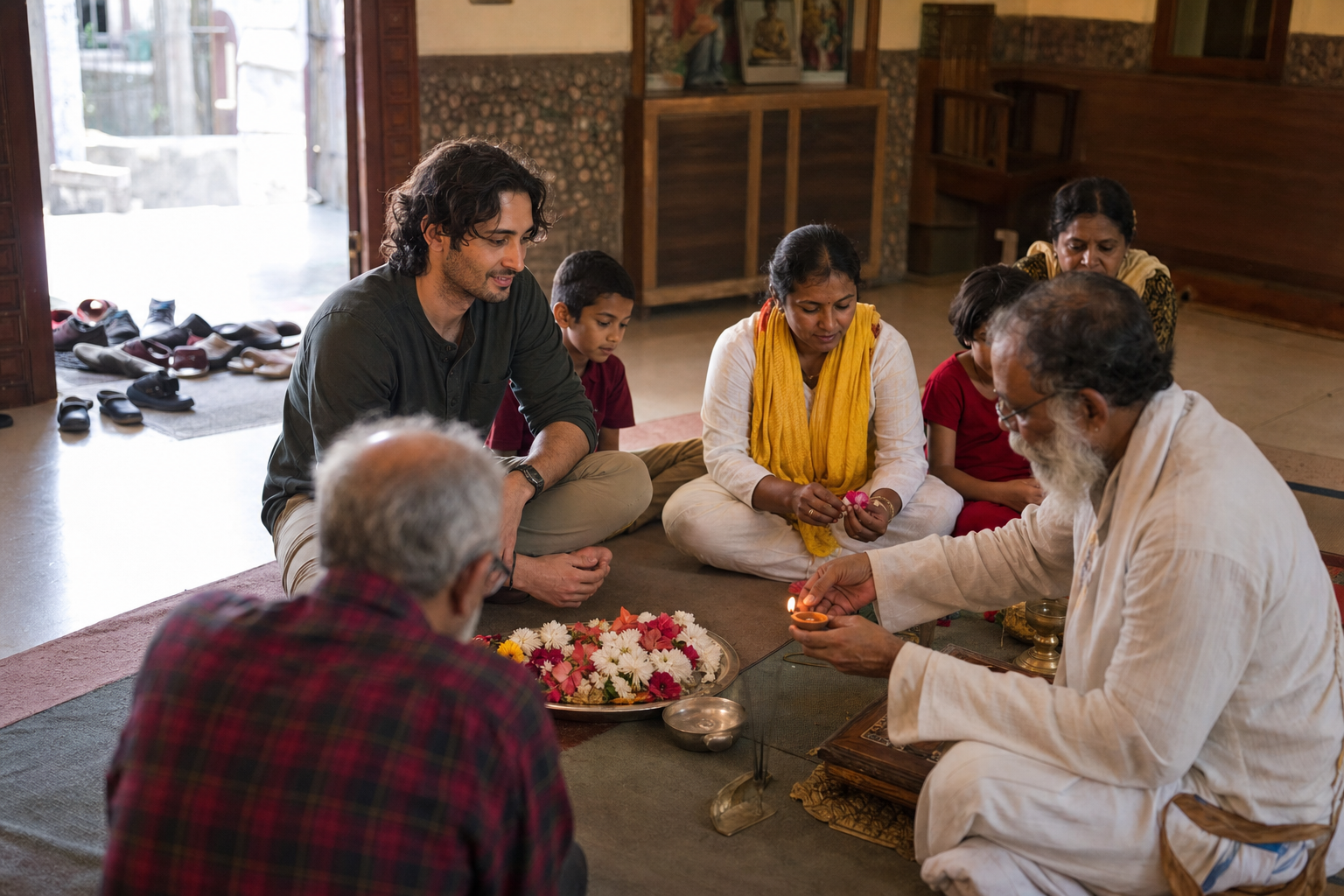
A homecoming should lead somewhere. If you cannot yet describe the beliefs, practices and community life you are embracing, you are still in the learning stage. There is no dishonour in remaining there until your conviction becomes clear.
- State your reason positively. Complete the sentence: I am drawn to this path because it teaches, cultivates or asks me to practise something I consider true. Resentment toward another religion or institution is not a sufficient spiritual foundation.
- Choose the tradition, not only the civilisational label. Hinduism, Buddhism, Jainism and Sikhism share a Dharmic civilisational setting, but they are not interchangeable. Learn what the particular tradition and community actually teach.
- Observe ordinary community life. Attend regular worship, study, meditation, ethical instruction or seva rather than judging the path only through a rally or ceremonial gathering. Ordinary conduct reveals more than a special occasion.
- Try the practice without making a public announcement. A period of prayer, meditation, study, self-discipline or service can show whether your interest survives beyond the first emotional impulse.
- Speak with someone who has no stake in your answer. A trusted person who neither recruits you nor opposes you can help you notice whether gratitude, fear, family conflict or group pressure is influencing the decision.
- Leave an unpressured interval before any ceremony. Learn first, reflect privately, and then decide. If an organiser insists that the decision must be completed in the same meeting, step back.
Before agreeing to a ritual or declaration, ask the officiant to explain what will be said, what commitments are expected afterward, whether a record will be created, whether money is requested, who will receive your personal information, and whether photographs or testimonials are planned. Then explain the process back in your own words. If you cannot do that yet, you do not have enough information to consent.
You should also be able to ask difficult questions without being treated as disloyal. A teacher who can explain the path calmly is more useful than an advocate who answers every question with a slogan.
Use clear consent tests to evaluate an organiser

A New Delhi gathering involving representatives from more than 25 organisations across Bharat shows that Dharmic reconnection can operate through broad civic networks. Wider coordination can support heritage education, volunteer training and service. It also makes a common ethical floor essential. Size, reputation and good intentions never replace your consent.
Signs of a trustworthy process
- You are first asked what you want, rather than told what your ancestry requires.
- The initial conversation happens privately, without a crowd waiting for an immediate answer.
- Education, ceremony, data collection, photography, publicity and formal referrals each require a separate yes.
- You may bring a trusted support person, pause the process, ask for written information or leave without losing access to ordinary community activities.
- Schedules, requested donations, organisers’ roles and contact details are explained before you commit.
- Service is offered because a person needs help, not as a reward for adopting a religious identity.
- Your present relatives and former religious community are discussed without humiliation or collective abuse.
- There is a named route for questions or complaints beyond the volunteer handling your case.
Reasons to step away
- You are told that delay proves cowardice, impurity or betrayal.
- Attendance at a meeting is treated as agreement to join, participate in a ceremony or appear in publicity.
- A group prioritises participant counts, photographs or public declarations over private understanding.
- Material assistance, employment, marriage approval, social acceptance or continued friendship is made conditional on your decision.
- You are asked for personal data that has no explained purpose, recipient or retention period.
- An unqualified volunteer promises a particular legal outcome or urges you to sign a form you do not understand.
- The organiser keeps contacting you after you have clearly declined.
A refusal does not require a theological debate. You may simply state that you do not consent and end the conversation. An organisation committed to dignity will honour that boundary the first time.
Protect your relationships, privacy and legal position

Once your decision becomes visible, other people may treat it as a judgement on them. You can reduce avoidable conflict by preparing a three-part boundary before speaking with relatives: state what you have decided, state what you are willing to discuss, and state which behaviour will end the conversation. You do not have to denounce another community to explain what you now affirm.
Keep publicity separate from spiritual commitment. You can participate in a ceremony and still refuse photography, a testimonial, social-media identification or the sharing of your contact details. Ask who controls any record, who can access it, how long it will be kept and how you can request its correction or deletion. Do this before an event, when there is still time to decline.
Spiritual participation, a community ceremony and a formal legal change are also separate matters. If you want to alter an official status or submit any document with legal consequences, do not rely solely on an organiser’s assurance. Obtain current advice from a qualified local legal professional before you sign or file anything. Never sign a blank, incomplete or unexplained form.
If disclosure could expose you to threats, violence, eviction or financial control, prioritise immediate safety over public symbolism. Delay an announcement, preserve important documents and contact a trusted person or appropriate local support. A voluntary spiritual decision does not become less sincere because you disclose it carefully.
After deciding, measure the homecoming by practice rather than publicity. Choose one sustainable daily discipline and one regular form of community participation. Study, prayer, meditation, ethical restraint, worship and seva matter because they reshape ordinary conduct. Reconnection becomes socially constructive when it grows through heritage education, respectful dialogue and service-led engagement, not hostility toward neighbours.
You do not need to erase every relationship from your earlier life. Retain relationships that respect your agency, and refuse demands that turn affection into a test of religious loyalty. Cultural continuity is strengthened when conviction and social peace can coexist.
Key takeaways
- Ghar wapsi contains at least five distinct choices: heritage, belief, practice, belonging and formal status. Give separate consent to each.
- Ancestry can invite inquiry, but it does not obligate you to adopt a religious identity.
- Learn the actual teachings and ordinary practices of the Hindu, Buddhist, Jain or Sikh path you are considering; shared Dharmic roots do not erase their differences.
- A trustworthy organiser permits questions, delay, refusal and privacy without punishment or loss of ordinary services.
- Treat ceremony, publicity, personal-data sharing and legal paperwork as separate decisions.
- Judge the durability of reconnection by the life you practise afterward, not by the scale of the event that marks it.
Your next step does not need to be a declaration. Take one sheet of paper and write what you seek, what you believe, what you are ready to practise and what you have not authorised. Bring that clarity into every conversation. A homecoming worthy of Dharma will leave your dignity, judgement and freedom intact.
References
